

Key Takeaways
Treat presentation skill as trainable, and use it before the stakes rise.
The advantage is learnable. Koegel rejects the idea that strong presenters are simply born that way. In his coaching, people improved by identifying specific habits, practicing them, and reviewing their performance. One client, Lee, rated himself a 3 out of 10; after using video to track changes, he reached an 8 or 9 and became a valued presenter on major proposals. The book also cites a Wall Street Journal recruiter survey in which 89% rated communication and interpersonal skills very important for MBA candidates.
Small signals have consequences. The book recalls how Kennedy's appearance in a televised debate shaped perceptions, while Al Gore's visible sighs and eye rolls distracted from his message. Strong delivery cannot guarantee a win, but weak delivery can cost an opportunity before the audience weighs the substance.
The practical strength of this argument is its shift from identity to behavior. Someone who believes they are simply an awkward speaker has little reason to experiment; someone who sees presentation as a bundle of learnable actions can improve one action at a time. The career examples also make communication concrete: it is not merely polish, but a way of making expertise legible to other people. The caution is that visible confidence can be mistaken for competence. Delivery should help the audience evaluate substance, not substitute for it.
Give every presentation one memorable purpose, then make the next step unmistakable.
Build a route, not a data dump. Koegel's five-part planning method asks a presenter to clarify the main point, explain the meeting's aim, describe the audience's current situation, show the consequences of action or inaction, and specify what should happen next. These elements can shape an opening, the body, and the close. The presenter should check that the audience's situation has not changed before proposing a solution.
Close the loop. A company facing inventory problems, for instance, might explain the cost of lost customers, recommend new software, and ask for approval by a defined date. The close should restate the point the audience needs to retain, including after Q&A. This keeps the final impression from being an off-topic answer or a vague ending.
This structure works because it gives listeners a map before asking them to absorb details. It also forces the presenter to connect recommendation with consequence, a useful discipline in proposals where technical features can crowd out the business case. The method is not a script to follow mechanically: a meeting may reveal changed priorities, and a good presenter must revise the route rather than finish a polished argument for a problem that no longer exists.
Cut to the essential message, then earn the audience's attention again and again.
Protect the central point. Koegel cites estimates that focused attention is brief and that much spoken information is quickly forgotten. Those figures are best read as warnings, not as precise rules for every room. His practical lesson is to stay concise, relevant, and focused, while using examples and stories to make ideas stick.
Time is not a target. One sales leader was assigned 45 minutes but found that his team needed only two clear messages: concentrate on controllable daily work, and bring more energy to it. He delivered the focused talk in seven and a half minutes and received a standing ovation. The remaining time was not a debt he had to pay. A presentation succeeds when people understand what matters, not when the speaker fills every allotted minute.
The example exposes a common planning error: treating the agenda slot as a demand for content rather than a limit on time. Shorter talks can improve clarity because every additional point competes with the central one. Still, brevity alone does not create attention. A concise presentation can remain remote or dull; stories, questions, shifts in pace, and audience participation help listeners re-enter the message when their minds wander.
Make posture, gestures, and voice support the confidence your words claim.
Delivery is part of the message. Koegel draws on Albert Mehrabian's research about how people interpret feelings and attitudes, emphasizing that voice and nonverbal behavior affect perceived confidence and trust. The percentages often associated with that work apply to particular communication situations, not to every message. The broader point is that a mismatch between words and behavior can weaken credibility.
Make movement purposeful. A relaxed standing position, expressive gestures, steady eye contact, vocal variation, and deliberate pauses can make ideas easier to follow. Koegel calls repeated fillers such as “um” and “you know” verbal graffiti. One consultant's client counted an average of 26 “ums” or “uhs” per minute on a call and asked that someone else handle presentations. Recording a talk can reveal habits the speaker cannot hear in the moment.
The strongest version of this advice is congruence: the body and voice should make the spoken claim easier to believe, not perform confidence for its own sake. Gesture can also function like a visual outline, emphasizing sequence or contrast while reducing reliance on slides. Yet body language is not a reliable lie detector, and mannerisms vary across people and cultures. The goal is clarity and connection, not forcing every speaker into one approved physical style.
Design the presentation around the audience's concerns, not your résumé.
Start with their world. Before presenting, learn who will attend, what they know, what decisions they face, and what they need from the meeting. Koegel recommends researching the organization, asking questions, and listening for useful details. A firm's history, size, or client list matters only when the presenter can explain what it means for this audience.
Connect with the whole room. A broker lost a proposal after focusing eye contact on the CEO and CFO while overlooking a senior vice president who also influenced the decision. Koegel advises greeting people beforehand, using names, sharing eye contact, and responding to signs of confusion or interest. Stories, questions, and relevant examples invite participation. Eye contact should be adapted to cultural expectations, since its meaning is not identical in every setting.
Audience knowledge is more than a persuasive trick. It tests whether the presenter has understood the problem well enough to offer a useful answer. Sharing attention also recognizes that decisions often depend on people who are not the most senior person in the room. At the same time, reading faces is only a source of clues, not certainty. A frown may mean confusion, disagreement, concentration, or simply fatigue, so checking directly is safer than guessing.
Practice in ordinary moments until pressure cannot hijack your habits.
Train outside the spotlight. Koegel argues that presentation skills become dependable when they are practiced in low-stakes situations: conversations, phone calls, voice messages, and daily interactions. He reports workshop participants spending 50% to 80% of their workday communicating, but only 0% to 2% practicing. Recording and reviewing a presentation, or asking a qualified observer for specific feedback, can expose habits that casual praise misses.
Rehearse for nerves, too. Athletes and performers in the book prepare extensively for brief moments of performance. Presenters can rehearse aloud, divide a talk into short sections, and practice likely questions. Koegel suggests becoming comfortable with the first two minutes and focusing attention on helping the audience understand the message. Nervousness need not disappear; it can be redirected into energy, movement, and vocal emphasis.
This is a useful model of skill acquisition: isolated rehearsal makes techniques available under stress, while feedback helps distinguish improvement from mere repetition. A recording is powerful because it replaces vague self-judgment with observable behavior. But practice needs a target. Repeating the same flawed delivery can make it more automatic, not better. The most productive cycle is to choose one behavior, test it, review the result, and then adjust.
Arrive early, prepare for technical failure, and make the first minute look deliberate.
Preparation begins before speaking. Koegel's 60/20 Rule divides an early arrival into setup time and time to meet the audience. Arrive 60 minutes ahead, use the first 40 minutes to arrange the room and test equipment, then spend the final 20 minutes greeting people and building rapport. This avoids opening with frantic note-shuffling, microphone tests, or furniture moving.
Technology should assist, not carry. A broker arrived two hours early and discovered that the room had changed and could not support the planned internet demonstration. His team had time to find another solution and still won the assignment. Koegel recommends rehearsing with visual aids, preparing a nontechnical backup, and deciding whether a delay to fix a device is worth losing the room's attention. A polished introduction also helps the audience understand why the speaker and topic matter to them.
The timing rule is valuable because it treats logistics and rapport as part of the presentation rather than administrative chores. Early arrival also creates options: a presenter can adapt when the room, equipment, or audience differs from expectations. The deeper principle is resilience, not attachment to a particular schedule. In some settings, a full hour may be impractical, but a deliberate check of the room and a fallback plan still reduce avoidable stress.
Treat Q&A as part of the presentation, and never bluff to escape a hard question.
Stay composed and useful. Questions reveal what the audience understood, doubts, or wants to know. Rehearse difficult questions in advance, listen carefully, and restate a question neutrally when needed. Answer briefly, include the wider group rather than speaking only to the questioner, and pause when a thoughtful answer needs time. If a question is unclear, ask for clarification; if the answer is unknown, say so and give a specific time for follow-up.
Protect credibility. One CEO seeking a $2 million investment tried to compare his product with a technology he mistakenly believed Microsoft was developing. The investor corrected him, exposing the bluff and ending the opportunity. Koegel's advice is to respect questions, correct false assumptions calmly, and keep the discussion within the presentation's purpose. After Q&A, close by returning to the central message instead of letting the last question set the final impression.
Q&A tests more than recall. It tests whether a speaker can remain open to challenge without surrendering structure or composure. A pause is useful because it makes room for judgment, while an honest admission of uncertainty preserves the conditions for trust. The balance matters: controlling the discussion should not mean shutting down legitimate disagreement. A strong answer serves both the person asking and everyone else who is trying to assess the issue.
Analysis
The book's central move is to replace the mystery of charisma with a sequence of observable skills. Its OPEN UP! framework gives readers a memorable inventory: organize the message, convey conviction, engage listeners, sound natural, understand the audience, and practice. The book then makes those qualities tangible through habits such as setting a clear purpose, sharing eye contact, using purposeful gestures, preparing for questions, and reviewing recordings. Its repeated stories of lost proposals and improved careers give the advice a commercial urgency, while examples from politics make small delivery choices feel consequential.
The most durable contribution is the insistence that communication is not limited to formal speeches. Meetings, interviews, phone calls, and informal conversations all shape how others interpret competence and intent. The book's practice advice follows from that broad definition: if communication occupies much of the workday, improvement cannot depend only on occasional high-stakes rehearsals. It must become a routine of observation, targeted practice, and correction.
Some supporting claims need careful handling. The attention-span and memory-retention estimates are presented as broad truths, and the often repeated Mehrabian percentages are easy to overgeneralize beyond the narrow context of communicating feelings and attitudes. The book is more persuasive when it uses them as prompts to examine delivery than when they seem to quantify all communication. Likewise, its body-language guidance is useful as a set of possible signals, not as a code that reveals exactly what another person thinks. Cultural differences and individual variation matter.
The framework's limitation is also its strength: it is operational rather than philosophical. It offers many techniques, and readers could become self-conscious if they try to control every gesture, pause, and facial expression at once. The sensible application is progressive. Choose a few behaviors that interfere with the message, practice them until they feel natural, and keep the audience's understanding as the measure of success. Exceptional presenting, in this account, is not flawless performance. It is deliberate communication that remains useful under pressure.
Review Summary
The Exceptional Presenter receives mostly positive reviews, with an average rating of 3.66/5. Readers appreciate its practical advice, straightforward approach, and actionable tips for improving presentation skills. Many find it helpful for both beginners and experienced presenters. The book is praised for its concise format and useful worksheets. Some criticisms include its focus on business presentations, lack of addressing performance anxiety, and repetitive use of the word "exceptional." Overall, readers find it a valuable resource for enhancing public speaking abilities.
People Also Read










Glossary
OPEN UP!
Six presentation qualitiesKoegel's acronym for six qualities of exceptional presenters: an organized message, visible passion, audience engagement, a natural conversational manner, knowledge of the audience, and regular practice. The framework is meant as a development checklist, not a demand that every speaker adopt the same personality or style.
Five Components of Any Presentation
A message-planning structureKoegel's planning framework organizes a presentation around five functions: establish the central point, state the meeting's aim, describe the current situation, explain consequences or benefits, and identify the next action. The presenter can use the structure in an opening, develop it in the body, and return to the central point in the close.
Own the Room
Confident, audience-centered controlKoegel uses this phrase for the confidence and professionalism that come from taking responsibility for a presentation's success. It means guiding the session, adapting to difficult circumstances, and doing what is needed for the audience to understand and remember the message. It does not mean dominating the room or ignoring audience needs.
60/20 Rule
Early setup and connectionA preparation routine that calls for arriving 60 minutes before a presentation. The first 40 minutes are used to prepare the room, materials, and equipment; the final 20 minutes are reserved for greeting attendees, building rapport, and learning useful information about them.
T-Rex
A distracting hand postureKoegel's name for a common speaker stance in which the arms are held stiffly in front of the body and the hands fidget or move without clear purpose. He argues that this can distract from the message. His alternative is to relax the arms between deliberate gestures rather than keeping the hands locked in place.
Verbal Graffiti
Distracting speech fillersKoegel's term for habitual fillers and verbal padding, including repeated hesitation sounds, unnecessary qualifiers, and phrases added to the ends of statements to seek agreement. He recommends recording speech, noticing recurring patterns, anticipating a filler, and pausing instead of using it.
Two-minute Drill
Rehearsed opening passageA preparation technique in which a presenter repeatedly practices the first two minutes of a talk until the opening flows smoothly. The wording need not be memorized exactly. The aim is to begin with a secure, clear message, reducing the uncertainty that can intensify nervousness.
The 3Ps of Introductions
Speaker introduction essentialsKoegel's checklist for introducing a speaker: professional background, personal background, and the purpose of the talk. The introduction should establish credibility and explain why the topic matters to the audience, while remaining brief enough to leave the main speaking time to the presenter.
FAQ
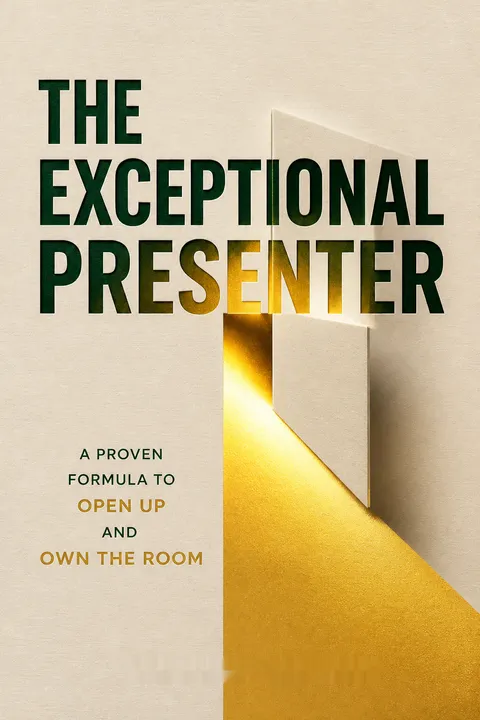
What's "The Exceptional Presenter" about?
- Purpose and Focus: "The Exceptional Presenter" by Timothy J. Koegel is a guide to mastering presentation skills, aiming to help individuals present themselves and their ideas at an exceptional level.
- Structured Approach: The book breaks down the art of presenting into a series of skills and provides a systematic approach to mastering each one.
- Practical Techniques: It includes stories, examples, bullet points, exercises, performance tracking, note pages, and practice charts to aid learning.
- Audience Engagement: The book emphasizes the importance of consistently exceeding an audience’s expectations and using the book as a coach or mentor.
Why should I read "The Exceptional Presenter"?
- Improve Presentation Skills: It offers a proven formula to enhance your communication skills, which are crucial in both professional and personal settings.
- Career Advancement: Exceptional presentation skills can significantly impact your career trajectory, income, and reputation.
- Comprehensive Guide: The book provides practical advice and techniques that are applicable to any audience and venue.
- Personal Growth: By following the book's guidance, you can build confidence and become more effective in various communication scenarios.
What are the key takeaways of "The Exceptional Presenter"?
- OPEN UP! Framework: The book introduces the OPEN UP! framework, which stands for Organized, Passionate, Engaging, Natural, Understand Your Audience, and Practice.
- Practice is Essential: A central theme is that practice is crucial for improvement; those who practice improve, and those who don’t, don’t.
- Audience Connection: Engaging with your audience and understanding their needs is vital for a successful presentation.
- Non-Verbal Communication: The book highlights the importance of non-verbal cues, such as posture and gestures, in conveying confidence and passion.
What is the OPEN UP! framework in "The Exceptional Presenter"?
- Organized: Exceptional presenters are well-prepared, with a clear structure and purpose for their presentation.
- Passionate: They exude enthusiasm and conviction, making their message more persuasive and memorable.
- Engaging: They connect with their audience, building rapport and involving them in the presentation.
- Natural: Their delivery is conversational and fluid, making them appear confident and at ease.
How does "The Exceptional Presenter" suggest handling nervousness?
- Channel Nervous Energy: Convert nervous energy into positive energy by using it to enhance your gestures and voice projection.
- Preparation and Practice: Rehearse your presentation multiple times, especially the first two minutes, to build confidence.
- Focus on the Message: Shift the focus from yourself to the importance of your message and how it benefits the audience.
- Visualization and Breathing: Visualize a successful presentation and practice deep breathing to calm nerves.
What are some best quotes from "The Exceptional Presenter" and what do they mean?
- "Those who practice improve. Those who don’t, don’t." This quote emphasizes the importance of practice in mastering presentation skills.
- "Every contact counts. Every interview counts. Every presentation counts." It highlights the significance of every communication opportunity in building your reputation and effectiveness.
- "Do not accept average when you can be exceptional." This encourages readers to strive for excellence in their presentation skills rather than settling for mediocrity.
- "The tone of the presentation is set before the presentation begins." This underscores the importance of first impressions and preparation.
How does "The Exceptional Presenter" define an exceptional presenter?
- Characteristics: An exceptional presenter is organized, passionate, engaging, and natural in their delivery.
- Audience Connection: They understand their audience and tailor their message to meet the audience's needs and interests.
- Confidence and Poise: They exude confidence and maintain composure, even under pressure.
- Continuous Improvement: They are committed to practicing and refining their skills to maintain a competitive edge.
What role does non-verbal communication play according to "The Exceptional Presenter"?
- First Impressions: Non-verbal cues, such as posture and eye contact, are crucial in making a positive first impression.
- Congruence with Message: Non-verbal communication should support and enhance the spoken message, not contradict it.
- Engagement and Confidence: Effective use of gestures and facial expressions can make a presenter appear more engaging and confident.
- Audience Perception: Non-verbal signals can influence how the audience perceives the presenter's expertise and trustworthiness.
How does "The Exceptional Presenter" suggest structuring a presentation?
- Five Components: The book recommends structuring a presentation with a clear purpose, objective, position, end result, and next steps.
- Attention-Grabbing Openings: Start with a strong opening to capture the audience's attention and set the tone for the presentation.
- Clear Transitions: Use smooth transitions between segments to maintain the flow and coherence of the presentation.
- Purpose Statement: End with a purpose statement to reinforce the key message and ensure it is memorable.
What are some practical tips from "The Exceptional Presenter" for engaging an audience?
- Use Stories and Examples: Incorporate stories and anecdotes to make the presentation relatable and memorable.
- Eye Contact and Smiling: Maintain eye contact and smile to build rapport and connect with the audience.
- Involve the Audience: Encourage participation through questions, discussions, and interactive elements.
- Adapt to Feedback: Be attentive to audience reactions and adjust your delivery accordingly to maintain engagement.
How does "The Exceptional Presenter" recommend handling Q&A sessions?
- Maintain Composure: Stay calm and composed, even when faced with challenging questions.
- Understand the Question: Ensure you fully understand the question before responding, and ask for clarification if needed.
- Involve the Audience: Repeat the question for the benefit of the entire audience and engage them in the response.
- Practice and Anticipate: Rehearse potential questions and answers to be better prepared for the Q&A session.
What is the significance of practice in "The Exceptional Presenter"?
- Habit Formation: Practice helps in forming habits, making skills second nature and reliable under pressure.
- Daily Opportunities: The book encourages using daily interactions as practice opportunities to refine presentation skills.
- Repetition and Improvement: Regular practice leads to improvement and helps in eliminating bad habits.
- Commitment to Excellence: Practicing consistently is key to achieving and maintaining exceptional presentation skills.
Download PDF
Download EPUB
.epub digital book format is ideal for reading ebooks on phones, tablets, and e-readers.








