

Plot Summary
Prologue
After the Sorceresses’ War, wizard Wigg carries four captured leaders of the Coven into the Sea of Whispers and sets them adrift in a frail skiff. He gives them food enough to force a choice between sailing home and risking the unknown waters, then uses a blue-glass bowl to drive their boat far east.
The sorceresses survive and turn toward a distant shore, while remembering that one of their Sisters was left behind in Eutracia. The exile ends the war but does not end the Coven. It sends its surviving leaders into another land, carrying their grievance and their plans with them.
The prologue makes mercy feel less like a resolution than a gamble. Wigg’s oath prevents him from executing the sorceresses, so he engineers a punishment that appears humane while deliberately narrowing their chances of survival. His restraint is ethically serious, but it is also strategic and compromised. The sorceresses understand that contradiction immediately, and their escape ensures that his decision will keep shaping the future. The sea functions as both prison and passage: it removes the Coven from Eutracia, yet delivers them to a new country where they can rebuild power beyond the wizards’ sight.
The Prince Finds the Caves
With his thirtieth birthday approaching, Prince Tristan of Eutracia practices throwing knives in the Hartwick Woods and broods over a future he does not want: the throne, followed by a life among the wizards. His horse Pilgrim chases the rare Fliers of the Fields into unfamiliar forest, where Tristan finds an ancient stone wall hidden beneath vines.
He breaks through it and falls into a cavern with a waterfall, strange writing, and a pool of red water. The warm water heals his injuries, but its pull becomes so powerful that he nearly drinks it. A strange force hurls him away from a tunnel entrance. Tristan escapes, hides what he found, and returns to the palace with a new, urgent hunger to learn magic.
Tristan’s first encounter with power arrives through curiosity, accident, and bodily sensation rather than disciplined study. The pool heals him while also making him vulnerable to its attraction, introducing magic as something that can both enlarge and overpower the self. His secrecy is understandable, but it repeats the isolation he resents: he wants knowledge while withholding his discoveries from those responsible for his safety. The cave therefore begins his transformation before he has chosen it, making his private escape from duty the event that draws him toward the very inheritance he rejects.
A Crown He Cannot Refuse
Wigg, the Lead Wizard, and Tristan’s pregnant twin sister Shailiha find him after a blood stalker attacks them in the forest. The creature is Phillius, Wigg’s former mentor, transformed during the war; Wigg kills him and explains the cruelty that created such assassins. Tristan returns from the caves with red stains on his clothes and an azure aura only Wigg can see.
When he demands to learn magic, Wigg explains the opposing schools of the craft, the Paragon, and the vows that bind the wizards. King Nicholas and Queen Morganna then tell Tristan why his succession is necessary. He agrees to become king, and his family gives him a medallion bearing their house’s lion and sword.
The episode recasts Tristan’s rebellion as a response to a life designed for him without his consent, while revealing that his family’s pressure comes from fear and responsibility rather than simple control. Wigg’s grief over Phillius shows that the war’s enemies were once people, not merely monsters. The family’s appeal changes Tristan’s decision by making the consequences personal: his refusal could harm Shailiha, her unborn child, and the kingdom. The medallion becomes a tangible expression of belonging, offered at the moment he reluctantly accepts a role he has never wanted.
The Duchess at Court
While Eutracia prepares for the succession ceremony, Duchess Natasha of Ephyra enters the royal court without her husband, whose sudden illness she has arranged. She is secretly a sorceress who has survived for centuries by changing her appearance and concealing her endowed blood.
Across the Sea of Whispers, the Coven’s First Mistress, Failee, reviews the Minion army built for an invasion: a vast force of winged warriors bred and trained for war. Commander Kluge receives orders to strike during the ceremony, seize the Paragon and Shailiha, and kill the rest of the royal family and the wizards. The Coven also expects Natasha, its hidden ally, to identify the people whose deaths matter most.
The apparent peace of the court rests on information the rulers cannot see. Natasha’s access is not secured by armies but by intimacy, politeness, and a carefully maintained public identity. Meanwhile, Failee has converted reproduction, military training, and surveillance into one coordinated system of control. The contrast exposes two kinds of power: Eutracia’s ceremonial legitimacy and the Coven’s concealed capacity for violence. Natasha’s presence links the domestic court to the distant invasion, so the threat is already inside the kingdom before the Minions arrive.
The Coronation Turns Massacre
During Tristan’s coronation, King Nicholas removes the Paragon and places it in the ceremonial water so it can pass to the new king. The stained-glass ceiling breaks open, and winged Minions pour into the Great Hall. They kill Frederick and most of the Royal Guard, then slaughter guests and wizards while the Paragon leaves the Directorate powerless.
Kluge forces Tristan to choose between killing his father quickly or watching him be tortured. Nicholas urges his son to spare him that suffering, and Tristan beheads the king. The Minions capture Tristan, Wigg, Morganna, and Shailiha. Succiu claims Shailiha as a Sister and has her taken away, while the invaders begin destroying Tammerland.
The attack turns the succession oath into an immediate test of its hardest clause: protecting life may require taking it. Tristan’s act against Nicholas is neither victory nor free choice; it is a decision made under coercion to spare his father a worse death. The ceremony’s vulnerability is built into its own ritual, since transferring the Paragon temporarily strips the wizards of power. Shailiha’s seizure amid the massacre also divides the siblings at the moment their shared inheritance becomes most dangerous.
Ashes Beneath the Palace
Wigg saves Tristan and himself by using an enchantment that makes them invisible beneath the dais, then hides them in the Redoubt. When the Minions leave Eutracia, the two emerge into a capital of burned homes, murdered citizens, and lawless looting. Tristan insists on recovering the bodies of his parents, Frederick, and the dead wizards, despite Wigg’s urgency to flee.
At the palace gates, a wiktor attacks; Tristan kills it with a dirk and the Minion sword. He and Wigg bury the royal dead, and Tristan cuts his palms, letting his blood fall on the graves as he vows to bring Shailiha and her unborn child home. He accepts the succession oath willingly at last.
The aftermath gives Tristan no clean space for grief. He must choose between immediate survival and the act of honoring the dead, and he refuses to leave his family displayed as trophies. His oath changes meaning here: what once represented an unwanted political sentence becomes a promise he makes himself. The blood on the graves binds his private loss to public responsibility. Yet his vow is also dangerous, since the intensity of his guilt can push him toward reckless action, a pattern that will repeatedly test Wigg’s guidance.
Lillith Was Never There
On the road north, Tristan and Wigg stop at an inn where the keeper sells refugee women as slaves. Tristan pays for Lillith, a frightened barmaid, then helps her escape with them. She tells him her family died in Tammerland, and he begins to imagine a life with someone who knows him only as a blacksmith’s apprentice.
At a riverside, Lillith reveals herself as Natasha, a Visage Caster who has shadowed them since the inn. She freezes Tristan and tries to conceive a child by him, intending to take their offspring to the Coven. Wigg pulls her away with an azure noose, and Tristan kills her with his dreggan. Her death confirms the threat to his blood, while the imagined Lillith leaves him grieving a love that never existed.
Natasha’s deception works because it exploits Tristan’s longing to be seen apart from his title. Lillith offers him the possibility of ordinary intimacy, then reveals that the tenderness was a weapon aimed at his body and bloodline. The betrayal does not make his desire foolish; it shows how urgently he wants a relationship untouched by political use. His grief is real even though the woman was an illusion. By killing Natasha, he survives, but loses the brief hope that someone might love him without first wanting something from him.
Berserkers in Shadowood
Wigg leads Tristan toward Shadowood, a hidden refuge protected by an invisible canyon and a bridge guarded by the gnome Shannon the Small. Tristan forces Shannon to let them cross, but the gnome later guides them through the forest as a berserker attack interrupts their camp. These hairless, green-eyed creatures travel through the trees on ropes of deadly fluid and prey on gnomes.
Shannon identifies them as former gnome hunters, transformed when the wizards created Shadowood and failed to protect everyone inside it. Wigg admits that the Directorate’s attempt to save the gnomes produced a new horror. The group reaches Tree Town, where the surviving gnomes live in houses built high among the branches.
Shadowood complicates the wizards’ self-image as guardians. Their refuge protects the gnomes from human hunters, but the magic used to create it transforms some hunters into continuing predators. Wigg’s remorse matters because it makes responsibility more than an abstract vow: good intentions do not erase the consequences of power used without full knowledge. Tristan’s willingness to confront the berserkers also shows his growing impatience with passive safety. He is beginning to judge decisions by whom they leave exposed, not merely by whether they preserve an institution.
Faegan’s Buried Confession
In Tree Town, Tristan and Wigg meet Faegan, the crippled wizard who helped create Shadowood and has lived among its gnomes for centuries. Faegan admits that the Coven tortured him for knowledge of the Tome after falsely claiming his young daughter had been killed. His partial surrender helped the sorceresses learn the craft, though he withheld much of what they sought.
He explains that Shailiha is meant to become the fifth sorceress and join the Blood Communion, which would empower the Coven to attempt the Reckoning, a ritual capable of destroying the world if mishandled. Faegan’s pigeon messages come from Geldon, Succiu’s enslaved dwarf, and reveal that Shailiha is being broken by the Chimeran Agonies.
Faegan’s confession refuses the easy division between traitor and hero. He resisted the Coven, but torture extracted enough knowledge to strengthen them; his survival came at a cost he has carried privately for centuries. His account also reframes the immediate rescue as a conflict with world-ending stakes. The Chimeran Agonies turn memory into the battlefield, making Shailiha’s identity itself the object of conquest. Tristan now faces a dilemma larger than defeating an army: he must reach someone whose own sense of reality is being deliberately rewritten.
A Portal to Parthalon
Faegan uses a hidden portal to send Tristan and Wigg directly to the Ghetto of the Shunned, avoiding the Sea of Whispers. The portal can only be opened from Shadowood and works for a limited time, so their return depends on Faegan reopening it. In the Ghetto, Ian, a leper who tends Faegan’s enchanted pigeons, shelters them while they wait for Geldon.
The Minions soon raid the district, destroy the aviary, and kill many residents, including Ian. Geldon returns after escaping notice at the Recluse and confirms that the invasion has made the Ghetto unsafe. He proposes entering the fortress disguised as new slaves, using the access granted by his position in Succiu’s household.
The portal converts geographical impossibility into a temporary opening, but it does not remove risk; it concentrates it. The travelers arrive with a narrow window, dependent on Faegan’s timing and Geldon’s ability to move unseen. Ian’s death shows how the Coven’s violence reaches even those who never meet its leaders. The pigeons, which had carried intelligence across an uncrossable sea, become evidence that knowledge can travel farther than armies, but their destruction also makes the alliance more precarious.
The Gallipolai’s Secret
On the way to the Recluse, Geldon takes Tristan and Wigg past the Vale of Torment, where Minions leave captured Gallipolai to die on turning wheels. Tristan kills the two guards and cuts down Narrissa, a winged woman whose hair and feathers remain white. Wigg cannot use his powers without exposing them, so Tristan frees her himself.
Narrissa leads him to a hidden clearing and summons the Specters of Gallipolai, souls of those killed on the wheels. Their amber and silver lights rise into the sky after she and Tristan kneel together. He brings her along, despite Wigg’s objections, and promises to return for her. The two share a fragile trust as they travel onward.
Narrissa gives Tristan a chance to act without a crown, prophecy, or army behind him. He rescues her because the wheel’s cruelty is intolerable, not because he expects strategic advantage. Her people’s secret ritual turns that rescue into a shared act of release, linking his instinctive compassion to a community’s memory. Their bond offers him a glimpse of mutual affection grounded in who he is, yet the journey’s danger makes that hope fragile. The episode also shows that moral action can matter even when it cannot undo the larger violence.
Inside the Recluse
Geldon brings Tristan and Wigg into the Recluse as chained slaves, passing Minion guards who believe the captives are bound for the Stables. Inside, they cross opulent halls to a hidden torture room and then reach the Sanctuary, where the Coven’s ritual will take place.
Shailiha appears in a sorceress’s gown, her pregnancy advanced and her old identity nearly erased by Failee’s Chimeran Agonies. She does not recognize Tristan as her twin. Failee has also trapped Wigg and stripped him of his powers, while the wiktors wait below the Sanctuary. Tristan learns that Failee intends to conduct the Blood Communion with Shailiha’s blood, then attempt the Reckoning.
The disguise gets the fugitives through the gate, but it also places them inside a system that treats people as inventory. The Recluse’s beauty conceals torture rooms, drugged slaves, and a breeding program built for the Minions. Shailiha’s estrangement is the most intimate consequence of that system: her body remains familiar while her memories and loyalties have been turned against her past. Tristan’s arrival cannot immediately restore her. He must face the possibility that love alone cannot undo coercion, even when it remains the reason he came.
The Child They Want
While Tristan is held in a gibbet, Failee demands that he submit to the Chimeran Agonies so the Coven can take his seed willingly. She wants his firstborn son to be bred into a controlled line of endowed descendants. Succiu then rapes him, using the craft to force his body to respond, and conceives a child.
Failee prepares the Blood Communion, explaining that the sorceresses need Shailiha’s blood and the Paragon to share her power. Wigg warns Tristan that the Reckoning will combine the Vigors and Vagaries with incomplete knowledge, risking the world itself. The prince refuses to cooperate, even as Succiu’s pregnancy gives the Coven another claim on his future.
The Coven’s project turns reproduction into political machinery. Succiu’s assault is not merely personal cruelty; it is an attempt to appropriate Tristan’s blood for a future population designed to secure female rule. Failee’s plan and Wigg’s warning make the body a site where private violence and cosmological danger meet. Tristan’s refusal preserves his agency, but cannot undo the pregnancy. The section denies any simple distinction between victory and survival: even resisting the Coven leaves him bound to a child conceived through coercion.
The Stone Breaks the Ritual
At the Communion, Failee places the Paragon above a goblet of the sorceresses’ blood and calls light through the skylight. The growing beams begin reaching toward the blood as the five women sit at the points of the Pentangle. Wigg’s warning cannot stop the ritual, and Tristan’s unfamiliar blood urges him to act.
He calms himself, hears his heartbeat, and wills the Paragon away from the light. The stone moves. The shattered beams become flying shards that strike the sorceresses, killing Failee, Vona, Zabarra, and Succiu. Tristan’s first deliberate use of the craft saves the ritual from completion, but the force of the failure begins tearing the Sanctuary apart.
Tristan’s first spell emerges not from training but from attention to his own body and blood. He succeeds because he stops trying to command magic as an external tool and listens for the capacity already moving within him. The victory is real, yet it is not clean: the same force that interrupts the Communion kills the women and destabilizes the building. The episode fulfills the promise of his inheritance while exposing its danger. Power can avert catastrophe, but an untrained act still unleashes consequences no one fully controls.
The Wiktors Escape the Pit
As the Sanctuary breaks apart, Wigg uses the Paragon’s remaining power and a little Cave water to ignite the wiktor pit, killing its creatures before they can swarm the survivors. Tristan finds Shailiha and holds her through the shaking, but she remains trapped in the aftereffects of the Agonies.
Wigg recovers the stone in a locket containing Cave water, while the group escapes the collapsing Recluse. Succiu, wounded but still alive, flees separately. Outside, Tristan is forced to face the limits of what rescue can mean: Shailiha is alive, yet her mind has not returned, and the Coven’s destruction has not undone the harm it inflicted on her.
The collapse makes the end of the Coven physically visible, but it does not restore what the Coven damaged. Wigg’s use of the stone and Cave water turns an inherited safeguard into a desperate weapon, while the wiktors’ destruction closes a threat created by the wizards themselves. Shailiha’s survival is therefore not equivalent to recovery. Tristan must accept that bringing someone home may mean carrying an injury that cannot be healed quickly, and that triumph can arrive beside grief rather than after it.
Kluge’s Last Challenge
Kluge pursues the fugitives through the Ghetto, taunting Tristan with his plan to seize Eutracia and claim Shailiha. He challenges the prince to single combat while the Minions watch. Tristan is exhausted and badly wounded, but uses the technique Frederick once taught him: he feints weakness, draws Kluge into a careless attack, and beheads him with the dreggan.
The Minions immediately accept Tristan as their new commander under their succession custom. But Kluge’s returning wheel has struck Narrissa. She dies in Tristan’s arms after telling him to remember her and to seek love again. The victory gives Tristan command of the army, yet it cannot save the woman who trusted him.
Tristan wins by combining the discipline Frederick taught him with the improvisation he has learned through survival. He does not overpower Kluge; he reads the commander’s arrogance and turns it against him. The Minions’ submission transforms an enemy force into a political responsibility, complicating the meaning of victory. Narrissa’s death prevents the moment from becoming triumphal. Tristan can defeat the man who destroyed his family and still fail to protect someone he loves, a loss that keeps his leadership from becoming a simple reward.
The Minions Kneel
With Kluge dead, Tristan orders the Minions to free the Gallipolai, end coercive breeding, rebuild the Ghetto, and stop attacking Parthalon’s people. He leaves Traax in command and prepares to return through Faegan’s portal with Wigg, Shailiha, and her newborn daughter. Shailiha has recognized Tristan’s face and name, but remains fragile and only partly restored.
Succiu’s son, Tristan’s firstborn, lies buried near the Recluse; Tristan leaves him there rather than risk the portal closing. He carries Narrissa’s body and grieves her alongside the family he has already lost. In Eutracia, he will still face a kingdom that believes he murdered his father, and a throne he must now accept.
The ending gives Tristan authority over the very army that destroyed his home, forcing him to decide whether inherited violence can be redirected. His orders begin dismantling the Minions’ coercive system, but they cannot make the army innocent or restore those it killed. The return to Eutracia is therefore not a restoration of the old world. Tristan carries a wounded sister, a newborn niece, and the dead, while inheriting a public reputation built on a forced act. Responsibility has replaced his earlier wish for escape, but peace remains unfinished.
Epilogue
In the ruined Recluse, an azure presence approaches the small grave marked for Tristan and Succiu’s son. Glowing hands uncover the infant and lift him from the earth. The child is dead, but the strange force gathers light around him until his chest rises and his eyes open.
The presence carries him skyward, declaring him its own. Far from the family Tristan has just tried to protect, the boy survives through an intervention whose purpose and identity remain unknown.
The epilogue refuses to let the victory close neatly. Tristan has defeated the Coven’s immediate plan, but the child conceived through Succiu’s assault is removed from the future he tried to choose. The azure hands echo the light associated with the Chosen Ones, yet their intervention is not explained or governed by the characters’ decisions. This shift widens the story beyond the conflict Tristan can see. It also turns inheritance into an unsettling question: the bloodline he tried to protect may now belong to another power, one that acts beyond his knowledge.
Analysis
The novel’s central conflict is not simply between good magic and bad magic. It is between different systems for controlling power and deciding who may inherit it. Eutracia’s monarchy, the Directorate’s vows, the Coven’s bloodline project, and the Minions’ military hierarchy all try to make power durable by organizing succession. Each system carries its own violence. The Directorate limits magic through irreversible vows, yet its secrecy and institutional caution leave others exposed. The Coven rejects those limits and turns bodies, memory, sex, and reproduction into instruments of rule.
Tristan’s development begins with a wish to escape responsibility and ends with him taking command of the force that devastated his home. His transformation is not a simple embrace of destiny. He learns that refusing power does not prevent its consequences, while wielding it without judgment can reproduce the harm he opposes. His first magic succeeds when he attends to his own blood rather than trying to imitate a trained wizard. That moment is both promise and warning: his unusual capacity may save others, but it will demand discipline he has not yet acquired.
The book also treats grief as a force that can either deepen responsibility or distort it. Tristan’s loyalty to his dead family drives him toward revenge, while his rescue of Narrissa shows that he can still act for someone outside his own history. Her death prevents that compassion from becoming an easy reward. Shailiha’s altered identity extends the same problem into the family: love persists, but memory and recognition can be damaged by coercion.
The ending offers political change, not closure. Tristan redirects the Minions and returns with Shailiha and her daughter, but Eutracia remains wounded, his public reputation is compromised, and his sister is not fully restored. The epilogue then removes his firstborn son from the grave through an unexplained azure force. Victory has interrupted the Coven’s ritual, but the larger question of who controls blood, inheritance, and magic remains open.
Review Summary
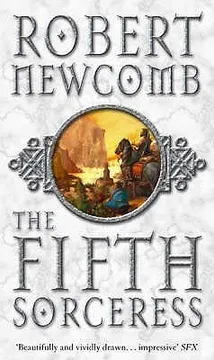
The Fifth Sorceress received overwhelmingly negative reviews, with many readers considering it one of the worst fantasy books ever written. Critics cited poor writing, excessive exposition, misogyny, homophobia, and illogical plot developments. The characters were deemed uninteresting and one-dimensional, while the world-building was criticized as generic and inconsistent. Some readers found the graphic violence and sexual content disturbing. A few positive reviews praised the story as captivating, but these were rare exceptions among the predominantly negative feedback.
Characters
Tristan
Reluctant heir in exilePrince Tristan of Eutracia is a gifted fighter who would rather live as a soldier than inherit the throne and submit to a wizard’s training. His throwing knives, stubborn humor, and preference for common company express a desire to be judged as a person rather than a title. He loves his twin sister Shailiha and is close to Wigg, but resists the obligations they represent until violence makes those obligations immediate. Tristan’s courage is inseparable from a dangerous impulsiveness: he intervenes when he sees suffering, even when doing so threatens his larger purpose. His central tension is not simply whether he can become powerful, but whether he can use power without surrendering his compassion or becoming ruled by vengeance.
Wigg
The grieving Lead WizardWigg is the ancient Lead Wizard of the Directorate, Tristan’s mentor, and a trusted friend to both royal twins. He is sharp, restrained, and habitually private, often hiding his feelings behind dry humor and carefully measured advice. His loyalty to Eutracia is shaped by centuries of war, difficult compromises, and the belief that power must be limited by vows. He loves Tristan and Shailiha as family, yet his protective instincts can become controlling because he knows dangers they cannot see. Wigg’s history with the Coven makes him both an expert guide and a man carrying old grief. His challenge is to preserve ethical judgment when every available choice risks harm.
Shailiha
The twin sisterShailiha is Tristan’s twin sister, a compassionate and inquisitive princess who is devoted to her family and comfortable asking questions others avoid. Pregnant during the crisis, she thinks instinctively about the child she carries and the people who will inherit the consequences of present decisions. Her closeness to Tristan makes her his strongest emotional bond, but she is not simply his confidante: she has her own judgment, courage, and sense of duty. Her relationship to the craft and to the history of women’s power places her at the center of a conflict she did not choose. Shailiha’s character joins tenderness with resolve, making her importance to the story more than her royal status or bloodline.
Failee
First Mistress of the CovenFailee leads the Coven and is its most powerful practitioner of the Vagaries. Brilliant, patient, and convinced that she alone can direct history, she treats people as materials for a design whose scale exceeds any one life. Her control is often calm rather than theatrical, which makes her cruelty more disturbing: she can discuss torture, breeding, and conquest as steps in a plan. Failee’s confidence is inseparable from a growing detachment from ordinary moral limits. She understands the craft deeply, yet her certainty makes her underestimate the consequences of what she does not know. Her ambition is not merely revenge against Eutracia; she wants power over the structure of the world.
Succiu
The dangerous second mistressSucciu is Failee’s second in command, an accomplished sorceress whose charm can turn into cruelty without warning. She enjoys dominance, sexual control, and the humiliation of people she regards as beneath her, especially her enslaved attendant Geldon. Her confidence depends on the assumption that she can control everyone around her, though her desire for Tristan complicates that certainty. Succiu is not the Coven’s chief strategist, but she is its most immediate personal threat to Tristan and Shailiha. She uses beauty, appetite, and magic together, treating intimacy as another form of possession. Her character shows how power can disguise coercion as desire, both to its victim and to its wielder.
Faegan
The crippled rogue wizardFaegan is a brilliant, eccentric wizard who lives among the gnomes of Shadowood in a wheelchair. His powerful memory, broad knowledge of the craft, and taste for riddles make him both an invaluable source of information and a frustrating guide. He has spent centuries preserving rare plants and corresponding secretly across the sea, still trying to repair damage from the war. Faegan’s past is marked by a choice forced through torture, and he resists presenting himself as either innocent or wholly culpable. He understands more of the Coven’s plans than anyone else the travelers meet, but even he cannot control how his knowledge will be used.
Kluge
Commander of winged MinionsKluge commands the Minions of Day and Night, a disciplined army bred for combat and obedience. He is physically formidable, tactically intelligent, and adept at turning cruelty into public spectacle. His authority rests on a system that rewards violence and treats death as both training and entertainment. Kluge’s attraction to Succiu makes him vulnerable to jealousy, but it does not soften his ambition or his contempt for anyone outside the Minion hierarchy. He sees Tristan as both an enemy and a personal rival, particularly because the prince possesses endowed blood. Kluge represents an army whose loyalty is powerful, but whose customs leave room for its command to change hands.
Geldon
The shackled informantGeldon is a dwarfed Parthalonian who has been enslaved by Succiu for centuries. His collar, leash, and assigned role procuring captives have made him a practiced survivor, careful about when to speak and when to appear obedient. Beneath that caution, he has built a quiet network with Ian and Faegan, using trained pigeons to send information across the sea. Geldon’s hatred of the Coven is rooted in personal humiliation and the suffering he has been forced to inflict on others. His courage is practical rather than grand: he risks himself through small, repeated acts of resistance that eventually become essential to the larger struggle.
Narrissa
A Gallipolai survivorNarrissa is a white-winged Gallipolai, one of the people the Minions consider defective and subject to imprisonment and execution. She survives through inherited customs that preserve her people’s identity despite their captivity. Her curiosity, tenderness, and capacity for trust stand in sharp contrast to the violence around her. When she meets Tristan, she recognizes a kindness that has not been extinguished by grief, and their bond grows through shared danger rather than royal status. Narrissa offers Tristan an image of a life based on mutual regard, while her connection to the Specters of the Gallipolai ties private compassion to collective memory.
Nicholas
The king who chose dutyKing Nicholas is Tristan and Shailiha’s father, a former smith chosen to rule Eutracia because he carried endowed blood. He loves his family deeply and has tried to prepare Tristan for a role the prince resists. Nicholas’s decision to join the Directorate after abdication is unusual, but it reflects his desire to serve the kingdom beyond his reign. He is direct when necessary and emotionally vulnerable with his children, especially when explaining how their mother’s health shaped the family’s future. His relationship with Tristan is marked by genuine love and the strain of asking his son to accept obligations he never chose.
Morganna
The queen and family anchorQueen Morganna is Tristan and Shailiha’s mother, a former commoner whose artistic skill and warmth helped make the palace feel welcoming. She creates tapestries, supports orphanages, and understands that small gestures can reach her children when formal instruction cannot. Morganna’s love for Tristan is especially tender because she sees both his resistance and his pain, yet she does not excuse the consequences of his choices. Her presentation of the family medallion gives him a lasting reminder of belonging. She represents the domestic life that Tristan is trying to protect amid political and magical upheaval.
Frederick
The warrior brother-in-lawFrederick is Shailiha’s husband, Tristan’s close friend, and commander of the Royal Guard. Large, formidable, and skilled, he teaches Tristan combat while treating the prince as an equal rather than a future king. Their relationship is built on teasing, rivalry, and deep loyalty. Frederick often sees the practical danger in Tristan’s impulsive behavior, but he also understands why the prince longs for a soldier’s life. His marriage to Shailiha and anticipation of fatherhood connect the royal family’s private hopes to the kingdom’s future.
Natasha
The Ephyra duchessNatasha is Duchess of Ephyra, a poised court figure whose beauty and political attentiveness make her welcome among the royal family. She has cultivated a friendship with Queen Morganna and moves easily through the palace’s social world. Her marriage to the elderly Duke Baldric gives her standing and access, while her composed manner conceals a relentless private ambition. Natasha is skilled at shaping how others see her, and she is careful to use charm and apparent concern to gather information. Her presence at court links the kingdom’s ordinary ceremonies to a danger no one there suspects.
Ian
Keeper of the pigeonsIan is a young leper from the Ghetto of the Shunned who helps Geldon care for the pigeons used to carry messages to Faegan. Though his illness has changed his face and body, he remains curious, hospitable, and attentive to the birds. He and Geldon share a small, vulnerable refuge inside a city built to contain people the Coven deems undesirable. Ian’s life shows the human cost of the Coven’s rule beyond its court and armies, as well as the quiet courage required to preserve communication under surveillance.
Shannon the Small
Keeper of the hidden bridgeShannon is a fiercely loyal gnome who guards the bridge into Shadowood and serves Faegan. Suspicious of wizards because of the damage their magic caused his people, he is blunt, stubborn, and fond of ale. His small stature conceals unusual strength and a willingness to defend the gnomes without hesitation. Shannon challenges Tristan physically before allowing him to cross, then becomes an uneasy guide through the forest. His distrust is grounded in history rather than mere temperament, giving the refuge’s protectors their own grievances and agency.
Vona
The red-haired sorceressVona is one of Failee’s trusted sorceresses and a member of the Coven. Direct and politically observant, she questions decisions that she believes may expose their plans. Her red hair and blue eyes distinguish her in the council, while her caution offers a counterpoint to Failee’s confidence. Vona understands that the Coven’s ambitions depend on secrecy as much as power.
Zabarra
The sharp-tongued sorceressZabarra is a young and powerful member of the Coven, known for a sarcastic manner and a habit of playing with her blond ringlets. She assists in the Coven’s planning and carries herself with more irreverence than Vona. Beneath her playful presentation is a clear awareness of Failee’s authority and the risks surrounding their plans.
Traax
Kluge’s second in commandTraax is an efficient Minion officer who serves as Kluge’s second in command. He is ambitious but careful, attentive to the habits that keep his leader’s favor. Traax oversees training and helps enforce the Minions’ brutal internal customs. His discipline makes him a capable officer, while his position leaves him dependent on a hierarchy in which power can change hands violently.
Plot Devices
The Tome of the Paragon
Prophecy and hidden knowledgeThe Tome is discovered with the Paragon in the Caves and contains three bodies of knowledge: the Vigors, the Vagaries, and the Prophecies. Faegan’s daughter first reads it while wearing the stone, allowing the wizards to learn the craft and defeat the Coven in the ancient war. The Prophecies remain unread because they are reserved for the Chosen One, whose role and future they describe. The Tome gives the conflict its framework, but its partial transmission to Failee creates a dangerous gap between what the Coven believes it can do and what it can safely accomplish. Its contents connect blood, magic, and the characters’ choices.
The Paragon and Cave Water
Power, transfer, and restraintThe Paragon is a living stone that amplifies the power of endowed blood. It can pass to a new bearer only after its connection to the previous host has been interrupted, a process supported by the red water of the Caves. The water also heals and sustains the stone, but it is dangerous to drink and can alter living creatures. During the succession ceremony, immersing the Paragon temporarily deprives the wizards of their powers. The stone’s dependence on both a host and the Cave water governs the political succession, the Coven’s ritual, and Tristan’s first use of magic. It is not merely a weapon but a relationship among blood, knowledge, and responsibility.
The Chimeran Agonies
Memory as coercionThe Chimeran Agonies are a Vagaries spell Failee uses to make a victim believe that terrible experiences are dreams caused by unwanted memories. By staging those experiences while the victim is deeply asleep, she aims to make the person reject their own past and accept the Coven’s version of reality. The method does not simply frighten Shailiha; it turns her memories into evidence against herself, making the loss of identity feel like a means of survival. Faegan has endured a related form of the spell, though he resisted it partially. The Agonies connect psychological manipulation to magical power and make memory a central battleground.
The Shadowood Portal
A narrow passage between worldsFaegan’s portal temporarily compresses the distance between Shadowood and Parthalon, allowing people to cross in moments instead of sailing the Sea of Whispers. Only Faegan can open it, and he can hold it for a limited time, making the return window as dangerous as the arrival. The device allows Tristan and Wigg to reach the Ghetto, but it does not guarantee safe passage through the Recluse or back again. Its rules turn time into a practical constraint: the travelers must move quickly, rely on allies, and choose what can be carried through. The portal’s existence also makes secrecy essential, since discovery would give the Coven a route to Shadowood.
The Three-Part Succession
Oath, blood, and inheritanceEutracia’s monarchy, the wizard’s vows, and the Paragon’s transfer form a single political system. A king of endowed blood guards the stone; at his heir’s thirtieth birthday, he abdicates and may join the Directorate. The vows require wisdom, compassion, and restraint in the use of lethal force, while the death enchantments punish wizards who break them or practice the forbidden Vagaries. Tristan’s reluctant inheritance therefore joins personal choice to political duty and magical law. The succession ritual creates a brief vulnerability that the Coven exploits, while the oath later becomes a promise Tristan chooses for himself after his family is killed.
Download PDF
Download EPUB
.epub digital book format is ideal for reading ebooks on phones, tablets, and e-readers.








