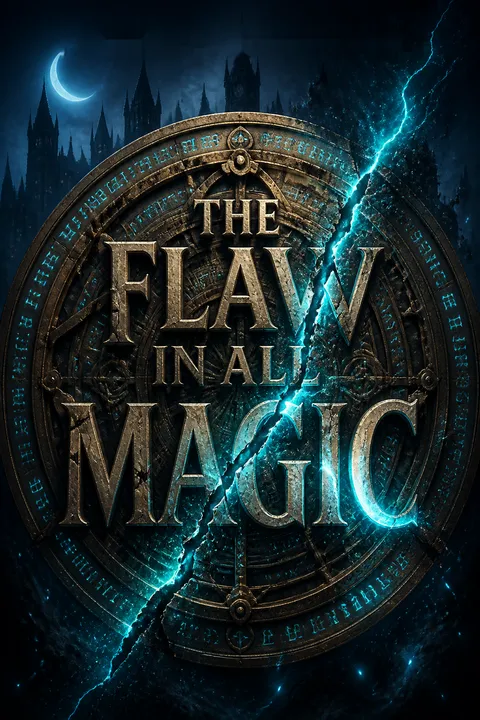


Plot Summary
Prologue
Working alone after midnight in the University’s artifice workshop, elf inventor Allaea Hesliar hears footsteps and assumes her friend Indree has come to drag her away from work. Instead, a masked stranger appears and attacks her with spellfire. Allaea raises a hurried shield and runs through the aisles, scattering tools as she searches for the exit.
She falls against a shelf and sees the copper sheets she came to find. The stranger catches up and burns her alive before she can escape. Her last moments leave one fact clear: the killer came prepared, and the University’s guarded workshop did not keep him out.
Allaea’s murder turns an institutional failure into a bodily fact. The workshop is full of devices built to make magic reliable, yet the spell meant to protect the people inside cannot protect its most diligent worker. Her choice to stay late is not simple recklessness: it grows from the care she gives her work and the belief that one more correction matters. The killer exploits the gap between technical safeguards and human attention. By beginning with Allaea’s fear rather than the investigator’s reasoning, the story makes every later discussion of wards answer to the cost of their failure.
Carver Returns to Campus
Two years after his expulsion, Tane Carver returns to the University of Thaless at Dean Liana Greymond’s request. The campus is unnaturally quiet, its entrances guarded, and the students avoid speaking openly. Greymond tells him that Allaea Hesliar, once his friend and a gifted artificer, was killed in the primary workshop.
A student, Kivit Thrung, has been detained, but the University cannot explain how he could have entered a room protected by layered wards. Greymond hires Tane to examine the spell diagrams because he understands magic without possessing it. The job offers him a chance to prove that non-mages can identify dangers mages overlook, but Allaea’s death makes the work personal before he begins.
Tane’s return binds two wounds together: the professional humiliation of expulsion and the private grief of losing a friend. The University seeks his expertise while restricting his access, reproducing the very hierarchy his dissertation challenged. He is useful as long as his knowledge can be contained. That contradiction supplies the investigation’s engine: Tane must persuade institutions to trust a form of competence they have already rejected. His excitement at being needed does not cancel his sorrow; it complicates it, since every step toward vindication risks turning Allaea’s death into evidence for his own argument.
The Wards Have a Crack
Tane questions Kivit Thrung and discovers that the goblin student lied about meeting a girl because he was waiting to confront Allaea over losing a place on the airship project. Thrung insists he watched the workshop door all night and saw no one enter. Greymond confirms that his account is sincere, leaving the murder apparently impossible.
Though forbidden to visit the scene, Tane steals a guard’s badge and slips through the wards. He realizes the first ward still admits former students, while the second accepts a guard badge. Inside, he finds Allaea’s body and the trail of parts she scattered while fleeing. A howl from deeper in the workshop interrupts his inspection, proving that someone or something else is there.
The clue is not a sophisticated magical exploit but a careless conjunction of rules. Tane reads a ward as language with consequences, while its original designers seem to have treated it as a finished object. His unauthorized entry demonstrates both the sharpness and the danger of his method: he is right to test the system, but he makes himself part of the crime scene. Thrung’s falsehood also introduces a recurring distinction between lying and guilt. A frightened suspect can conceal an embarrassing truth without concealing murder, and divination alone cannot decide which kind of deception matters.
The Portal and the Wraith
The howl leads Tane and Kadka, the half-orc guard escorting him, to an open portal and a masked figure searching the workshop’s spell-diagram drawers. Kadka attacks, and Tane helps block the intruder’s escape, but the mage knocks them aside and flees through the rift.
His departure leaves an unstable portal behind, from which a wraith emerges and begins draining the workshop’s magical lights. Tane uses a copper rod to draw the spirit into a brass engine casing, where it cannot pass through the insulating shell.
Constable Inspector Indree Lovial arrives with her team and recognizes Tane as the former lover who vanished after his expulsion. He hides the recovered scrollcaster, and the chancellor dismisses Kadka from the Guard for helping him.
The chase converts Tane’s theoretical knowledge into physical cooperation. He cannot outcast a trained mage, so he relies on timing, materials, and Kadka’s strength; she, in turn, trusts his explanation enough to act on it. The wraith makes magical risk tangible: a portal is not simply a doorway but a tear that can release consequences neither caster nor institution controls. Indree’s arrival reopens a second breach, emotional rather than magical. Tane’s disappearance left her without an explanation, and now they must work together before either has decided whether trust can be restored.
A Black Market Trail
The brass scrollcaster Tane took from the masked mage can copy documents through magic, but its receiver marks have been altered to frustrate tracing. After Kadka insists on joining the investigation, they visit Essik Tisk, a dockside trader who leads them into an ambush.
Kadka fights off several attackers, and their leader, sprite artificer Bastian Dewglen, explains that he made the scrollcaster. Bastian remembers selling it to a nervous young man in a cowl who bought warding components, but cannot identify him.
He agrees to inspect the device for clues. That night, the killer sends Tane a painful warning and an image of his home, demanding he abandon the case. Kadka shields him from spellfire, and the attack convinces Tane they are close to something important.
The black market complicates the story’s moral geography. Bastian is a criminal, yet he regards himself as a civic participant whose prosperity depends on the Protectorate surviving. Tane gets further by appealing to that identity than by treating him as a simple source to exploit. Kadka’s intervention also revises Tane’s idea of useful competence: he brings analysis, she brings a willingness to move before danger becomes abstract. The warning attack confirms that the investigation has reached beyond a lone killer. It also exposes how magic can wound through remote contact, making privacy and distance less secure than Tane’s carefully designed office wards suggest.
What They Carry
While they study the workshop wards in Tane’s cramped office, Kadka presses him about why he treats magic as an adversary. He tells her that a faulty spell in an ancryst train killed his parents when he was thirteen, leaving him scarred; he entered the University without magic to prove that ordinary people should understand the systems they depend on.
Kadka explains that she left Sverna after her mother’s death, seeking the magical world she had heard about as a child, but has often been treated as an outsider.
Their exchange deepens their partnership. The next day, Tane and Indree compare missed classes with access to Guard badges. A student’s roommate identifies Randolf Cranst as absent and increasingly drawn to magical-supremacist ideas.
The two investigators’ motives are not interchangeable. Tane wants accountability for a preventable technical failure and recognition for his intellectual method; Kadka wants to encounter magic directly, not remain stationed outside its rooms. Their shared pursuit gives each a different kind of agency. Tane’s childhood loss explains his vigilance but also his need to prove that he was right, a need capable of distorting judgment. Kadka’s story reveals how exploration can be both liberation and self-testing. She does not merely follow Tane’s case; she chooses danger because it offers a life more vivid than the exclusion she has known.
Cranst Turns on Them
Indree’s search spell leads Tane, Kadka, and Indree toward Porthaven, where Randolf Cranst’s followers surround them. Tane uses a darkness charm to disrupt the attackers’ spells, while Kadka and Indree fight through the group. Cranst escapes toward the harbor, but Indree’s divination focus lets them follow.
Cornered, he admits that Allaea was not supposed to be at the workshop and then stabs himself before he can explain his purpose. Tane finds a key and a badge bearing the old Mage Emperor’s emblem in Cranst’s belongings. Before they can question anyone further, the group realizes that Cranst’s attack on Bastian’s workshop may have been meant to silence the artificer and destroy the scrollcaster.
Cranst’s death resolves the most visible suspect while making the larger mystery more dangerous. His ideological conviction gives his violence a public language, but his suicide prevents that language from becoming a useful confession. The investigators win physically and lose information at the same time. Tane’s charm and Kadka’s combat skill show a practical alliance taking shape, while Indree’s authority keeps their survival connected to lawful investigation. The Emperor’s emblem shifts the case from personal rivalry toward organized political nostalgia. A dead suspect can close a file only if the crime was truly his alone, and the evidence now argues against that comfort.
The Scrollcaster Is Lost
At Bastian’s workshop, Tane and Indree find the room wrecked and several people dead. Bastian contacts Tane through a sending, explaining that Cranst and accomplices attacked, damaged the wards, and destroyed the scrollcaster before he could save it.
He did learn that the device’s last use was to receive a document, not send one. Indree is angry that Tane withheld the evidence, but accepts that he had preserved access to a source who would never speak to the constabulary.
The Lady Protector, Abena Jasani, then meets with the investigators. Although Tane warns that the conspiracy may still threaten the airship, Abena refuses to delay its launch, fearing that postponement would undermine the fragile diplomacy the project is meant to support.
The destroyed scrollcaster demonstrates the cost of Tane’s unilateral secrecy: his private channel protected a witness, but it also left the official investigation unable to secure evidence. Indree’s decision not to arrest him reflects pragmatic trust rather than absolution. Abena’s refusal to delay the launch introduces a competing responsibility. She is not merely defending ceremony or reputation; she believes the airship may prevent future conflict. The story therefore refuses an easy choice between caution and political hope. Each option carries public consequences, and the investigators must act within a timetable set by people whose stakes extend far beyond the murder.
The Portal Was Prepared
Tane remembers that the sound from the portal matched the howl of a tunvok, a rare ice wolf kept at the Conservatory. With Kadka’s help, he uses the howl’s direction and a piece of ancryst as a crude detector to search the nearby Greenstone neighborhood. In a cellar, they find airship heating-glyph plans, portal texts, and a preassembled portal spell.
Tane realizes the University ward barred people from making a portal, not from activating one already made by an authorized caster. Someone with the right standing prepared the spell for Cranst to use. The airship plans are also evidence that its design has been tampered with. The culprit must be one of the senior University figures with portal authority and access to the launch.
The solution depends on listening across categories: an animal sound becomes geographic evidence, an old watch becomes a detector, and grammar becomes a security vulnerability. Tane’s non-magical method is not opposition to magic so much as unusually attentive reading of its material conditions. The prepared portal also changes the moral scale of the crime. Cranst may have acted violently, but he was enabled by an insider who could build the mechanism and exploit institutional trust. The discovery that the airship plans were altered ties Allaea’s final work to the political crisis, making her diligence part of the evidence rather than a private biographical detail.
The Chancellor’s Emblem
At the launch ceremony, Tane and Kadka bring the portal diagram and airship plans to Indree. They suspect Greymond because she knew where the investigators would search, but when Indree confronts her, Greymond insists she shared their movements only with Chancellor Talain Nieris. Tane connects Nieris’s boast about his portal expertise with the Emperor’s emblem in Cranst’s belongings and the statue in Nieris’s office.
They conclude that Nieris supplied Cranst with replacement heating-glyph plans, already installed on the airship. Indree heads for the ship, where Nieris has taken Abena. Tane steals a Mageblade’s pistol to provoke the guards into action and boards. The hatch shuts behind him, and the airship rises with him trapped aboard.
The revelation works because the clues have accumulated in ordinary sight: a boast, a badge, a statue, and a pattern of institutional deference. Nieris’s power has been protected partly by the assumption that his expertise makes him trustworthy. Greymond’s involvement is narrower than Tane first fears, but her routine reporting shows how procedure can transmit danger without requiring a grand conspiracy. Tane’s decision to board alone repeats his habit of treating himself as the necessary instrument. It is courageous, but it also excludes Kadka, whose cooperation has repeatedly kept his insight from becoming a fatal abstraction.
The Airship Becomes a Trap
On the flying airship, Nieris summons Tane to the bridge and binds him beside the unconscious Lady Abena. He explains that he altered the heating glyphs so the envelope will overheat and rupture above the city, making the airship’s failure appear to discredit Abena’s effort at peace. Nieris intends to escape through a portal and leave Tane as a convenient suspect.
He frames magical rule as the only answer to a world that distrusts mages. As he begins casting, Kadka reaches the ship by climbing a trailing tether, but cannot enter the bridge without alerting him. Tane understands that the Chancellor’s arrogance has made him maintain too many spells at once, and begins creating distractions to weaken his control.
Nieris’s plan turns engineering into political theatre: he does not simply sabotage a machine but intends to make its destruction argue for the supremacy he already believes in. The airship’s public symbolism is therefore inseparable from its technical design. His grievance is rooted in genuine status resentment, yet he converts it into a hierarchy that would make others’ fear self-fulfilling. Tane’s insight about overextended spells applies his central theory to a person rather than a diagram. The flaw is not an isolated typo but a psychological excess: Nieris’s certainty persuades him that no one can exploit the limits he imposes on himself.
The Wraith Takes Nieris
Tane fires at Nieris, then uses an empty charmglobe and a hidden flash charm to force the Chancellor to divide his attention. His wards falter long enough for Kadka to smash through the opening and pin him before he can finish the portal. The destabilized magic releases the wraith trapped in the airship’s power system; it drains Nieris until he is left mentally and magically shattered.
Meanwhile, the heating glyphs keep drawing power, and the envelope begins to fail. Kadka steers the ship toward the bay while Tane lures the wraith into the brass-lined engine room, where it consumes the gems powering the dangerous spells. The lift fails, but the damaged airship splashes into the water instead of crashing over the city.
The climax pays off the story’s materials and relationships at once. Brass blocks magic, a decoy consumes attention, and the wraith’s appetite can be redirected toward the ship’s power source. None of these solutions is a display of superior force; each depends on understanding a limitation and accepting help at the right moment. Kadka pilots without instruction, while Tane trusts her with the ship and faces the spirit himself. Nieris is undone by the uncontrollable consequence of the same portal magic he treated as mastery. The landing is a costly rescue, not a clean victory: survival depends on redirecting danger rather than eliminating it.
A New Kind of School
After rescuers reach the airship, Indree embraces Tane and then returns to the work of securing Nieris and the wraith. At a campus memorial, she honors Allaea’s contribution to the project, and Abena names the first airship the Hesliar. To protect diplomatic confidence, officials present Nieris’s crimes as his retirement and blame the murder on Cranst, though Nieris has been left unable to wield magic.
Greymond becomes chancellor and announces that non-magical students may apply to the University. Tane is offered teaching work, Kadka a place in the Guard, and Indree invites Tane to meet again. Back at his office, a worried woman seeks help finding her missing husband, and Tane and Kadka take up the case together.
The ending grants institutional change without pretending that truth and justice align perfectly. The University opens its doors to non-mages, answering the educational principle behind Tane’s dissertation, but the official account conceals Nieris’s role to preserve a fragile political project. Allaea receives public remembrance through the airship bearing her name, though that honor cannot restore the life or truth lost. Tane’s future remains unsettled; recognition gives him choices rather than a final identity. The new missing-person case makes that uncertainty productive. Instead of returning unchanged to the institution that expelled him, he leaves with a partner and a practical vocation built around questioning magic.
Analysis
The novel’s central mystery is built around a deceptively practical question: how can a guarded room be entered without anyone crossing its door? Its answer grows from the book’s larger concern with the distance between a system’s formal design and the people who maintain, interpret, and depend on it. Tane reads magic as an accountable technology. He does not deny its power; he asks who wrote its instructions, who checked them, and who is excluded from understanding them. The plot repeatedly rewards this scrutiny, but it also shows that insight alone is not enough. Tane’s solitary confidence nearly costs him the relationships and lives his investigation is meant to protect.
Kadka and Indree embody distinct forms of knowledge that Tane cannot replace. Kadka responds physically and immediately, while Indree works through evidence, warrants, and institutional responsibility. Their strengths make his reasoning actionable, and their challenges reveal the limits of his self-image as the only person capable of seeing clearly. His growth lies less in becoming less clever than in learning that competence is relational. The climax succeeds because he trusts Kadka to steer, confronts Nieris without assuming he can control every variable, and uses materials and timing rather than magical power.
Nieris’s conspiracy sharpens the political dimension. He converts a real history of hostility toward magic into a justification for rule by the magical, repeating the hierarchy he claims will protect his people. Abena’s diplomacy is not naïve optimism; it is a high-risk alternative to permanent suspicion. The airship’s sabotage attacks that alternative by turning technical failure into political evidence. The ending preserves this tension: the University opens education to non-mages, yet officials conceal the full truth to keep diplomatic trust intact. Reform arrives, but not in a world where truth has no cost. Allaea’s work remains the human measure of both the machine’s promise and the institution’s failure.
Review Summary
The Flaw in All Magic receives praise for its engaging mystery plot, likeable characters, and unique premise featuring a magicless protagonist investigating magical crimes. Readers particularly love Kadka, the half-orc partner, praising her personality and the platonic dynamic between leads. The worldbuilding blends fantasy with steampunk/magepunk elements. Travis Baldree's narration is widely commended. Some criticisms include predictable plot twists and info-dumping. The pacing is generally praised as fast and enjoyable, with most reviewers rating it 4-5 stars and expressing interest in continuing the series.
Characters
Tane Carver
The magicless spell-readerTane is a former University student who understands magical theory despite having no gift for casting. Quick-witted, improvisational, and alert to the gap between what a spell says and what its maker meant, he has built his life around finding errors others dismiss. His humor protects a more serious mixture of grief, resentment, and hunger for recognition. He wants ordinary people to understand the magic that governs their safety, but he can mistake being right for being entitled to act alone. His battered watch case, inherited from his father, keeps private loss close to his working method. Tane’s strongest intelligence is practical: he notices the overlooked condition, object, or assumption that turns an impossible problem into a solvable one.
Kadka
The fearless half-orcKadka is a half-orc from Sverna who came to the Protectorate hoping to experience the magic she heard about as a child. A trained fighter with keen senses and a direct manner, she moves toward danger rather than waiting for certainty. Her confidence is not the same as invulnerability; she has spent much of her life being reduced to whichever part of her heritage other people find convenient. She values self-reliance, but also chooses companionship when it respects her agency. Tane’s explanations let her engage with magic on her own terms, while her physical courage repeatedly forces him to act on knowledge instead of hiding behind it. Her curiosity is as important as her strength.
Indree Lovial
The determined inspectorIndree is a skilled diviner and constable inspector, as disciplined in investigation as she once was in her University studies. She values evidence, procedure, and the protection those structures can offer people without influence. Her history with Tane makes his return both professionally useful and personally painful: he vanished without giving her the chance to understand his decision. Indree’s composure does not erase her grief or affection; it allows her to keep working while both remain present. She is not simply a foil to Tane’s improvisation. Her authority, judgment, and willingness to revise a position when evidence changes are essential counterweights to his tendency to go ahead alone.
Allaea Hesliar
The brilliant artificerAllaea is an elven inventor whose skill and persistence have earned her a place on the University’s ambitious airship project. She is sharp-tongued, demanding, and impatient with complacency, yet her bluntness is joined to loyalty and a strong instinct to help people who need it. She was close to Indree and shared a warm, intellectually lively friendship with Tane. Allaea’s devotion to improving a design can push her beyond sensible working hours, but it also reflects her belief that technical details have human consequences. In the story, her work is not merely a clue left behind; it embodies the care and competence the institutions around her rely upon without always recognizing.
Liana Greymond
The farsighted deanGreymond is the University’s Dean of Divination and Tane’s former mentor. Her partial foresight gives her unusual access to events, while her professional reserve helps her manage a university anxious about reputation and security. She respects Tane’s intelligence but carries the hurt of having been deceived by him during his years as a student. Her relationship with him therefore combines genuine regard with limits on trust. Greymond represents the institution at its most capable and its most defensive: she can recognize the value of an unconventional investigator, yet remains attentive to the consequences of letting him too close.
Talain Nieris
The ancient chancellorNieris is an elven mage and long-serving chancellor of the University, accustomed to command and recognized for exceptional magical knowledge. His age, status, and cultivated manners lend him the appearance of measured authority. He believes deeply in the power of magic and in the responsibility, or entitlement, he associates with mastery. As a political figure, he is attentive to the University’s standing and the Protectorate’s future. His confidence can look like composure, but it rests on an assumption that expertise places him beyond ordinary scrutiny. That assumption shapes how he treats both institutional safeguards and people whose abilities do not resemble his own.
Abena Jasani
The magicless ProtectorAbena is the Protector of the Realm, a human leader without magical ability in a nation built around magic. She supports an airship project meant to strengthen trade and diplomacy with the wary countries across the channel. Her political judgment is guided by the belief that practical cooperation may prevent future conflict, even when the risks are real. Abena understands that a public retreat can have consequences beyond one ceremony, and she weighs individual danger against the security of the whole Protectorate. Her position makes her an important counterexample to the claim that magical power must determine who should govern.
Kivit Thrung
The frightened artifice studentThrung is a goblin artifice student who resents losing a place on the airship project to Allaea. He feels that prejudice against goblins has made his work easier to dismiss, and his insecurity drives him to confront her. When investigators question him, he lies about his presence near the workshop because he fears being judged by his species as much as by his actions. Thrung’s role shows how a suspect can appear guilty for reasons that are real but unrelated to murder. His anxious self-protection makes him a useful early test of Tane’s ability to distinguish deceit from violence.
Randolf Cranst
The resentful studentRandolf is a University student whose growing interest in magical-supremacist ideas connects him to a network of like-minded people. He is not presented as the most gifted scholar in his class, which makes the sophistication of the magical breach surrounding the case difficult to explain. His cousin Dedric gives him a possible route to a Guard badge, while his absences and extremist reading draw investigators toward him. Cranst’s fervor is shaped by an ideology that turns anxiety about the Protectorate’s place in the world into a promise of restored dominance.
Bastian Dewglen
The patriotic sprite fenceBastian is a sprite artificer and black-market dealer who runs a clandestine workshop behind a genial, almost theatrical manner. He is protective of his business and cautious about customers, yet he sees himself as a patriot whose livelihood depends on a prosperous Protectorate. His interest in Kadka’s unusual resistance to divination reflects both scientific curiosity and a habit of noticing valuable exceptions. Bastian’s criminal contacts give Tane access to information unavailable through official channels, but his loyalty has limits: secrecy is also the structure that keeps his trade alive.
Sorn Brassforge
The cautious artifice deanBrassforge, a dwarf and Dean of Artifice, oversees the University’s ambitious engineering work, including the airship. He is more comfortable discussing machines than politics and trusts the expertise of the people who approve and build them. That confidence makes it difficult for him to imagine that a completed design might still contain a dangerous flaw. His response to Tane’s warnings reveals how divided responsibility can obscure accountability.
Valis Orthea
The gentle invocation deanOrthea is the ogren Dean of Invocation, physically imposing but notably gentle in temperament. She is appalled by senseless violence and uncomfortable when suspicion falls on those in her circle. Her presence complicates the assumption that a formidable body or magical position predicts aggression. She represents one of the University’s senior authorities, though she is less politically forceful than the chancellor.
Essik Tisk
The wary dockside traderTisk is a kobold fishmonger whose public stall conceals a connection to illegal magical trade. He knows Tane as a former customer and recognizes that the scrollcaster may bring dangerous attention to his business. His choice to lead Tane and Kadka into an ambush shows that protecting his trade can outweigh personal loyalty. Tisk illustrates the transactional, unstable networks that thrive beyond official oversight.
Selene Meadowgrass
The sprite animal keeperSelene is a sprite and senior keeper at the Conservatory of Magical Beasts. She is practical, knowledgeable about the animals in her care, and committed to protecting species driven from their habitats. Her work with a newly arrived ice wolf gives Tane and Kadka access to a sound that becomes a clue. Selene also offers a reminder that magical beings are not simply tools or threats; they have needs and circumstances beyond human convenience.
Dedric Cranst
The Guard cousinDedric is a member of the University Guard and Randolf Cranst’s cousin. His access to a Guard badge makes his household relevant to the investigation, though he is not shown as sharing Randolf’s ideology. He answers questions about his cousin with concern and uncertainty, offering investigators a useful lead without providing a full explanation.
Plot Devices
Spell wording and wards
Rules with human errorsIn this world, magic responds to the precise instructions supplied by a spell’s maker. Wards can be powerful and still fail through overlooked wording, careless assumptions, or a distinction between who may create a spell and who may activate it. Tane’s ability to inspect those instructions without magical training makes the rules both a mystery mechanism and an argument about expertise. The plot repeatedly shows that a system can be technically functional while remaining dangerously misunderstood by the people who rely on it.
Tane’s ancryst watch case
A keepsake becomes a toolThe battered watch case belonged to Tane’s father and holds a small piece of ancryst. Tane touches it when anxious, tying his investigation to the childhood loss that shaped his distrust of magical machinery. Because ancryst reacts to magical fields, the case can also serve as a crude detector when Tane and Kadka search for a hidden ward. Its changing function links grief, memory, and practical ingenuity without turning the object into a magical solution by itself.
The black-market scrollcaster
A stolen message trailBastian’s brass scrollcaster copies documents between two linked devices, allowing private transmission of valuable plans. The case found in the workshop connects the masked intruder to an illegal artificer and raises the possibility that protected airship diagrams have been copied or replaced. Altered receiver marks make the device difficult to trace, and its destruction costs the investigators a direct route to the sender. What Bastian can recover about its last use still points toward an unseen exchange.
Portals and the wraith
A breach leaves danger behindPortals tear through the boundary between the physical world and the Astra, so an unstable crossing can admit a wraith that feeds on magical energy. The portal initially explains how the masked intruder bypassed guards, while the wraith makes each careless use of magic carry an immediate physical threat. Tane traps the spirit inside a brass engine casing, then later uses brass insulation and the wraith’s appetite to protect the city from a failing airship. The danger that first appears as a consequence of escape becomes a tactical problem the investigators must understand.
The airship’s heating glyphs
Engineering turned into sabotageThe airship depends on magical heating glyphs inside its envelope and ancryst engines to steer and remain aloft. Allaea’s work focuses on making those glyphs more efficient, while the completed diagrams pass between mages, engravers, and workers who cannot independently verify them. That division lets an altered design escape notice until the ship is already in the air. The airship therefore unites the mystery’s technical question with its political stakes: a failure could destroy lives and discredit Abena’s attempt to build peace through trade.
Magebreakers Series

Download PDF
Download EPUB
.epub digital book format is ideal for reading ebooks on phones, tablets, and e-readers.








