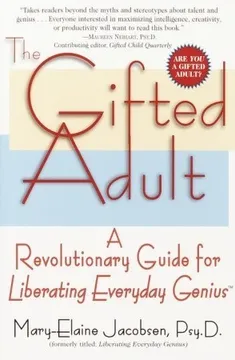


Key Takeaways
Treat unusual intensity as a design feature, then learn to steer it.
Difference from within. Jacobsen argues that giftedness is not only fast learning or impressive output. It also involves how a person notices, feels, interprets, and responds to the world. She calls the underlying traits First Nature: heightened receptivity and an urge to improve what seems imperfect. These can show up as the visible trio of Intensity, Complexity, and Drive.
Ann, a lawyer, responds to criticism by shrinking her initiative and doubting her judgment. John, a restless creative director, responds by pushing harder and alienating colleagues. Their opposite reactions illustrate the same problem: when people treat a basic temperament as a defect, they may suppress it or let it run unchecked. The book offers a lens for self-understanding, not a diagnosis.
The useful move is to ask whether a trait is being expressed badly, rather than assuming the trait itself is bad. That resembles person-environment fit: a fast, idea-rich worker may flourish in one setting and struggle in another. But a reframe should not become an excuse. Intensity can explain impatience without making its effects harmless, and sensitivity does not establish giftedness by itself. The strongest application is practical: identify the trait, examine its costs and benefits, then adjust the behavior or environment without demanding that the person erase their temperament.
IQ captures a narrow snapshot, not the whole shape of ability.
A limited measure. The book challenges the habit of treating one IQ score as a verdict on a person's potential. It traces testing from Alfred Binet's effort to identify children needing educational support to later uses that ranked people. Jacobsen stresses that formal scores reflect performance on particular tasks and can be affected by what someone has learned; they do not capture every ability, creative contribution, or personality trait.
She draws on Howard Gardner's model of multiple intelligences, including linguistic, spatial, musical, bodily, interpersonal, intrapersonal, logical, and naturalist abilities. Picasso, in her account, showed striking artistic ability while struggling at school. Jacobsen estimates that about 10 percent of adults may fit a broader definition of giftedness, roughly 20 million Americans. That is her estimate, not a standardized count.
The distinction between measuring a skill and judging a whole person remains essential in education and hiring. A score can help answer a defined question, but trouble begins when a proxy becomes a biography. The chapter's broad approach also needs care: Gardner's categories are an influential way to discuss strengths, not a universally accepted or definitive map of intelligence. The sound conclusion is neither to worship IQ nor to dismiss measurement. Use assessments as partial evidence, interpreted alongside real performance, opportunity, context, and the person's own goals.
Turn talents into contribution by joining ability, purpose, and action.
Ability needs direction. Jacobsen calls her larger model Evolutionary Intelligence, or EvI. It joins a person's multiple abilities and gifted traits with Advanced Development: a human-centered vision, a sustained sense of mission, and action that brings ideas into the world. In the author's account, talent alone can remain unused, while concern without action can remain a wish. Purpose connects the two.
The example of Mitch shows the model in everyday scale. After serving in Vietnam, he returned with deep hostility toward Vietnamese people. Years later, as a firefighter in a Milwaukee neighborhood with Southeast Asian families, he began talking with local teenagers and learned what they needed. He helped organize a youth club and connect families with community support. His experience became constructive action, not just private insight or good intentions.
Linking competence to a public purpose can make difficult work feel coherent, a point that aligns with research on intrinsic motivation and self-determination. The model is most persuasive as an ethical compass, not as a scientific equation or a ranking system. Its language of mission and duty can inspire, but it can also burden people who already feel responsible for fixing everything. Contribution need not be grand or self-sacrificing. A useful test is whether the chosen action helps others while remaining sustainable and genuinely connected to the person's abilities.
Replace inherited criticism with an accurate story about your traits.
Revising the self-image. Jacobsen says repeated complaints such as “too sensitive,” “too driven,” or “too full of ideas” can become an inner voice. She calls the protective identity built around those messages the False Self. It may exaggerate a trait to defy criticism or suppress it to win approval. Either response can obscure what the person actually wants and can do.
The book's Five Facets of Freedom form a path from recognizing and understanding one's characteristics, through addressing old wounds and learning self-management, to using one's abilities more fully. Rewriting personal history does not mean pretending that every criticism was wrong. It means checking who supplied the judgment, whether it fits, and what responsibility remains. The goal is a truer account, not a flattering one.
Narrative revision can reduce shame by separating a person's identity from labels imposed during childhood. Yet this work is strongest when it preserves accountability. A comment about dominating a meeting may be poorly delivered and still contain useful information about impact. The distinction between a trait and its expression makes room for both self-respect and repair. It also guards against a tempting but risky conclusion: that every setback proves others cannot understand the gifted person. Sometimes the most liberating response is to accept accurate feedback without accepting a global condemnation of the self.
Balance intensity, complexity, and drive instead of suppressing or unleashing them.
Steer the energy. Intensity describes heightened energy and sensitivity; Complexity includes rapid, associative thinking and perceptiveness; Drive is the pull toward goals and high standards. Jacobsen's central management principle is to avoid both extremes: shutting a trait down or letting it overwhelm everything around it. Balanced expression preserves the asset while reducing collateral damage.
Victor, a capable leader, becomes sarcastic and humiliating when coworkers slow a project. His independence and speed help him solve problems, but his unmanaged reactions damage trust and delay the work. The book recommends noticing recurring triggers, considering how behavior affects others, and preparing a different response. For example, a person can keep a strong conviction while choosing a more constructive time and manner to voice it.
This is a practical form of emotion regulation: awareness creates a pause between activation and action. The aim is not blandness, but a wider range of responses. That distinction matters in workplaces, where organizations sometimes label dissent as a personality problem rather than examine whether the dissent is valid. At the same time, a good idea does not excuse contempt or coercion. Individual self-management helps, but teams also need norms that allow disagreement, protect attention, and give people different working styles room to contribute.
Give high standards a finish line before they become procrastination.
Excellence needs release. Jacobsen distinguishes an urge to bring work to its best possible form from perfectionism that makes “good enough” feel unacceptable. The latter can create a seesaw: endless preparation, followed by a last-minute scramble or no finished work at all. Her Ready, Set, Go approach starts by naming the goal, ranking the factors that matter, and deciding whether more preparation is likely to improve the result enough to justify the time.
The technique is a decision aid, not a guarantee. A person weighing a job move might rank safety, relationships, pay, and challenge, then compare options against those priorities. Jacobsen also recommends a Five-Minute Method for starting an avoided task: commit to focused work for five minutes, then decide whether to continue. Both tools turn vague hesitation into a next step.
This advice anticipates a useful distinction from decision science: more information is valuable only when it can change the choice. A ranked list can expose hidden priorities, while a small work interval lowers the psychological cost of beginning. But numerical scoring can create false precision, especially when uncertain values are multiplied into tidy totals. The method should clarify judgment, not replace it. Its deeper lesson is to set an explicit stopping rule: decide what evidence would be sufficient, what quality level is needed, and when further refinement stops serving the goal.
Build intimacy through listening, boundaries, and needs stated plainly.
Connection takes practice. Jacobsen argues that sharp perception can become a relationship liability when someone assumes they already know what a partner means. Reflective listening counters this: give the other person room to speak, acknowledge the feelings beneath the words, and ask briefly when meaning is unclear. Understanding does not require agreement.
When something needs to change, she recommends assertiveness rather than hinting or blaming: identify the issue, name the relevant feeling, and explain its consequence. She also warns against falling in love with a partner's imagined potential. The book cites relationship research reporting that successful couples have many more positive than negative interactions, presented as a five-to-one ratio. The point is not to keep score, but to notice whether appreciation and care are present alongside conflict.
Listening is not passive; it is a disciplined way to test assumptions before acting on them. The framework also treats boundaries and vulnerability as partners rather than opposites: people can be open without offering unlimited access. The reported five-to-one ratio is best treated as a memorable research finding, not a universal quota for every couple or a substitute for safety. Where contempt, coercion, or abuse is present, better communication alone is not the remedy. In ordinary conflict, though, curiosity and direct requests often do more than another round of mind-reading.
Use turning points as clues, then make your mission concrete.
Meaning emerges in retrospect. Jacobsen calls significant shifts Evolutionary Moments. They may be dramatic events or small experiences that only later make sense as part of a broader direction. Andy McGuire, for example, was badly burned as a child. As an adult, an article about efforts to require flame-resistant children's sleepwear brought that experience back into focus. He joined the campaign, then worked on other public-safety issues and used documentary filmmaking to advance causes.
The book encourages readers to identify such turning points and use them to shape a personal mission: what matters, what abilities can serve it, and what action is possible now. But the story is not a formula for discovering a single predetermined destiny. The practical task is to turn a pattern of interests and experiences into a specific, revisable commitment.
Retelling a life as a sequence of turning points can reveal connections that were invisible at the time. It can also create hindsight bias, making a winding path look more inevitable than it really was. Treating the pattern as a hypothesis keeps the insight useful without turning it into fate. A mission statement should help choose among real opportunities, not become another standard for self-punishment. The most durable purposes are often concrete enough to guide action, but flexible enough to change as evidence, responsibilities, and circumstances change.
Analysis
The book's most durable contribution is its refusal to equate giftedness with grades, fame, or a single test score. It asks readers to consider temperament, development, social context, and achievement together. That shift can be especially valuable for adults who have spent years interpreting curiosity, sensitivity, or changing interests as personal defects. Its recurring strength is also its most credible practical insight: an ability can be both a resource and a source of friction, depending on how it is expressed and supported.
The framework should nevertheless be read as a clinical and self-help model, not established measurement science. Jacobsen explicitly describes the EvI Profile as a prototype, not a standardized instrument. Her estimate of millions of unidentified gifted adults depends on a broad definition and should not be mistaken for a verified prevalence figure. The book's claims about intuition, sensory differences, evolutionary purpose, and a distinct gifted personality are presented with more certainty than the evidence in the excerpt can support. Personal stories make the ideas vivid, but anecdotes cannot show that these traits uniquely identify gifted adults or explain every difficulty.
A careful reader can keep the humane insight while loosening the categorical claims. Intense curiosity may reflect high ability, but it can also overlap with other temperaments, developmental conditions, stress, or ordinary variation. A label should not replace assessment when someone needs educational, medical, or psychological support. Nor should the language of exceptional potential make people responsible for solving society's problems alone. The best use of the book is as a prompt for inquiry: Which traits reliably energize this person? Which behaviors harm relationships or health? What conditions allow strengths to become useful? That approach keeps the invitation to self-knowledge while making room for evidence, context, and change.
Glossary
First Nature
Inborn receptivity and improvement driveJacobsen's term for two proposed underlying traits of giftedness: heightened receptivity to sensory, emotional, and environmental input, and an urge to improve things toward an internal sense of how they should be. She presents these as foundational tendencies that can produce the more visible traits she calls Intensity, Complexity, and Drive.
Everyday Genius
Gifted potential beyond fameJacobsen's name for people with unusual abilities and a strong potential to move ideas or social progress forward, whether or not they become famous or achieve conventional success. The term emphasizes personality and inner experience as well as output. It is a conceptual category in the book, not a standardized clinical or psychometric diagnosis.
Evolutionary Intelligence
Ability directed toward human contributionJacobsen's proposed model combines multiple abilities and gifted traits with Advanced Development. In her framework, a person's skills and intensity become Evolutionary Intelligence when joined to a human-centered vision, a sustained sense of mission, and real-world action. The concept is aspirational and practical in purpose; the book does not present it as a validated intelligence test.
Intensity, Complexity, and Drive
Three broad giftedness traitsJacobsen's umbrella categories for characteristics she associates with gifted adults. Intensity refers to heightened energy and sensitivity. Complexity concerns associative thought, perceptiveness, and multiple interests. Drive describes strong motivation, persistence, and high standards. The book treats these as potential strengths that can become liabilities when suppressed or expressed without regard for limits and other people.
Advanced Development
Growth toward purposeful contributionThe developmental element in Jacobsen's model of Evolutionary Intelligence. It consists of Humanistic Vision, Mandated Mission, and Revolutionary Action. These describe, respectively, concern for the collective good, commitment to a meaningful direction, and action that puts that commitment into practice. Unlike the abilities and traits in the model, the book presents Advanced Development as something that changes through experience.
False Self
Protective identity shaped by disapprovalJacobsen's term for an adapted identity that develops when a person hides or exaggerates natural traits to avoid criticism, rejection, or shame. It may once have helped someone fit in or feel protected, but can become restrictive in adulthood. The book contrasts this defensive pattern with a more authentic expression of the person's needs, abilities, and values.
Five Facets of Freedom
Five-stage self-liberation pathJacobsen's sequence for developing and applying gifted potential. It moves from identifying and understanding oneself to addressing wounds, managing one's traits, and using one's abilities more fully. The stages are meant to build on one another, connecting self-knowledge with practical self-regulation and purposeful action rather than treating self-acceptance as the endpoint.
Evolutionary Moment
Experience that redirects personal developmentJacobsen's term for an event or series of experiences that helps redirect a person's development toward a more fitting purpose. Such moments may feel ordinary when they occur and gain significance in retrospect. A catalyzing Evolutionary Moment is especially influential, changing how someone understands their abilities or direction, often after experience has accumulated over time.
EvI Profile
Self-rating inventory for the modelA 240-item questionnaire Jacobsen created to help readers assess multiple intelligences, gifted traits, and Advanced Development. Respondents rate statements and use their scores to reflect on strengths and areas for growth. The book explicitly describes it as a prototype, not a standardized tool for diagnosis, school admission, or employment decisions.
Download PDF
Download EPUB
.epub digital book format is ideal for reading ebooks on phones, tablets, and e-readers.








