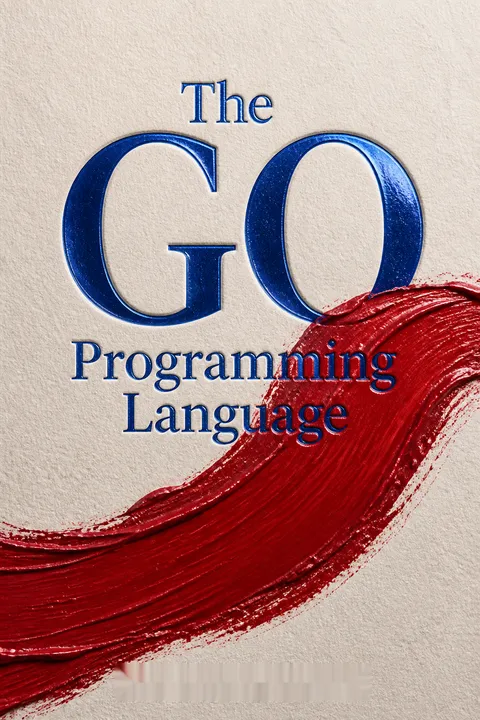


Key Takeaways
Keep the language simple enough that whole systems remain understandable
Simplicity is a design choice. Go began at Google in response to software systems growing harder to change as features and options accumulated. The response was not to add every powerful construct found in other languages, but to favor a compact language, predictable conventions, fast compilation, and a substantial standard library. The book presents Go as a practical tool for building reliable, efficient software, especially network services and developer tools.
Learn by building real tasks. The opening tour moves from printing arguments and finding duplicate lines to generating images, fetching URLs, and serving HTTP requests. The examples show how small, ordinary pieces combine into useful programs. The Go tool and gofmt reduce setup and style debates so attention can stay on program behavior.
What's striking is that simplicity is treated as an engineering constraint, not a promise that every task will feel effortless. A smaller language can make code review and maintenance more legible because fewer mechanisms compete to express the same idea. This connects to cognitive-load research: consistency reduces the mental work of switching between local conventions. The tradeoff is real, however. Omitting a feature can move complexity into libraries, conventions, or repeated code. Simplicity succeeds when the whole system becomes easier to reason about, not merely when the language specification is shorter.
Use types to make meaning explicit and defaults useful
Types carry intent. Celsius and Fahrenheit are both represented by floating-point numbers, yet Go's named types prevent them from being mixed accidentally. Converting between them requires an explicit conversion, making a change in meaning visible. Go also avoids implicit numeric conversions, which can make expressions more verbose but exposes mismatches early.
Start from a valid state. Every variable receives a zero value: zero for numbers, false for booleans, an empty string for strings, and nil for reference types. A well-designed type makes that default useful. A new byte buffer, for instance, can be ready to use without a constructor. Strings are immutable byte sequences, conventionally UTF-8, so Unicode characters must be distinguished from individual bytes.
This design joins two complementary ideas: types prevent category errors, while meaningful defaults reduce initialization ceremony. The Celsius example resembles dimensional analysis in physics, where a quantity's unit matters as much as its numeric magnitude. The zero-value rule also makes partial construction less hazardous, but it places responsibility on type designers to choose sensible defaults. A zero value that silently looks valid when it is not can conceal defects. Explicit types help most when they encode distinctions that matter to the domain, rather than adding names without stronger guarantees.
Treat slices and maps as shared references, not private containers
Slices are views. A slice records a pointer, a length, and a capacity over an underlying array. Copying a slice copies that descriptor, not its elements, so two slices can expose the same storage. Appending may reuse that storage or allocate a new array; assign the returned slice because either outcome is possible. The book's in-place filtering example saves allocation, but also changes the original data.
Maps have their own rules. A map is a hash table whose keys must be comparable. Missing keys yield the value type's zero value, while reading a nil map is safe and writing to one panics. Map iteration order is unspecified, so sort keys when output order matters. These behaviors make slices and maps convenient, but aliasing and mutation remain part of their contract.
The useful mental shift is from asking whether a value was copied to asking what storage it still reaches. This is closely related to ownership models in systems programming: aliasing is manageable when mutation rights are understood. Go keeps that model lightweight, which is productive for ordinary application code but makes some bugs less visible than a type-level ownership system would. The book's advice to reassign append results is therefore more than syntax. It reminds programmers that a slice's apparent sequence and its backing storage can change independently.
Return ordinary errors, and defer cleanup when resources are acquired
Make failure visible. Go functions commonly return a result and an error together. Callers inspect the error and choose whether to retry, add context, stop, or continue with reduced functionality. When a URL fetch fails during an HTML parse, for example, the error can preserve both the parsing problem and the URL being processed. This keeps routine failure in the normal control flow instead of turning it into an opaque crash.
Pair acquisition with cleanup. After opening a file or receiving an HTTP response, place a defer call to close it. Deferred calls run when the function returns, including on error paths, and run in reverse order. They are less suitable inside a long loop when resources must be released on each iteration, so moving that work into a helper function can make cleanup timely.
This approach makes error handling part of a function's public behavior: callers see what can fail and retain control over the response. That fits fault-tolerant systems, where retrying a transient network error differs from rejecting invalid input. The cost is repetition, and unchecked errors can still undermine the discipline. Deferred cleanup reduces one class of resource leaks, but it does not decide whether a failure is recoverable or whether partial work is safe. Those decisions remain explicit, which is precisely the strength and burden of the model.
Describe behavior with interfaces, then let types satisfy them implicitly
Specify what a value can do. The io.Writer interface asks only for a Write method. A file and a memory buffer can both satisfy it, allowing fmt.Fprintf to send output to either without knowing how either is represented. Go types satisfy interfaces implicitly: a type needs the required methods, but it does not declare its relationship to the interface in advance.
Compose rather than inherit. Methods can be attached to named types, including slices and maps. Struct embedding promotes fields and methods, allowing larger behavior to be assembled from smaller parts. The HTTP server example uses Handler and HandlerFunc to adapt ordinary functions into request handlers. Small interfaces tend to be easier to satisfy and reuse; the book warns against inventing interfaces that have only one implementation without a concrete need.
Implicit satisfaction makes interfaces useful at package boundaries: an abstraction can be designed where it is consumed, even when the concrete type comes from elsewhere. This resembles structural typing and supports loose coupling without a central declaration of every relationship. The subtle risk is behavioral, not syntactic. Matching method names and signatures does not guarantee that a type honors the interface's intended contract, as the book's nil buffer example illustrates. Small interfaces reduce implementation burden, but clear documentation must still explain what successful behavior means.
Use goroutines for concurrent work and channels to coordinate it
Start independent work cheaply. A goroutine is a concurrent function execution, created with the go statement. The clock server handles each client in a separate goroutine; the web crawler fetches multiple pages concurrently. Channels carry typed values between goroutines. An unbuffered send waits for a receiver, creating synchronization. A buffered channel can let sending and receiving proceed at different times, but an undersized buffer can block the program.
Coordinate completion and capacity. The book uses WaitGroup to wait for workers, select to choose among communication events, and a counting semaphore to cap concurrent web requests at 20. That limit matters: unrestricted crawling opened too many connections and produced system errors. Closing a channel can signal that no more values will arrive, while cancellation can broadcast a stop request to many workers.
The channel-centered style makes communication visible in the program structure, much like actor systems that isolate tasks and exchange messages. It is especially effective when work naturally divides into independent stages. Yet channels do not make every program safe automatically. Sending a pointer can still expose shared mutable state, and unbounded goroutine creation can exhaust resources. The crawler's semaphore is a valuable corrective: concurrency is a resource budget, not a virtue measured by the number of workers. Good coordination includes both a completion plan and a capacity plan.
Protect shared state through ownership or synchronization, never assumption
Races change results. In the bank example, Alice adds money while Bob deposits concurrently. Because the update is effectively a read followed by a write, Bob's deposit can be lost even though both operations appear simple. A data race occurs when goroutines access the same variable concurrently and at least one access writes. Without synchronization, memory visibility and execution order are not guaranteed.
Choose a protection strategy. Confine a variable to one goroutine and communicate through channels, or guard shared access with a mutex. Use an RWMutex only when concurrent reads are useful and writes remain exclusive. sync.Once supports safe one-time initialization. The race detector can find races exercised by tests, but it cannot prove that untested executions are race-free.
The book's strongest lesson here is epistemic: intuition about statement order is not a substitute for a memory model. The bank's missing deposit is a small example of a broader class of failures that can be rare, load-dependent, and difficult to reproduce. Ownership through confinement reduces the number of possible interactions; locks make the remaining boundaries explicit. Neither is free. Locks can serialize useful work, while message-passing designs can become cumbersome. The right test is whether the chosen scheme makes invariants and access rights easier to verify.
Make tests executable, specific, and routine in the package workflow
Test the behavior users encounter. Go test discovers functions named Test in files ending with test.go. A table-driven palindrome test catches failures involving accented letters and punctuation, cases missed by the first implementation. Useful failure messages name the input, actual result, and expected result, helping maintainers diagnose a problem without reconstructing the test's intent.
Measure different questions separately. Coverage shows which statements a test suite executes, not whether those statements are correct. Benchmarks measure repeated operations and can compare implementations; profiling helps locate actual CPU, memory, or blocking costs. The go tool also organizes packages, downloads dependencies, formats source, and builds programs. Tests, examples, benchmarks, and production code can therefore share one lightweight workflow.
Go's testing style treats tests as ordinary programs, which makes them transparent and easy to adapt, but asks authors to design their own diagnostics rather than rely on elaborate assertion machinery. That is a useful discipline: a test's message is an interface for future maintainers. Coverage and benchmarks answer different questions, and neither is a quality score by itself. A line can execute without meaningful input variation, while a fast benchmark can optimize an unrepresentative task. Measurement becomes valuable when it is tied to explicit risks and realistic workloads.
Use reflection sparingly, and spend portability only for necessary control
Reflection inspects runtime values. The reflect package can discover a value's dynamic type, traverse fields, and update addressable variables. The book uses it to explain generic formatting, JSON-like encoding, and decoding an S-expression into structs. It can also read struct tags that map HTTP parameters to fields. This power supports libraries whose inputs cannot be fully known at compile time.
Low-level access has a price. Reflection can panic when types or values do not match expectations, is harder for static tools to analyze, and can be much slower than specialized code. The unsafe package and cgo go further, exposing memory layout or linking C libraries such as bzip2. Such techniques can solve real interoperability or performance problems, but they weaken portability and safety. Keep them isolated and use them only when measurement or necessity justifies the cost.
Reflection is best understood as a controlled escape hatch for generic infrastructure, not a shortcut for ordinary application logic. Its use in encoders and formatters is compelling because those tools must inspect types they cannot enumerate in advance. The same flexibility shifts checks from compile time to runtime, so errors become harder to localize and refactoring tools lose information. Unsafe access and foreign-function interfaces add another boundary where assumptions must be audited carefully. The practical standard is not purity, but containment: isolate exceptional power behind a narrow, well-tested API.
Analysis
The book's organizing idea is that reliable software comes from making important boundaries visible. Types distinguish quantities that share a machine representation. Packages limit what neighboring code can depend on. Interfaces make required behavior explicit while allowing implementations to remain independent. Channels and mutexes expose coordination choices. Tests turn assumptions into repeatable checks. These are not separate Go features so much as a consistent preference for local reasoning.
Its teaching method reinforces that preference. The reader first sees small programs that do recognizable work, such as joining command-line arguments, fetching pages, or serving a clock. The chapters then revisit the same practical terrain with stronger abstractions: HTTP handlers lead to interfaces, crawling leads to goroutines and semaphores, and a cache reveals why shared state needs synchronization. This spiral gives new concepts a concrete problem to solve rather than presenting language syntax as an end in itself.
The most durable contribution is the distinction between convenience and guarantees. A channel can synchronize without making pointed-to data immutable. A mutex can prevent simultaneous access without making an operation atomic if its critical section is too small. A passing test suite cannot establish the absence of defects, and coverage cannot establish correctness. The text repeatedly asks readers to identify the guarantee a mechanism actually provides.
The compromises deserve attention too. Go's deliberate restrictions reduce the number of ways to express a program, but they do not eliminate complexity. Error checks can be repetitive, implicit interface satisfaction can obscure behavioral expectations, and reflection or unsafe code can move errors from compilation to runtime. The book's answer is not that the language solves these problems automatically. It is that conventions, focused APIs, executable tests, and careful ownership make them easier to manage. That is a stronger and more useful claim than promising bug-free code.
Review Summary
The Go Programming Language is highly praised as the definitive book for learning Go, drawing comparisons to K&R's C book. Readers appreciate its comprehensive coverage, clear explanations, and practical examples. Many consider it essential for serious Go programmers, praising its depth and attention to language idioms. Some criticism exists regarding its suitability for absolute beginners and potential wordiness in places. Overall, it's regarded as an excellent resource for experienced programmers looking to master Go, with particular praise for its treatment of concurrency and low-level programming concepts.
People Also Read










Glossary
goroutine
Lightweight concurrent functionA goroutine is a concurrent execution of a Go function, started with the go statement. The Go runtime schedules many goroutines over a smaller number of operating system threads. Their stacks begin small and can grow, making it practical to create large numbers of concurrent activities, though work still needs coordination and resource limits.
channel
Typed message conduitA channel carries values of one specified type between goroutines. Sending and receiving use the <- operator. An unbuffered channel synchronizes sender and receiver; a buffered channel can hold a limited queue of values. Closing a channel signals that no more values will be sent, and receiving from a drained closed channel yields zero values.
slice
View over an arrayA slice is a variable-length view over an underlying array. It consists of a pointer to an element, a length, and a capacity. Multiple slices can share storage, so modifying one may affect another. Appending may reuse the array or allocate a new one, which is why callers should keep the slice returned by append.
zero value
Default value for a typeThe zero value is the value Go assigns when a variable is declared without an explicit initializer. It is zero for numeric types, false for booleans, the empty string for strings, and nil for several reference types. Go's design encourages types whose zero values are safe and useful starting states.
interface satisfaction
Implicit method matchingA concrete type satisfies an interface when it has every method the interface requires. Go does not require the type to declare that relationship. This lets interfaces be defined around the behavior a caller needs, including for concrete types from other packages, while keeping the concrete representation hidden.
defer
Schedule a call for returnA defer statement evaluates a function call when encountered, then runs that call as the surrounding function returns, including on many error paths. Deferred calls run in last-in, first-out order. It is commonly used to release resources immediately after acquisition, though a defer inside a long loop may delay cleanup too long.
serial confinement
Transfer ownership between stagesSerial confinement is a concurrency discipline in which a variable is used by one goroutine or pipeline stage at a time. A stage may pass the variable to the next through a channel, then stop accessing it. Sequential ownership avoids concurrent access without requiring a mutex for that variable.
reflection
Runtime type and value inspectionReflection lets a program inspect types and values at runtime, including fields, methods, and struct tags, and can update addressable variables. It supports general-purpose tools such as formatters and encoders that cannot know every input type at compile time. Reflection shifts some errors to runtime and is harder to analyze than ordinary typed code.
unsafe.Pointer
Pointer outside ordinary type rulesunsafe.Pointer can hold the address of a variable without preserving its ordinary Go pointer type. It enables low-level conversions and memory access that the type system normally prevents, including some interoperability techniques. Converting between pointers and numeric addresses can break garbage-collector assumptions, so such code requires careful containment and can compromise portability.
Download PDF
Download EPUB
.epub digital book format is ideal for reading ebooks on phones, tablets, and e-readers.








