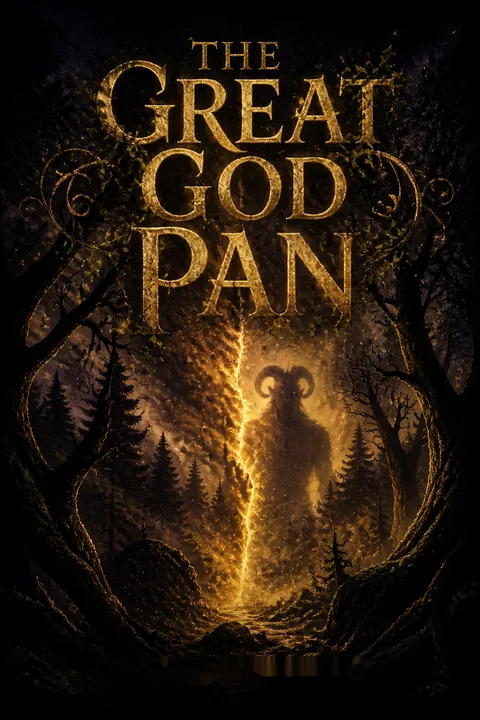


Plot Summary
Raymond Opens the Veil
On a Welsh hillside, Dr Raymond3 asks his cautious friend Clarke1 to witness an experiment meant to open a passage between the material world and an unseen one. His subject is Mary,5 a young woman he rescued and raised, who trusts him enough to accept the operation. Raymond3 uses a drug to render her unconscious, then makes a small incision in her brain while Clarke1 watches, sickened by his calm.
When Mary5 wakes, wonder gives way to terror; she convulses and collapses. Three days later Raymond3 shows Clarke1 that she has lost her reason and lies awake in vacant confusion. Raymond3 calls the experiment a success because she saw what he sought, but the ruined life beside him5 makes Clarke1 understand the price of his ambition.
Raymond treats the brain as a door whose opening can be controlled by technical skill, but the experiment exposes the gap between access and comprehension. Mary’s consent is real in the narrow sense that she agrees to trust him, yet her dependence on the man who raised her makes that consent ethically compromised. Clarke’s presence supplies a witness, not a safeguard: his horror cannot interrupt the procedure or undo its result. The scene makes scientific authority feel dangerous precisely because Raymond is not confused about what he intends. He is confident about the method and blind to the human consequences.
The Forest Takes Rachel
Years later, Clarke1 copies a Welsh village story told by his friend Dr Phillips.11 Helen Vaughan,4 an orphan sent to live on a farm, spends long days alone in the nearby wood. A labourer’s young son, Trevor,9 sees her there with a strange naked man and runs home screaming.
Months later, a Roman stone head resembling a faun triggers another fit; Trevor’s9 mind never recovers. As Helen4 grows older, Rachel,8 a farmer’s daughter, becomes her close companion and joins her forest walks.
Rachel8 returns from one outing distraught, asking her mother why she had been allowed to go. Later, while walking in a meadow, Rachel8 vanishes in broad daylight. Her disappearance remains unexplained, and Clarke’s account leaves the woods holding more than a village can name.
Clarke’s copied testimony turns a private horror into a chain of local evidence: a child’s panic, an ancient carving, a young woman’s unexplained absence. The Roman head matters because it makes the uncanny recur outside the forest, as though the image itself can reopen Trevor’s terror. Helen’s long freedom to roam gives her an agency the village cannot interpret, while Rachel’s family first treats their intimacy as socially advantageous. Their later grief suggests the cost of mistaking proximity for understanding. By placing the story in a document Clarke can close, the narrative shows how record-keeping can preserve fear without making it manageable.
Herbert's Soho Confession
In London, Villiers,2 an inquisitive gentleman who watches the city for unusual encounters, recognizes his former Oxford friend Charles Herbert7 begging in rags. Herbert7 explains that he inherited a country estate, married a striking woman named Helen Vaughan,4 and then lost his fortune and health under her influence.
She disappeared, leaving him unable to describe what he had seen without reviving its terror. Villiers2 later asks Austin,6 a friend versed in London society, about Herbert’s7 old address.
Austin6 recounts a puzzling case from Paul Street: a prosperous stranger was found dead in the area of Herbert’s7 house, with no wounds or poison to explain his death. A doctor privately judged that sheer fright had killed him. The police could prove nothing, but neighbors regarded the Herberts7 with dread.
Herbert’s account turns the earlier village mystery into a London social problem, but his ruined body is the only evidence he can offer. His inability to narrate events clearly makes trauma both persuasive and frustrating: Villiers believes the man’s fear, yet cannot use it as proof. Austin’s account adds the machinery of respectable explanation, including police inquiry and medical examination, only to show its limits. The dead stranger’s unexplained terror connects private experience to public rumor. Villiers’s curiosity is not simply courage; he enjoys treating other people’s misfortune as a puzzle, a habit that will draw him deeper into the danger he observes.
A Face From Raymond's Past
Villiers2 visits the empty Paul Street house and feels a physical dread strongest in one upstairs room. Among old newspapers, he finds a carefully drawn woman’s face. Herbert7 later appears in a newspaper report as having starved in a lodging house, his fortune and standing gone.
When Villiers2 shows the drawing to Clarke,1 the collector of occult testimony recognizes something in its expression from the night of Raymond’s3 experiment. The woman is not Mary,5 he realizes, though the resemblance unsettles him.
A name written on the back identifies her as Helen. Clarke1 nearly faints, then urges Villiers2 to abandon the search. Villiers2 leaves with a sharper question than before: the woman who ruined Herbert4 is tied to the experiment Clarke1 has spent years trying to forget.
The portrait functions less as a likeness than as a transfer of recognition. Clarke can distinguish Helen from Mary, yet the resemblance makes the past feel present again, collapsing the years between Raymond’s laboratory and Herbert’s rented rooms. The image turns an uncertain oral account into a material clue, but it does not explain the relationship it reveals. Clarke’s reaction exposes the cost of his private archive: what he collected to manage his fascination now supplies a route back into it. Villiers, by contrast, treats the same clue as permission to continue. The men share evidence but assign it opposite meanings.
Meyrick's Book of Horrors
Clarke1 sends Villiers2 a letter advising him to burn the portrait and forget Helen,4 but the warning only confirms that he knows more than he will say. While walking with Austin,6 Villiers2 hears of Mrs Beaumont,4 a wealthy new hostess whose guests praise an antique wine she claims is a thousand years old.
Austin6 then shows him a portfolio left by Arthur Meyrick,10 a painter who died after a severe collapse abroad. Its drawings depict pagan figures and scenes of disturbing excess; the final page shows the same woman4 Villiers2 has traced to Herbert.7
Austin6 cannot explain Meyrick’s10 connection to her, but Villiers2 recognizes another chapter in the pattern. The portfolio makes the danger visible without making it intelligible, while Mrs Beaumont’s4 polished social entrance places that image among London’s most comfortable rooms.
Meyrick’s portfolio changes the investigation from a sequence of suspicious deaths into a visual record of a world ordinary language cannot comfortably contain. Its images are evidence, but they remain ambiguous enough to invite both denial and obsession. Mrs Beaumont’s cultured hospitality sharpens that ambiguity: the antique wine and elegant rooms make age and violence part of fashionable display. The contrast is not a simple disguise of evil as beauty. Rather, social polish gives the disturbing material a protected venue and an audience willing to treat strangeness as entertainment. Villiers sees a pattern where Austin sees an unanswerable association, and that interpretive difference keeps the inquiry moving.
The West End Suicides
Lord Argentine,12 a popular host who had dined at Mrs Beaumont’s4 house, is found dead by strangulation after leaving home during the night. Within weeks, three other wealthy men die by similar means, each apparently without a motive; then Sidney Crashaw becomes the fifth.
As London’s papers announce another inexplicable suicide, Villiers2 tells Austin6 that he saw Crashaw at two in the morning, leaving Mrs Beaumont’s4 house. Crashaw’s face seemed consumed by despair and terror, though he was still physically alive.
Villiers2 believes the man had already encountered something that made ordinary life impossible, and expects he died soon afterward. Austin6 recoils from the connection, but Villiers2 decides not to report it publicly. Instead, he intends to gather evidence about the woman4 and the house before acting.
The deaths puncture the assumption that wealth and social standing offer protection from the uncanny. The victims are not described as desperate men, and the familiar legal category of suicide cannot account for their shared, brutal method. Villiers’s sighting of Crashaw supplies a temporal link, not a full explanation: the man leaves Beaumont’s house alive, yet appears inwardly destroyed. That distinction lets the story place horror in perception before it reaches the body. Villiers’s decision to keep quiet reflects both prudence and possessiveness. He believes he has seen something others would dismiss, and he wants to control the investigation rather than submit it to institutions he considers inadequate.
Helen's Names Converge
Villiers2 traces Mrs Beaumont4 through Soho’s hidden networks and learns that she once lived there under the name Mrs Raymond,4 amid accounts of conduct so disturbing that even his informant recoils.
He follows her from a Soho house to the elegant Ashley Street home and confirms that she is the woman4 known to him through Herbert’s7 story and Meyrick’s10 portrait: Helen Vaughan.4 An escaped guest has also left a written account of her private entertainments, though Austin6 cannot bear to read more than a fragment.
Villiers2 receives a letter confirming Meyrick10 knew a Mrs Vaughan,4 then buys a length of hemp cord. He plans to confront Helen4 with Clarke,1 leave her alone with the cord for fifteen minutes, and call the police if she has not killed herself.
The investigation’s method is socially specific: Villiers moves between polished drawing rooms and marginal streets because the same woman can inhabit both without being recognized by the same witnesses. Her aliases expose how reputation is manufactured, but they do not give Villiers access to her motives. The guest’s testimony marks a limit to knowledge: Austin refuses the document, and Villiers accepts its implications without presenting its details. His plan with the cord is a troubling shift from observer to judge. He frames it as a choice bounded by police intervention, yet he has already decided that Helen should die. His pursuit of evidence has become an exercise of power.
The Body Loses Its Shape
Villiers2 and Clarke1 confront Helen4 and leave her locked alone with the cord; when they return, she has hanged herself. Dr Matheson’s13 surviving notes describe the corpse changing before him, its human structure dissolving and passing through forms that move from woman to man to animal and beyond.
Afterward, Villiers2 visits the Welsh village and finds a Roman inscription commemorating a marriage witnessed beneath a sacred shade. Clarke1 asks Raymond3 to explain the resemblance between Helen4 and Mary.5
Raymond3 admits that Mary5 gave birth to Helen4 nine months after the experiment, then died without recovering her reason. He had sent Helen4 away as a child because he recognized the horror attached to her. The experiment opened a passage, but Raymond3 cannot name what came through it.
The final revelation joins the narrative’s two geographic worlds without reducing either to a complete explanation. Raymond’s confession makes Helen the human consequence of his experiment, while Matheson’s account insists that her body cannot be contained by ordinary categories. The Roman inscription offers a material echo of the hidden union, yet it does not decode the event; history preserves a trace, not a verdict. Raymond’s remorse arrives too late to restore Mary or protect the people caught in Helen’s wake. His admission clarifies responsibility without granting mastery. The story ends by making its central horror legible as a consequence and still unknowable as a force.
Analysis
The story makes the pursuit of hidden knowledge inseparable from questions of consent and responsibility. Raymond3 believes that technical understanding entitles him to open Mary’s5 perception, but his procedure leaves her unable to live as before and creates consequences he cannot contain. His scientific vocabulary does not dispel the supernatural; it becomes a form of confidence that masks uncertainty. Villiers2 repeats the same danger on a social scale. He gathers testimony and follows Helen4 across London, but his final plan treats investigation as authority to impose a verdict.
Machen’s fragmented structure gives no observer a complete account. Clarke’s memoirs, Meyrick’s drawings, the newspaper reports, Matheson’s13 notes, and Raymond’s3 letter offer different kinds of evidence, none sufficient alone. The reader reconstructs a causal pattern while remaining unable to name the force at its center. That partial knowledge is not a puzzle left unsolved through carelessness; it is the form the horror takes. Human witnesses can document effects, but documentation does not make the unknown safe.
The contrast between the Welsh forest and London’s drawing rooms also matters. In the village, Roman remains and woodland paths make the past physically present. In the city, clubs, rented houses, and fashionable hospitality place the same threat inside institutions that claim respectability. Helen’s4 movement between these settings unsettles the assumption that danger belongs to remote places or marginal people. The story’s most unsettling consequence is that neither scientific authority, social privilege, nor careful observation provides mastery over what lies beyond ordinary perception.
Review Summary
The Great God Pan received mixed reviews, with many praising its atmospheric horror and influential impact on the genre. Critics noted its fragmented narrative structure, ambiguous descriptions, and Victorian-era sexual anxieties. Some found it confusing or underwhelming, while others considered it a masterpiece of cosmic horror. Readers appreciated Machen's evocative prose and ability to create tension through suggestion rather than explicit descriptions. The novella's themes of hidden pagan forces and the dangers of forbidden knowledge resonated with many, cementing its place as a classic of weird fiction.
People Also Read
Characters
Clarke
The cautious occult archivistClarke is a respectable, methodical man whose private fascination with occult evidence persists despite his public preference for ordinary explanations. He attends Raymond’s3 experiment, then spends years trying to discipline his curiosity by collecting and organizing accounts of the uncanny. His archive gives the story one of its channels of evidence, but it also exposes his vulnerability: he cannot forget what he has witnessed, even when he tries to retreat into routine. Clarke is less an investigator than a reluctant custodian of disturbing knowledge. His caution is sincere, though it cannot erase his attraction to the mysteries he records.
Villiers
The London mystery hunterVilliers is a well-connected gentleman who treats London’s streets as a field of observation. Curious about people and incidents others overlook, he enjoys the search for hidden explanations and is willing to cross social boundaries to obtain them. His practical intelligence helps him connect witnesses, addresses, portraits, and names, but he sometimes mistakes access to evidence for authority over what it means. Villiers is more decisive than Clarke1 and less troubled by the ethical cost of pursuit. His confidence makes him an effective investigator, while his appetite for a mystery steadily draws him beyond the safe role of spectator.
Dr Raymond
The occult experimenterDr Raymond is a physician devoted to the belief that human perception conceals a greater reality. He combines technical confidence with a willingness to treat another person’s mind and body as instruments for discovery. His manner is controlled, even when the consequences of his work become impossible to ignore. Raymond sees himself as a pioneer rather than a reckless man, and that self-image lets him underestimate the difference between opening a door and understanding what may cross it. He represents knowledge pursued without adequate humility, as well as the burden of recognizing too late that an experiment can create consequences no theory can contain.
Helen Vaughan
The elusive central mysteryHelen Vaughan appears first in accounts of a Welsh village and later in London society, where people remember her beauty but struggle to explain the unease she leaves behind. Her ability to move through sharply different social worlds makes her difficult to locate and harder to interpret. Others describe her through their fear, fascination, or moral judgment, so the reader encounters her largely through testimony rather than her own perspective. That distance is central to her presence in the story: Helen is not simply a mysterious woman, but a person onto whom observers project the limits of what they can understand.
Mary
Raymond's trusting wardMary is a young woman raised under Raymond’s3 protection and accustomed to trusting his judgment. Her willingness to participate in his experiment reflects affection and dependence more than informed understanding of its risks. She has little power over the terms on which Raymond3 interprets her experience, making her an important measure of the human cost behind his theories. The story gives her very little independent voice, a silence that underscores how easily a person can become a subject in someone else’s pursuit of knowledge.
Austin
Villiers's society-minded friendAustin knows London’s social circles and hidden districts, and his information helps Villiers2 connect apparently separate events. He is interested in unusual people but retains a stronger instinct for self-preservation than Villiers2. When evidence becomes too disturbing, Austin draws a boundary rather than pretending he can master it. His caution gives the story a counterweight to Villiers’s2 investigative appetite, while his access to club gossip and private testimony keeps the mystery grounded in the city’s everyday networks.
Charles Herbert
Villiers's unsettled old friendHerbert is Villiers’s2 former Oxford companion, once a man of comfortable means and ordinary social prospects. His marriage introduces him to experiences he cannot explain without fear, and his account reaches Villiers2 only after his former life has fallen away. Herbert’s importance lies in the gap between his privileged background and his inability to protect himself from what he encounters. He is a witness whose distress is credible to those who see him, but whose fragmented explanation leaves others to reconstruct the events around him.
Rachel M.
Helen's Welsh companionRachel is the daughter of a prosperous farmer and becomes Helen’s4 closest companion during their village years. Her family initially welcomes the friendship, partly because Helen4 is believed to have money and prospects. Rachel’s warmth and trust make her a contrast to Helen’s4 reserve, while her involvement in the forest story connects private friendship to the village’s larger unease. She is mostly known through what her family and Clarke’s source11 report, which leaves her inner experience only partially visible.
Trevor W.
The frightened village boyTrevor is a labourer’s young son whose childhood experience in the forest links Helen4 to a frightening image from the Roman past. His terror persists after adults try to explain it away, and a later encounter with an ancient stone carving deepens his distress. Trevor’s story matters because it offers an early, involuntary witness to events that the adults cannot verify. His vulnerability also shows how the consequences of the uncanny can fall on someone too young to shape or interpret what he has seen.
Arthur Meyrick
The painter's visual witnessMeyrick is a painter and Austin’s6 friend, remembered as an unusually perceptive talker as well as an artist. His drawings survive him and give Villiers2 a visual record that intersects with the search for Helen4. Meyrick’s work makes him significant even though he is absent from the investigation itself: his images suggest that art can preserve encounters a witness may be unable or unwilling to explain. His story also links the London inquiry to a wider geography beyond Britain.
Dr Phillips
Clarke's village informantDr Phillips is Clarke’s1 friend and the source of the Welsh village account that Clarke1 copies into his private memoirs. He insists that the events are true but withholds identifying details, giving Clarke1 a story that is both compelling and incomplete. Phillips functions as a link between local testimony and the London investigation. His reluctance to disclose more suggests that knowledge can be withheld not from indifference, but from a belief that telling the whole account may itself be harmful.
Lord Argentine
The celebrated hostArgentine is a popular nobleman whose famous dinners make him a fixture of London society. He is remembered as energetic, generous, and unusually capable of enjoying the privileges he acquires. His presence helps establish the reach of the story’s threat into elite social life, where wealth and reputation appear to offer security.
Dr Robert Matheson
The exacting physicianMatheson is a physician who approaches what he sees with professional discipline, checking his own senses before recording his observations. His surviving notes matter because they translate an extreme experience into the language of a careful medical witness. He represents the limits, rather than the failure, of clinical observation: he can describe what happens to a body without explaining the force that alters it.
Dr Harding
Meyrick's Buenos Aires doctorHarding treats Meyrick10 during the painter’s final illness in Buenos Aires. His later letter gives Austin6 a modest but useful piece of corroboration about Meyrick’s10 acquaintances. Harding is a distant witness, included not for personal drama but because his professional account helps Villiers2 test the connections he has assembled.
Plot Devices
The neural operation
The sensory breachRaymond’s3 small brain operation is presented as a technical means of opening perception beyond the ordinary senses. Its apparent precision contrasts with the uncontrolled consequences that follow. The procedure begins the chain connecting Mary5, Helen4, and the later horrors, while also establishing the story’s central conflict between a desire to know and the inability to control what knowledge exposes. The operation is not simply a supernatural mechanism: it is an ethical choice made by a physician who mistakes technical access for wisdom.
Clarke's memoirs and papers
Evidence in fragmentsClarke’s1 private archive gathers accounts that arrive through friends, letters, sketches, and remembered testimony. These documents let the story move between Wales and London without a single investigator witnessing every event. They also create uncertainty: each source has limits, and no account can explain the whole mystery by itself. The fragmented structure mirrors the characters’ own condition. They can preserve evidence, compare impressions, and recognize patterns, but their records never give them complete command of what they have seen.
Helen's portrait and aliases
Recognition across identitiesA portrait found in Paul Street connects Herbert’s7 story to Clarke’s1 memories, while the names Helen Vaughan4, Mrs Herbert, Mrs Raymond3, and Mrs Beaumont4 reveal how the same woman moves through different social settings. The image gives Villiers2 a clue before he has enough context to understand it; the aliases then turn recognition into an investigation. Together, portrait and names make identity a practical problem of witness, reputation, and access. This device contains a central plot revelation.
Meyrick's portfolio
A visual warningThe painter’s10 book preserves a set of disturbing images, including a face Villiers2 recognizes from the portrait. Its drawings foreshadow the story’s final bodily horror without translating that horror into a clear explanation. As an object passed from the dead artist10 to Austin6 and then examined by Villiers2, the portfolio also extends the investigation across time and distance. It functions as evidence, warning, and a reminder that representation may reveal a pattern while leaving its meaning unresolved.
The hemp cord
Villiers's final ultimatumVilliers2 buys the cord as part of his plan to confront Helen4 and force an outcome in a locked room. He tells Austin6 that Helen4 will have a short time alone with it before he calls the police. The cord transforms Villiers2 from investigator into an active participant, making the climax depend on a choice he believes he can control. Its use brings the story’s investigation to a physical end, but not to an explanation of the force that has shaped Helen’s4 life.
FAQ
Synopsis & Basic Details
What is The Great God Pan about?
- A Transgressive Experiment: Dr. Raymond, a visionary scientist, performs a surgical procedure on his ward, Mary, to "lift the veil" between the material and spiritual worlds, hoping she will see the ancient god Pan. The experiment shatters Mary's mind, leaving her an idiot, but also results in the birth of Helen Vaughan, a being of uncanny beauty and profound evil.
- A Trail of Corruption: The story then follows the devastating impact of Helen Vaughan, who appears under various identities (Helen Herbert, Mrs. Beaumont) in rural Wales and later in London society. Her presence is linked to madness, moral decay, and a series of inexplicable suicides among prominent men, as she embodies a primal, destructive force.
- An Investigation into the Unseen: Through fragmented narratives, including the memoirs of Clarke and the investigations of Villiers and Austin, the true nature of Helen and her connection to Raymond's initial experiment are gradually uncovered. The narrative culminates in a confrontation with Helen and a horrifying revelation of her non-human essence, exploring the dangers of forbidden knowledge and the fragility of human reality.
Why should I read The Great God Pan?
- Masterpiece of Cosmic Horror: Readers seeking a foundational work of cosmic horror will find Machen's novella deeply unsettling, as it explores the terror of ancient, amoral forces lurking just beyond human perception, influencing later authors like H.P. Lovecraft.
- Atmospheric and Psychological Depth: The story excels in building an oppressive atmosphere of dread and psychological unease, focusing on the internal disintegration of characters confronted with the unspeakable, rather than overt gore, making it a compelling psychological horror.
- Exploration of Forbidden Knowledge: It offers a profound meditation on the dangers of scientific hubris and the pursuit of knowledge that transgresses natural boundaries, questioning the very fabric of reality and the human capacity to withstand ultimate truth.
What is the background of The Great God Pan?
- Fin-de-Siècle Occult Revival: The novella emerged during the 1890s, a period marked by a resurgence of interest in mysticism and the occult, with groups like the Theosophical Society and the Hermetic Order of the Golden Dawn gaining prominence. Machen himself was briefly a member of the latter, influencing the story's themes of hidden knowledge and spiritual transgression.
- Welsh Border Country Influence: Machen's upbringing in Caerleon, Wales, a region rich in Roman history and Arthurian myth, deeply imprinted his work. The story's setting in the Welsh border country, with its ancient Roman roads and forests, serves as a liminal space where the material and spiritual worlds, and self and other, blur, as noted in the text's introduction.
- Gothic Literary Traditions: "The Great God Pan" draws heavily on gothic literature tropes, such as the mysterious house, the incarcerated woman, and fragmented narratives, while subverting them with a distinctly modern psychological and cosmic horror, pushing the boundaries of the genre.
What are the most memorable quotes in The Great God Pan?
- "Clarke, Mary will see the god Pan!": This chilling declaration by Dr. Raymond in Chapter I encapsulates the story's central premise and the hubris of his experiment, setting the stage for the horrific consequences of lifting the veil to forbidden realities.
- "And the devil was made flesh. And man was made.": This inverted biblical quote, "ET DIABOLUS INCARNATUS EST. ET HOMO FACTUS EST," inscribed by Clarke in his memoirs in Chapter II, powerfully summarizes the monstrous, unholy birth of Helen Vaughan and the corruption of human form by infernal forces.
- "It was a devil's face that I looked upon.": Villiers's horrified description of Crashaw's face in Chapter VI, after seeing him leave Mrs. Beaumont's house, vividly conveys the psychological impact of Helen's influence, suggesting a complete spiritual damnation that transcends mere physical death.
What writing style, narrative choices, and literary techniques does Arthur Machen use?
- Evocative and Lyrical Prose: Machen employs a rich, often poetic prose style, particularly in descriptions of nature and the uncanny, contrasting the beauty of the Welsh landscape with the horror it conceals, as seen in the opening chapter's "sweet breath came from the great wood" juxtaposed with the "awful terror."
- Cumulative Dread through Fragmented Narratives: The story's structure, moving through various eyewitness accounts, letters, and memoirs (like Clarke's "Memoirs to prove the Existence of the Devil"), builds suspense and a sense of overwhelming, inexplicable horror, mirroring the piecemeal discovery of a terrible truth.
- Emphasis on the Unseen and Unspeakable: Machen masterfully uses suggestion and implication rather than explicit description for the most horrific elements, such as Mary's vision or Helen's transformation. This technique forces the reader's imagination to fill the void, making the horror more personal and profound, as when Dr. Matheson struggles to describe "that which was on the bed."
Hidden Details & Subtle Connections
What are some minor details that add significant meaning?
- Clarke's Dream of Dissolution: In Chapter I, under the influence of Raymond's concoction, Clarke experiences a vivid dream where "the sacrament of body and soul was dissolved," foreshadowing the ultimate dissolution of Helen's body and the blurring of human and non-human forms. This early, involuntary vision hints at the cosmic scale of the experiment's implications.
- The "Chinese Boxes" Metaphor: Villiers's thought in Chapter III, "A case like this is like a nest of Chinese boxes; you open one after another and find a quainter workmanship in every box," subtly frames the narrative structure itself. It suggests that each revealed identity or incident of Helen Vaughan is merely an outer layer, hinting at an even more profound and intricate horror at the core of her being.
- The Paul Street House's "Unpleasant Physiognomy": The vagabond's absurd description of No. 20 Paul Street in Chapter III as having "the most unpleasant physiognomy he had ever observed" is a subtle anthropomorphism. It suggests the house itself, as a vessel for Helen's evil, radiates a palpable malevolence, reflecting the corruption within its walls before any explicit horrors are revealed.
What are some subtle foreshadowing and callbacks?
- Raymond's "Land to Let" Nerve Cells: In Chapter I, Dr. Raymond refers to a group of nerve cells in the brain as "land to let, a mere waste place for fanciful theories," which he claims he can activate. This subtly foreshadows Mary's mind becoming a vacant, "waste place" after the experiment, open to the "fanciful theories" of the spiritual world, but with devastating consequences.
- The Faun/Satyr Head as a Recurring Trauma: The Roman-era stone head of a faun or satyr in Chapter II, which triggers Trevor W.'s second, more severe fit, serves as a powerful callback to his initial encounter with Helen and the "strange naked man." This object concretizes the ancient, pagan nature of the horror and its lasting psychological impact, linking the past to present trauma.
- The "Odour of Corruption" Motif: Clarke's dream in Chapter I, induced by Raymond's preparations, includes an "odd odour" that is "not unwholesome" but makes him sleepy. This subtly prefigures Dr. Matheson's later experience in Chapter VIII, where he is overwhelmed by an "odour of corruption" during Helen's final transformation, linking the initial, seemingly benign chemical influence to the ultimate, putrid manifestation of evil.
What are some unexpected character connections?
- The Flâneur as Unwitting Witness: The "gentleman, whose business or pleasure, or both, made him a spectator of the London streets at five o'clock in the morning" (Chapter III) who discovers the body in Paul Street, is an unexpected, almost anonymous, link. This figure, a Baudelairean flâneur, highlights how the mundane, observant life of the city can inadvertently stumble upon profound horror, connecting the casual observer to the central mystery.
- Lord Argentine's Valet's Observation: The valet's brief account in Chapter VI of Lord Argentine "quietly letting himself out at the front door" in a Norfolk coat and knickerbockers, rather than evening wear, provides a crucial, subtle detail. It suggests Argentine's secret, nocturnal pursuit of Mrs. Beaumont, revealing a hidden life that contrasts with his public persona and directly links him to the "contagion of evil" before his suicide.
- The Old Shopkeeper and the Hemp Cord: The unnamed old man in the "dusty shop" in Chapter VII, who sells Villiers the "best hempen cord," is an unexpected, almost symbolic, connection. He represents the mundane world unwittingly supplying the tools for the confrontation with the supernatural, and his lament about diverted traffic ("just before my father died") subtly echoes the ancient, forgotten paths of the Roman road where Helen's horror began.
Who are the most significant supporting characters?
- Dr. Phillips, the Chronicler of Early Horrors: Dr. Phillips serves as a crucial narrative conduit, providing Clarke with the initial, detailed account of Helen Vaughan's childhood in Wales. His testimony, though secondhand, establishes the pattern of her destructive influence and the inexplicable nature of the events, lending credibility to the supernatural elements before the London narrative unfolds.
- Austin, the Rationalist Confronted by the Uncanny: Austin acts as Villiers's skeptical confidant, initially providing a rational counterpoint to the unfolding mysteries. His gradual shift from detached observer to a man "sick at heart" and "white and ghastly" after encountering the evidence of Helen's evil (the manuscript, the rope) highlights the overwhelming power of the horror to break down even the most logical minds.
- Herbert, the Embodiment of Moral Ruin: Charles Herbert, Villiers's old college friend, is more than just a victim; he is a living testament to Helen's corrupting power. His physical and spiritual degradation, described as being "ruined, in body and soul" (Chapter III), serves as a stark, tangible warning of the profound and insidious nature of the evil Helen embodies, making the abstract horror concrete.
Psychological, Emotional, & Relational Analysis
What are some unspoken motivations of the characters?
- Dr. Raymond's God Complex and Control: Beyond scientific curiosity, Raymond's motivation in "The Great God Pan analysis" appears rooted in a profound desire for control and a god-like power over life and perception. His statement, "I rescued Mary from the gutter... I think her life is mine, to use as I see fit" (Chapter I), reveals a chilling disregard for Mary's autonomy, driven by an egoistic quest to transcend human limits, rather than pure scientific advancement.
- Clarke's Morbid Fascination as Self-Punishment: Clarke's "Memoirs to prove the Existence of the Devil" (Chapter II) suggest an unspoken motivation beyond mere curiosity. His initial horror at Mary's fate, followed by a brave but ultimately futile attempt to cling to the commonplace, implies a subconscious need to confront or even punish himself with the very horrors he witnessed, unable to truly escape the trauma.
- Helen Vaughan's Amoral Existence: Helen Vaughan's motivations are largely inscrutable, hinting at an amoral, non-human nature. Her actions—seducing, corrupting, and destroying—are not driven by human malice or desire for power in the conventional sense, but rather by an inherent, instinctual expression of her being, a "contagion of evil" that simply is, rather than wills.
What psychological complexities do the characters exhibit?
- Villiers's Dual Nature of Curiosity and Terror: Villiers embodies the complex psychological struggle between an intellectual fascination with the unknown and a visceral terror when confronted with its reality. His "assiduity which was worthy of more serious employment" (Chapter III) in exploring London's obscure mazes contrasts sharply with his "blood run cold" reaction to Crashaw's face, highlighting the human mind's capacity for both daring inquiry and profound dread.
- The Victims' Descent into Existential Despair: The West End suicides, particularly Crashaw, exhibit a psychological state beyond mere madness. Villiers describes Crashaw's face as an "infernal medley of passions... Furious lust, and hate that was like fire, and the loss of all hope, and horror that seemed to shriek aloud... and the utter blackness of despair" (Chapter VI). This suggests an encounter with an ultimate, soul-destroying truth that renders life meaningless and existence unbearable, leading to self-annihilation.
- Mary's Passive Submission and Innocence Lost: Mary's psychological state before the experiment is characterized by a childlike innocence and "submission strong within her" (Chapter I), making her a tragic figure. Her subsequent vacant grin and idiocy represent not just a loss of reason, but a complete psychological obliteration, a mind utterly overwhelmed and emptied by a vision it was never meant to comprehend, leaving only a shell.
What are the major emotional turning points?
- Mary's Awakening: Awe to Abject Terror: The most immediate emotional turning point is Mary's awakening in Chapter I. Her eyes initially "shone with an awful light, looking far away, and a great wonder fell upon her face," quickly giving way to "the most awful terror" and hideous convulsions. This rapid shift from sublime revelation to utter horror establishes the story's central theme: the unbearable nature of forbidden truth.
- Clarke's Recognition of Helen's Portrait: In Chapter IV, Clarke's fainting spell upon seeing Helen's portrait marks a critical emotional turning point. The image, which he initially believes is Mary but then recognizes as something more, triggers a profound, visceral reaction, connecting his past trauma directly to the present horror and confirming his deepest, most repressed fears about the experiment's legacy.
- Austin's Confrontation with the Manuscript: Austin's refusal to read the manuscript detailing Mrs. Beaumont's "entertainment" in Chapter VII, declaring, "I should never sleep again," signifies his emotional breaking point. As the rationalist, his decision to recoil from explicit knowledge, despite his earlier skepticism, underscores the overwhelming and soul-destroying nature of the evil they are pursuing, marking his transition from observer to traumatized witness.
How do relationship dynamics evolve?
- Raymond and Mary: From Paternalism to Exploitation: The relationship between Dr. Raymond and Mary evolves from a seemingly benevolent, paternalistic guardianship ("I rescued Mary from the gutter... I think her life is mine") to one of profound exploitation and monstrous creation. Raymond's detached scientific ambition utterly overrides any human concern, transforming Mary into a mere instrument for his forbidden experiment, with devastating consequences for her and the world.
- Villiers and Austin: From Skepticism to Shared Horror: The dynamic between Villiers and Austin shifts from a typical friendship where Austin plays the skeptical, rational foil to Villiers's more imaginative nature, to a bond forged in shared, undeniable horror. Austin's initial dismissiveness ("just a little fanciful") gradually erodes as he confronts the tangible evidence of Helen's evil, culminating in his "mute horror" and a shared, unspoken understanding of the unspeakable.
- Helen and Her Victims: Seduction as a Prelude to Destruction: Helen Vaughan's relationships with men like Herbert, Lord Argentine, and Crashaw consistently follow a pattern of seductive allure leading to profound destruction. She draws them in with her "most wonderful and most strange beauty" (Chapter III), only to corrupt them "body and soul," draining their vitality and sanity, revealing her relationships as predatory and parasitic, a manifestation of the "contagion of evil."
Interpretation & Debate
Which parts of the story remain ambiguous or open-ended?
- The True Nature of "Pan": While Dr. Raymond explicitly states Mary will "see the god Pan," the story leaves the exact nature of this entity ambiguous. Is Pan a literal pagan deity, a symbolic representation of primal, amoral cosmic forces, or a psychological manifestation of humanity's repressed, bestial subconscious? This ambiguity is central to
The Great God Pan symbolismand its enduring horror. - The "Marriage Beneath the Shade": The inscription to Nodens, commemorating a "marriage which he saw beneath the shade" (Chapter VIII), remains open to interpretation. It's unclear if this refers to a literal ancient ritual, a symbolic union between humanity and the primordial forces Helen embodies, or a historical precedent for the unholy conception of Helen, leaving the reader to ponder the cyclical nature of such events.
- Helen's Agency and Consciousness: The extent to which Helen Vaughan is a conscious, malevolent entity versus an amoral, instinctual conduit for ancient forces is debatable. Her "motivations" are never fully explained; she seems to act as a force of nature, a "thing without form taking to itself a form" (Chapter VII), raising questions about free will versus inherent, monstrous destiny.
What are some debatable, controversial scenes or moments in The Great God Pan?
- Dr. Raymond's Ethical Justification for the Experiment: Raymond's assertion, "I rescued Mary from the gutter... I think her life is mine, to use as I see fit" (Chapter I), is highly controversial. It raises profound ethical questions about scientific hubris, the exploitation of vulnerable individuals, and the moral boundaries of experimentation, making his actions a central point of
The Great God Pan analysis. - The Graphic Description of Helen's Transformation: Dr. Matheson's account of Helen's body "melt[ing] and dissolve[ing]... from sex to sex, dividing itself from itself... descend[ing] to the beasts... to worse than beast" (Chapter VIII) is intensely graphic and disturbing. Its purpose—whether to shock, to illustrate cosmic horror, or to symbolize a reversal of evolution—can be debated, as can its effectiveness in conveying the unspeakable.
- **Villiers's "Choice"
Download PDF
Download EPUB
.epub digital book format is ideal for reading ebooks on phones, tablets, and e-readers.








