

Key Takeaways
Treat serious fraud as a failure of market trust, not just a stolen sum.
The damage spreads. The book defines a serious fraud not merely by its size, but by its capacity to start a cycle of deception, siphoning, and apparent success. Investors and lenders trust the increasingly impressive figures until the scheme collapses. The 2008 US mortgage crisis shows how the damage can travel: risky loans were presented as sound, repackaged into securities, and sold through institutions that failed to disclose the danger. When borrowers defaulted, the losses spread far beyond the original lenders.
Trust is economic infrastructure. Fraud distorts information, makes investors wary, and pushes regulators and banks toward costly checks. The resulting paperwork and delays can burden honest businesses too. Fraud is therefore not just theft from particular victims; it can weaken the machinery that helps capital reach productive uses.
What's striking is the distinction between a fraud's direct loss and its effect on confidence. Markets depend on shared expectations that reported facts are broadly reliable. Once those expectations break, even sound businesses can face higher financing costs because lenders cannot easily distinguish them from deceptive ones. That is a classic information problem, not simply a failure of individual virtue. The analogy has limits: unlike a contagious disease, fraud does not spread automatically, and different crises have different causes. But it captures how fear can travel farther than the original misconduct.
Watch borrowed money loop back as fake promoter confidence.
The same cash reappears. A project might require promoters to provide 30 percent of its cost, with a bank lending the remaining 70 percent. In a simple fraud, promoters use the loan to buy an overpriced or worthless asset from a connected company, then route much of the payment back into the business as supposed new capital. A lender may read this as evidence that the promoters are investing more of their own money.
Rotation magnifies the illusion. The book calls repeated circulation of funds circular transactions or round-tripping. It describes an illustrative scheme that starts with ₹30 lakh and repeatedly recycles funds to qualify for larger loans. Its startling projection of roughly ₹36,000 crore after ten rounds is a demonstration of the arithmetic, not a realistic or guaranteed outcome. In the Bhushan Steel case, investigators alleged that a network of 155 companies helped divert and recycle funds.
This is a particularly useful way to read a balance sheet: ask whether apparent new capital has an independent source, or whether it is yesterday's borrowing wearing a fresh label. The underlying problem resembles a weakness in measurement systems. If each company verifies only its own entry, the same money can appear to support several businesses at once. The book's numerical illustration clarifies the mechanism, but its rapid growth depends on banks repeatedly accepting the recycled funds as genuine equity. The key safeguard is tracing the complete path of cash, not simply checking whether entries balance.
When lenders hide defaults, one balance sheet can freeze an economy.
A delayed loss grows. The book describes alleged practices at IL&FS in which fresh loans to companies connected to a struggling borrower were used to repay earlier loans. These so-called evergreen loans made overdue debt appear current without improving the borrower's ability to repay. Investigators alleged that such repeated refinancing concealed stressed loans and enlarged eventual losses. IL&FS ultimately defaulted on obligations reported at about ₹91,000 crore, despite top group companies retaining AAA ratings as late as August 2018.
Funding links transmit shocks. The book connects the default to short-term borrowing by non-bank lenders, which financed long-term loans to infrastructure and property businesses. After the crisis, mutual funds curtailed funding and lenders pulled money back. Industry leader T.V. Mohandas Pai estimated that non-bank lenders withdrew ₹3 lakh crore over the following year, worsening a liquidity squeeze for borrowers and consumers.
The episode illustrates how accounting choices and funding structure can reinforce each other. Concealing a bad loan preserves a firm's access to new credit, while short-term lenders can withdraw quickly when confidence falters. This is a maturity mismatch: money that can leave soon supports projects that need years to produce returns. The account also shows why a high credit rating is not a substitute for scrutiny of the evidence behind it. Still, attributing a national slowdown to one default is difficult; the book's causal chain is informative, but the wider economy has multiple influences.
A rising share price can become collateral for its own fraud.
Price feeds borrowing. Haridas Mundhra raised the prices of shares in companies he controlled through circular trading, then used those inflated shares as collateral for loans. The loan money helped him buy more shares and support the price again. Decades later, Ketan Parekh used a similar loop with a group of favoured stocks, trading through fronts to make prices and activity look stronger than they were. Harshad Mehta's manipulation of ACC shares, from about ₹200 to ₹9,000 in three months, shows how a dramatic rise can draw in investors who mistake momentum for value.
Information can be rigged too. Insiders can trade or tip others using unpublished price-sensitive information, which gives them an advantage over ordinary investors. In both price manipulation and insider trading, the harm reaches beyond the person on the other side of one transaction: market prices stop serving as trustworthy signals.
The feedback loop matters because prices do more than record opinions. They influence collateral values, investment decisions, and the confidence of other lenders. When a price is manipulated, the false signal can recruit new participants into the scheme without any direct contact between them and the fraudster. This resembles a coordination problem: each investor interprets other people's buying as evidence, even when the apparent crowd is manufactured. The comparison also suggests why disclosure rules matter. Yet no regulator can treat every fast rise as fraud; genuine companies can grow quickly, so evidence must distinguish manipulation from changing fundamentals.
Follow the goods and invoices, not just the bank guarantee.
Trade can disguise borrowing. In the alleged Punjab National Bank fraud involving Nirav Modi's businesses, Letters of Undertaking enabled overseas banks to finance imports. The book argues that the deeper scheme was trade-based money laundering: related or controlled companies allegedly moved diamonds across borders at manipulated prices, used new financing to repay earlier loans, and siphoned off the balance. Diamonds are especially useful for such schemes because their value can be difficult to establish precisely. The bank guarantee explains why a lender advanced money; it does not prove that the trade was genuine.
Origin can be disguised too. The book recounts Indian stainless steel producers' allegations that Chinese goods were routed through Indonesia with limited processing to claim trade agreement benefits. It also describes fake export claims that sought GST refunds on inflated or fictitious transactions. Across these cases, paperwork can look complete while the underlying movement or value of goods is misleading.
Cross-border trade is difficult to supervise because no single participant sees the full route. Customs officials inspect documents and shipments, banks assess credit exposure, and exporters and importers operate under different legal systems. This fragmentation creates opportunities for transactions that are individually plausible but collectively incoherent. A useful investigative question is whether the goods' route, price, and commercial purpose make sense together. Trade protections also require care: low prices can benefit consumers, and not every rerouting is fraudulent. The challenge is to distinguish efficient commerce from sham processing or deliberate mispricing.
Treat audited profits as claims to verify, especially when cash is missing.
Numbers can become theatre. Satyam founder Ramalinga Raju admitted that the company had fabricated financial results over several years. His letter identified a fictitious bank balance of ₹5,040 crore and an overall balance-sheet gap of ₹7,136 crore. Investigators found that the company had created fake customers, invoices, and thousands of false salary accounts to support revenue that did not exist. Auditors had accepted bank documents that were not genuine. A later attempt to merge Satyam with the promoter family's real-estate businesses intensified suspicion rather than restoring confidence.
Timing can manufacture growth. The book also describes alleged premature revenue recognition and circular service transactions at Ricoh India. Its lesson is not that every estimate or intangible asset is suspect. Rather, reported profit should be tested against cash receipts, customers, delivery evidence, and related-party dealings. A polished audit opinion is only as reliable as the work supporting it.
The Satyam case exposes a central limit of auditing: verification can fail when auditors rely on evidence supplied by the very management they are supposed to examine. Independent confirmation from banks and customers is therefore more than procedural tidiness; it breaks the circular logic of self-reported records. The book also recognizes that modern businesses can hold valuable intellectual property that conventional accounts measure poorly. That makes skepticism essential, but skepticism alone cannot establish fraud. Weakly measured value and deliberate fabrication are different problems, and good analysis must resist treating them as interchangeable.
If recruitment pays more than product value, the pyramid is already showing.
Growth outruns arithmetic. In a pyramid scheme, participants pay to join and are promised earnings for recruiting more people. If each person must recruit six others, the chain expands geometrically: after a small number of rounds, the required recruits exceed the world's population. The promise cannot be fulfilled for everyone. Early participants may receive money from later recruits, but most people near the base lose their fees when recruitment slows.
A product does not settle the question. The book distinguishes a legitimate referral business, where commissions arise from genuine product sales, from a scheme whose main engine is recruitment. Frontier Trading sold Japan Life mattresses at prices far above their reported value while using recruitment to drive the business. In the Qnet case, authorities questioned whether commissions greatly exceeded the value of goods sold. High commissions are a warning sign, though the business model and actual sales matter more than labels.
The mathematical argument is powerful because it makes a vague promise testable: where does each participant's return come from, and can ordinary product demand sustain it? The distinction between recruitment and retail sales is also a better diagnostic than simply asking whether a company has a product. However, a high commission rate alone does not prove a pyramid scheme. New businesses may use aggressive sales incentives, and legitimate referral marketing can spread rapidly. The decisive evidence concerns the source of payouts, the real value delivered to end customers, and whether earnings depend primarily on enrolling new participants.
Trace beneficial ownership across shells before trusting a clean corporate surface.
A company can be a mask. Shell companies may have little or no active business, yet their bank accounts and legal identities can make money appear to pass through independent firms. Repeated transfers obscure where funds began and who ultimately controls them. The book describes shipping entrepreneur Jayanti Dharma Teja acquiring a fleet through successive borrowing against ships, while also allegedly diverting money through secret commissions. After scrutiny began, he fled abroad and relied on assets and connections outside India.
Secrecy completes the route. Tax havens can offer low taxes, strong confidentiality, and legal structures that separate control from formal ownership. Trusts, foundations, and chains of companies can make it difficult for creditors or investigators to identify the person who benefits. These structures can have legitimate uses, including estate planning and business activity. Their risk arises when secrecy and layered control conceal the source of funds or the person directing transactions.
The important investigative shift is from asking which company holds an asset to asking who can use it, direct it, or benefit from it. Formal ownership and practical control can diverge, especially across multiple jurisdictions. This is a problem of network visibility: one institution sees one account or company, while the relevant story exists in the connections among them. At the same time, secrecy is not itself proof of criminality. Privacy, liability separation, and estate planning are legitimate interests. Effective oversight therefore needs access to beneficial ownership information and evidence of misconduct, rather than blanket suspicion of offshore structures.
Build faster, joined-up detection without burying honest trade in paperwork.
Rules chase innovation. The book describes a regulatory cycle: new technologies or financial products appear, fraudsters exploit gaps before rules catch up, and regulators respond after abuse is exposed. By then, another innovation may have opened a new gap. Data analytics can flag unusual transactions, while investigators can test whether the pattern has a plausible business explanation. Neither tool is sufficient alone: algorithms may miss activity routed through shell companies, while manual checks can be slow and costly.
Prevention needs coordination. Banks need to monitor loans throughout their life, protect risk officers' independence, and verify key information rather than relying on impressive presentations. Regulators, tax authorities, customs, and law enforcement agencies can share intelligence and coordinate investigations. For schemes aimed at ordinary savers, the book also stresses public education. Faster action matters, but controls that make every legitimate loan or shipment prohibitively difficult can damage the market they are meant to protect.
The strongest policy insight is a design constraint: detection must improve without making ordinary economic activity so expensive that only large firms can manage it. Data tools can reduce the cost of screening, but unusual patterns are not synonymous with criminal conduct. Human review supplies context, while shared information can reveal links invisible to any single agency. The book's emphasis on coordination is therefore more than bureaucratic housekeeping. Its harder question is accountability: when several agencies share a case, clear responsibility is needed so that collaboration does not become another reason for delay.
Analysis
The book's unifying claim is that serious fraud is less a collection of ingenious tricks than a recurring struggle over who can see and verify economic reality. The methods are often elementary: circulate the same money, inflate an asset, disguise a related party, misstate a shipment, or use later investors to satisfy earlier claims. What changes is the institutional environment around them. Complex finance, cross-border structures, and rapid technology allow simple deception to persist at a larger scale and for longer.
Three mechanisms recur across the cases. First, a false signal attracts fresh resources: a rising share price, apparent promoter investment, audited profit, or an impressive repayment record. Second, connected transactions recycle those resources, allowing borrowed or newly collected money to mimic productive capital. Third, intermediaries and legal structures obscure the relationship between the apparent transaction and its beneficiary. Gatekeepers matter because they can interrupt any of these stages, but they may face conflicts, weak information, or incentives to preserve a valued client.
The book is particularly strong when it explains mechanics through specific cases, from Mundhra's share-backed borrowing to Satyam's fabricated cash and the alleged diamond trade loop behind PNB losses. Its caution about pending allegations is important: an investigative account is not a court verdict. The broad systemic argument also needs calibrated use. A major default can aggravate a liquidity shock, but its precise effect on national growth is difficult to isolate from other economic conditions.
The practical conclusion is not maximal surveillance. It is better visibility at critical junctions: verify cash independently, test whether trade makes commercial sense, identify who controls related entities, and connect information across institutions. Controls must be proportionate, because excessive friction can punish honest borrowers and traders. The book ultimately presents fraud prevention as a continuing contest between economic ingenuity and institutional learning, with public trust as the stake.
Review Summary
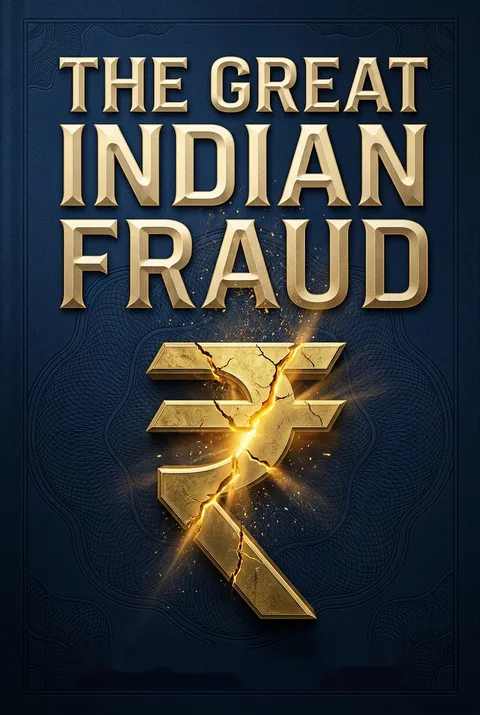
The Great Indian Fraud receives high praise for its comprehensive exploration of financial frauds in India. Readers commend the author's ability to explain complex schemes in simple terms, covering various types of fraud with real-world examples. The book is lauded for its insightful analysis of fraud mechanisms, historical context, and impact on the economy. Many reviewers appreciate the author's storytelling skills and the book's educational value. Some criticisms include the exclusion of certain politically sensitive scams and the use of simplistic graphics. Overall, readers find it informative, eye-opening, and highly relevant.
Glossary
Circular transactions
Recycled funds shown as newA sequence in which money moves through connected or cooperating entities and returns to its starting point or a related business. Each transfer can be recorded as a separate investment, sale, or advance, making the same underlying funds appear larger or more economically active than they are. The book also refers to this practice as round-tripping and, in Hindi, pudia ghumao.
Evergreen loans
Fresh loans masking old defaultsA practice in which a lender or related financing structure provides new borrowing that a distressed borrower uses to repay an earlier loan. The old facility may then appear settled even though the borrower's ability to repay has not improved. Repeating the process can delay recognition of non-performing loans and increase the eventual exposure and losses.
UPSI
Unpublished price-sensitive informationInformation about a company that is not public and could materially affect the price of its securities if disclosed. Company insiders or others who receive such information may have an unfair advantage when trading or tipping another person. Indian securities rules restrict trading on UPSI to protect equal access to information and the integrity of market prices.
Trade misinvoicing
False import or export pricingDeliberately declaring an import or export at a value different from a defensible market price. Under-invoicing can conceal value or reduce duties, while over-invoicing can support capital movement, inflated financing, or other forms of deception. Products whose value is difficult to assess, such as diamonds, can be especially useful in schemes involving repeated cross-border transactions.
Origin fraud
Misstating a product's countryMisrepresenting where goods were made or sufficiently processed so they can receive trade benefits or avoid duties imposed on their true country of origin. Common methods include routing goods through another country or carrying out limited assembly there. Investigations are difficult because the relevant production and records may span several sovereign jurisdictions.
Equity-to-profit model
Investor capital disguised as earningsA proposed fraud cycle in which a company attracts investment by reporting strong profits, sells equity at a higher valuation, and routes the new capital through related entities so that it returns as apparent revenue or profit. The improved reported results can attract further investors. The model depends on disguising capital flows as genuine sales or business income.
Unregulated Collective Investment Schemes
Public money pooled outside oversightSchemes that collect money from multiple people and promise returns or other benefits without operating within the regulatory framework that applies to authorised investments. The book uses the term for arrangements such as many Ponzi operations, which may conceal how funds are used and pay earlier participants with money from newer ones.
Shell company
Entity with little operating activityA company that has little or no substantial business activity but may hold accounts, receive transfers, issue invoices, or appear in a chain of transactions. Shell companies can serve legitimate purposes, but fraudsters may use them to disguise control, route funds, create false business activity, or obscure the original source and final beneficiary of money.
Regulatory cycle
Innovation, abuse, and rulemakingThe sequence described in the book in which a new technology or financial practice appears before rules adequately address its risks. Fraudsters exploit the gap, regulators discover the abuse and introduce controls, and another innovation creates a fresh gap. The cycle becomes dangerous when detection and rulemaking take much longer than the underlying innovation.
Whole-of-government approach (WGA)
Coordinated public enforcementA model for tackling financial crime through cooperation among agencies with different responsibilities, including tax and customs administrations, financial intelligence units, regulators, investigators, and prosecutors. Sharing information and coordinating action can expose links that no single agency can see. The book notes that this approach is promoted internationally but is not fully institutionalised in many countries.
Download PDF
Download EPUB
.epub digital book format is ideal for reading ebooks on phones, tablets, and e-readers.








