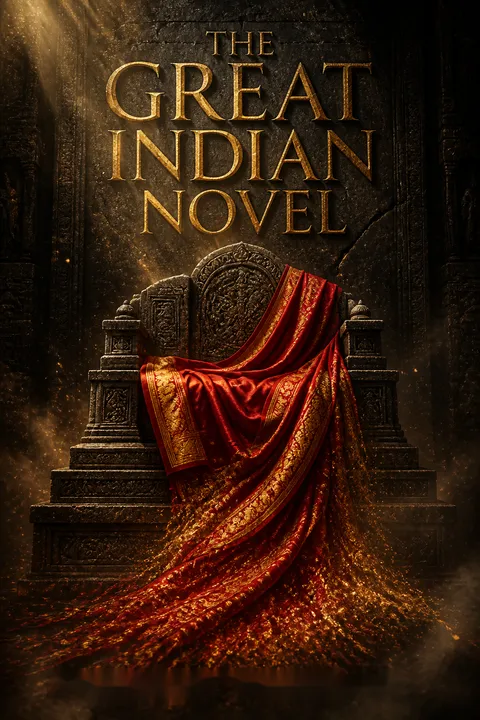


Plot Summary
Vyas Dictates His India
At eighty-eight, Ved Vyas has lost his place in politics but not his appetite for argument. When advisers dismiss his memories as the complaints of an obsolete man, he recruits Ganapathi to take down the story of India as he has lived it. The tale begins with Vyas himself: Satyavati, a fisherwoman, bears him after a travelling sage fathers him, then returns to her village while the infant is raised elsewhere.
Years later, King Shantanu desires Satyavati, but her father will consent only if her sons inherit the throne. Shantanu’s heir, Ganga Datta, gives up his succession and swears never to marry or father children. Vyas’s family history is already a political bargain with lasting consequences.
The dictation frame makes memory an active political choice, not a neutral record. Vyas is both witness and participant, and his need to recover a public audience signals that the story will examine how history is shaped by who gets to tell it. His family begins in secrecy, unequal power, and negotiated legitimacy, anticipating a national history built from compromised inheritances. The bargain around Satyavati’s marriage also establishes a recurring tension: private sacrifices are repeatedly presented as necessary for public stability, though the people asked to make them rarely control what follows.
The Vow That Costs
Ganga Datta’s renunciation clears the way for Satyavati’s sons to inherit Hastinapur, and the court renames him Bhishma for the severity of his promise. As regent, he abducts three princesses for his half-brother Vichitravirya; when Amba reveals she loves Raja Salva, Ganga sends her back, but Salva rejects her as dishonoured.
Ganga refuses to marry her himself, leaving Amba to pursue revenge. Vichitravirya dies without heirs, so Satyavati summons Vyas to father children with the widowed queens. Ambika’s fear produces blind Dhritarashtra, Ambalika’s produces pale Pandu, and a maidservant bears Vidur, the most capable of the three. Ganga raises the boys, binding the dynasty to his own lifelong authority.
Ganga’s vow is praised as selflessness, yet it also removes his descendants from succession and creates a dynastic problem that later demands other people’s bodies. His abduction of Amba’s party treats marriage as administration; her refusal to accept the damage as an impersonal cost exposes the violence hidden inside royal custom. Vyas’s secret paternity further unsettles the distinction between lawful inheritance and biological truth. The resulting heirs carry physical and political consequences of choices made by elders, while Ganga’s benevolent guardianship cannot erase that those choices were made for them.
Princes Made by Others
Dhritarashtra marries Gandhari, who blinds herself to share her husband’s world, but their only child is daughter Priya Duryodhani, not the many sons they expected. Pandu marries Kunti and Madri, then suffers a heart attack that makes sex dangerous. He asks Kunti to secure heirs through other men; she discloses a first son, Karna, born before marriage and set adrift as an infant.
Pandu refuses to recognize him, and Kunti bears Yudhishtir, Bhim, and Arjun through chosen fathers. Madri bears twins Nakul and Sahadev. Meanwhile, the teacher Jayaprakash Drona trains the princes and his son Ashwathaman. When self-taught Ekalavya matches Arjun, Drona demands his writing hand’s thumb as payment, making exclusion part of the education.
The princes inherit identities assembled through secrecy, bodily sacrifice, and unequal access to recognition. Pandu treats reproduction as dynastic engineering, while Kunti’s earlier motherhood becomes a shame she is compelled to disclose on his terms. Gandhari’s self-blinding turns marital loyalty into a literal restriction on perception, a gesture that foreshadows the family’s difficulty seeing its own injuries. Drona’s demand of Ekalavya’s thumb sharpens the same structure: talent alone does not guarantee entry when institutions protect those already selected. The family’s future conflicts are seeded not by fate alone, but by decisions about whose claims count.
Gangaji Finds the Peasants
After leaving the regency, Gangaji pursues self-rule and equality through disciplined, nonviolent action. A peasant named Rajkumar walks more than a hundred miles to ask him to investigate Motihari, where colonial rules force tenants to grow indigo for planters at prices fixed by the buyers.
Gangaji visits the villages, records testimony, and openly refuses a police order to leave. At his trial he accepts responsibility rather than evade punishment, leaving the magistrate unable to proceed normally.
The administration eventually drops the case, assists his inquiry, compensates tenants, and abolishes the planting requirement. Later, Gangaji backs jute workers demanding a fair wage increase. When hunger weakens their strike, he fasts until the owners agree to a settlement, though the final increase falls short of the workers’ original demand.
Gangaji’s method depends on turning the law’s authority back upon itself. By accepting arrest, he makes the state display the coercion that ordinary procedure conceals, while peasant testimony transforms private suffering into public evidence. The jute strike reveals a more troubling edge: his fast strengthens collective resolve, but his insistence that workers endure hunger can make moral leadership resemble control. The results are real, yet limited, and the compromise demonstrates that moral force does not eliminate bargaining power. Gangaji’s influence grows because he offers the oppressed a public role, even as his ideals demand costly discipline from them.
Bullets at Bibigarh
When the British annex Hastinapur, the population pours into the Bibigarh Gardens to hear Gangaji denounce the seizure. Sir Richard, unwilling to permit the rally, sends Colonel Rudyard and troops to the walled park.
The soldiers fire without warning into the packed, unarmed crowd, killing hundreds and injuring many more as people struggle through narrow exits. Gangaji arrives afterward, sickened by the bodies and the wounded. The administration retires Rudyard, but imperial supporters reward him with a large collection, making the massacre’s defence as damning as the shooting itself.
Gangaji’s followers turn from cautious reform toward a determined freedom struggle. The violence also hardens the divide between his nonviolent movement and those, including Pandu, who question whether restraint can defeat the Raj.
The massacre converts colonial rule from an abstraction into a visible relationship of force. Rudyard’s disciplined firing is more revealing than a moment of rage because it shows violence operating as routine administration. The reward he receives teaches Indians that official disapproval does not necessarily mean moral accountability. Gangaji’s response is not simply grief: he interprets the event as proof that resistance must deny the Raj its preferred advantage in arms. Yet the episode also intensifies disagreement over strategy. The same deaths that deepen commitment to nonviolence make others doubt that nonviolence can protect the people it asks to endure attack.
Mangoes Divide the Movement
The British tax even the mango, requiring villages to register trees and pay according to their expected crop. Gangaji first petitions the Viceroy, then leads a long march to an unregistered grove and plucks a mango before reporters.
The act sparks nationwide civil disobedience and fills prisons, but violence at Chaurasta, where a mob kills two Indian policemen, prompts him to suspend the campaign. Pandu condemns the unilateral decision and challenges Dhritarashtra for leadership of the Kaurava Party, winning the presidency before Gangaji’s pressure forces him to resign.
Meanwhile, Mohammed Ali Karna, a brilliant constitutional lawyer, leaves the Kauravas and takes control of the Muslim Group, arguing that Muslims need political safeguards against Hindu-majority rule. Two nationalist movements now compete over what independence should mean.
The mango campaign shows Gangaji’s gift for making an ordinary object carry national meaning, but its success also exposes the fragility of a mass movement built on strict moral discipline. The violence at Chaurasta forces him to choose principle over momentum, and Pandu experiences that choice as an undemocratic personal command. Karna’s departure adds a second rupture: a demand for minority security grows into a separate political constituency. These conflicts are not reducible to good and bad leaders. They reveal competing fears about representation, authority, and the risk that unity may preserve injustice rather than resolve it.
Pandu Takes Another Road
Pandu’s challenge to Gangaji and Dhritarashtra fails, and he leaves the Kaurava Party convinced that civil disobedience cannot win freedom quickly enough. During the Second World War he forms the Onward Organization, escapes British detention in disguise, and travels through Afghanistan to Germany, hoping to enlist Axis help against Britain.
Hitler offers broadcasts rather than an army. Pandu then reaches Singapore, where he recruits Indian prisoners of war into a force intended to fight for independence alongside Japan.
When the campaign turns against the Japanese, his troops falter against Indian soldiers serving Britain. Pandu’s heart condition, already worsened by his forbidden desire for Madri, proves fatal during their retreat by plane. His death leaves Kunti and five sons behind, while Dhritarashtra becomes the dominant surviving leader.
Pandu’s trajectory is a study in the seduction of efficacy. Frustrated by the slow moral pressure of Gangaji’s politics, he turns to military alliances without controlling their aims or capacity to honour Indian independence. His recruits’ reluctance to fight compatriots reveals the human limit of political strategy. The personal and political strands meet in Pandu’s fatal return to sexual desire, a consequence of the heart condition he had long feared. His failed route does not make his frustration groundless; it shows how a legitimate impatience with injustice can lead a movement into dependence on powers whose interests are not its own.
Freedom's Bed of Arrows
The war leaves Britain too weakened to hold India, but Karna insists that independence must include a separate Muslim state. The hurried Partition draws borders through communities and sends millions fleeing amid mass killing.
Gangaji travels among the violence, unable to restore the fellowship he once inspired. On the night independence begins, Amba returns under the name Shikhandin, having transformed herself to become the kind of person capable of killing Ganga Datta.
She accuses him of a barren life and shoots him; he dies in the arms of Sarah Moore, his longtime ally. India celebrates political freedom while the country is being torn apart. Kunti’s hidden first son, Karna, now leads the new state, and his own origins remain unknown to the public.
Independence arrives as both achievement and indictment. The transfer of power ends foreign rule, but the rushed division turns political categories into danger for ordinary families. Gangaji’s inability to stop the violence exposes the limits of moral authority when communities no longer trust one another. Shikhandin’s revenge completes a personal consequence seeded by Ganga’s earlier refusal to repair the harm he caused Amba. His death is therefore not only a national loss but a judgment on the certainty with which he once treated vows. The title’s image of the arrow-bed joins the epic past to a country whose new freedom rests on wounds.
The Border at Manimir
As Prime Minister, Dhritarashtra faces the unresolved future of Manimir, a Muslim-majority kingdom whose Maharaja refuses to join either new country. When Karnistani-backed tribesmen invade, Vidur flies to the capital and pressures the Maharaja to sign accession to India before Indian troops intervene.
The army pushes back the invasion, but Dhritarashtra calls for a United Nations ceasefire before the campaign is complete, leaving the territory divided and the dispute alive. The military defeat by neighbouring Chakra later shakes his confidence and contributes to his withdrawal from public life.
Meanwhile, Drona tutors the Pandavas and Ekalavya, then leads the princes into rural reform. When threats emerge against the young men, Vidur secretly guides them away from danger, setting the family on a long passage through India.
Manimir condenses the dilemmas of the new state: secular belonging, territorial security, and the costs of international restraint. Vidur’s practical urgency secures the accession, while Dhritarashtra’s appeal to international judgment preserves lives at the price of an unresolved frontier. Neither decision is simply foolish or pure. The later military humiliation undermines the prime minister’s self-image, showing how moral conviction can be damaged by strategic failure. Drona’s rural work offers a countermodel to high politics, but the threat against the Pandavas shows that even local reform becomes dangerous when it challenges established power.
Fire Beneath the House
While Drona organizes land reform, Priya Duryodhani arranges a covert attack on the Pandavas. Their host, Purochan, moves them into a house coated with highly flammable lac, planning to burn them inside. Vidur intercepts Purochan’s coded message and sends the brothers a deliberately cryptic warning.
Arjun identifies the resin’s smell, and the family digs a tunnel before the blaze begins. With help from Vidur’s agent, they escape underground while Purochan and his associates die in the fire; the public believes the Pandavas are dead.
They travel anonymously through villages, intervening when landlords, corrupt officials, or temple authorities abuse the poor. Their victories rarely last, but some villagers change, and the brothers learn a country their royal upbringing had kept at a distance.
The lac house turns political rivalry into a literal trap: the family’s apparent shelter is designed to consume them. Survival depends on knowledge shared across generations, from Vidur’s bureaucratic access to Arjun’s attention to material detail. The escape preserves the Pandavas but also erases their public identities, allowing them to experience poverty and injustice without the protection of rank. Their village interventions are deliberately modest; they cannot permanently reform every place they visit. The uneven outcomes resist the fantasy of heroic rescue and suggest that durable change depends on what communities continue after the rescuers leave.
Five Weddings, One Bride
At a Kaurava youth camp, the Pandavas meet Draupadi Mokrasi, the gifted young woman adopted by a low-caste household after her birth to Dhritarashtra and Lady Drewpad. She chooses Arjun, but on the journey home Kunti unknowingly tells her sons to share whatever they have brought back.
Bound by an old promise to obey her, the brothers ask Vyas to resolve the crisis. He invokes religious precedent and Draupadi’s many prayers, and she marries all five, one ceremony each night.
Arjun’s exile for entering a brother’s private time leads him south, where he meets Krishna, a charismatic local politician, and marries Krishna’s sister Subhadra. Draupadi and Subhadra begin in mutual discomfort but become close, while Bhim’s first wife leaves with their son.
Draupadi’s marriage begins with her own choice and then becomes subject to a family rule she did not create. Kunti’s careless instruction activates the brothers’ oath, transforming a domestic misunderstanding into a lasting arrangement. Vyas’s solution treats tradition as a resource that can be interpreted, not merely obeyed, but it also places Draupadi inside a structure of male kinship. Arjun’s attraction to Krishna’s unforced political wisdom gives the story a counterpoint to Delhi’s ambition. The bond between Draupadi and Subhadra suggests that women can build solidarity inside arrangements that were not designed around their freedom.
The Daughter Takes Delhi
After Dhritarashtra’s death and the short, uncertain government of Shishu Pal, party elders choose Priya Duryodhani as Prime Minister, assuming her gender and inexperience will keep her manageable. She instead uses her father’s legacy to consolidate power, marginalizes the Old Guard, and attracts Ashwathaman with promises of a more radical programme.
A dispute over bank nationalization and the presidency splits the Kaurava Party. Duryodhani backs Ekalavya against the official candidate, then calls for a conscience vote; Ekalavya wins narrowly, and the party expels her.
She answers by creating a rival organization and wins a sweeping election under a promise to remove poverty. After a court ruling threatens her position, she declares an internal state of Emergency, jails opponents, censors the press, and authorizes coercive sterilization.
Duryodhani’s ascent grows from a misreading of her as a symbol rather than an agent. The party elders appoint her to decorate power, and she learns to use that underestimate as leverage. Her appeal to poverty gives voters a language of hope, but the Emergency reveals how easily representation can become a claim of ownership over the represented. She presents institutional control as public purpose while weakening the checks that could test that claim. The novel’s political satire is sharpest here because the authoritarian turn is neither sudden nor foreign: it emerges through familiar party procedures, electoral legitimacy, and leaders who believe they alone understand the people.
Ballots Against the Siege
Jayaprakash Drona leaves retirement to lead a mass protest against corruption, police abuse, shortages, and Duryodhani’s broken promises. Opposition parties join him, and Yudhishtir becomes a prominent challenger. The government arrests leaders and suspends liberties, but the restrictions increasingly harm ordinary people through forced evictions and sterilization drives.
Vyas initially tolerates the Emergency, reasoning that order might help the poor; Arjun’s doubts and reports from the country force him to recognize the damage. Krishna and Arjun join the democratic opposition.
At the height of her control, Duryodhani unexpectedly lifts the Emergency and calls an election, apparently trusting flattering intelligence reports and underestimating public anger. Voters turn out in force and defeat her. Drona and Yudhishtir’s coalition forms a government, restoring open political competition.
The Emergency tests whether public consent can be inferred from silence. Duryodhani mistakes the absence of protest for approval, while Vyas initially makes a similar error by treating visible administrative order as evidence of social benefit. Arjun’s reporting becomes ethically consequential when he refuses to let abstractions conceal forced displacement and bodily coercion. The election restores a formal mechanism for accountability, but the victory does not settle the deeper question of whether democratic institutions can represent people who have been excluded from everyday power. The crowd’s return to politics is moving precisely because it is contingent, not a guaranteed triumph of virtue.
The Messiah's Last Lie
The victorious coalition quickly fractures over office, policy, and caste politics. When Drona lies gravely ill, Yudhishtir fears that his son Ashwathaman will persuade the Front to abandon him. He sends Sahadev to tell Drona that Ashwathaman has died.
Yudhishtir then repeats the statement, technically referring to a cockroach he has killed, and secures the dying teacher’s support. Drona dies soon afterward, and the Prime Minister presents his final words as an appeal for unity.
Vyas recognizes that literal accuracy has been used to produce a fatal falsehood and breaks with his grandson. The coalition collapses, elections return Duryodhani to power, and the case against her is dropped. The people have removed a ruler, but the replacement fails to hold.
Yudhishtir’s deception is the novel’s most concentrated examination of the gap between truth’s letter and its ethical purpose. He preserves his self-conception as honest by exploiting ambiguity, yet the consequence is Drona’s death and the manipulation of a movement built in Drona’s name. Vyas’s refusal to excuse him marks a break between family loyalty and moral judgment. The coalition’s collapse then makes electoral victory feel provisional rather than redemptive. Democracy can remove a leader, but without durable agreement and accountable institutions, it cannot guarantee that the forces defeated at the polls will stay defeated.
The Story Starts Again
As Vyas considers what his account has omitted, he dreams of India as a ruined Hastinapur and watches familiar figures attempt an impossible climb toward a mountain. Krishna cannot move beyond the foothills; Draupadi and the Pandava brothers fall one by one, each exposed by a different failure of action, judgment, or care.
Yudhishtir reaches the summit but refuses to abandon a dog that has accompanied him. In the dream, the dog becomes Dharma, yet Yudhishtir questions whether righteousness alone has helped his family or country.
Vyas wakes to an India still muddling through its contradictions. Convinced that his own telling has been shaped by a mistaken perspective, he tells Ganapathi that he must begin the memoir again, returning the narrative to its opening claim.
The final dream refuses the comfort of a clean moral accounting. Each character’s strengths carry a corresponding failure, and even Yudhishtir’s fidelity to principle cannot establish that principle as an adequate guide to political life. The dog episode offers an image of ethical consistency, then subjects it to the harder question of consequence. Vyas’s decision to restart does not erase his testimony; it reveals that narration itself remains unfinished and interested. The circular ending makes India neither a solved allegory nor a fixed inheritance. It is a continuing argument over which truths deserve authority and how any account can be revised.
Analysis
The Great Indian Novel treats national history as a family argument that can never be cleanly separated from inheritance. Thrones, political parties, and newly independent states all pass through arrangements made by parents, guardians, and leaders who claim to act for a greater good. Their intentions matter, but consequences often fall on people with less power: Amba, Kunti, Ekalavya, Draupadi, peasants, workers, and refugees. The epic framework makes these repetitions visible without turning them into destiny. Vyas’s characters resemble mythic figures, yet they remain accountable for choices that the old stories might excuse as fate or dharma.
The book’s central political question is not simply whether idealism or pragmatism is superior. Gangaji’s nonviolence can move an empire, but it cannot prevent every act of communal violence. Dhritarashtra’s conscience restrains military action, but can leave a conflict unresolved. Duryodhani invokes popular welfare while dismantling the checks that make popular consent meaningful. Yudhishtir prizes truth and law, yet uses verbal technicality to deceive a dying mentor. Each virtue becomes dangerous when treated as sufficient in itself. The novel therefore distrusts moral purity and cynical efficiency alike, asking instead whether leaders remain answerable to those who bear the cost of their decisions.
Its form carries the same skepticism. Vyas is a participant who claims authority, then repeatedly admits that he omits, misremembers, and dreams. The frame does not invalidate his account; it makes interpretation part of the reader’s work. The circular ending refuses the national comfort of a final victory or a settled moral. India continues, but continuation is not proof of justice. The book’s lasting challenge is to keep inherited values open to scrutiny: tradition can supply ethical resources, but only people willing to question its use can prevent it from becoming another instrument of power.
Review Summary
The Great Indian Novel by Shashi Tharoor is a satirical retelling of the Mahabharata set against the backdrop of Indian independence and post-colonial politics. Readers praise Tharoor's wit, clever parallels, and insightful commentary on Indian history and culture. However, some find the narrative uneven, with a stronger first half. Critics note occasional crassness and forced comparisons. The book's appreciation requires familiarity with both the Mahabharata and Indian political history. Overall, it's considered an ambitious and mostly successful literary experiment.
Characters
Ved Vyas
The restless national chroniclerAn elderly politician, historian, and father to several dynastic heirs, Vyas dictates his memoir to Ganapathi after his public career has dwindled. His wit and appetite for digression conceal a serious anxiety about what the next generation remembers and what it prefers to forget. He knows the machinery of government from inside, yet often treats himself as an observer when events demand intervention. His shifting judgments make him an imperfect guide, but also a revealing one: he exposes how love, shame, ideology, and hindsight distort the record. He is driven less by a wish to defend his reputation than by the need to keep India’s conflicting histories in circulation.
Ganapathi
The demanding amanuensisThe patient but exacting scribe assigned to record Vyas’s memoir. His presence gives the narrator someone to address, correct, and occasionally provoke, while his steady transcription turns oral memory into a public document. He is not simply a silent instrument: Vyas’s imagined reactions and questions shape the pace and emphasis of the account. Ganapathi represents the next generation of readers, whose skepticism tests whether the old man’s stories can still make sense.
Satyavati
The matriarch of successionA fisherwoman whose beauty and ambition carry her into Hastinapur’s royal household. Satyavati understands that marriage is not only private affection but a route to security and dynastic power. She presses for her sons’ succession and later seeks a solution when the family line is threatened. Her practical intelligence helps preserve the dynasty, though the arrangements she accepts place lasting burdens on others. She is a mother whose influence operates through decisions made behind the palace curtain.
Ganga Datta, called Gangaji
The ascetic freedom leaderThe former heir to Hastinapur renounces marriage and succession, then becomes a political and spiritual force against British rule. Gangaji combines severe self-discipline with a talent for public theatre, turning everyday acts, clothing, fasting, and lawbreaking into instruments of protest. He believes truth must be pursued through means that do not reproduce the opponent’s violence. His moral certainty inspires followers, but his tendency to decide what others should sacrifice creates friction with those closest to him. He is both a reformer and a difficult guardian, a figure whose ideals cannot be separated from the costs they impose.
Amba
The wronged princessA royal woman whose intended marriage is disrupted when Gangaji takes her from a suitor’s court. Her attempts to recover her place are thwarted by men protecting their pride and vows. Amba is neither a passive victim nor an easy emblem of grievance; she is persistent, intelligent, and unwilling to accept that the damage to her life is merely a regrettable side effect of dynastic arrangements. Her story exposes the human consequences of treating women’s futures as pieces on a succession board.
Dhritarashtra
The blind political visionaryThe blind eldest son of the royal line, educated in England and drawn to socialist ideas, Dhritarashtra becomes a gifted public leader. His blindness shapes his sense of the visible world, but does not prevent him from imagining a more equal political order. He depends on Gangaji’s endorsement and on Vidur’s administrative skill, while his own decisions reveal the limits of principle when combined with personal authority. He is a complex mixture of idealism, ambition, and paternal attachment, capable of seeing national possibilities while missing the consequences of choices made close to home.
Pandu
The impatient patriotDhritarashtra’s younger brother, Pandu is physically courageous and politically practical, but often impatient with compromise. A heart condition disrupts his married life and redirects him toward ascetic discipline and public action. He becomes an organizer who works among ordinary people, in contrast to Dhritarashtra’s command of speeches and party strategy. Pandu’s pride in direct action makes him wary of leaders who ask others to wait. He represents a recurring political temptation: when ethical resistance seems too slow, force and foreign alliances can appear to offer a cleaner route to freedom.
Vidur
The indispensable civil servantThe youngest of Vyas’s three royal sons, born to a maidservant and therefore excluded from the throne despite his intelligence. Vidur turns his abilities toward administration, mastering the systems through which princely India and the new state are governed. He is cautious without being indifferent, and his loyalty shifts between family, public duty, and the people endangered by political schemes. His skill lies in noticing how forms, files, and coded messages can determine outcomes. He often acts quietly, but his interventions change the fate of those around him.
Gandhari
The self-blinding queenDhritarashtra’s wife, Gandhari binds her eyes to share her husband’s blindness, turning marital solidarity into a lifelong bodily choice. She expects a large family and is disappointed by the limits of her motherhood, while her husband’s public life leaves her increasingly isolated. Gandhari’s devotion is intense but not necessarily reciprocated in the form she needs. Her story raises a difficult question about sacrifice: whether a gesture made in love remains meaningful when the person for whom it is made does not truly share its cost.
Priya Duryodhani
The formidable royal daughterThe only child of Dhritarashtra and Gandhari, Priya grows up perceptive, isolated, and acutely alert to the emotional debts of her household. Her relationship with her parents shapes her guardedness and her determination to avoid dependence. She understands how public symbols can be converted into political authority, and she is skilled at reading the ambitions of allies. Duryodhani’s intelligence is joined to a deep fear of vulnerability, which makes control feel safer than trust. She is a woman navigating a political culture that underestimates her, then responding to that underestimation on her own terms.
Kunti
The guarded motherPandu’s wife and the mother who raises his sons, Kunti carries a secret from her youth into a marriage governed by dynastic need. She is resourceful, elegant, and capable of setting limits, even when the people she loves expect her compliance. Her maternal devotion is real, but it cannot protect her from loneliness or prevent her sons from leaving home. Kunti’s life links private desire with public inheritance: her decisions shape the next generation, while the consequences of those decisions remain difficult to discuss openly.
Mohammed Ali Karna
The constitutional rivalA brilliant Bombay lawyer of uncertain origins, Karna is polished, disciplined, and intensely protective of his autonomy. He distrusts mass politics and prefers constitutional argument, yet his political career takes shape amid disputes about religious identity and representation. He is secular in personal habits but increasingly attentive to the political vulnerability of Muslims under a Hindu-majority movement. Karna’s ambition is inseparable from a demand for recognition: he wants not merely to advise established leaders but to command a constituency himself. His composure gives way to a private unease that his public brilliance cannot wholly conceal.
Jayaprakash Drona
The teacher of resistanceA wandering Brahmin teacher who turns personal humiliation under British rule into a commitment to train a new generation. Drona combines scholarship with practical skills, teaching the Pandavas and his son Ashwathaman both intellectual disciplines and methods of resistance. His concern for the poor is genuine, and he is willing to enter public life when injustice demands it, but he distrusts the compromises that power requires. Drona offers moral authority without an instinct for governing, making him an inspiring guide whose students must decide how to translate his ideals into institutions.
Ekalavya
The excluded prodigyA gifted student from a low-caste household who teaches himself by listening outside Drona’s lessons. Ekalavya’s ability unsettles the hierarchy of formal instruction, where access and social position can matter more than merit. He is intelligent, proud, and alert to the bargains hidden inside institutions. His later political presence carries the memory of being denied full recognition, making him a pointed figure in debates about representation and advancement.
Yudhishtir
The scrupulous eldest brotherThe eldest of Pandu’s sons, Yudhishtir is educated, serious, and committed to truth, law, and duty. He expects others to respect the same standards and can mistake personal certainty for moral clarity. His integrity makes him a trusted leader, but his attachment to rules sometimes blinds him to the unequal conditions under which people must obey them. He is most compelling when his principles are tested by political necessity, because he must confront the difference between being technically correct and acting justly.
Bhim
The protective strongmanPandu’s immensely strong son, Bhim is physically imposing, warm-hearted, and quick to defend those he loves. He is less reflective than his brothers, but his courage and plain sense of fairness make him a reliable presence in danger. Bhim often solves immediate problems through force, which can protect the vulnerable while also narrowing the range of possible responses. His loyalty to family is unquestioned, though the story repeatedly tests whether guarding a group is the same as recognizing the needs of each person within it.
Arjun
The searching public voiceThe most balanced of the Pandavas in skill and temperament, Arjun becomes a journalist whose work takes him through the varied crises of India. He is perceptive, physically capable, and drawn to people whose wisdom differs from his own. Yet he hesitates when political action demands a choice between flawed alternatives. His relationships with Draupadi, Subhadra, and Krishna expose different dimensions of his emotional and intellectual life. Arjun’s central struggle is not ignorance but irresolution: he sees complexity clearly, then must decide whether seeing is enough.
Draupadi Mokrasi
The many-husbanded democracyAdopted into a low-caste household, Draupadi grows into a striking and socially open woman whose beauty draws public attention without making her aloof. She chooses Arjun, then becomes bound to all five Pandava brothers through a family promise and an interpretation of religious precedent. Her life reflects the tension between personal agency and collective claims, while her warmth allows her to form bonds across a crowded household. The novel also uses her as a figure for India itself, making the treatment of her body and choices a measure of the nation’s regard for dignity.
Krishna
The joyful local strategistA popular politician in southern India, Krishna combines mischief, insight, and a gift for speaking to people in their own idiom. He is deeply rooted in local life and resists the assumption that national office is the only meaningful form of service. Arjun is drawn to his ability to act without losing his ease, and later seeks his counsel in moments of doubt. Krishna’s distance from central power is both a source of independent judgment and a limitation: advice can illuminate a crisis without necessarily taking responsibility for resolving it.
Ashwathaman
The restless reformerDrona’s son and a political heir to his father’s concern for equality, Ashwathaman is energetic, articulate, and impatient with gradual reform. He moves among parties and causes in search of a platform that can turn idealism into policy. His disagreements with more cautious leaders reveal how easily socialist conviction can be used by ambitious politicians, even when the conviction itself is sincere. He carries both the promise and the instability of a movement that wants rapid change.
Nakul and Sahadev
The diplomatic twinsThe youngest Pandava brothers share a close bond but differ in temperament. Nakul is quick-tongued and socially agile, while Sahadev is quieter and more reflective. Their twinship makes them easy to treat as a pair, yet each responds differently when asked to judge, act, or remain silent. They enter public service in roles that test their ability to balance institutional loyalty with personal conviction.
Madri
Pandu's second wifeThe princess of Shalya and Pandu’s second wife, Madri is affectionate, imaginative, and determined to secure a place for herself within a household already shaped by Kunti. Her wish for children reflects both personal longing and the political pressures placed on royal women. She is often treated as comic relief, but her choices reveal how humour can coexist with vulnerability and how a woman’s ambitions are constrained by the expectations of a dynasty.
Subhadra
Krishna's independent sisterKrishna’s sister, Subhadra is a modern young woman whom her brother refuses to treat as a marriage arrangement. Her relationship with Arjun begins in an unconventional courtship and develops into a household bond with Draupadi. Subhadra’s independence is not presented as a simple rejection of family; she chooses connection while retaining a strong sense of self. Her eventual friendship with Draupadi complicates the rivalry others might expect between them.
Sarah Moore
Gangaji's English allyAn Englishwoman who supports Indian workers and becomes Gangaji’s close companion in public campaigns. Sarah’s solidarity unsettles colonial categories because she uses her social position to challenge the interests of her own class. She understands the moral logic of sacrifice more readily than many of Gangaji’s Indian followers, though she is not merely a witness to his politics. Her practical loyalty gives his movement shelter, advocacy, and a human bond outside his immediate family.
Plot Devices
The Mahabharata parallel
Maps epic onto modern IndiaThe novel recasts the Mahabharata’s family, rivalries, vows, and moral tests as a satirical history of modern India. Characters and events echo epic counterparts, but the correspondences are deliberately unstable: contemporary politicians retain personal motives, historical choices alter the inherited patterns, and Vyas repeatedly questions whether myth clarifies reality or simply makes it easier to accept. The device allows private family disputes to illuminate public questions about succession, partition, authority, and justice, while preventing the reader from treating either the epic or modern history as a straightforward moral fable.
Vyas's dictation frame
Makes memory visibly selectiveThe elderly Ved Vyas tells his national history to Ganapathi, a demanding amanuensis. Their arrangement gives the narrative an audible audience and makes its interruptions, jokes, corrections, and uncertainties part of the story. Vyas acknowledges that he chooses what to remember and sometimes admits that dreams, rumour, and received accounts blur together. The frame therefore asks readers to judge not only the events but the narrator’s need to shape them. Its circular return to the opening suggests that no single memoir can finish the work of interpreting a nation.
Truth-force and fasting
Turns vulnerability into leverageGangaji’s satyagraha makes disciplined suffering a political instrument. He disobeys unjust laws openly, accepts arrest, and fasts to intensify the resolve of supporters rather than threaten opponents directly. The method succeeds in Motihari and helps workers at Budge Budge, but the narrative refuses to treat it as universally effective or morally uncomplicated. Gangaji can ask others to endure severe hardship, and later movements cannot always maintain his discipline. The device tests the difference between nonviolent conviction and passive submission, while showing how a tactic can be powerful, limited, and vulnerable to imitation.
Coded messages and false shelter
Makes survival depend on readingVidur’s intercepted cables and deliberately indirect warning give the Pandavas a chance to recognize that their new home is a death trap. Arjun notices the smell of lac, a resin that has been spread over the house to make it burn quickly, and the family digs an escape tunnel before the fire is set. The episode turns literacy, observation, and bureaucratic access into practical forms of protection. The apparent home conceals danger, while a message that seems absurd becomes legible through trust and careful interpretation.
Dreams as political revision
Tests history through epic visionsVyas’s dreams translate political events into mythic scenes, including the final ascent toward a mountain and the testing of Yudhishtir’s righteousness. These visions do not provide a stable supernatural explanation. Instead, they expose the narrator’s doubts about the adequacy of inherited virtues, the failures of leaders, and the unresolved suffering hidden by triumphant accounts. The dreams let the novel stage arguments that ordinary political language cannot settle, but Vyas remains unsure whether they are insight, fear, or memory rearranged. They deepen rather than close the book’s interpretive questions.
FAQ
Synopsis & Basic Details
What is The Great Indian Novel about?
- Epic Reimagined Allegory: The Great Indian Novel is a satirical and profound retelling of the ancient Indian epic, the Mahabharata, transposed onto the canvas of twentieth-century Indian history, from the British Raj to post-Independence. Narrated by the aged, cynical, yet deeply insightful Ved Vyas, it chronicles the birth and struggles of modern India through the allegorical lives of characters who mirror historical figures and mythological archetypes.
- Myth as Modern Allegory: The novel explores the enduring relevance of India's mythic past in shaping its contemporary political and social landscape. It blends historical events, political satire, and philosophical musings, suggesting that the cycles of ambition, betrayal, duty (dharma), and power dynamics from the Mahabharata are perpetually replayed in the nation's journey.
- Quest for Identity: At its core, the book is a sprawling narrative about India's quest for self-rule and identity, examining the compromises, conflicts, and moral ambiguities inherent in nation-building. It delves into themes of leadership, non-violence, partition, and democracy, all filtered through the unique, often unreliable, perspective of its chronicler, Ved Vyas.
Why should I read The Great Indian Novel?
- Intellectual Satire, Parody, and Intertextuality & Wit: Readers should engage with The Great Indian Novel for its unparalleled intellectual wit and sharp satire, which lampoons both the grandiosity of ancient myths and the absurdities of modern politics. Shashi Tharoor's narrative voice, embodied by Ved Vyas, is consistently entertaining, offering a fresh, irreverent, and often hilarious perspective on serious historical events.
- Deep Cultural Insight: The novel provides a rich, layered exploration of Indian culture, philosophy, and political thought, making complex historical and mythological concepts accessible and engaging. It challenges conventional narratives, inviting readers to question the "truths" of history and the nature of leadership, making it a compelling read for anyone interested in India's soul.
- Timeless Relevance: Despite being set in the 20th century, the themes of power, morality, betrayal, and the struggle for justice remain profoundly relevant today. The book offers a unique lens through which to understand the cyclical nature of human and national endeavors, ensuring its insights resonate long after the final page.
What is the background of The Great Indian Novel?
- Mahabharata as Blueprint: The novel's foundational background is the ancient Sanskrit epic, the Mahabharata, which "has not only influenced the literature, art, sculpture and painting of India but it has also moulded the very character of the Indian people" (About the Title). Tharoor explicitly states his title is a direct reference: "Maha means great and Bharata means India."
- Post-Colonial Critique: Set against the backdrop of 20th-century Indian history, the book offers a critical examination of British colonial rule, the Indian independence movement, and the challenges of post-Partition nation-building. It satirizes figures and events from this period, such as Gandhi's non-violence (Ganga Datta), Nehru's idealism (Dhritarashtra), Jinnah's separatism (Karna), and Indira Gandhi's Emergency (Priya Duryodhani's Siege).
- Author's Unique Perspective: Shashi Tharoor's own background as a diplomat, writer, and later politician, deeply informs the narrative. His academic training (PhD at 22) and extensive experience with the United Nations (Under-Secretary-General for Communications and Public Information) lend an authoritative yet detached voice to Ved Vyas, allowing for a blend of scholarly insight and political cynicism.
What are the most memorable quotes in The Great Indian Novel?
- "India is not an underdeveloped country but a highly developed one in an advanced state of decay." (Chapter 1): This opening declaration by Ved Vyas immediately sets the novel's cynical yet profound tone, challenging conventional Western perceptions of India and hinting at the deep historical layers the narrative will explore. It encapsulates the idea of a glorious past overshadowed by a complex, decaying present.
- "Fasting is my business." (Chapter 25): Uttered by Ganga Datta (Gandhi) during the Budge Budge jute workers' strike, this seemingly simple phrase encapsulates the complex, often paradoxical, nature of his non-violent resistance. Ved Vyas notes its multiple interpretations, highlighting how Ganga's personal sacrifice became a powerful, yet sometimes manipulative, political tool.
- "At the hour of darkness, as the world slumbers, India awakes to the dawn of freedom." (Chapter 69): Dhritarashtra's (Nehru's) iconic speech at Midnight, marking India's independence, is a direct echo of Nehru's "Tryst with Destiny." The novel immediately juxtaposes this triumphant vision with Ganga Datta's despair, who "saw only the long dark night of honor that was breaking his nation in two," underscoring the bitter irony and tragic cost of Partition.
What writing style, narrative choices, and literary techniques does Shashi Tharoor use?
- Unreliable Narration and Self-Reflexivity: Tharoor employs a highly self-aware, metafictional narrative, with Ved Vyas constantly addressing his amanuensis Ganapathi and the reader directly. This choice foregrounds the act of storytelling itself, allowing Vyas to comment on the construction of history, the unreliability of memory, and the subjective nature of truth, as seen when he questions, "Is it permissible to modify truth with a possessive pronoun?" (Chapter 46).
- Satire, Parody, and Intertextuality: The novel is a masterclass in satirical allusion, drawing heavily from the Mahabharata while simultaneously parodying and critiquing 20th-century Indian history and politics. Tharoor weaves in countless literary and historical references, from Shakespeare to Kipling, often with a humorous or ironic twist, such as the accidental killing of "Professor Kipling" (Chapter 21) instead of Colonel Rudyard.
- Linguistic Playfulness & Shifting Tones: Tharoor's prose is characterized by its remarkable linguistic dexterity, incorporating puns, wordplay, and a blend of formal, archaic, and colloquial English. The tone shifts seamlessly from high philosophical discourse to low farce, from poignant tragedy to biting cynicism, often within the same paragraph, reflecting the multifaceted and contradictory nature of India itself.
Hidden Details & Subtle Connections
What are some minor details that add significant meaning?
- V.V.'s Physical Scars: Ved Vyas's casual mention of a "livid scar from a recent political encounter with the lathi-wielders of the Raj" (Chapter 7) is a subtle detail that reveals his active participation in the independence struggle, not just as a chronicler but as a direct participant. This personalizes his narrative authority and hints at the physical costs of resistance, often overlooked in grand historical accounts.
- Environmental Symbolism in Hastinapur: The description of Hastinapur palace in Chapter 7, with its "cool marble, the sweeping stairways, the large halls, the furniture that seemed to have been bought to become antique," contrasts sharply with the "dusty courtyard" and "tell-tale uniforms of the numerous liveried attendants." This subtly highlights the superficial grandeur of princely states under the Raj, masking underlying decay and the exploitation of labor, foreshadowing its eventual annexation.
- British Officials' Linguistic Blunders: Sir Richard's confusion between "bhisti" (water-carrier) and "lota" (water pot), and his mispronunciation of "banned crow" for "bandh karo" (close it) in Chapter 8, are minor comedic details that underscore the British colonialists' profound ignorance and cultural insensitivity. This seemingly trivial detail reveals the deep chasm of misunderstanding that underpinned the Raj's rule.
What are some subtle foreshadowing and callbacks?
- Pandu's Strike on Kipling: Pandu's impulsive act of striking "Professor Kipling" for calling Indians "dogs" in Chapter 9 subtly foreshadows the later, accidental assassination of Kipling by two young men seeking revenge for the Bibigarh Massacre in Chapter 21. This callback suggests a karmic retribution for colonial arrogance, implying that even seemingly minor slights can have far-reaching, unexpected consequences in the cyclical nature of history.
- Priya Duryodhani's Childhood Ruthlessness: Priya Duryodhani's calculated attempt to poison Bhim at her twelfth birthday picnic in Chapter 43, and her subsequent attempt to drown him, is a chilling foreshadowing of her later political ruthlessness and willingness to eliminate rivals. The detail that the "poison" was actually an antidote, neutralized by a snakebite, adds a layer of ironic fate, suggesting her schemes, though brutal, are sometimes thwarted by unforeseen circumstances.
- Ganga Datta's "Bed of Arrows" Dream: Ved Vyas's nightmare of Ganga Datta dying on a "bed of a hundred arrows" (Chapter 69), with his lifeblood mingling with his assassin's, is a powerful callback to Bhishma's deathbed in the Mahabharata. This symbolic imagery foreshadows the complex, multi-layered nature of Ganga's death, suggesting it was not merely an act of individual violence but a culmination of national suffering and internal contradictions.
What are some unexpected character connections?
- Jayaprakash Drona and Heaslop's Shared Humiliation: The unexpected connection between Jayaprakash Drona and Ronald Heaslop, the British equerry, is revealed in Chapter 45. Heaslop's past humiliation of Drona, flinging coins at him and dismissing his knowledge, becomes a pivotal moment that fuels Drona's anti-colonial resolve. This personal slight later culminates in Drona, as a minister in independent India, offering Heaslop a job in his department (Chapter 71), a subtle act of grace that transcends simple revenge.
- Kunti and Karna's Secret Mother-Son Bond: The most significant hidden connection is the revelation that Mohammed Ali Karna is Kunti's illegitimate son, born from her youthful liaison with Hyperion Helios (Chapter 10, 37). This secret parentage, concealed for years, explains Karna's "golden skin" and his deep-seated sense of being an outsider, driving his ambition and his eventual demand for a separate nation. Kunti's later, silent mourning for him (Chapter 81) underscores the tragic weight of this unacknowledged bond.
- Draupadi's Mixed Parentage: The revelation that Draupadi Mokrasi is the biological daughter of Dhritarashtra and Georgina Drewpad (Chapter 72) is a surprising twist. This mixed parentage, symbolizing the complex legacy of the Raj and its intertwining with Indian leadership, explains her unique position as the "personification of Indian democracy," born from both colonial and nationalist roots.
Who are the most significant supporting characters?
- Sarah-behn (Sarah Moore): As Ganga Datta's "Scottish sister" and loyal disciple, Sarah-behn (Chapter 23-26) is crucial in humanizing Ganga and bridging the cultural divide. Her intuitive understanding of his fasts and her unwavering support, despite her British origins, highlight the universal appeal of his moral principles and the possibility of cross-cultural solidarity in the nationalist movement.
- Shakuni Shankar Dey: "Priya Duryodhani's Kanika" (Chapter 109), Shakuni is the Machiavellian advisor who orchestrates the "dice game" (the Emergency) and counsels Priya Duryodhani on consolidating power. His "oily and slick" demeanor and "gleaming bald pate" symbolize the corrupting influence of power and the cynical manipulation of democratic processes, making him a pivotal antagonist in the narrative's later stages.
- Kanika Menon: Dhritarashtra's High Commissioner in London and later Defence Minister (Chapter 79, 85), Kanika is a sharp-witted, acerbic intellectual who embodies the pragmatic, often cynical, side of Indian diplomacy and politics. His "hawk-like features" and "scabrous character-assassination" (Chapter 89) provide a stark contrast to Dhritarashtra's idealism, offering a realistic counterpoint to the moral dilemmas faced by the leadership.
Psychological, Emotional, & Relational Analysis
What are some unspoken motivations of the characters?
- Gandhari's Self-Imposed Blindness: Beyond duty to her blind husband, Gandhari's decision to blindfold herself (Chapter 14) is an unspoken act of profound, almost masochistic, solidarity and a rejection of a world she perceives as inherently flawed. It reflects a deep-seated desire for purity and a refusal to acknowledge realities that contradict her ideals, ultimately leading to her isolation and "sad betrayal" (Chapter 42).
- Priya Duryodhani's Quest for Control: Her childhood experiences, particularly her mother Gandhari's "sad betrayal" and her father Dhritarashtra's emotional distance (Chapter 42), instill in Priya Duryodhani an unspoken, desperate need for control. Her ruthlessness and centralization of power are driven by a deep-seated fear of vulnerability and abandonment, a determination "not to let that happen to me" (Chapter 101).
- Karna's Drive for a Separate State: Karna's relentless pursuit of Karnistan (Pakistan) is not solely political but deeply personal, stemming from his unspoken trauma of illegitimacy and abandonment. His "golden skin glowing like the sun" (Chapter 36) and his "un-Indian reticence about his origins" mask a profound need for a place where he belongs and can rule unchallenged, a "Hacked-off Land" (Chapter 60) that mirrors his own fragmented identity.
What psychological complexities do the characters exhibit?
- Ganga Datta's Moral Ambiguity: Ganga Datta, the saintly figure, exhibits the psychological complexity of a leader whose moral authority borders on manipulation. His fasts, while acts of self-sacrifice, are also a form of "insidious blackmail" (Chapter 27), forcing others to concede. This reveals a tension between his pursuit of "Truth" and the practical, sometimes coercive, application of his principles, making him both revered and feared.
- Dhritarashtra's Blindness to Reality: Despite his intellectual brilliance and "visionary" speeches, Dhritarashtra's psychological complexity lies in his profound inability to see the practical consequences of his idealism. His physical blindness becomes a metaphor for his political naiveté, leading him to make decisions like appealing to the UN over Manimir (Chapter 76
About the Author

Download PDF
Download EPUB
.epub digital book format is ideal for reading ebooks on phones, tablets, and e-readers.








