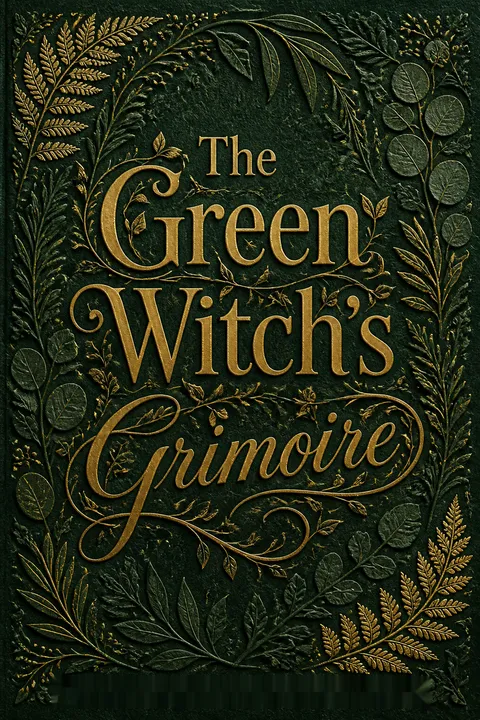


Key Takeaways
Make a grimoire that records your practice, not somebody else's.
A working record. A grimoire is a personal collection of reference material, practical records, and reflection, not simply a spellbook to copy from. Its contents might include plant information, seasonal notes, rituals, recipes, dreams, and the practitioner’s changing values. The book’s central argument is that this record should grow from the green witch’s own relationship with nature and spiritual practice.
Personal, not inherited. Historical European grimoires often gathered formal magical instructions, and some were encoded or altered as they were copied. They can offer inspiration, but they were made for other people and purposes. A modern grimoire is allowed to be several books, a binder, a digital archive, or any combination that serves its keeper.
The idea is less about mystique than authorship: a record becomes useful when it captures what a person actually notices and does. That resembles a field journal, where observations accumulate into knowledge specific to a place and observer. It also resists treating inherited instructions as universal recipes. One useful distinction is between personal meaning and factual reliability. A ritual can be personally powerful without proving a claim about the external world, and a good grimoire can preserve both the experience and the uncertainty.
Choose a format you can change before beauty becomes a barrier.
Design for use. A bound book feels cohesive, but fixed sections can fill unevenly. A binder makes pages movable, while a modular notebook lets separate inserts be replaced as needed. Digital records can be searched and edited, but depend on functioning software, reliable backups, and privacy protections. A small pocket version can hold quick notes until they are added to a larger collection.
Start modestly. The author recommends thinking about both beauty and usefulness, while avoiding an expensive, elaborate setup before testing the system. A workbook can be spilled on, revised, or restarted. Number pages, maintain an index, and label separate volumes so a growing collection remains findable. A digital archive should be password protected and backed up regularly.
This is a practical answer to a familiar design trap: people often optimize a tool for how it looks before discovering how they will use it. In information design, flexible systems tend to survive changing needs better than rigid taxonomies. An index is especially important because storage without retrieval is little better than a pile of notes. Digital search helps, but physical browsing can prompt unexpected associations. A hybrid system can preserve both strengths, provided the user knows which version is authoritative and keeps backups.
Record workings like experiments, then revisit the evidence.
Build a usable record. The grimoire has three linked functions: reference, record, and reflection. For a spell or ritual, note the goal, materials, words or actions, date, place, relevant conditions, and what actually happened. Leave room for immediate impressions and later follow-up. The author’s sample spell record describes a healing intention for a dog with mastitis, notes the symbolic action, then records that the dog had surgery and recovered. The record documents sequence and reflection, not proof that the spell caused recovery.
Look for patterns. Reviewing entries over months can reveal recurring interests, changing needs, and practical patterns in when or how the practitioner works. Journals also preserve details that fade with emotion and time. Short, regular entries are enough to begin; the collection gains value through comparison.
The lab-notebook analogy is valuable because it shifts record-keeping from decoration to method. A dated record can distinguish what was planned, what changed, and what followed, reducing hindsight distortion. The caution is crucial: a favorable outcome after a ritual does not establish that the ritual produced it. Follow-up records can support personal learning, but causal claims require comparison and alternative explanations. The same discipline applies beyond spirituality, from tracking symptoms to reviewing a creative practice.
Treat plant lore as layered evidence, not a list of magical labels.
Make a complete entry. A plant record can include botanical and common names, physical traits, illustration, toxicity warnings, geographic range, medical information, practical and historical uses, traditional magical associations, personal observations, and a sample or photograph. The red clover example combines identification and growing information with cautions about possible medication interactions, pollination, and customary associations such as purification and prosperity.
Keep sources visible. The author stresses citing where information came from, both to respect its origin and to check it later. Traditional associations are a starting point, not a substitute for firsthand observation. Record personal impressions separately, and research a plant’s risks before touching, burning, or ingesting it. The book explicitly warns that its spiritual material does not replace professional medical advice.
Layering sources helps prevent two very different kinds of claims from blurring together. Botanical identification and toxicity can be checked against reliable references; a personal symbolic association describes an individual experience. Keeping them in separate fields improves both safety and intellectual honesty. This is close to good scientific data practice, where observations, interpretations, and prior literature are distinguished. Herbal records deserve particular caution: traditional use does not establish safety or effectiveness, and interactions with medication can matter even when a plant is being used for spiritual reasons.
Learn your local landscape before importing someone else's correspondences.
Begin nearby. Local plants, animals, rocks, and seasonal changes form the environment a practitioner encounters directly. The author argues that these materials can feel more personally connected than ingredients shipped from far away, and often have local substitutes. Research the area’s geography and native species, then observe places through different seasons and record what changes.
Gather responsibly. Wildcrafting means collecting plants from the wild. Identify a plant positively before harvesting, check whether it is protected, and consider whether taking a sample could harm the population or habitat. Do not uproot the whole plant. Ask permission as part of the author’s spiritual practice, and leave the area cleaner than you found it. Responsible sourcing also means considering labor, environmental impact, authenticity, and cultural origins. The author recommends smoke cleansing as an alternative to appropriating white sage ceremonies.
This joins ecological literacy with spiritual practice: attention to a plant’s habitat can make symbolic work less detached from the conditions that sustain life. It also introduces a useful test for consumer choices: where did this material come from, and what costs are hidden by its apparent naturalness? Local sourcing is not automatically sustainable, and imported materials are not inherently unethical. The stronger principle is traceability, restraint, and respect for cultural context, rather than assuming that proximity alone guarantees responsible use.
Use intuition, then write down what could challenge it.
Notice and interpret. The book presents divination as a way to explore intuition and possible meaning in symbols, cards, objects, or unusual events. It recommends recording where and when an omen appeared, the first response, relevant context, and associations found through research. Review the entry later, when distance may reveal a connection that was not apparent at first.
Keep the timeline honest. In one example, an oracle card showing mismatched but complementary socks prompted the thought that success need not look conventional. The practitioner later connected this interpretation to a new work arrangement and also applied it to living with chronic illness. The useful record preserves the original impression and its later interpretation separately, rather than pretending the meaning was obvious from the start.
The practice can be understood as structured reflection: an image gives the mind a prompt, and writing allows associations to surface. That can help someone articulate a concern indirectly. Yet humans are skilled at finding patterns after outcomes are known, so a later match can feel more certain than it was. Recording the first interpretation, considering ordinary explanations, and keeping unsuccessful readings in the archive can limit selective memory. The practice need not be dismissed, but personal significance should not be confused with external evidence.
Let spiritual values govern ordinary choices, not only rituals.
Compare the two lives. The book distinguishes morals, personal ideas about right and wrong, from ethics, the way those values are applied in particular situations. It asks readers to write down spiritual values and everyday values separately, then compare them. Questions about payment for spiritual work, workplace rules, fairness, and responsibility can reveal tensions between stated principles and daily decisions.
Expect revision. The author introduces Lawrence Kohlberg’s six stages of moral reasoning, from obedience motivated by avoiding punishment to decisions guided by broader principles, alongside Carol Gilligan’s attention to care and relationships. These are prompts for reflection, not a ready-made moral code. Revisiting values matters because experience can change how a person understands justice, empathy, or responsibility.
The comparison between professed values and daily conduct is a strong form of ethical self-audit. It connects private conviction to institutional life, where a workplace or community can reward behavior that conflicts with personal standards. Kohlberg’s stages provide a vocabulary for different kinds of reasoning, while care-based approaches foreground relationships and particular needs. Neither should be treated as a simple ladder that ranks every decision. Real ethical problems often involve competing goods, unequal power, and incomplete information, which makes ongoing reflection more useful than claiming moral purity.
Turn reverence for nature into local action you can sustain.
Make values visible. The book treats caring for nature as both attention and action. Small choices, such as picking up litter or using a reusable cup, can model concern; local volunteering, supporting responsible businesses, or helping a community project can carry that concern further. For disasters, the author suggests practical help such as donations alongside ritual or reflective responses, while cautioning practitioners not to imagine they can solve a crisis alone.
Honor limits and cycles. The book asks readers to witness not only growth and beauty but also endings, loss, and damage. Ritual can help acknowledge these realities. Activism can also exhaust people, so rest and choosing where to focus are part of sustainable commitment. The goal is not to fix the whole world single-handedly, but to act consistently within one’s actual reach.
This section gives spiritual commitment an observable test: does it change how resources, attention, and effort move through ordinary life? Environmental psychology and community organizing both emphasize that repeated local participation can create a sense of collective efficacy, the belief that people acting together can affect shared conditions. A symbolic practice may support grief or motivation, but it cannot replace material aid, policy work, or ecological expertise. The useful balance is neither grandiosity nor helplessness: choose concrete actions, join others where possible, and protect the capacity to continue.
Analysis
The book’s central move is to redefine a grimoire from a storehouse of borrowed spells into an instrument for developing judgment. Its practical architecture matters: reference entries preserve what has been learned, records capture what was done, and reflection turns accumulated detail into questions about meaning, ethics, and change. These functions make the book’s spiritual claims more accountable to experience, even though they do not make supernatural causation empirically testable.
Its strongest contribution is the insistence that personal practice needs both intimacy and discipline. A practitioner’s own observations matter, but they become more useful when dated, sourced, and separated from inherited lore. The plant-entry template makes that distinction unusually concrete by putting botanical identification, toxicity, history, tradition, and personal impressions beside one another. The book also broadens the grimoire’s scope beyond ritual: local ecology, supply chains, privacy, accessibility, civic conduct, and burnout all belong to spiritual practice when they shape how a person lives.
That breadth creates a tension. The book presents intuitive readings and energetic correspondences as meaningful within its spiritual worldview, while its strongest practical advice resembles documentation and critical inquiry. Readers can preserve the experience without treating a coincidence as proof, or use ritual for reflection without substituting it for medical care, ecological expertise, or material assistance. This distinction strengthens rather than diminishes the project.
The grimoire is therefore less a finished book than a feedback system. It helps its keeper notice, record, compare, revise, and act. Its physical form can be beautiful, but beauty is not the measure of success. The real test is whether the record remains usable, honest about its sources and limits, and capable of changing as the practitioner and the surrounding world change.
Review Summary
Readers praise The Green Witch's Grimoire as an informative guide for creating personal grimoires. Many appreciate the author's readable style and inclusive approach. The book offers practical advice on crafting and organizing grimoires, with tips applicable to various spiritual practices. Reviewers highlight its usefulness for both green witches and those interested in general journaling or herbal knowledge. Some wished for visual examples, but overall, readers found the book inspiring and valuable for developing their spiritual practices and connecting with nature.
Glossary
Grimoire
Personal magical recordA collection of spiritual reference material, records of practice, and personal reflection. In this book, it is not merely a spellbook or a fixed inherited text. It may take the form of one book, several volumes, a binder, a digital archive, or a combination, and is meant to evolve with its keeper.
Wildcrafting
Harvesting wild plantsCollecting plants from their natural environment. The book treats wildcrafting as both a practical and ethical activity: identify the plant correctly, check for toxicity and legal protections, consider effects on the habitat, take only a small amount, and leave the area in good condition.
Bibliomancy
Guidance from a bookA divinatory practice in which a person holds a question or goal in mind, opens a book at random, and interprets the passage or image encountered. The book adapts the method for intuitive spellcraft: ideas from randomly opened pages can suggest words, materials, or symbolic actions for a working.
Asperging
Sprinkling blessed waterA method of blessing or consecrating a place or object by sprinkling it with water charged with intention. The book describes using fingertips or a fresh herb stalk to distribute the water, sometimes steeping herbs in it first. It presents asperging as one possible way to establish sacred space.
Speculum
Focus for scryingAn object used as a visual focus during scrying, a divinatory practice involving sustained attention to a surface or light source. Examples described include a crystal ball, dark mirror, bowl of water, polished stone, or candle flame. The focus occupies conscious attention while the practitioner observes images or impressions.
Kohlberg's six stages of moral reasoning
Stages of moral judgmentA model associated with psychologist Lawrence Kohlberg that describes six forms of moral reasoning, progressing from obedience motivated by avoiding punishment through social expectations and laws to social contracts and broad ethical principles. The book presents the model as a prompt for examining values, alongside Carol Gilligan’s emphasis on empathy and care.
Ethics of care
Morality attentive to relationshipsA perspective on moral reasoning that emphasizes empathy, relationships, and responding to people as individuals with particular needs. In the book, Carol Gilligan’s contribution is presented as an additional dimension to Kohlberg’s stages, reminding readers that ethical judgment may involve care and context as well as rules or abstract principles.
FAQ
What's "The Green Witch's Grimoire" by Arin Murphy-Hiscock about?
- Purpose of the Book: "The Green Witch's Grimoire" is a guide to creating a personal grimoire, a book that records your magical practices, spells, rituals, and spiritual journey as a green witch.
- Focus on Personalization: The book emphasizes the importance of personalizing your grimoire to reflect your unique spiritual path and interactions with the natural world.
- Practical Guidance: It provides practical advice on designing, organizing, and using a grimoire, including choosing materials, recording information, and integrating your spiritual and mundane lives.
- Spiritual Development: The book also explores how a grimoire can aid in personal and spiritual development, helping you to reflect on your values and ethical practices.
Why should I read "The Green Witch's Grimoire"?
- Comprehensive Guide: It offers a comprehensive guide to creating and using a grimoire, making it an invaluable resource for both novice and experienced green witches.
- Personal Growth: The book encourages personal growth and self-reflection, helping you to deepen your connection with nature and your spiritual practice.
- Practical Tips: It provides practical tips and exercises for organizing your grimoire, recording spells and rituals, and using it as a tool for spiritual development.
- Ethical Considerations: The book also addresses ethical considerations in witchcraft, helping you to align your spiritual and mundane lives.
What are the key takeaways of "The Green Witch's Grimoire"?
- Personalization is Key: Your grimoire should be a personal reflection of your spiritual journey, tailored to your unique path and experiences.
- Integration of Life and Practice: The book emphasizes integrating your spiritual and mundane lives, ensuring your ethical practices are consistent across both.
- Practical and Spiritual Balance: It provides guidance on balancing the practical aspects of creating a grimoire with the spiritual insights it can offer.
- Ongoing Development: Your grimoire is a living document that evolves with you, reflecting your growth and development as a green witch.
How does Arin Murphy-Hiscock define a grimoire in "The Green Witch's Grimoire"?
- Organic and Evolving: A grimoire is described as an organic, evolving piece of art and magic that reflects your spiritual journey and development.
- Comprehensive Record: It serves as a comprehensive record of your magical practices, including spells, rituals, observations, and personal reflections.
- Personal Reflection: The grimoire is a personal reflection of your spirit, philosophy, and interactions with the natural world.
- Inspiration and Tool: It is both an inspiration and a practical tool, supporting your spiritual journey and personal growth.
What practical advice does "The Green Witch's Grimoire" offer for creating a grimoire?
- Design and Organization: The book provides detailed advice on designing and organizing your grimoire, including choosing paper, ink, and layout.
- Recording Practices: It emphasizes the importance of recording your magical practices, including spells, rituals, and meditations, to track your spiritual development.
- Indexing and Referencing: Practical tips are given for indexing and referencing your grimoire to easily locate information and track your progress.
- Incorporating Art and Inspiration: The book encourages incorporating art, poetry, and other inspirational elements to make your grimoire a beautiful and personal reflection of your journey.
How does "The Green Witch's Grimoire" address the integration of spiritual and mundane ethics?
- Consistent Ethical System: The book emphasizes the importance of having a consistent ethical system that aligns your spiritual and mundane lives.
- Reflection and Reevaluation: It encourages regular reflection and reevaluation of your ethical practices to ensure they align with your current values and experiences.
- Practical Application: The book provides exercises and prompts to help you explore and integrate your spiritual ethics into your daily life.
- Balancing Values: It discusses the balance between spiritual and mundane values, helping you to live authentically and in harmony with your beliefs.
What are some key exercises and prompts in "The Green Witch's Grimoire"?
- Ethical Reflection: Exercises for reflecting on your spiritual and mundane ethics, helping you to align your values across both areas of your life.
- Journaling Prompts: A variety of journaling prompts are provided to encourage self-reflection and exploration of your spiritual journey.
- Ritual Creation: Guidance on creating rituals to honor different aspects of your spiritual practice, including honoring death as part of the natural cycle.
- Divination Practices: Exercises for recording and reflecting on divination practices, helping you to develop your intuition and understanding of omens.
How does "The Green Witch's Grimoire" suggest using a grimoire for divination?
- Record of Impressions: The book suggests using your grimoire to record your impressions and experiences with divination, creating a personal reference system.
- Developing Intuition: It encourages using divination to hone your intuition and deepen your understanding of natural energies and symbols.
- Omens and Messages: The grimoire can be used to interpret omens and messages in daily life, helping you to gain insight and guidance from the natural world.
- Reflective Practice: Regularly reviewing your divination records can provide valuable insights into your spiritual development and intuitive growth.
What are the best quotes from "The Green Witch's Grimoire" and what do they mean?
- "A grimoire is an organic, evolving piece of art and magic." This quote emphasizes the dynamic nature of a grimoire, reflecting your ongoing spiritual journey and growth.
- "Your grimoire is perhaps your most valuable resource as a green witch." It highlights the importance of a grimoire as a comprehensive record and tool for your spiritual practice.
- "In the end, your grimoire is what you need it to be." This underscores the personal nature of a grimoire, tailored to your unique path and experiences.
- "Walking the talk doesn’t mean being obvious and theatrical about your spirituality." This quote encourages living authentically and aligning your actions with your spiritual values.
How does "The Green Witch's Grimoire" guide the use of plants in witchcraft?
- Herbal Entries: The book provides guidance on creating detailed herbal entries, including physical descriptions, magical uses, and personal experiences.
- Magic of Plants: It explores the magical associations of plants and how to incorporate them into your spiritual practice and grimoire.
- Practical Activities: Practical activities are included for collecting, pressing, and using plant samples in your grimoire and magical work.
- Personal Interaction: The book emphasizes the importance of personal interaction with plants to develop your own understanding and associations.
What role does journaling play in "The Green Witch's Grimoire"?
- Self-Reflection: Journaling is presented as a tool for self-reflection, helping you to explore your thoughts, emotions, and spiritual journey.
- Record of Growth: It serves as a record of your spiritual growth and development, allowing you to track changes and insights over time.
- Emotional Release: Journaling provides a safe space for emotional release, helping you to process and understand your feelings and experiences.
- Regular Practice: The book encourages regular journaling as a practice of mindfulness and self-discipline, supporting your overall spiritual development.
How does "The Green Witch's Grimoire" address the concept of witnessing?
- Definition of Witnessing: Witnessing is described as being present and aware, acknowledging and honoring events and changes in the natural world.
- Honoring the Cycle: The book emphasizes the importance of witnessing all stages of the natural cycle, including death and transformation.
- Spiritual Practice: Witnessing is presented as a spiritual practice, helping you to connect with and honor the energy of the earth and its cycles.
- Clergy for Nature: The concept of serving as clergy for nature is introduced, highlighting the role of a green witch in supporting and witnessing the natural world.
About the Author
Other books by Arin Murphy-Hiscock
Download PDF
Download EPUB
.epub digital book format is ideal for reading ebooks on phones, tablets, and e-readers.








