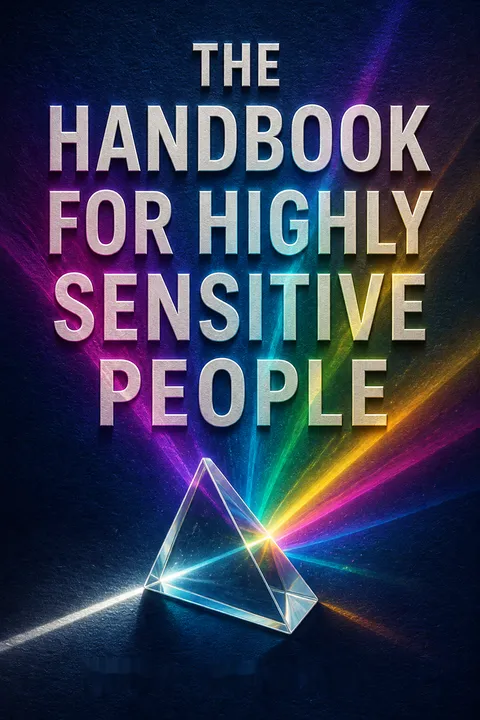


Key Takeaways
Treat high sensitivity as a temperament, not a flaw to correct
A different processing style. The book describes highly sensitive people, or HSPs, as people who register subtle sensory and emotional information deeply and take longer to process it. Collins cites an estimate that about one in five people have this trait. It is not an illness, and sensitivity does not automatically mean introversion: she notes that roughly a third of HSPs are extroverted.
Strengths and strain coexist. Research discussed in the book found stronger brain responses in HSPs to other people’s emotions, alongside heightened awareness and empathy. The same responsiveness can support careful listening, creativity, and noticing details, but can also make busy or emotionally charged settings exhausting. Collins’s starting point is self-understanding, not trying to become less sensitive.
This framing is useful because it replaces a moral judgment, such as being weak or dramatic, with a question about how someone processes input. It also resembles a broader principle in psychology: a trait can carry both benefits and costs depending on the environment. The estimate of one in five is a population-level claim, not a way to diagnose an individual. A checklist can prompt reflection, but persistent distress, sensory problems, or fatigue may have causes beyond sensitivity and deserve appropriate professional assessment.
Plan for sensory recovery before your system reaches overload
Overwhelm has inputs. Collins describes over-arousal as the body’s heightened stress response to too much stimulation, such as noise, crowds, pressure, or emotionally intense situations. Her own prison work involved constant alertness, harsh noise, and distressing incidents. Even travel could leave her depleted by long journeys, unfamiliar environments, and lack of quiet.
Use ACE deliberately. The ACE method means Avoid, Control, or Escape. Avoid a situation when attendance is optional. When it matters, control the dose by taking breaks, finding quiet, or building in time to adjust. If the setting remains too much, leave when possible. Collins also recommends scheduling recovery time rather than stacking demanding events back to back. The practical aim is not to avoid life, but to notice limits before exhaustion takes over.
This advice translates a vague instruction to toughen up into environmental design. Stress research consistently supports the importance of recovery after sustained demands, and planned breaks can preserve attention and emotional regulation. The caution is that avoidance can shrink someone’s world if it becomes the only response. A useful distinction is between reducing needless overload and gradually approaching meaningful situations with support. Persistent exhaustion or sleep disruption should not automatically be attributed to HSP status; medical evaluation can identify other contributors.
Let empathy inform you, but do not make you responsible for everyone
Care needs a boundary. Collins calls HSPs “empathic sponges” because they may be strongly affected by other people’s moods and distress. She discusses research showing heightened responses to emotional faces and greater activity in brain systems associated with empathy. In her prison work, this sensitivity helped her recognize pain and respond compassionately, but difficult incidents could stay with her long after work ended.
Separate signal from duty. A useful practice is to pause and ask whether a feeling began within oneself or appeared in response to someone else. Then decide what help is actually wanted and sustainable. Collins recommends quiet breaks, time in nature, and boundaries around one-sided relationships. Her energy-protection visualizations offer a spiritual way to imagine those boundaries; the concrete value is in making space to recover and choosing how to respond.
Empathy is not the same as emotional accuracy, and feeling another person’s distress does not prove that its cause is known. Research on emotional contagion helps explain how moods can spread through attention and interaction without requiring a literal transfer of energy. This distinction preserves empathy while reducing overconfidence and over-responsibility. The strongest practical insight here is that compassion works better when paired with limits: a helper who is depleted has less capacity to listen carefully, make sound judgments, or offer consistent support.
Read people-pleasing and perfectionism as strategies, then meet the need underneath
Old adaptations can persist. Collins uses the terms shadow and mask for feelings or behaviors a person hides, and the roles they adopt to gain acceptance or protection. A child who learns to earn approval by achieving may become a perfectionistic adult. A child who keeps everyone happy may grow into a habitual rescuer. These patterns can help someone cope at first, yet later leave little room for their own needs.
Ask what the pattern secures. The book presents six core human needs: certainty, variety, significance, and love or connection, alongside growth and contribution. A people-pleaser might seek connection and significance by always being useful, while a workaholic may seek security through constant achievement. Naming the need makes alternatives possible, such as reciprocal friendships, meaningful service, or direct requests for support.
This approach turns behavior into information rather than evidence of a defective personality. It is compatible with family-systems thinking, where roles can stabilize relationships while constraining individuals. The model is best treated as a reflective prompt, not a complete map of motivation: people often pursue several needs at once, and circumstances matter. Nor does identifying a childhood role prove that trauma occurred. The practical question is whether a once-useful strategy still fits the person’s adult life and relationships.
Make self-respect visible through boundaries, rest, and honest requests
Self-love is behavior. Collins defines self-love not as self-admiration but as actions that support physical, emotional, mental, and spiritual wellbeing. Her suggestions include noticing self-criticism, treating oneself with the compassion offered to a friend, and reducing comparisons with people who have different temperaments.
Practice small acts of agency. If an immediate no feels difficult, pause before answering and give yourself time to decide. State a feeling without accusation, then explain what boundary or request follows. A short protected period of rest can be a place to begin. Collins also advises self-care, realistic expectations, and attention to whether relationships balance giving and receiving. These are not gestures of selfishness. They make kindness more sustainable and help prevent resentment from accumulating beneath a helpful exterior.
The behavioral definition matters because self-worth is difficult to build through affirmations alone when daily choices continually communicate that one’s needs do not count. Research on self-compassion links a kinder response to personal failure with less shame and more constructive coping. Boundaries also clarify expectations for other people, rather than requiring them to guess. Still, not every relationship permits a safe or simple refusal. In coercive settings, support from trusted people or professionals may be more important than a direct confrontation.
Name painful feelings before trying to replace them with positive thoughts
Start with what is present. Collins argues that suppressing difficult feelings in favor of instant positivity can leave the underlying distress unaddressed. She recommends the Emotional Freedom Technique, or EFT, also called tapping. In the book’s version, a person identifies a feeling, rates its intensity from zero to ten, taps a sequence of points on the hand, face, head, and upper body, and says words that acknowledge the problem. The person then checks whether the intensity has changed.
Stay honest and flexible. If another feeling or memory surfaces, the person can focus on that rather than forcing a cheerful conclusion. Collins presents tapping as a self-help tool for stress, anxiety, and difficult beliefs. It may help some people slow down and attend to emotion, but it should not replace professional treatment for significant trauma, anxiety, or other mental-health concerns.
The sequence has a psychologically plausible strength: it combines attention to bodily sensations, emotional labeling, and a structured pause. Those elements can help some people feel less swept along by distress. The book’s stronger claims about EFT’s effectiveness need more qualification. Research on tapping is developing, and the evidence base is not equivalent to that for established therapies such as cognitive behavioral therapy or trauma-focused treatment. It is sensible to regard the technique as an optional coping aid, with its usefulness judged by outcomes rather than by claims about energy pathways.
Give grief its own timetable, and seek company that respects its depth
Loss is not a neat sequence. Collins describes grief as a process that can move among denial, anger, bargaining, depression, and acceptance rather than follow a fixed schedule. For HSPs, intense processing may make a loss feel especially consuming, but the book does not set a deadline for recovery. Collins recounts returning to grief after the death of her Labrador, Nero, and feeling understood by HSP friends when others did not grasp the depth of her loss.
Support can take many forms. A bereavement group, a trusted friend, or a trained professional may offer company without demanding that grief disappear quickly. Collins also describes a therapy dog in a prison unit whose presence helped vulnerable prisoners engage in group sessions. The examples point to the value of safe connection, whether through people or animals, during periods when words are difficult.
The permission to grieve at an individual pace can counter the social pressure to appear recovered on schedule. At the same time, the familiar five-stage model is not a universal sequence or a diagnostic checklist; grief varies with the relationship, circumstances, culture, and available support. Animals can be powerful sources of attachment and routine, which helps explain why their loss can be profound. If grief becomes dangerous, prevents basic functioning for an extended period, or includes thoughts of self-harm, compassionate professional help is warranted.
Use spiritual explanations as optional meaning, never as medical proof
A belief-based lens. In the book’s final section, Collins describes a spiritual account of life involving a soul, a continuing spirit, and a “divine blueprint” for experiences and lessons. She also discusses past-life regression, angels, and earthbound souls. These ideas are presented as a perspective for readers who find them meaningful, not as a requirement for understanding sensitivity.
Keep explanations distinct. Collins sometimes interprets repeated relationship patterns as mirroring unresolved inner beliefs, and describes illness or exhaustion in spiritual terms. Such interpretations may offer personal meaning, but the book does not establish them as scientific explanations. Symptoms such as fatigue, pain, anxiety, or insomnia should not be assumed to arise from spiritual causes or sensitivity alone. Medical or mental-health assessment remains important when symptoms persist or disrupt daily life.
Spiritual narratives can help people organize suffering, sustain hope, and connect with practices that feel culturally or personally significant. Their value as meaning-making should be distinguished from their evidential status. Claims about past lives, spirit attachments, auras, or a pre-birth plan are not established clinical explanations, and some interpretations could intensify fear or delay care. A respectful approach neither mocks belief nor treats it as fact: it asks whether the framework helps the person live more safely and compassionately while keeping health decisions grounded in appropriate evidence.
Build a life where sensitivity can contribute without consuming you
Purpose can grow from experience. Collins sees HSP strengths such as careful listening, noticing subtleties, compassion, and creativity as useful in many roles, from teaching and healthcare to research and public service. Her own career moved from prison work toward counseling and teaching about sensitivity. She presents that path not as a model everyone must copy, but as an example of how difficult experience can inform meaningful work.
Balance before service. The book asks readers to consider physical, mental, emotional, and spiritual wellbeing together, rather than treating contribution as the only measure of a worthwhile life. Meaningful work can be a job, a relationship, a creative practice, or a modest act of service. The test is not whether it proves a grand destiny, but whether it uses personal strengths while leaving enough energy for health, rest, and reciprocal connection.
This is a more sustainable account of purpose than the idea that every sensitive person must become a healer or activist. It allows meaning to emerge through ordinary roles and repeated choices. Research on motivation similarly suggests that a sense of purpose is more durable when people experience agency, capability, and connection, rather than obligation alone. The caution is important: framing sensitivity as a special calling can become another demand to over-give. Contribution is most convincing when it is chosen freely and supported by boundaries.
Analysis
The book is a hybrid of temperament education, memoir, self-help, and spirituality. Its narrative authority comes partly from Collins’s own experience: she describes being overwhelmed by sensory and emotional demands while working in a prison, then learning to understand the trait and changing the shape of her work. This grounds the practical message in a memorable paradox: sensitivity can be a liability in an environment that ignores limits, and an asset when it supports careful attention to people in distress.
The strongest material is the reframing of sensitivity as a non-pathological trait, paired with practical advice about recovery time, boundaries, self-compassion, and recognizing learned roles. The book also makes a useful distinction between empathic concern and the habit of rescuing everyone. Its organizing journey, from identification to self-management to a more integrated sense of purpose, gives readers a coherent route through a wide range of challenges.
The evidence, however, is uneven. The discussion of sensory processing sensitivity draws on psychological research, while claims about electromagnetic fields, energy transfer, attraction, past lives, spirit attachments, and divine planning belong to spiritual belief rather than established science. These ideas can offer meaning to some readers, but they should not be used to explain medical symptoms or to replace evidence-based care. The book’s broad HSP checklists are likewise prompts for reflection, not diagnostic instruments.
A careful reading preserves the humane center while separating it from speculative explanations. High sensitivity need not be treated as either a superpower or a disorder. It is a pattern of responsiveness whose consequences depend on history, context, support, and choice. The practical aim is not to eliminate sensitivity or romanticize overwhelm, but to create conditions in which perception, empathy, and reflection remain useful without becoming a route to exhaustion.
Review Summary
The Handbook for Highly Sensitive People receives mixed reviews. Many readers find it helpful in understanding and accepting their sensitivity, appreciating the practical strategies offered. The book's first two sections on HSP traits and coping mechanisms are generally well-received. However, some readers are put off by the spiritual content in the final section, which includes discussions on past lives and energy healing. While some appreciate the holistic approach, others feel it detracts from the book's overall value. The writing style and organization receive both praise and criticism.
People Also Read







Glossary
Sensory processing sensitivity
heightened processing of stimuliThe temperament trait used in the book to describe deeper processing of sensory, emotional, and environmental information. People with the trait may notice subtleties, respond strongly to stimulation, and need longer to recover from intense input. The book treats it as a trait, not a disorder, while emphasizing that people experience it differently.
ACE method
avoid, control, or escapeA practical approach Collins adapts for situations likely to cause overstimulation. Avoid an optional situation, control exposure when participation matters by taking breaks or finding quieter conditions, and escape when the environment cannot be managed. The method is intended to help people plan for limits rather than wait until they feel overwhelmed.
Emotional Freedom Technique (EFT)
structured tapping for distressA self-help method also called tapping. The user focuses on a troubling feeling, rates its intensity, taps a series of points on the hand and upper body, and speaks statements that acknowledge the feeling. Collins presents it as a way to work with emotional distress and limiting beliefs. It is not a substitute for professional care.
Six core human needs
six proposed behavior motivesA framework the book attributes to Tony Robbins, with roots it links to Maslow’s work. It groups certainty, variety, significance, and love or connection as personality needs, and growth and contribution as spiritual needs. Collins uses the model to consider what a behavior may be trying to secure, while needs and priorities vary across people and circumstances.
The highly sensitive brain: an fMRI study of sensory processing sensitivity and response to others’ emotions
study of sensitivity and emotionA study by Bianca Acevedo, Elaine Aron, Arthur Aron, and colleagues, cited in the book. Using functional brain imaging, it examined sensory processing sensitivity and responses to other people’s emotions. Collins refers to findings of stronger activation in regions associated with awareness, empathy, and processing of others’ emotional states. The study concerns measured responses, not proof of every claim made about sensitivity.
Law of Attraction
belief that like attracts likeA spiritual framework presented in the book in which a person’s thoughts and feelings are said to attract experiences of a similar energetic quality. Collins also uses mirroring to describe recurring patterns as reflections of unresolved beliefs or needs. These are metaphysical interpretations, not established scientific mechanisms; similar patterns can also be explored through learning, expectations, and relationship behavior.
Divine blueprint
spiritual plan for a lifetimeCollins’s term for the spiritual belief that a soul has a plan for a human lifetime, including experiences intended to support learning or growth. The concept is used to interpret life challenges, meaningful connections, and recurring patterns. It is offered as an optional spiritual perspective, not a verifiable account of how events or personal traits are determined.
Download PDF
Download EPUB
.epub digital book format is ideal for reading ebooks on phones, tablets, and e-readers.








