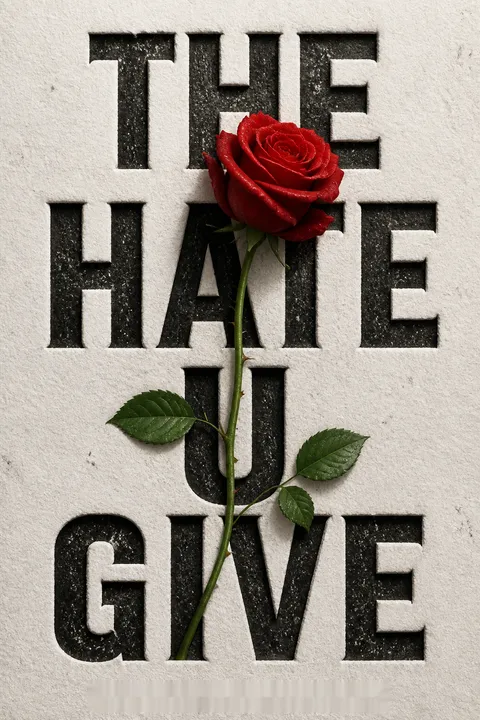


Plot Summary
Spring Break, Broken Taillight
Sixteen-year-old Starr Carter is uncomfortable at Big D’s crowded Garden Heights party, where she feels as if she belongs neither to her neighborhood nor entirely to Williamson Prep, the mostly white school her parents send her to. Then Khalil, her childhood friend, finds her.
They catch up: his grandmother has cancer, his mother is struggling with addiction, and he hints that he needs Starr’s father, Maverick, for help. When gunfire erupts, Khalil pulls Starr through the crowd and drives her away. She asks about his expensive sneakers and suspects he is selling drugs, but he refuses to explain. Before they can reach home, a patrol car’s lights fill the rearview mirror.
The Stop Turns Fatal
Starr remembers her parents’ instructions for police encounters: keep her hands visible, stay still, and watch the officer. Khalil, irritated by a stop for a broken taillight, challenges the officer before handing over his documents.
Officer Cruise, whom Starr identifies by badge number 115, orders Khalil out, searches him, and finds nothing. After Cruise returns to his patrol car, Khalil opens his door to ask whether Starr is all right. Cruise shoots him three times.
Starr rushes to Khalil, tries to help, and sees his life leave him while Cruise points his weapon at her. Her parents collect her, dispose of her bloodstained clothes, and keep her home. The killing also brings back the memory of Natasha, the friend Starr lost in a drive-by shooting at ten.
Rosalie Knows the Truth
At home, Starr’s family debates whether she should speak to detectives. Her mother, Lisa, fears exposing her daughter; Maverick distrusts a process that may blame Khalil. Starr agrees after Uncle Carlos, a detective, promises Officer Cruise will not be present.
Before the interview, Starr visits Khalil’s grandmother, Rosalie, whose cancer treatment has left her struggling financially. Rosalie confirms Khalil had been selling drugs, but says he wanted to stop and respected Maverick’s warnings about prison or death.
Her account deepens Starr’s grief and her resolve to tell what she saw. At the station, Starr recounts the stop carefully. The detectives then question Khalil’s possible drug dealing and gang ties, prompting Lisa to challenge their focus on his past instead of the officer’s actions.
A Bandana in Church
At Khalil’s funeral, Starr struggles to recognize him beneath the makeup in his coffin. His classmates remember him with photographs and stories, while lawyer and activist April Ofrah tells the congregation that police do not plan to arrest the officer, despite an eyewitness account.
She urges a peaceful march for accountability. Then King, leader of the King Lords, lays a gray gang bandana on Khalil’s chest. Rosalie tears it away, furious that King is claiming her grandson.
The gesture makes Starr fear Khalil had joined the gang, and she blames herself for not knowing what his life had become. Outside, mourners march past the police station. That night, protests turn violent, police fire tear gas, and the neighborhood becomes dangerous for Starr’s family.
DeVante Chooses Survival
During the unrest, Starr and Seven play basketball at Rose Park, where two Garden Disciples threaten them. A young King Lord named DeVante steps in, then tells Seven that King expects him to avenge his brother Dalvin, killed in a gang dispute. DeVante does not want to kill anyone. Maverick gives him work at the family store and later hides him with Uncle Carlos, a detective who is off duty.
Lisa objects that Maverick is putting their own family at risk, while Maverick sees a chance to keep another young man from repeating the path he escaped. DeVante’s place in the household exposes the Carters’ disagreement over whether helping Garden Heights requires remaining there, even as King’s reach makes the danger immediate.
Williamson’s Uneasy Protest
At Williamson, Starr switches into a careful version of herself, avoiding slang and confrontation so classmates will not label her angry or ghetto. She is already tense with Chris, her white boyfriend, after he tried to move their relationship further than she was ready for.
During basketball, Hailey makes a fried-chicken joke aimed at Starr; when Hailey and Maya ask whether Khalil was the drug dealer on the news, Starr denies knowing him. The lie protects her identity but feels like abandoning a friend.
Later, Williamson students stage a protest mainly to miss class, with Hailey treating Khalil’s alleged dealing as an explanation for his death. Starr stays behind with Chris, unable to bear the spectacle. The school’s casual performance of concern sharpens her sense that her two social worlds do not share the same stakes.
The Witness Becomes Visible
After Mr. Lewis identifies King as a major dealer during a live news interview, police confront Maverick outside the store and force him face-down onto the pavement. Their attention shifts to Starr, and she realizes the neighborhood has connected her to the shooting.
Kenya, her Garden Heights friend, challenges Starr for staying silent while the news calls Khalil a thug. Starr cannot dismiss the accusation: she has watched the story of his life shrink to a label. She creates an anonymous Tumblr page, The Khalil I Know, and posts personal photographs that show the child and friend behind the headlines.
When she meets Ofrah, she agrees to consider a public interview. Ofrah explains that the supposed gun in Cruise’s account was Khalil’s black hairbrush, turning a small, ordinary object into the disputed center of the case.
Khalil’s Debt Comes Due
At Uncle Carlos’s house, DeVante tells Starr that Khalil was never a King Lord. King placed the bandana on the coffin to claim status and save face after Khalil refused to join. DeVante also explains why Khalil sold drugs: Khalil’s mother, Brenda, had stolen from King, who threatened her, and Khalil sold for him to repay the debt and protect her.
Starr had known Khalil was struggling, but not the danger he was carrying for his mother. The revelation makes her regret judging him and denying their friendship. At a meeting with Ofrah, she learns the officer said he mistook Khalil’s hairbrush for a gun. With King’s threats still hanging over the family, Starr chooses to tell a national audience what the official version leaves out.
Starr Takes the Camera
In an interview with reporter Diane Carey, Starr describes Khalil as a funny, generous boy, not the fixed image of a criminal. She explains his mother’s addiction, the debt that drove his drug dealing, and his refusal to join a gang. Starr also recounts that Khalil never threatened Officer Cruise and that the officer kept a gun trained on her after shooting him.
She knows her disclosure may anger King, but decides Khalil deserves a full account. The interview spreads nationally and draws both support and threats. Chris recognizes Starr by her voice and mannerisms, then realizes she was the witness who kept the worst part of her life from him. His discovery makes the silence between them impossible to ignore.
Chris Enters Garden Heights
At prom, Chris barely speaks to Starr, hurt that she hid her role in Khalil’s death and her earlier loss of Natasha. They argue beside the limousine, where Starr finally explains why she concealed Garden Heights: she feared becoming a charity case in the eyes of Williamson classmates and did not want Chris to see only her poverty or grief.
She tells him about growing up in the projects, her closeness to Khalil, and the drive-by that killed Natasha. Chris apologizes for making her pain about his exclusion and listens as she mourns the friend she had drifted from.
They reconcile, say they love each other, and return to the dance floor together. Starr has not erased the divide between their lives, but she has stopped pretending intimacy can survive behind a locked door.
The Grand Jury Room
On the eve of Starr’s grand jury appearance, someone throws a brick through the Carter home’s window, a threat aimed at the family after her interview. Starr says she will not testify, but Maverick reminds her of the principles he raised her on, and Cedar Grove King Lords arrive to protect them.
Uncle Carlos and Maverick finally set aside their longstanding resentment and agree on Starr’s safety. The next morning, surrounded by family and community members, Starr enters the grand jury room alone.
She spends three hours answering detailed questions about the stop and shooting, promising to tell the truth. Two weeks later, no decision has arrived. Starr continues to live under the threat while trying to attend school, where the pressure of public judgment keeps reaching her.
A Fist, Then a Coalition
When Hailey says Khalil would have died eventually, Starr punches her, and Seven fights Hailey’s brother when he steps in. Williamson suspends both Carter siblings.
Maverick refuses to let the neighborhood’s anger become another cycle of destruction, so he brings Garden Disciples and Cedar Grove King Lords together to plan a response if the grand jury refuses charges. The rare alliance shows that rivals can cooperate when their community is at stake.
At Seven’s graduation and birthday gathering, his mother Iesha confronts him for excluding her; Seven names the years of neglect and abuse that made him turn to Maverick and Lisa as parents. The argument leaves him devastated, while Kenya helps Starr understand that her own fear has kept her from fully sharing her Garden Heights friendships.
The Decision Burns
The grand jury declines to indict Officer Cruise. Starr is at Chris’s house when Seven calls: DeVante has disappeared. They return to Garden Heights and find him beaten at Iesha’s home, where King’s gang has attacked him.
Iesha orders Seven to take Kenya and Lyric too, allowing them to escape King’s reach. As protests swell, Starr joins a march on Carnation Street and takes a bullhorn, naming herself as the witness. When police fire tear gas, she throws a can back and runs with Seven, Chris, and DeVante.
They reach the store, but a firebomb traps them inside. Maverick and neighbors pull them out. Witnesses identify King as the arsonist, and police arrest him. DeVante, seeing Starr risk herself to speak, agrees to become a witness against King.
Roses in New Soil
The family’s new home in Brook Falls offers safety, but the burned store remains a wound in Garden Heights. Mr. Lewis offers Maverick his barbershop property so the grocery can be rebuilt larger. Neighbors arrive to clear rubble and support the Carters.
Kenya tells Starr that she felt hidden from Starr’s Williamson friends; Starr admits she was ashamed of the neighborhood and promises to stop treating their shared brother, Seven, as if he belonged only to Kenya. Starr also receives an apology from Hailey, but recognizes it does not acknowledge the harm Hailey caused and ends the friendship.
Maverick replants roses damaged by the fire, while Starr chooses to keep speaking for Khalil and the people whose lives are reduced to headlines. She leaves Garden Heights physically, not morally, and commits to remembering.
Analysis
The novel makes storytelling a form of power by placing Starr between competing accounts of Khalil. Police reports and television coverage emphasize his suspected criminality; Starr’s memories restore the child who shared baths, jokes, and poverty with her. Neither the private portrait nor the public record is free of complexity. Khalil sold drugs, but the reasons for doing so expose how addiction, debt, and economic exclusion narrow a young person’s options. The book asks readers to hold those facts together without mistaking explanation for excuse or accusation for justice.
Starr’s code-switching is more than a stylistic habit. It is a survival practice learned under conditions where the same behavior can be read differently depending on her race, class, and setting. At Williamson she fears being reduced to a stereotype; in Garden Heights she fears being judged as someone who has abandoned home. Her movement toward a public voice is therefore not a simple rejection of fear. She speaks while still afraid, and learns that privacy can protect her while silence can also leave other people’s stories undefended.
The family and community plots prevent activism from becoming an abstract ideal. Maverick must weigh neighborhood loyalty against his children’s safety. Lisa insists that protecting a family is not the same as betraying a community. Seven’s responsibility toward Kenya and Lyric shows how violence turns teenagers into substitute adults, while DeVante’s experience reveals why gang affiliation can feel like care before it becomes control. The final rebuilding effort gives no easy victory: the store is destroyed, the grand jury refuses charges, and King’s arrest is only a beginning. The novel’s hope rests instead on durable acts of attention, testimony, mutual aid, and remembrance. Starr cannot make Khalil’s life long enough, but she can refuse the story that says it did not matter.
Review Summary
The Hate U Give is a powerful, timely novel addressing racism, police brutality, and the Black Lives Matter movement. Readers praise Thomas's authentic portrayal of complex characters and family dynamics. The book is lauded for its educational value, thought-provoking narrative, and ability to spark important conversations. Many consider it a must-read, highlighting its relevance and emotional impact. While a few critics found certain aspects stereotypical or exaggerated, the overwhelming majority of reviews are highly positive, emphasizing the book's significance in contemporary literature.
People Also Read






Characters
Starr Carter
The divided witnessStarr is a sixteen-year-old Black girl raised in Garden Heights and educated at Williamson Prep, a mostly white private school. She has learned to adjust her language and behavior to avoid being misread in either place, but the effort leaves her unsure where she can be fully herself. Her family’s political convictions, her love of basketball and music, and her close attention to how people tell stories all shape her. Starr is observant, funny, loyal, and more guarded than she wants to be. Her central psychological struggle is not simply finding a voice; it is deciding when self-protection has become complicity, and whether others can be trusted with the parts of her life she keeps hidden.
Khalil Harris
Starr’s childhood friendKhalil grew up alongside Starr and Natasha, sharing the ordinary intimacy of neighborhood childhood: games, family visits, jokes, and first crushes. He is quick-witted and affectionate, with a protective streak that can obscure his own needs. His grandmother Rosalie and younger brother Cameron matter deeply to him, while his mother’s addiction and financial hardship place him under pressures Starr only partly understands. Khalil’s story is surrounded by competing descriptions of who he is, which makes his friendship with Starr an emotional anchor as well as a challenge to easy labels. He represents a young person whose private motives and tenderness are easily erased when others define him by the most stigmatized parts of his life.
Maverick Carter
A father who stayedMaverick owns Carter’s Grocery in Garden Heights and raises Starr, Seven, and Sekani with a fierce blend of affection, discipline, and political conviction. His past as a King Lord and his prison sentence have made him skeptical of institutions that claim to protect the community. He teaches his children practical rules for surviving police encounters, but also asks them to think critically about the forces shaping their choices. Maverick’s pride in Garden Heights sometimes conflicts with his responsibility to keep his family safe. Beneath his bluntness is a man who measures himself by whether he is present for his children, and who wants his experience to become a warning rather than an inheritance.
Lisa Carter
The family’s steady centerLisa, Starr’s mother, is a nurse whose daily work caring for patients informs her instinct to protect and comfort her family. She balances Maverick’s commitment to the neighborhood with a clear-eyed concern about what its dangers cost their children. Lisa is warm without being indulgent, and her humor and sharpness make her a formidable parent when fear or grief threatens to overwhelm the household. She has built a life through persistence, education, and practical care, yet she also understands that love cannot control every outcome. Her relationship with Starr is close enough for conflict, and she repeatedly tries to help her daughter keep living without demanding that she stop grieving.
Chris
Starr’s Williamson boyfriendChris is Starr’s white boyfriend and a fellow Williamson student, as well as a basketball player and music producer. His humor, devotion, and willingness to embarrass himself help Starr feel accepted at school, where she usually edits herself. Yet he cannot understand the full weight of her life when she keeps it from him, and his early pressure around sex shows that affection does not automatically make him attentive to her boundaries. Chris is earnest rather than knowingly dismissive, but he begins the story protected by the assumptions that Starr must navigate every day. His relationship with her tests whether love can cross a racial and class divide without requiring either person to pretend the divide is unreal.
Seven Carter
The protective older brotherSeven is Maverick’s eldest son and Starr’s older brother. He is protective, capable, and often forced to think about the safety of his half-sisters Kenya and Lyric, whose home life is unstable. His loyalty can make him take on responsibilities that belong to adults, even as he tries to build a future of his own. With Starr, he alternates between teasing and vigilance, carrying the familiar intimacy of a sibling who knows exactly how to annoy her and when to stand beside her.
Kenya
Starr’s Garden Heights friendKenya is Starr’s friend and Seven’s half-sister, raised in the orbit of King and the King Lords. She is stylish, outspoken, and quick to confront anyone who threatens her or those she loves. Her confidence can conceal how little control she has over the violence in her household. Kenya presses Starr to acknowledge their friendship and the neighborhood they share, even when Starr’s separate school life makes her feel excluded. Their bond is shaped by affection, envy, and an honest recognition of each other’s blind spots.
DeVante
A young man seeking escapeDeVante is a teenage King Lord whose loyalty to his brother and family has drawn him into a life shaped by gang protection and drug money. He is bright, guarded, and more vulnerable than his bravado suggests. His fear of prison and desire to keep his mother and sisters safe pull against the demands of King’s organization. At the Carters’ store and in Carlos’s home, he encounters adults who expect more from him than survival. His connection to Khalil gives Starr a view of the pressures neither boy could easily explain to her.
Uncle Carlos
The cop inside the familyCarlos is Lisa’s older brother, a police detective, and a second father figure to Starr, especially during Maverick’s imprisonment. His career gives him access to the institution Maverick distrusts, but his family loyalty makes neutrality impossible. Carlos wants Starr protected and believes cooperation can help reveal the truth, while his professional identity complicates how she sees him. His history with Maverick is marked by old resentment and competing claims to having cared for Lisa and the children. He is affectionate, principled, and not immune to the assumptions his job can foster.
Hailey
Starr’s old school friendHailey is one of Starr’s longtime Williamson friends, bonded to her through childhood jokes, shared routines, and a history of grief. She is confident and accustomed to leading the friendship group, often assuming that good intentions settle the meaning of her actions. When conversations turn to race, she treats Starr’s objections as accusations against her character rather than invitations to examine what she has said. Hailey’s role exposes how affection can coexist with denial, and how a friendship’s comfortable past may not be enough to sustain it when one person begins to name previously ignored harms.
Maya Yang
The honest middle friendMaya is Starr’s friend at Williamson and a mediator between Starr and Hailey. She is perceptive enough to notice when a joke or slur hurts, even when she initially laughs along to avoid conflict. Her Chinese American identity gives her firsthand experience of being treated as a stereotype, though she and Starr do not always know how to speak about that together. Maya’s quiet support becomes important because she is willing to acknowledge both the harm done and her own earlier silence.
April Ofrah
The activist attorneyOfrah is a Garden Heights lawyer and police-accountability activist who represents Starr and supports Khalil’s family. She understands the legal process as well as the power of public attention, and tries to protect Starr from becoming a spectacle. Her confidence in the value of Starr’s voice sometimes leads her to move faster than Starr’s parents would prefer. Ofrah offers guidance, preparation, and a political framework, but she does not speak in Starr’s place. She treats the teenager as both a person in need of protection and someone capable of deliberate public action.
King
The neighborhood gang leaderKing leads the West Side King Lords and exerts influence through money, intimidation, and control over young people who need protection or income. He is Kenya and Lyric’s father and a former ally of Maverick, which makes his presence personal as well as dangerous for the Carters. King understands loyalty as something owed to him and treats resistance as betrayal. His polished wealth hides the coercion that sustains it, making him a local power whose reach extends into families, businesses, and the choices teenagers believe they have.
Rosalie
Khalil’s steadfast grandmotherRosalie is Khalil’s grandmother, Starr’s former caregiver, and a respected neighborhood presence known for looking after children. She is proud and reluctant to ask for help, even while facing illness and financial strain. Her love for Khalil is direct and unsentimental: she remembers his flaws without allowing them to erase his worth. Rosalie’s bond with Starr rests on years of care, giving Starr a place to grieve without being treated as fragile or asked to perform a particular kind of sorrow.
Brenda
Khalil’s struggling motherBrenda is Khalil’s mother, whose addiction has damaged her relationship with her children and left her dependent on others. Her grief is complicated by the years she was absent and by the shame surrounding her drug use. Lisa responds to her as a person in crisis, while Starr initially sees only the mother Khalil needed and did not have. Brenda’s presence reveals how addiction and poverty can turn family love into a painful mixture of responsibility, resentment, and hope.
Iesha
Seven’s troubled motherIesha is Seven, Kenya, and Lyric’s mother, living under King’s control and struggling to provide a stable home. Her relationship with Seven is strained by years of choices that made him feel unwanted, though she remains tied to him through family and shared history. Iesha can be sharp and self-protective, and her behavior often worsens conflict before it reveals what she fears. She complicates the idea that a parent’s love is always safe or consistently expressed.
Sekani Carter
The youngest Carter siblingSekani is Starr’s younger brother, observant, mischievous, and quick to puncture family tension with jokes or inconvenient truths. He is protected by the older members of the household, but he also notices more than they assume. His presence reminds Starr that her choices affect a younger generation watching how the adults respond to danger and injustice.
Officer Brian Cruise
The officer under investigationCruise is the white police officer who stops Khalil and Starr on a dark Garden Heights street. Starr remembers him by his badge number and watches his decisions closely. His account of the encounter becomes a competing public version of events, while his father’s televised defense presents him as a threatened family man. Through him, the novel examines how official authority can turn an assumption into an irreversible action.
Plot Devices
Starr’s two worlds
Code-switching under pressureStarr’s movement between Garden Heights and Williamson Prep organizes the novel’s social and emotional conflicts. At school, she monitors her slang, anger, and appearance so classmates will not stereotype her. In the neighborhood, she worries that her school life makes her seem distant or ashamed. The split helps her navigate danger, but it also teaches her to hide important experiences from friends and her boyfriend. As Starr begins speaking more openly, the two settings stop functioning as sealed identities and become parts of one life she can claim.
The eyewitness account
Truth under institutional pressureStarr is the only civilian witness to the traffic stop, so her memory becomes central to the police investigation, the grand jury, and public debate. The repeated questioning forces her to reconstruct the shooting while officials probe Khalil’s conduct and credibility. Her account is not a neutral record: fear, grief, racial assumptions, and the threat of retaliation shape what she can safely say. The device makes testimony both evidence and an act of risk, while showing how the dead can be put on trial through the stories told about them.
The hairbrush
A harmless object becomes evidenceCruise claims that he mistook Khalil’s black hairbrush, kept by the car door, for a gun. The brush becomes a concrete test of the stories told by the officer, the police department, and Starr. Its ordinary purpose is clear to her, but its dark shape is treated as threatening within the officer’s account. The object condenses the novel’s central conflict between what happened and what authorities assume happened. Its later use in a protest chant also turns evidence into a public symbol that people can carry and repeat.
Tupac’s Thug Life
A framework for cause and consequenceKhalil explains Tupac’s phrase Thug Life to Starr on the night of the shooting, giving her a way to connect individual choices with the conditions surrounding them. Maverick later expands the idea through poverty, scarce jobs, addiction, and the drug economy that reaches Garden Heights. The phrase does not excuse every decision Khalil or DeVante makes; instead, it asks what pressures make those decisions seem necessary and who profits when young people are trapped in them. It gives Starr a vocabulary for linking personal grief to structural injustice.
The Khalil I Know
Personal memory counters public labelsStarr’s anonymous Tumblr page uses photographs and brief memories to show a Khalil who cannot be reduced to the news label of suspected drug dealer. The page lets her grieve privately while also shaping the public record, attracting attention from people who never knew him. Its power is intimate rather than forensic: the posts restore childhood, humor, and affection to a story dominated by official statements. Social media becomes both a means of connection and a risk, since every new audience increases the possibility that Starr’s identity will be exposed.
FAQ
What's The Hate U Give about?
- Starr Carter's Story: The novel follows Starr Carter, a 16-year-old who witnesses the police shooting of her best friend, Khalil. It explores her journey to find her voice amidst racial tensions.
- Dual Worlds: Starr lives in a poor, predominantly black neighborhood but attends a predominantly white private school, creating tension as she navigates her identity.
- Themes of Injustice: The book addresses systemic racism, police brutality, and the impact of violence on communities, emphasizing the importance of speaking out against injustice.
Why should I read The Hate U Give?
- Relevant Social Issues: It tackles pressing issues like police violence and racial inequality, encouraging readers to engage with these topics.
- Empowering Narrative: Starr’s journey from silence to activism is inspiring, especially for young adults, showing the power of finding one’s voice.
- Rich Character Development: The well-developed characters allow readers to connect with their struggles and triumphs, enhancing empathy and understanding.
What are the key takeaways of The Hate U Give?
- Importance of Voice: The novel emphasizes using one’s voice to advocate for justice, showing that silence can perpetuate injustice.
- Complexity of Identity: It explores the challenges of navigating dual identities, particularly for those straddling different cultural worlds.
- Community and Activism: The story illustrates the power of community and collective action in the face of injustice, encouraging solidarity.
What are the best quotes from The Hate U Give and what do they mean?
- “The Hate U Give Little Infants Fucks Everybody.”: This quote highlights the cyclical nature of violence and the need for systemic change.
- “Sometimes you can do everything right and things will still go wrong.”: It reflects the unpredictability of life and the importance of resilience.
- “I can’t be silent.”: This signifies Starr’s transformation from a passive observer to an active participant in the fight for justice.
How does Starr’s character develop throughout The Hate U Give?
- Initial Silence: Starr is initially hesitant to speak out about Khalil’s death, fearing repercussions and struggling with her identity.
- Awakening to Activism: She becomes more aware of injustices and the importance of her voice, learning to confront her fears.
- Empowerment and Growth: By the end, Starr embraces her identity and stands against systemic racism, reflecting personal growth and empowerment.
What role does family play in The Hate U Give?
- Support System: Starr’s family provides strong support, encouraging her to speak out and stand up for Khalil.
- Complex Relationships: The novel explores family dynamics, particularly between Starr and her parents, whose differing views create tension but strengthen their bond.
- Cultural Heritage: Her family represents cultural heritage, instilling values of resilience and activism that shape Starr’s identity.
How does The Hate U Give address the theme of police brutality?
- Personal Experience: The novel presents police brutality through Starr’s firsthand experience of witnessing Khalil’s shooting, humanizing the issue.
- Systemic Issues: It critiques systemic racism within law enforcement, illustrating how marginalized communities are disproportionately affected.
- Call to Action: The story urges readers to speak out against police violence and support movements for justice, emphasizing accountability and reform.
What impact does Khalil’s death have on the community in The Hate U Give?
- Community Outrage: Khalil’s death sparks protests and unites residents in their demand for justice, highlighting collective grief and anger.
- Activism and Solidarity: The community rallies to support Khalil’s family and advocate for change, demonstrating the power of solidarity.
- Long-lasting Effects: The novel shows the enduring impact of Khalil’s death, emphasizing the need for healing and remembrance.
How does The Hate U Give portray the media’s role in social justice?
- Media Representation: The novel critiques how the media often misrepresents victims, focusing on their backgrounds rather than the circumstances of their deaths.
- Influence on Public Perception: It shows how media narratives shape public perception and can influence case outcomes involving police violence.
- Call for Accountability: The story calls for responsible journalism, urging journalists to consider the impact of their words in the fight for social justice.
What is the significance of the title The Hate U Give?
- Thug Life Meaning: The title references “THUG LIFE,” highlighting how societal neglect and violence against youth harm everyone.
- Cycle of Violence: It underscores the cyclical nature of violence and the consequences of systemic racism.
- Call for Change: The title urges readers to confront hate and injustice, challenging them to advocate for a better future.
How does the setting influence the story in The Hate U Give?
- Garden Heights: This neighborhood represents the struggles and resilience of its residents, serving as a backdrop for the unfolding events.
- Williamson Prep: Starr’s experiences at this school contrast with her life in Garden Heights, emphasizing her dual identity challenges.
- Cultural Significance: The settings reflect the cultural significance of community and identity, shaping the characters’ experiences and actions.
How does Angie Thomas use symbolism in The Hate U Give?
- The Hairbrush: Symbolizes assumptions about black individuals and the dangers of racial profiling, highlighting consequences of misunderstanding.
- The Rose: Represents beauty and resilience, symbolizing Khalil’s life and impact despite his tragic death.
- The Color Black: Used to symbolize struggles and strength, representing identity complexities and the fight for justice.
Download PDF
Download EPUB
.epub digital book format is ideal for reading ebooks on phones, tablets, and e-readers.








