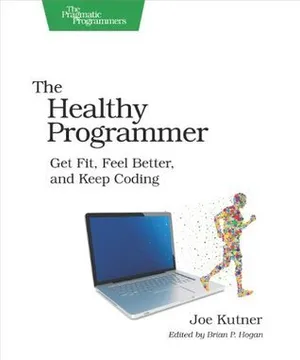


Key Takeaways
Treat your body as part of the programming system.
Health affects the work. The book’s central case is that a programmer’s body and mind are not separate systems. Long hours indoors and sitting still can bring pain and increase health risks, while exercise may support attention, memory, and creative thinking. The goal is not athletic perfection, but lower risk of lifestyle-related illness and less pain in daily life.
A change needs a system. Programmer Chad Fowler weighed nearly 300 pounds before deciding that his habits contradicted the discipline he urged others to bring to their careers. He and his wife began exercising, even when that meant late-night gym visits. Over time, consistent routines helped him lose weight and become a runner. The turning point mattered, but the repeated actions did the work.
What's useful here is the shift from treating health as a side project to seeing it as part of the conditions that make skilled work possible. That framing can counter a common professional trap: sacrificing the body to demonstrate commitment to the job. It also avoids making fitness an aesthetic contest. The argument is strongest when health is valued both for its own sake and for its effects on work. If productivity becomes the only justification, illness or disability can wrongly be interpreted as a failure to optimize.
Replace a harmful habit's routine while preserving its cue and payoff.
Habits save effort. The book describes a habit as a cue, a routine, and a reward. In an MIT maze study, a click cued rats to follow a familiar route to chocolate. With repetition, the routine required less active attention. The book compares this to caching a repeated computation: once learned, the behavior runs with less conscious effort.
Change the middle. To alter a habit, first notice what prompts it and what benefit it provides, then substitute a different routine that offers a similar payoff. An afternoon snack, for instance, may be prompted by a time of day but rewarded by a walk or a friendly conversation, not only by the food. The book recommends recording context, testing what satisfies the urge, and writing down a replacement plan.
This model makes behavior change a diagnostic problem rather than a referendum on willpower. If a replacement habit fails, the missing piece may be that it does not deliver the reward the old routine provided. That insight travels beyond food and exercise to work rituals, phone checking, and social habits. The model is deliberately simple, though real behaviors can have several cues and rewards at once. Addiction, stress, and material constraints may also require more than swapping one routine for another.
Interrupt sitting hourly; a standing desk cannot replace movement.
Stillness is the concern. The book reviews studies linking prolonged sitting with poorer health, including a twelve-year study of 17,013 Canadians in which the heaviest sitters had higher mortality even after researchers accounted for physical activity. These findings show an association, not proof that sitting alone caused the outcomes. The book also cites research suggesting that brief movement breaks can help counter the effects of long inactive stretches.
Vary the position. Its practical plan is to move for about five minutes each hour and avoid staying in one position for much longer than twenty minutes. Walking is preferable when practical; seated mobility exercises can break up stillness when leaving the desk is not possible. Standing is not a cure-all: prolonged standing can cause discomfort and may pose risks for some people. A workstation should make several positions easy to switch between.
The distinction between exercise and everyday movement matters. A scheduled workout can coexist with a workday that is otherwise almost entirely motionless, so the desk routine deserves its own attention. The most durable intervention is often a change in the work environment, such as making short walks socially acceptable or building breaks into meetings. The book's precise timing should not be mistaken for a universal medical threshold. Its more robust principle is to reduce uninterrupted stillness and choose movement that is comfortable and feasible.
Use short brisk walks to improve health and make learning stick.
Start with walking. The book reports that IT workers averaged about 4,300 steps per day in a cited study, less than the 10,000-step target then commonly promoted. It argues that step totals alone do not capture intensity, and recommends including at least twenty minutes of moderate activity, which can be divided into shorter bouts. A pedometer or phone tracker can reveal a baseline and make progress visible.
Move around learning. The mathematician Andrew Wiles described walking while working through Fermat's last theorem, using the time to concentrate and capture ideas. Research summarized in the book links exercise with improvements in memory and cognitive flexibility. It discusses brain-derived neurotrophic factor, or BDNF, a protein involved in strengthening connections between neurons. Walking is not a magic creativity switch, but it can be a practical break before or after demanding learning.
Walking is compelling partly because it has a low barrier to entry and can be attached to ordinary tasks, such as thinking through a difficult problem. That makes it more scalable than a plan that assumes every worker can reach a gym. The cognitive argument also gives exercise an immediate reward, rather than asking people to act only for distant health benefits. Still, a walk should not be sold as a guaranteed performance enhancer. Cognitive effects vary, and the opportunity to move safely depends on the workplace and the person.
Build a diet you can sustain by testing rules against real life.
Experiment before committing. The book's agile diet is a method for finding an eating pattern that fits an individual's needs and preferences, rather than following one prescribed menu forever. It suggests trying a structured approach for a short period, noticing what is satisfying and practical, then adapting. The author's teenage wrestling story shows the danger of extreme restriction: rapid weight loss came at the cost of adequate nutrition and performance.
Measure with restraint. The book treats calorie balance as central to weight change and recommends recording one representative day's intake before making gradual adjustments. It suggests small changes, such as reducing roughly 100 calories at a time, rather than severe cuts. It also promotes a balanced diet and five fruit or vegetable servings daily. These are the book's 2013 recommendations, not a personalized prescription; nutritional needs and medical circumstances differ.
The most durable contribution is not allegiance to any diet label, but the emphasis on sustainability, observation, and adjustment. A plan that reliably leaves someone hungry or unhappy is unlikely to survive ordinary life. This resembles iterative design: test a rule in context, inspect the result, and revise it. Calorie estimates can be imprecise, and weight regulation is more complex than a simple arithmetic ledger. The book's incremental approach helps temper that simplification, while its medical disclaimer remains important for people with health conditions or a history of disordered eating.
Prevent programmer pain by changing movement patterns, not just buying gear.
Test before treating. The book focuses on common muscular back pain and wrist discomfort, while warning that injury or spinal damage needs professional evaluation. It describes the Kraus-Weber Test, a set of six movements used to assess basic core strength and flexibility. Failing a test is a signal to consider conditioning, not a diagnosis. For the back, it presents controlled trunk and hip exercises, including the curl-up, side bridge, and bird dog.
Notice how work happens. For wrist pain, the book explains that keyboard use is not necessarily a cause of carpal tunnel syndrome, though computer users may experience other wrist symptoms. It recommends gentle nerve-gliding movements and introduces the Alexander Technique, a method of observing a habitual movement, interrupting it, and directing a less strained alternative. Equipment can help, but posture, breaks, and individualized medical advice matter too.
The musician comparison is revealing: repeated skilled work can still be physically costly when technique and recovery are ignored. Pain is useful information, but it does not identify its own cause. This section's best practical move is to combine awareness of movement with gradual strengthening instead of searching for a single perfect chair or brace. The book's exercises should not be treated as universal therapy. Persistent, severe, or worsening symptoms deserve qualified assessment, especially because self-tests can create false reassurance as easily as unnecessary alarm.
Fit exercise into coding breaks, then progress toward balanced fitness.
Make activity part of the day. The Pomodoro Technique divides work into focused intervals, commonly twenty-five minutes, followed by short breaks. The book adapts those breaks into a Pomodoro workout: alternate programming tasks with brief walks or mobility and strength exercises. This can reduce the friction of setting aside separate exercise time, while keeping each break short enough to return to work.
Progress beyond breaks. Short activity is a starting point, not a complete fitness plan. The book describes five dimensions of fitness: body composition, cardiovascular endurance, flexibility, muscular endurance, and strength. It recommends warming up before harder activity, building running ability through a gradual run-walk plan, and using varied circuits for strength. It also argues that complex activities such as climbing can combine physical effort with learning new movements. Intensity should increase progressively, with recovery and medical guidance when needed.
The work-break pairing is a strong example of designing behavior around an existing rhythm rather than relying on an empty calendar. It may also make breaks feel legitimate in workplaces that reward constant availability. Yet microbreaks and training sessions serve different purposes: a few minutes of mobility can interrupt inactivity, but do not automatically provide the progressive challenge needed for broader fitness. The useful distinction is between movement woven into the workday and planned exercise, with each serving a different role.
Take movement outdoors, but treat vitamin claims with measured skepticism.
Leave the cube. The book argues that office work can limit exposure to sunlight and outdoor environments. It discusses vitamin D, whose production in the body depends partly on ultraviolet light, while noting that exposure needs vary with skin pigmentation, latitude, season, clothing, and other factors. It cautions against turning emerging associations between vitamin D and many diseases into claims that supplements cure them.
Choose a restorative setting. The book describes forest-bathing, a leisurely experience of walking in a wooded environment and attending to its surroundings. It cites small studies in which forest visits were associated with changes in natural killer cell activity, stress measures, and blood pressure. These findings support spending time outdoors as a potentially restorative practice, but they do not establish that forests prevent disease. Outdoor activity should be adapted to personal health and local conditions.
This section usefully separates the broad value of leaving an indoor work environment from the narrower, less settled claims about a particular nutrient. Natural settings may make walking more pleasant, which alone can improve the odds that a habit continues. The mechanistic explanations are intriguing, but short studies of physiological markers do not demonstrate long-term disease prevention. Sun exposure also carries risks, and individual needs vary substantially. The sound takeaway is to seek safe outdoor activity, not to treat sunlight as a universal dosage.
Make healthy routines social and accessible enough for coworkers to join.
Build support at work. The book presents health as partly shaped by colleagues and employers. Teaching a short lunch seminar can help the presenter retain what they explain, while giving coworkers a shared starting point. Group activities can add accountability and companionship. The author favors games such as dodgeball because they are easier for people with different skill levels to join than some traditional sports.
Design the invitation. The book cites a study where an enthusiastic class leader and participants were associated with greater enjoyment and stronger interest in returning. It also describes corporate wellness examples: SAS reported low voluntary turnover, while Johnson & Johnson reported substantial savings associated with its program. These cases suggest possible benefits, not guaranteed results. Effective programs are described as accessible, supportive, personalized, and led with visible commitment rather than pressure or punishment.
Social design can make healthy behavior feel normal rather than exceptional. A beginner-friendly activity matters because a group that quietly rewards only the fittest participants can reproduce the very barriers it means to remove. The workplace examples also broaden the question from personal discipline to institutional responsibility: schedules, facilities, and leadership shape what choices are realistic. Company success stories are suggestive, but they cannot establish that any one wellness program caused lower turnover or savings. Access and employee trust are better starting measures than spectacle.
Keep health in beta: measure small gains, revise, and maintain.
Treat progress as ongoing. The book borrows kaizen, a Japanese idea of continuous improvement through small changes, and applies it to health. Instead of expecting one dramatic transformation, a person can look for modest gains: an extra repetition, a walk completed, or a meal choice that better fits a plan. An exercise log makes these changes visible and can help reveal when a new routine is not working.
Keep adapting. The book's Healthy Stand-Up asks a person to review what they did yesterday, decide what to do today, and identify obstacles. Goals and two-week iterations provide structure, but the intended result is a sustainable practice, not a completed checklist. The author emphasizes that fitness and nutrition need maintenance: stopping the habits that produced improvement can mean losing some of that progress. New goals should reflect personal interests, abilities, and health needs.
The software analogy earns its place here because health behavior is rarely a project with a clean finish. Feedback helps distinguish a useful change from one that looks good on paper but fails in daily life. Small wins can also protect motivation during slow progress. The analogy has limits, however: bodies do not respond as predictably as code, and not every setback is a process defect. A humane system leaves room for illness, disability, changing circumstances, and rest without converting them into personal failure.
Analysis
The Healthy Programmer is a practical health guide organized around a programmer's workday. Its structure is cumulative: begin with a habit change, add walking and movement breaks, address diet and common pain, then expand into exercise, outdoor time, workplace support, and long-term maintenance. The central argument is not that developers need extraordinary athleticism. It is that ordinary occupational routines can quietly undermine health, and that small, repeatable changes can make a substantial difference.
Its most distinctive strength is translation. Habit loops become an interface for changing behavior; iterations and retrospectives become a way to test personal routines; Pomodoro breaks become opportunities to move. These analogies give readers a memorable operating model and make health feel less like a moral test. The stories of Chad Fowler, Andrew Wiles, and working programmers also connect abstract claims to concrete lives. Most importantly, the book links movement to both long-term physical health and immediate cognitive experience, giving readers more than one reason to act.
The adaptation should not turn every cited number into timeless medical advice. The book was published in 2013, and some specific claims about vitamin D, blue light, calorie targets, standing-desk risks, and exercise effects depend on evidence and guidance that can change. Many studies cited are observational or small, and an association is not proof of causation. The source itself repeatedly distinguishes the two, and its medical disclaimer rightly directs people with symptoms or existing conditions to professionals.
The best way to use the book is as a behavior-design framework rather than a complete clinical program. Notice patterns, make movement easier, choose food rules that can last, and record enough information to make adjustments. Its strongest message is that a healthy working life is not built by one heroic resolution. It is built by designing a workday in which the body is not forgotten.
Glossary
Agile diet
Personalized, iterative eating planA method for developing a sustainable way of eating through short experiments and adjustments. Rather than committing to a single fashionable diet, a person tests structured approaches, observes what is nutritious, satisfying, and practical, then adapts the rules to individual needs and preferences. The book distinguishes a temporary weight-loss diet from the eating pattern a person can maintain.
Cue, routine, reward
Three parts of a habitA model of habit formation described in the book. A cue signals that a behavior should begin, the routine is the behavior itself, and the reward is the result that reinforces repetition. To change a familiar habit, the book recommends identifying its cue and payoff, then replacing the routine with another behavior that can provide a similar reward.
Healthy Stand-Up
Daily health planning check-inA brief review modeled on a software team's stand-up meeting. A person considers what they did yesterday to support health, what they plan to do today, and what might block that plan. The practice makes health actions visible and encourages daily planning and problem-solving instead of relying on vague intentions.
Pomodoro workout
Movement during work breaksAn adaptation of the Pomodoro Technique that places short bouts of physical activity between focused work intervals. The book uses a common pattern of twenty-five minutes of work followed by a five-minute break, with the break used for walking, mobility, or bodyweight exercises. Its purpose is to combine work structure with regular movement.
Nonexercise activity thermogenesis (NEAT)
Energy used in daily movementThe energy the body expends during ordinary activities that are not formal exercise or sleep. The book uses examples such as standing, fidgeting, and household tasks. It presents NEAT as one reason everyday movement can matter for energy expenditure and bodyweight, while distinguishing it from planned workouts.
Computer Vision Syndrome (CVS)
Symptoms from prolonged screen focusA temporary group of symptoms associated with prolonged visual focus on a computer screen. The book lists dry or irritated eyes, blurred vision, headaches, fatigue, neck discomfort, and difficulty refocusing. It recommends attention to screen distance, lighting, blinking, and periodic shifts of visual focus, alongside appropriate professional eye care.
Kraus-Weber Test
Basic core fitness assessmentA six-part test of minimum muscular fitness, originally developed to assess strength and flexibility in major muscle groups. The movements examine abdominal and hip-flexor strength, upper- and lower-back strength, and flexibility. In the book, it is used as a check on core conditioning, not as a diagnosis or a routine exercise program.
Alexander Technique
Awareness-based movement retrainingA method for noticing and changing habitual patterns of posture and movement. The book presents three steps: observe the pattern, inhibit the unwanted action, and direct the body toward a different action. It applies this approach to repeated computer tasks, with the aim of reducing unnecessary tension and strain.
forest-bathing
Attentive time in wooded natureA Japanese practice of taking a leisurely excursion through a forest while attending to the natural surroundings. The book discusses research on possible effects of forest visits on stress, blood pressure, heart rate, and immune markers. It describes these results as promising but does not establish forest-bathing as a treatment or disease-prevention method.
brain-derived neurotrophic factor (BDNF)
Protein supporting neural connectionsA protein involved in supporting neurons and strengthening connections between them. The book discusses research suggesting that exercise can increase BDNF and connects this mechanism to learning and memory. It uses the concept to explain why physical activity may support cognitive processes, while noting that the precise ideal timing and dose of exercise for learning are not established.
conditioned hypereating
Cue-driven excessive eatingA term used in the book for eating that becomes an automatic, excessive response to food-related cues. The behavior can occur without a person being overweight, so body size alone does not reveal whether eating feels out of control. The book encourages identifying triggers and recognizing when eating is driven by availability or habit rather than hunger.
the big three
Three spine-stabilizing exercisesA group of exercises associated with spine researcher Stuart McGill: the curl-up, side bridge, and bird dog. The book presents them as controlled movements intended to condition the trunk muscles that support spinal stability. They are not framed as a universal treatment; the appropriate exercise depends on the individual and the source of pain.
Download PDF
Download EPUB
.epub digital book format is ideal for reading ebooks on phones, tablets, and e-readers.








