Key Takeaways
1. The Holy Grail: Diversify with Uncorrelated Investments
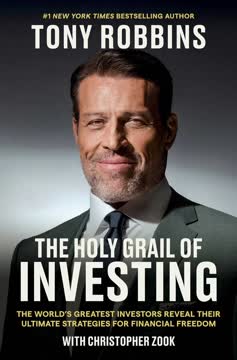
According to Dalio, the Holy Grail is a portfolio of eight to twelve uncorrelated (or non-correlated) investments which, together, will dramatically reduce risk without sacrificing returns.
Maximize reward, minimize risk. The core principle of "The Holy Grail of Investing," inspired by Ray Dalio, emphasizes building a portfolio with 8 to 12 investments that do not move in unison. This strategy can reduce risk by as much as 80% while maintaining or even increasing upside potential. Traditional diversification often fails because many common assets (stocks, bonds, REITs, even crypto) can become positively correlated, meaning they fall together during market downturns.
Correlation challenges. Recent market events, like 2022, saw both stocks and bonds plummet simultaneously, highlighting the inadequacy of traditional 60/40 portfolios. This unexpected correlation can leave investors exposed, especially those nearing retirement who are increasingly over-allocated to stocks. The goal is to find assets that "zig and zag in ways that balance each other out," providing true protection during volatile periods.
Beyond traditional assets. Achieving true uncorrelated diversification often requires looking beyond publicly traded stocks and bonds. The book introduces various alternative investments that historically exhibit low correlation to public markets, offering avenues for investors to build a more resilient and robust portfolio. These alternatives are often the domain of ultra-high-net-worth individuals and large institutions.
2. The Great Migration: Smart Money Shifts to Alternatives
Ultra-high-net-worth families (those with over $30 million) have nearly 46 percent of their assets in alternative investments, with only 29 percent in publicly traded stocks.
Beyond public markets. The world's wealthiest investors are increasingly allocating significant portions of their portfolios to alternative investments like private equity, private credit, and private real estate. This "Great Migration" is driven by the superior, often uncorrelated, returns these assets have historically generated compared to public markets. For example, private equity has outperformed the S&P 500 by over five percentage points annually between 1986 and 2022.
Shrinking public opportunities. The number of publicly traded U.S. companies has nearly halved since 1996, with many remaining public companies being mediocre in terms of profitability. Conversely, tens of thousands of private companies are growing and innovating, offering a vast and often more profitable opportunity set. The total value of companies held by private equity funds now dwarfs public stocks by nearly 4 to 1.
Accessibility expanding. While historically exclusive, regulations are slowly loosening, potentially allowing average investors to access private markets through vehicles like 401(k)s or by passing an "accredited investor" test. This democratization could further fuel the growth of the alternative investment industry, which is projected to reach over $14 trillion by 2025 in private equity alone.
3. GP Stakes: Own the Racetrack, Not Just the Horse
“Do you want to bet on a horse or own a piece of the entire racetrack?”
Invest in the managers. GP stakes involve acquiring a minority, passive ownership in the General Partner (GP) of an asset management firm (e.g., private equity, private credit, real estate). This strategy allows investors to own a piece of the "racetrack" – the business that manages multiple investment funds – rather than just betting on individual "horses" (specific fund investments). This offers unique benefits not typically available to limited partners.
Attractive revenue model. Asset management firms generate revenue from two primary sources:
- Management Fees: An annual fee (typically 2%) on total capital managed, providing predictable, contractually secured cash flow.
- Performance Fees: A percentage (typically 20%) of the fund's investment gains, offering significant upside when funds perform well.
These economics make the GP business a powerful wealth-building machine, often highly efficient due to economies of scale.
Diversification and alignment. GP stakes provide "vintage diversification" across numerous funds and market cycles, as well as diversification across industries, geographies, and asset classes managed by the firm. This dramatically reduces risk. Furthermore, GPs often sell stakes to fund their own commitments to new funds, ensuring strong alignment of interests with investors. This "growth engine" for the GP, rather than a "cash-out" for owners, is a key differentiator.
4. Pro Sports: Durable Assets with Global Tailwinds
“I don’t know which SAAS (software as a service) company will be around in 5 years, but I know that 50 years from now, there will be a World Series in October.”
Resilient and uncorrelated. Professional sports franchises, particularly in North America, are incredibly durable assets with unique characteristics that make them attractive investments. They have consistently outperformed public markets (e.g., 18% compounded annual return for the "Big 4" leagues between 2012-2022 vs. 11% for S&P 500) with very low correlation to public markets (0.14 between 2000-2022) and minimal leverage.
Multiple revenue streams. Modern sports teams are multifaceted global empires, far beyond just ticket and concession sales. Their revenue streams include:
- League Revenue: Equal share of national/international broadcast rights and sponsorships (e.g., NFL's $16.6 billion projected by 2024).
- Team Revenue: Local media rights (e.g., Dodgers' $7 billion TV deal), real estate (stadiums, surrounding developments), licensing/sponsorships, luxury boxes, and increasingly, legalized gambling.
These diverse and growing revenue sources provide economic resiliency, even during inflationary periods.
Expanding accessibility. Historically, ownership was limited to billionaires. However, recent rule changes (starting with MLB in 2019) now allow specific investment funds to acquire minority stakes in multiple teams across various leagues (MLB, NBA, NHL, MLS, Premier League). This opens a path for qualified individual investors to participate in a diversified portfolio of these high-performing, inflation-hedged assets, often with potential tax benefits from depreciation.
5. Private Credit: Income is the Outcome in Rising Rate Environments
While bond values were collapsing with rising rates, many of the biggest institutions were enjoying the benefits of private credit.
An alternative to bonds. Private credit offers established businesses a way to borrow money outside traditional banks, providing investors with significantly higher income returns (2-3x traditional bonds) and serving as a non-correlated income strategy. While traditional 60/40 portfolios suffered in 2022 due to correlated stock and bond declines, private credit often thrived.
Rising rates, rising returns. Unlike traditional fixed-income assets, private credit loans typically have floating interest rates that adjust with market rates. This means that as interest rates rise, the income payments to private credit lenders also increase, making it a beneficial asset class during inflationary periods. The industry has grown from $42 billion in 2000 to over $1.5 trillion today, projected to reach $2.3 trillion by 2027 as banks tighten lending.
Stability and protection. Private credit has demonstrated remarkable stability through difficult markets, with low default rates (averaging -1% annually from 2004-2022). Lenders are highly selective, often focusing on recession-proof industries and structuring "senior secured loans" with strong covenants and collateral, ensuring they are first in line for repayment. This focus on capital preservation aligns with Warren Buffett's Rule #1: "Don't lose money."
6. Energy: Navigating the Inevitable Demand and Innovation
“Energy is the key to human progress.”
Unavoidable demand. Global energy demand is projected to increase by 50% by 2050 due to population growth and billions entering the middle class. Despite the push for renewables, experts agree that traditional fossil fuels (oil, gas, coal) will continue to be essential, with all energy sources expanding to meet demand. This presents a "Golden Age" for energy investing, balancing traditional and green solutions.
The "energy addition" reality. History shows new energy sources are "added" rather than fully replacing existing ones. Wind and solar, despite massive investment, currently provide only 3% of global energy needs. Challenges include geographic limitations, intermittency, and the environmental impact of mining critical minerals for green technologies. Nuclear power, with new small modular reactors (SMRs), is poised for a comeback as a clean, dense, and safe baseload energy source.
Innovation and opportunity. The underinvestment in traditional energy supply (down 50% since 2014) combined with growing demand creates a supply-demand mismatch, likely leading to higher prices. This, alongside trillions invested in green technologies like carbon capture (e.g., NetPower's near-zero-emissions natural gas plant) and advanced hydrogen production (e.g., Omnigen Global's pyrolysis converting fossil fuels to green hydrogen and graphite), offers diverse investment opportunities in private equity, undervalued public companies, refineries, liquefaction, and private credit for energy.
7. Venture Capital: Fueling the Next Wave of Disruption
In forty years, I’ve never called myself a venture capitalist. I always say I’m a venture assistant.
High risk, high reward. Venture capital (VC) focuses on early-stage private companies with high potential for disruption, even if most fail. The goal is to find "moonshot" companies that can reshape the future and generate exponential returns, like Vinod Khosla's $4 million investment in Juniper Networks yielding $7 billion. Top-tier VCs act as "venture assistants," providing capital, wisdom, and networks to help founders realize their dreams.
The "flywheel of success." Success in VC is concentrated among top-tier firms due to:
- Deep Pockets: Ability to diversify across many high-risk companies.
- Longevity: Investing across multiple "vintages" (funds) to capture different market cycles.
- Deal Flow: Attracting the best entrepreneurs who seek their expertise and funding.
These firms consistently outperform, with the top 10% generating 34% annual returns between 2004-2016, while others struggled.
Future of innovation. We are entering an era of unprecedented innovation, with VC at the forefront of:
- Artificial Intelligence (AI): From "copilots" for professionals to new company creation (e.g., ChatGPT).
- Healthcare Advances: Precision therapies, gene editing (CRISPR), and brain-computer interfaces (Neuralink).
- Supersonic Travel: Companies like Hermeus aiming for Mach 5 aircraft.
- 3D Printing & Robotics: Affordable housing (ICON), advanced manufacturing, and automated warehouses.
This acceleration creates immense opportunities, though current valuations in some AI sectors show signs of speculative "mania."
8. Real Estate: The World's Largest Asset in Transition
“Buy land. They aren’t making any more.”
Tax-advantaged behemoth. Real estate is the largest and oldest asset class globally, valued over $300 trillion, with residential ($258 trillion) being the largest segment. For U.S. investors, it offers significant tax benefits like depreciation and 1031 exchanges, allowing for perpetual tax deferral and even tax avoidance of capital gains upon death, making it a cornerstone for many wealthy families.
Navigating market shifts. After decades of falling interest rates boosting real estate values, the recent rapid rate hikes have created a tumultuous market. While residential real estate shows resilience due to low inventory and high homeowner equity (average 58%), commercial real estate faces significant headwinds.
Commercial real estate crisis. The "virtual office" trend, obsolescence risk from AI, and a looming "debt wall" of $2.5 trillion in maturing loans by 2028 are causing a crisis in commercial real estate. Cities like San Francisco see office vacancies exceeding 25% and property values plummeting (e.g., an 80% drop for a Union Bank building). This distress, however, creates "blood in the streets" opportunities for savvy investors to acquire assets at deep discounts.
9. Secondaries: Opportunities to Buy Quality at a Discount
When you have something that’s really working for you, ride it. But, conscious that every day you hold it, you’ve bought it again.
Liquidity in illiquid markets. Secondaries involve buying existing stakes in private equity, private credit, or real estate funds from other investors (LPs) who need to liquidate their positions early. This market, which reached $134 billion in 2021, offers buyers significant advantages:
- Discounts: Often purchasing stakes at 70-90 cents on the dollar relative to current valuations.
- Shorter Timelines: Reducing the typical 5-10 year "lock-up" period, effectively eliminating the J-Curve.
- Visibility: Knowing the exact underlying assets and their performance, reducing "blank check" risk.
GP-led secondaries. Post-financial crisis, fund managers (GPs) innovated "GP-led secondaries" to retain high-performing assets beyond a fund's typical 10-year life. They move select companies into "continuation vehicles," offering LPs the option to cash out or roll their investment into the new fund. This maximizes value for all parties and has become nearly half of the entire secondary market.
Buyer's market ahead. The current market landscape, with institutional investors needing to rebalance portfolios due to public market declines, suggests a "buyer's market" for secondaries. This creates opportunities for sophisticated investors to acquire high-quality assets at attractive discounts. Success requires deep due diligence, strong relationships with fund managers, and diversification across various secondaries.
10. The Power of People: Culture, Mentorship, and Adaptability
The character piece is number one. Everybody can perform differently yet still fit into the team, so to speak, if they have character.
Foundational values. Across all interviews, the titans of investing consistently emphasize that people and culture are paramount to long-term success, often more so than individual genius. Mentorship, like Robert Smith's experience at Bell Labs or Wil VanLoh's with A.V. Jones, is crucial for shaping leaders and fostering intellectual curiosity.
Building enduring firms. Scaling an investment firm from "good to great" hinges on:
- Shared Economics: Liberally sharing profits to attract and retain top talent (Bill Ford, Wil VanLoh).
- Strong Culture: Emphasizing teamwork, integrity, excellence, and a shared mission (Ramzi Musallam, Tony Florence).
- Adaptability: The willingness to learn from mistakes, make mid-course corrections, and embrace change (Bob Zorich, Wil VanLoh).
- Talent Density: Hiring individuals with high IQ, EQ, self-awareness, humility, and a relentless desire to learn and improve (David Golub, Ian Charles).
Beyond individual stars. While individual talent is important, the most successful firms are built on collaborative teams rather than relying on one or two "franchise players." This collective strength, combined with a focus on process and client relationships, creates an "insurmountable intellectual property stack" (Robert Smith) and an enduring franchise.
11. The True Holy Grail: Gratitude, Contribution, and Purpose
In our hearts we all know that it’s not money that makes us rich.
Wealth beyond finance. The ultimate "Holy Grail" transcends financial metrics. True wealth is found in gratitude for life's blessings, the loving warmth of relationships, laughter, meaningful work, and the capacity to learn, grow, share, and serve. Sir John Templeton emphasized gratitude as the secret to wealth, noting that even billionaires can be miserable if ungrateful.
The power of giving. Tithing or consistently giving a portion of one's income, regardless of amount, shifts one's mindset from scarcity to abundance. This act of contribution, whether money, time, talent, or compassion, is psychologically transformative, leading to greater fulfillment and a sense of freedom. The author, Tony Robbins, highlights his personal commitment to giving, having provided over a billion meals through Feeding America.
Meaning and impact. The greatest gift is a life with meaning beyond oneself. Finding a cause greater than personal gain, and passionately serving it, enriches individuals more than any financial accumulation. This ultimate game-changer transforms life from a battle into a celebration, fostering a sense of purpose and making one a blessing in the lives of others.
Last updated:
Similar Books