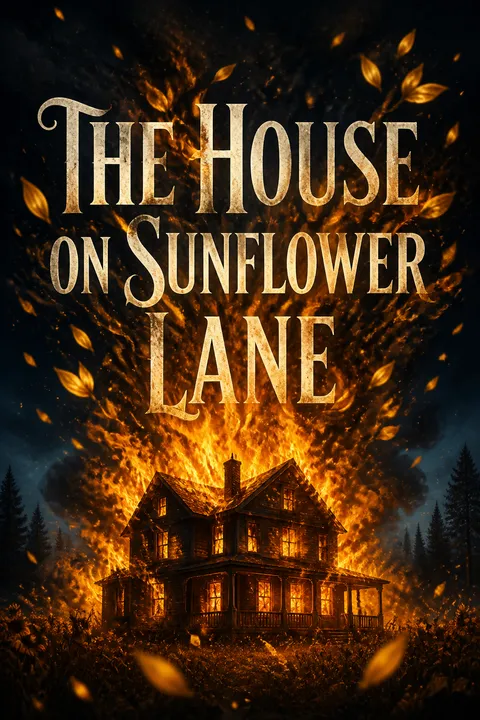


Plot Summary
A House Full of Promise
In 2019, Shannon and Marc Holloway need a larger home before their first child arrives, but student debt leaves them with few options. Realtor Tom Altamira finds them a small farmhouse on Sunflower Lane, with five acres, a sagging porch, and a barn full of tools left behind by its previous occupants.
Shannon imagines a family life there; Marc sees projects he can repair, and they make an offer that day. After closing, Shannon discovers a dried corsage in the master bathroom, marked for Fern, the former owner. The relic unsettles her, but she leaves it where she found it. The couple sees the house as a chance to build a future, not a place someone else abandoned for a reason.
The house first attracts Shannon through the very qualities that later make it dangerous: age, hidden layers, and the promise that care can transform neglect. Her wish to make a home is not foolish in itself, but it encourages her to read every abandoned object as useful potential. The corsage briefly exposes a prior emotional life, then gets put aside, much as the histories of the women who lived here will be deferred. The purchase therefore begins as an act of hope while quietly establishing the novel's central risk: imagining that affection and labor can make a damaged place safe.
Fern's Empty Place
In 1961, Fern Carlisle tends the house and her daughters, Joyce and three-year-old Loretta, while her husband Raymond grows distant and stays away for work. Joyce speaks of Loretta, an unseen presence in the woods, and Fern tries to dismiss it as childish invention. The house already feels hostile: Fern's garden will not grow, strange cold and footsteps unsettle the family, and Raymond eventually leaves.
In October 1962, Fern briefly turns her attention from Loretta to Joyce, who has been scratched by the family cat. When Fern looks back, Loretta has vanished from the yard. Neighbors search the woods with lanterns and dogs, but find no trail. Fern cannot accept that her daughter is gone, and her grief fixes her to the home.
Fern's tragedy is preceded by ordinary pressures that narrow her ability to respond: domestic isolation, a failing marriage, and the exhausting work of raising children without reliable help. The supernatural enters a life already structured by abandonment, making it difficult to separate haunting from emotional collapse. Loretta's disappearance is especially cruel because it follows a moment of divided maternal attention, a commonplace event that grief can later recast as culpability. Fern's refusal to abandon the house is not simply denial. It is the only action left to a mother who has no explanation, no support, and no confirmed body to mourn.
Footsteps After Midnight
Shannon and Marc move into the farmhouse while Shannon is heavily pregnant. She gives birth to Hazel in June 2019, then spends months recovering and caring for the sleepless infant with little help. At night, she hears heavy steps on the floorboards, but Marc sleeps through them, and exhaustion makes her question her own judgment.
When Hazel begins napping in the nursery, Shannon hears the steps through the baby monitor, takes a kitchen knife, and searches the house. She finds no intruder, only the sensation of being watched near the nursery. In 2020, neighbor Kim Gillespie warns Shannon that Fern died in the house and calls it haunted. Shannon is frightened, but pandemic isolation and newborn care leave little room to investigate.
The first haunting is filtered through the material realities of postpartum life: interrupted sleep, physical pain, and the uneven distribution of care. Shannon's self-doubt is therefore earned, not a sign that she is unreliable. She has reason to suspect hallucination, and Marc's failure to hear the baby reinforces her isolation. Kim's warning confirms that the house has a local reputation, but arrives as gossip rather than usable knowledge. The narrative makes uncertainty part of the danger: Shannon must decide whether to trust her perception while the very conditions that make her vulnerable also give her plausible reasons to dismiss it.
The Family Falls Apart
During COVID lockdown, Marc's remote job consumes him, while Shannon cares for Hazel and tries to keep the household functioning. Their arguments sharpen, and Marc retreats to his office, where Shannon discovers trash, a sleeping bag, and a note suggesting he feels he does not belong.
He denies needing help, then leaves the marriage by placing signed divorce papers on the kitchen counter. He gives up custody, though he continues paying support and the mortgage. Alone in the house, Shannon begins freelancing and rebuilds routines with Hazel.
One night, Hazel wakes laughing and waves at someone behind Shannon. Shannon carries her out of the nursery without looking back. The sight deepens Shannon's fear, but she keeps trying to provide Hazel with an ordinary childhood.
Marc's retreat parallels the earlier men who vanish from the property's family histories, but the book does not reduce his depression to a supernatural symptom. Shannon sees real signs of crisis and tries to reach him; his refusal to speak leaves her to manage both practical survival and uncertainty. The divorce intensifies a pattern of female responsibility, while Hazel's unexplained delight introduces a different kind of abandonment: a child forming a relationship her mother cannot enter. Shannon's renewed routines show resilience, but also how easily survival can be mistaken for safety.
The Closet Has a Name
At Hazel's third birthday party in June 2022, Shannon's father helps celebrate beneath the oak tree, though no other invited guests arrive. Hazel names her new stuffed cat Loretta and explains that a woman lives in her closet.
Shannon recognizes the name from the old barn sign, Joyce's Clubhouse, Loretta Keep Out. Her father returns from the house pale and frightened, saying he saw something in Hazel's room and warning Shannon to get Hazel out. He collapses before she can learn more.
Later, Hazel says the closet woman saw her grandfather and feels sorry for frightening him. Shannon checks the nursery camera and sees the closet open, a distortion emerge, and her father freeze in the doorway. The haunting is no longer something she can explain away.
The birthday gathers the novel's emotional and supernatural threads in one ordinary family ritual. Hazel's naming of Loretta links her play to a history Shannon has not yet learned, while the absent guests underline how thin Shannon's social support has become. Her father's collapse gives the haunting a bodily cost, and the camera changes the status of the evidence: Shannon is no longer relying solely on a frightened memory. Yet the footage cannot explain what the presence is or what it wants. It verifies danger without giving her control, a distinction that drives the next phase of her response.
A Door Opens Wider
After discovering that Joyce Marshall, Fern's surviving daughter, has died, Shannon asks Kim about the family. Kim reveals that Fern had two daughters and that Loretta vanished in the woods as a child.
Believing Fern's spirit is still waiting, Shannon speaks to her through Hazel's closet and tells her she can stop waiting. The room grows quieter, but Hazel soon appears before the closet, begging Fern to return and saying she fears another woman. That night, the nursery door is open and Hazel is walking barefoot toward the woods.
Shannon catches her at the tree line. Hazel says a woman promised to show her Loretta, now that Fern is no longer watching. Shannon carries her to the car and flees to a Huntsville hotel, leaving home without packing.
Shannon's attempt to comfort Fern is compassionate, but it rests on an incomplete account of what keeps the house active. Once Fern's presence recedes, the danger she had been holding at bay can reach Hazel more directly. The scene turns maternal empathy into a consequential risk: Shannon's instinct to speak to another grieving mother is emotionally intelligible, yet the unseen listener exploits the opening. The escape is a decisive break from the old house, but not a clean rescue. Hazel's words establish that the antagonist can lure rather than merely frighten, and that physical distance may not be enough.
Safe Rooms Don't Hold
At the hotel, clerk Latoya gives Shannon flip-flops, food, and the number of Maureen, a retired teacher who offers a spare room. Shannon brings Hazel there and begins arranging to sell the farmhouse. The move provides sleep, meals, and kindness, but not lasting safety.
Hazel draws a tall, faceless figure behind Maureen's house and says the tricky lady followed them because she missed her. Later, Hazel wakes and names another child, Viola, who wanted to play at the window.
Realtor Tom Altamira reports that a family touring the farmhouse felt uneasy in Hazel's room, and Shannon's camera records the father being violently shoved into a wall. Tom recognizes the property as the infamous Carlisle house and urges Shannon to meet his sister Carmen, a hospice nurse experienced with paranormal disturbances.
Latoya and Maureen interrupt Shannon's isolation with concrete care, a contrast to the neglect that has defined her earlier crises. Their help matters precisely because it does not solve the supernatural problem; it gives Shannon enough stability to keep acting. The drawing and Viola's name show that the presence is not confined to the farmhouse, while the realtor's footage establishes that its violence can affect strangers too. Tom's recognition reframes his earlier role: he is not merely a seller but someone who must reckon with a history he failed to identify. Community becomes a practical resource, not a magical cure.
The Land Remembers
Tom helps Shannon trace the property's ownership through county records and the Huntsville library. A 1871 newspaper article reports that Samuel Ellison disappeared, his three-year-old daughter Viola vanished near the woods, and his wife Ada died after their homestead burned.
The family history echoes Fern's, and the child at Shannon's window is no longer an invented name. Librarian Morgan points them to a book by Harry and Hilda Birch, evangelists who visited Fern's home in 1963. Tom and Shannon locate Hilda in Decatur.
On their drive, Tom recalls that the Trail of Tears passed through the region, and Hilda later describes the land as burdened by old suffering. The history suggests a pattern rooted in the place itself, though its source remains uncertain.
Research shifts the story from a single haunted household to a repeated local history. The archive gives Viola a name and sequence of events, but the newspaper's sparse account also demonstrates how easily women and children disappear from public memory. Tom's knowledge of the Trail of Tears offers a possible context for the land's accumulated violence, not a definitive supernatural explanation. That distinction matters: historical trauma cannot be treated as a tidy origin story or a solved mystery. The records increase moral urgency because Shannon now understands that the danger has touched several families, while leaving its underlying nature unresolved.
Beneath the Freezer
While clearing the barn, Shannon and Tom move an old chest freezer that has stood over a concealed trapdoor for decades. Stone steps lead to a root cellar containing a blanket, a basin, a little girl's dress, shoes, bonnet, rag doll, and carved wooden animals. The objects suggest that someone once lived below the barn, and the newspaper's account of Ada's death in a cellar becomes newly disturbing.
Hilda and her daughter Rebecca later join Tom, Shannon, and Carmen to listen to the 1963 exorcism recording. Under the Birches' prayers, the tape captures overlapping adult and child voices that sound human rather than demonic. In the cellar, the group finds Ada's hidden letters. A slam above them forces them out before they can read further.
The cellar turns historical research into physical encounter. The child's belongings are not merely clues but evidence of care preserved in a place of confinement, inviting sympathy before anyone knows the full story. The recording similarly unsettles the Birches' confident interpretation: what they classified as demonic mockery may be human grief. Their mistake is not presented as malice, but certainty imposed on sounds they could not understand. The letters promise another perspective, while the slam above the cellar makes knowledge itself feel contested. The living can uncover the past, but the house still controls the conditions under which they do so.
A Thread to Sever
After the cellar visit, Maureen finds Hazel standing barefoot in the rain, staring toward the trees, with dark soil on her hands and clothes. Hazel later says the woman in the house saw Shannon touching her belongings and is angry.
Carmen senses that Hazel remains linked to the farmhouse, so she places protective obsidian under the child's pillow and prepares a severing ritual. Maureen, who has sheltered Shannon and Hazel, refuses to host it because she believes it would violate her faith and home. Tom offers his apartment instead.
There, Carmen lays a red thread across sleeping Hazel and asks Shannon to name the connection in her own terms. As Shannon speaks about fear, grief, loneliness, and the rage of carrying everything alone, the thread responds. Carmen cuts it, and Hazel wakes laughing.
The soil on Hazel's body makes the supernatural intrusion tactile, while her report confirms that the hidden place has registered the group's trespass. Maureen's refusal is a boundary rather than a betrayal: she cares for Shannon but cannot participate in a rite that conflicts with her beliefs. Tom's offer supplies an alternative, allowing care to continue without demanding that Maureen surrender her conscience. The severing ritual works through Shannon's testimony as much as Carmen's practice. Naming her own fear and resentment lets Shannon participate instead of waiting for an expert to rescue her, though the apparent success will prove temporary.
Ada's Last Letters
At Tom's apartment, Shannon reads Ada Ellison's letters to her dead mother. They describe Samuel's withdrawal and disappearance, Viola's conversations with an unseen woman, and Ada's growing fear that the land is hostile.
After Viola vanishes, Ada searches for help but is treated as unstable. She moves into the root cellar, believing her daughter remains nearby, then writes that she will set a fire to cleanse the homestead. Her letter reveals that she intends to die there, still leaving a light for Viola.
Shannon recognizes the pattern of abandoned mothers and endangered girls, but also sees that Ada remained attached to the place through grief. The letters sharpen Shannon's resolve: she will face what Ada faced, but she will not confront it alone.
Ada's letters counter the public record by restoring the private texture of her life: chores, marital disappointment, fear for a child, and the humiliating experience of not being believed. Shannon's recognition of herself in Ada makes the archive emotionally dangerous, but it also separates identification from repetition. Ada's sacrifice arose from isolation and the belief that fire alone could purify the land. Shannon can honor her suffering without treating her choices as a model. The letters make the cycle legible while suggesting that witness, companionship, and action may offer options Ada was denied.
The House Strikes Back
On moving day, Tom's cousin Diego arrives with his sons Mateo and Elias to clear the farmhouse. The group finds a dead dove on the porch and an open front door, though no one admits entering. They work through the house until Shannon and Mateo tackle Hazel's room. As Mateo tries to move a dresser, the closet shifts, the air turns foul and cold, and an unseen force hurls the furniture onto him.
The mirror shatters, pinning Mateo beneath the dresser and cutting him badly. Tom calls an ambulance while Shannon freezes, pulled back to the memory of her father's collapse. Mateo is taken to hospital, and the house is emptied, but the family leaves with a new injury and no certainty that the threat has weakened.
The attack breaks the assumption that evacuation is a neutral, administrative task. The house punishes the very act of removing a child's belongings, and the danger spreads from Shannon's family to people helping her. Mateo's injury also exposes how trauma can immobilize: Shannon's memory of her father interrupts her ability to respond, while Tom must act. Their guilt is understandable but misplaced, since the force chooses the violence. The emptied house is not cleansed or defeated. Removing possessions only strips away the domestic surface and leaves the conflict more exposed.
Fire Against the Hunger
With the house empty and closing only days away, Carmen returns with Shannon to perform a deeper cleansing. She marks a cord for Viola, Ada, Loretta, Fern, Hazel, Shannon, and the unnamed dead, hoping recognition will sever the house's hold.
The knots undo themselves, and the entity knocks Carmen unconscious, then fills the room with layered voices. One voice, which Shannon recognizes as Ada's, urges her to do what Ada could not. Shannon pours flammable oil across the nursery and the hidden presence's space, then overturns Carmen's smoking censer.
The fire catches on Ada's letters and spreads through the house. Shannon drags Carmen outside. On the lawn, Carmen wakes as the farmhouse burns, and Shannon watches the place that endangered her daughter disappear in flames.
The cleansing fails because recognition alone cannot undo the force binding the house, and its failure raises the stakes beyond ritual procedure. Shannon's decisive action is not a technically informed exorcism; it is an act of refusal shaped by what she has learned from Ada. Unlike Ada, she does not enter the fire seeking purification through solitary sacrifice. She escapes with another living person. The contrast gives the fire a double meaning: it destroys the physical site and marks Shannon's break from inherited helplessness, yet it cannot guarantee that the pain bound to the land has ended.
A Sale Without a House
Shannon and Carmen leave before firefighters arrive, then give statements while trying to conceal how the blaze began. Carmen recovers under Shannon's care, and Hazel stays close to her as the adults regain their footing. The property buyer surprises Shannon by keeping his offer: he wanted the acreage and planned to demolish the outdated house regardless.
The sale closes, freeing Shannon from the mortgage and the site. One year later, she has a small new-build home, steady design work, friends, and a crowded birthday party for Hazel. Yet when a guest mentions a three-year-old girl recently missing near Gurley, Shannon and Tom exchange alarmed looks. The house is gone, but the news suggests the pattern may have survived it.
The buyer's indifference to the burned house gives Shannon a practical escape without offering supernatural certainty. She can sell the land and rebuild her life, but the transaction does not function as proof that the threat has been erased. The year-later party deliberately recalls the birthday that ended in her father's death, this time surrounded by friends and ordinary care. Then news of another missing child punctures the security of that scene. The ending distinguishes personal recovery from historical resolution: Shannon has reclaimed a future, while the broader cycle remains frighteningly possible.
Epilogue
One year later, Shannon lives with Hazel in a modest new-build home and has rebuilt a circle of friends. Hazel's birthday party fills the small yard with children, while Tom, Carmen, and Maureen share in the celebration. Then a guest reports that a girl about Hazel's age has vanished near Gurley.
Shannon sees Tom's expression change, and both understand what the news may mean. The Sunflower Lane house is gone, but the final moment leaves open whether the force that preyed on children was ever confined to its walls.
The epilogue gives Shannon a genuine recovery without mistaking recovery for victory over every danger. Her new home, work, and friendships are concrete achievements, and the birthday party reverses the isolation of Hazel's previous celebration. Yet the missing child near Gurley makes the place's destruction an incomplete answer. The novel closes by separating a house from the land and its history: burning a structure may free one family, but it does not necessarily erase what has been repeated there. The final unease is therefore not a denial of Shannon's healing, but a limit placed on what one family's survival can resolve.
Analysis
The novel's haunting is built from repetition, but its central question is not simply what supernatural being occupies the property. Across Ada, Fern, and Shannon, a recognizable social arrangement recurs: a mother is left to manage a household, a young daughter encounters something the adults cannot see, and institutions or neighbors offer incomplete understanding. The men who withdraw are part of this pattern, but the book also gives Shannon's experiences concrete psychological and economic pressures. Postpartum exhaustion, pandemic isolation, divorce, grief, and precarious freelance work make her fear plausible even before the camera supplies evidence. That grounding prevents supernatural explanation from erasing the ordinary conditions that make her vulnerable.
The archive supplies history without producing certainty. Newspaper records omit names, the Birches misread voices, and the land's Indigenous history is raised as a possible source of accumulated sorrow rather than a solved supernatural origin. These gaps matter: the story treats forgetting and misinterpretation as active dangers. Ada's and Fern's grief is initially folded into the category of evil, while the living repeatedly lack the language or willingness to recognize what has happened. Shannon's act of listening to the letters and naming the lost children counters that erasure, though remembrance alone does not defeat the threat.
Motherhood is portrayed as care under impossible conditions, not as effortless instinct. Shannon's guilt makes her believe that needing help means failing Hazel; the people who help her demonstrate the opposite. Latoya offers basic necessities, Maureen gives shelter within her own limits, and Tom and Carmen share labor and risk. The final fire is therefore not a triumphant mastery of the supernatural. It is a desperate, collective-era response enacted by a woman who refuses the solitary sacrificial role Ada assumed. Shannon survives and builds a new life, yet the missing child in the epilogue keeps private recovery distinct from universal closure. The book's most durable claim is that naming suffering and sharing its burden can interrupt isolation, even when they cannot guarantee that history will not repeat.
Review Summary
The House on Sunflower Lane receives an overall rating of 4.29/5, with readers praising its atmospheric slow-burn tension, emotionally grounded characters, and compelling dual timelines. Many highlighted the powerful themes of motherhood, isolation, and generational haunting. Frequent praise focused on strong character development and an immersive, creepy atmosphere. Common criticisms included pacing issues in the middle sections, an anticlimactic or unclear ending, and unanswered questions about the supernatural entity. Most reviewers found it a compelling, deeply affecting read, particularly for fans of atmospheric, emotionally driven horror.
Characters
Shannon Reed
A mother who keeps goingShannon is a graphic designer and Hazel's mother, first drawn to Sunflower Lane because she believes a neglected house can become a safe family home. She is observant but often doubts her own perceptions, especially when sleep deprivation, postpartum distress, and isolation give her reasonable grounds to question what she hears. Her instinct is to shoulder responsibility rather than ask for help, a habit reinforced by a failing marriage and limited support. As the danger becomes undeniable, she learns to accept help from people she barely knows and to act without pretending she understands everything. Her central strength is not fearlessness, but the ability to keep choosing Hazel's safety while afraid.
Hazel Reed
A child who hears the hiddenHazel is Shannon and Marc's young daughter, a bright, affectionate child whose curiosity and openness make her unusually responsive to the house's unseen presences. She loves cats, imaginative play, and her mother, and her cheerful explanations often carry information the adults cannot access. Her age leaves her unable to distinguish an imaginary companion from a dangerous invitation, so she depends on Shannon to interpret what she experiences without frightening or silencing her. Hazel's vulnerability is not passivity: she notices, names, and sometimes resists what adults cannot see. Her drawings and spontaneous remarks become vital clues, even when their meaning is difficult for her mother to bear.
Marc Holloway
The husband who withdrawsMarc is Shannon's husband and Hazel's father, an engineer whose practical intelligence and early enthusiasm for renovating the farmhouse help make it feel like a shared project. He is easily absorbed in his own thoughts, and the pressures of work, parenthood, and the pandemic expose how poorly he communicates distress. As he retreats, Shannon is left guessing whether he is struggling, avoiding his family, or concealing something. His distance becomes a defining wound in Shannon's life, but he is not portrayed as a simple villain; his failure lies in withdrawing without explaining himself or accepting meaningful help. He represents the intimate abandonment that leaves others to carry the consequences.
Fern Carlisle
The mother still waitingFern is the former owner of Sunflower Lane and the mother of Joyce and Loretta. In the early 1960s she tries to make a life in an isolated farmhouse while her marriage deteriorates and her younger daughter speaks of an unseen woman. Fern is dutiful, capable, and proud of caring for her family, but her husband's absence and the loss of Loretta leave her with grief she cannot resolve. Her attachment to the house grows from a mother's hope that her missing child might return. To Shannon, Fern becomes both a warning and a fellow mother, a presence whose motives cannot be understood simply by calling her a ghost.
Loretta Carlisle
The vanished little sisterLoretta is Fern's youngest daughter and Joyce's little sister. At three, she is imaginative and unusually attentive to the woods, where she speaks of a woman who seems to call to her. She loves a worn stuffed rabbit and wanders barefoot, details that become important as later families encounter traces of the Carlisle household. Loretta is not present to explain what happened to her, so the adults must piece together her story through family memories, records, and objects. Her disappearance gives Fern's grief its enduring focus and establishes the child-centered pattern that threatens Hazel.
Ada Ellison
A voice from the cellarAda is an earlier mother who lived on the property in the nineteenth century with her husband Samuel and daughter Viola. Her unsent letters to her deceased mother reveal a perceptive, lonely woman trying to make sense of her husband's growing estrangement and her child's frightening encounters. She wants to leave the isolated homestead but has little money, no nearby family, and few people willing to believe her. Ada's writing gives Shannon access to a private history absent from public records. Her story illuminates the pattern of mothers left to face danger alone, while her choices demonstrate both the force and the limits of love under extreme isolation.
Tom Altamira
The realtor who staysTom is the Huntsville realtor who first sells Shannon and Marc the farmhouse, then returns to help Shannon escape it. Professional, attentive, and historically curious, he initially fails to recognize that the property is the notorious Carlisle house. Once he understands the danger, he takes responsibility without making Shannon prove her fear, helps research the land, assists with packing, and offers practical shelter. His kindness is expressed through actions, from bringing food to handling paperwork and moving boxes. Tom's own past experience with betrayal makes him alert to the cost of overlooking warning signs. He becomes a reliable ally while retaining a grounded, sometimes lightly comic manner.
Carmen Altamira
The careful spirit workerCarmen is Tom's sister, a hospice nurse who has studied spiritual cleansing and energy work. Her daily proximity to death gives her a composed, unsentimental presence, while past mistakes have taught her not to approach a haunting casually. She reads the house as containing several presences rather than one simple ghost, and she tries to protect Hazel through practical preparations and ritual. Carmen is confident in her skills but not omniscient; her work can fail, and the danger can physically injure her. Her relationship with Tom is warm and teasing, while her care for Shannon grows from professional competence into a genuine willingness to stand beside her.
Joyce Carlisle Marshall
Fern's surviving daughterJoyce is Fern's elder daughter and Loretta's sister, a strong-willed child who enjoys drawing and playing with her friend Shirley. Her memories and childhood belongings help establish the family life that existed before Loretta disappeared. As an adult, she moves far from Alabama and remains connected to the property through inheritance, though Shannon cannot reach her directly. Joyce's life bridges Fern's generation and Shannon's, while her distance from the farmhouse hints at how survivors sometimes protect themselves by leaving what others cannot release.
Viola Ellison
The first missing childViola is Ada and Samuel's three-year-old daughter, a sensitive child who notices presences adults cannot perceive. She speaks of a woman in the trees and asks questions that frighten her mother, while Ada tries to protect her in an isolated homestead. Viola's disappearance predates Loretta's by nearly a century, making her the earliest identified child in the property's repeating history. Her name reaches Shannon first through Hazel, then through archives and Ada's letters, turning an eerie clue into the trace of a real family.
Shannon's father
A grandfather with old loyaltiesShannon's father is a practical, affectionate Alabama man who loves football, hardware stores, and his granddaughter Hazel. He initially dismisses the pandemic, then changes his behavior after losing an old friend to COVID. His bond with Shannon softens as he begins bringing supplies and checking on the young family. He helps make Hazel's birthday joyful and represents the imperfect but durable support Shannon longs for. His presence also ties the farmhouse's threat to the personal grief that will shape Shannon's choices.
Maureen Ledbetter
A generous temporary refugeMaureen is a retired kindergarten teacher who offers Shannon and Hazel a room after hearing about them through hotel clerk Latoya. She is warm, observant, and comfortable with children, and she gives Shannon practical care without demanding a full explanation. Her faith also sets a clear boundary: she cannot host Carmen's ritual in her home. Maureen's kindness and refusal coexist without cancelling one another, showing that support does not require identical beliefs. She continues to matter to Shannon beyond the immediate crisis.
Kim Gillespie
The neighbor with the historyKim is Shannon's outspoken neighbor, a social and curious woman who enjoys delivering local stories but also takes the woods and farmhouse seriously. Her blunt warnings first introduce Fern's death and later reveal Loretta's disappearance, details Shannon could not have found on her own. Kim's manner can seem intrusive, yet her local memory is an important counterweight to the incomplete official records. She knows enough to be uneasy, though not enough to explain the danger.
Hilda Birch
An aging witness to the hauntingHilda is an elderly former evangelist who once visited Fern's home with her husband Harry. She remembers the house and preserves the recording they made there, but age and reflection have softened her certainty about what they encountered. Hilda is willing to revisit evidence that challenges the interpretation she once accepted. Her testimony helps Shannon understand the human grief embedded in the property's history, while her humility contrasts with the confidence of the younger ministers she and Harry once were.
Harry Birch
The confident revival preacherHarry is Hilda's husband and a traveling preacher who visits Fern after hearing of her family's troubles. He believes the disturbances are demonic and approaches them through prayer, scripture, and a recorded deliverance session. His earnest desire to help is real, but his certainty limits what he can hear in the evidence. The recording he leaves behind later allows others to reconsider what he and Hilda believed they had defeated.
Raymond Carlisle
Fern's absent husbandRaymond is Fern's husband and the father of Joyce and Loretta. His growing distance and long absences leave Fern carrying the household alone. His work at the Arsenal offers an explanation for some late nights, but the marriage's emotional separation becomes unmistakable. Raymond's withdrawal forms part of the pattern that unsettles Fern before Loretta disappears.
Samuel Ellison
Ada's withdrawn husbandSamuel is Ada's husband and Viola's father, a homesteader whose increasingly strange absences and emotional withdrawal alarm his family. Ada's letters suggest that he senses something about the land but refuses to explain it. His disappearance leaves Ada isolated with their daughter and deepens the property's repeated association with men who leave.
Rebecca Birch Griffiths
Hilda's practical daughterRebecca is Hilda's adult daughter. She accompanies her mother to the farmhouse, helps manage the fragile old recording equipment, and watches over Hilda during the cellar visit. Her practical caution balances her mother's determination to return to a place tied to painful memories.
Latoya
The hotel clerk who helpsLatoya works at the Huntsville hotel where Shannon arrives barefoot with Hazel. She quietly provides flip-flops, food, and the contact information for Maureen, recognizing a family in need without pressing for an explanation. Her kindness gives Shannon a first foothold after fleeing the farmhouse.
Mateo Altamira
Tom's helpful young cousinMateo is one of Tom's younger cousins, brought along to help Shannon move out of the farmhouse. He is friendly and playful, especially when talking about his little sister, and he treats the move as a practical favor rather than an occasion to pry. His presence makes the danger to Shannon's helpers tangible.
Plot Devices
Sunflower Lane
The house that repeatsThe farmhouse draws Shannon and Marc with its age, land, barn, and apparent potential. Its rooms and objects connect the present family to Fern Carlisle's history, while the nursery repeatedly becomes the site of unexplained activity. The house's hidden spaces and cold spots keep physical history close to supernatural danger. It also shapes the plot materially: Shannon must sell and clear it, and the move exposes helpers to harm. Its eventual destruction gives Shannon an exit, but the later report of a missing child leaves uncertain whether the house itself contained the threat or merely stood on land where it could recur.
The Nursery Camera
Evidence beyond memoryShannon installs a camera in Hazel's room because Hazel talks and laughs toward the closet when alone. Initially its ordinary footage offers no explanation, but the birthday recording captures the closet opening and Shannon's father reacting to something at the doorway. Later footage records a prospective buyer being shoved. The camera turns private fear into observable evidence, helping Shannon persuade Tom and seek Carmen's help. It cannot identify the presence or establish its intentions, however. The device makes the haunting harder to deny without making it easier to understand.
Ada's Letters
A private history recoveredThe letters Ada Ellison wrote to her deceased mother preserve the fears and choices omitted from newspapers and land deeds. Through them, Shannon learns how Samuel withdrew, how Viola described the unseen woman, how Ada sought help, and how the mother eventually chose to burn her homestead. The letters create a parallel between Ada's isolation and Shannon's own burden, but also show that Ada's solitary sacrifice did not end the pattern. During the final confrontation, the letters serve as a link to the history Carmen tries to address, and their destruction accompanies Shannon's desperate act.
The Root Cellar
A buried refuge and clueHidden beneath a chest freezer in the barn, the root cellar contains a blanket, a basin, and a child's carefully preserved belongings. Its arrangement suggests that someone used the space as shelter and kept a place for a missing girl. The cellar ties the nineteenth-century Ellison family to the later Carlisle history and brings Shannon's research into contact with material evidence. It is also a threshold the group should not have entered casually: their visit provokes a hostile response and Hazel later reports that the presence noticed them touching the objects.
The Unraveling Thread
A ritual's false releaseCarmen uses a red thread to represent Hazel's connection to the farmhouse and asks Shannon to name the emotions bound up with the haunting. When Shannon speaks honestly about fear, grief, and the anger of carrying responsibility alone, Carmen cuts the thread and Hazel seems restored. The relief is temporary. Carmen later attempts a broader cleansing with named knots honoring the missing children, the mothers, Shannon, Hazel, and the unrecorded dead. The house undoes the knots and attacks Carmen, demonstrating that a ritual can offer protection without guaranteeing control over the force it confronts.
Download PDF
Download EPUB
.epub digital book format is ideal for reading ebooks on phones, tablets, and e-readers.








