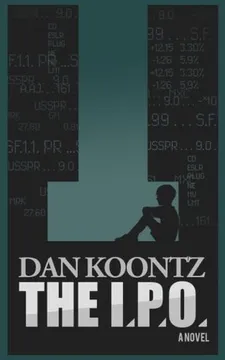


Plot Summary
The First Human IPO
Ryan Tyler Jr. is seven when a crash kills both his physician parents as they drive to collect him from daycare. Three months later, still sleeping in an orphanage, he learns that the friend who has cared for him, cardiologist Jared Ralston, is moving away.
Across the country, financier James Prescott launches Avillage, a stock exchange built around selected orphans, and presents Ryan as its first listing. Ryan runs away from school, hides in a Walmart, and watches Prescott describe his parents and his future on television.
Police return him to the orphanage, but the screen has already shown his photograph and a rising stock price. Ryan understands neither the market nor why it has chosen him. He knows only that strangers have turned his life into a public event.
The opening makes bereavement inseparable from public spectacle: Ryan is still a child trying to grasp the finality of his parents' deaths when Prescott converts that loss into a persuasive investment story. The market's language promises care, but its first act is to define Ryan without his consent. His flight to Walmart is more than a frightened child's escape. He is searching for information about a future already being arranged around him, and the television makes that invisible power briefly visible.
Adoption With Shareholders
The next morning Ryan recognizes Thomas and Sara Ewing as the couple shown on the broadcast and hides beneath his bed. Sara wins him over by meeting him at eye level, and he leaves the orphanage with the couple for a lavish home prepared for him.
The comfort unsettles him: he studies photographs of his birth parents rather than immediately embracing his new room. Meanwhile, Prescott explains publicly that Avillage, not the adoptive parents, holds legal guardianship and that investors will eventually receive part of each listed person's earnings.
Ryan searches the new phone provided by the Ewings and finds Ralston on his board of directors. Though the Ewings give him affection and stability, his discovery turns his former confidant into someone with a financial stake in decisions made about him.
Ryan's adoption offers genuine tenderness, which prevents the novel's critique from collapsing into a simple claim that every person in the system is cruel. Sara and Thomas care for him, yet their parental role sits beside a corporate authority they cannot fully overrule. Ryan's grief makes the contrast especially sharp: the photographs preserve a family he lost, while his new room advertises a future designed by other people. His early discovery about Ralston teaches him to hold gratitude and suspicion at once.
A Son Put On Market
Avillage's second prominent listing is J'Quarius Jones, a gifted young basketball player raised by his grandmother after his mother dies giving birth. When J'Quarius enters an orphanage, Aaron Bradford, Prescott's ruthless deputy, arranges his adoption by former players Arlene and Hansford Washington.
J'Quarius's biological father, Melvin Brown, seeks a paternity test, threatening the listing. Bradford has Brown framed with child pornography, then destroys the evidence and sends him to jail. Brown escapes supervision and dies by suicide outside Avillage headquarters, carrying his son's image.
Bradford suppresses his letters, leaving J'Quarius unaware of his father. The Washingtons give the boy a loving home and basketball guidance, but Bradford's scheme has removed the one person who might have challenged the corporation's claim over J'Quarius.
J'Quarius's story exposes the exchange's central moral sleight of hand: it claims to rescue children while treating family ties as obstacles whenever they interfere with a listing. Brown's poverty and isolation make him easy to discredit, while Bradford's control of information turns a legal question into an engineered certainty. The Washingtons' real care complicates the picture without absolving the system. J'Quarius can be loved by his adoptive parents and still be deprived of the truth about his origins.
The Frame Blinks Back
Ryan grows up in the Ewing household, excelling at school while Avillage directs his education and restricts some choices, including soccer and a return to the spelling bee he won. He secretly tracks other listed orphans and notices how quickly one sick child's stock disappears from the exchange.
A strange note appears on his digital photo frame, directing him to writing hidden in a picture of his birth mother. The writing leads him to a deliberately absurd online listing, where a used game arrives with instructions for meeting a player called VillagePariah.
The player is Dillon Higley, a teenage programmer and fellow Avillage orphan. Dillon has mapped the exchange's children and suspects the corporation is manipulating their lives. Ryan agrees to meet, but remains unsure whether Dillon's suspicions are evidence or anger.
Ryan's intelligence first serves the system that has selected him, but the frame gives that intelligence a different task: reading the seams in an apparently ordinary family archive. The clue is intimate because it uses his mother's image, yet it also forces him to see his childhood as accessible to unseen hands. Dillon offers a rival interpretation of Ryan's comfortable life. Their alliance begins not with trust, but with a disagreement over whether material security can excuse loss of agency.
The Last Game
Ryan and Dillon arrange to meet during J'Quarius's final high school game, hoping to recruit a recognizable figure to challenge Avillage. J'Quarius has already fainted at an earlier game, where doctors found a dangerous heart condition and warned Bradford that strenuous sport could kill him.
Bradford withholds the warning from the Washingtons and pushes J'Quarius toward a lucrative contract in Russia. At halftime, J'Quarius sees a banner from a lawyer carrying a photograph of Melvin Brown and learns that his biological father loved him.
He tells Hansford he wants to discuss it after the game, then returns to play. After a spectacular dunk, J'Quarius collapses. Medics cannot revive him. Bradford later blames the hospital and settles for a token payment, while the Washingtons are left grieving and Ryan's attempt to enlist J'Quarius ends in shock.
The game turns a hidden medical risk into public theater. J'Quarius's talent is celebrated precisely when the people controlling his future are converting it into money, and Bradford values the contract more than the warning attached to it. The banner arrives too late to restore the father J'Quarius never knew, but it alters the meaning of his final hours: he dies having learned he was loved. Ryan witnesses both the human cost of Avillage and the limits of trying to build a movement around someone without his consent.
The Girl Behind BUTY
A decade after Ryan's adoption, he and Dillon contact Annamaria Olivera, a Panamanian orphan whose modeling career has made her Avillage's most visible success. She has spent years partying and living without a stable home, while believing her beauty is the only thing anyone values.
When she meets Ryan, she tells him that shortly before her adoption, she woke from surgery with new breast implants and unexplained scars. Ryan recognizes that she may also have been sterilized. Dillon's records link her listing to Bradford and show that her orphanage received a referral fee.
The three young adults argue over whether Ryan's relatively secure upbringing makes him blind to the corporation's abuses. Annamaria, furious at what may have been done to her body without her knowledge, joins their effort to investigate.
Annamaria's appearance has been treated as both her asset and her consent, allowing powerful adults to disguise control as opportunity. Her suspicion about sterilization makes the costs of Avillage bodily, not merely financial. Ryan's discomfort with Dillon's accusations reveals his own investment in the benefits he has received; Annamaria's experience makes neutrality harder to maintain. Yet the discovery remains uncertain at first, and the characters must distinguish evidence from outrage before they can turn pain into a credible challenge.
The Missing Birthday
Searching his deceased father's old email account, Ryan discovers that his mother planned to tell him on his birthday that she was pregnant. The crash did not only take the parents he remembers; it erased a sibling he had wanted.
He also finds messages showing that Ralston pressed his father to share his phone's location before the family moved to Boston, then wrote in a farewell email just before the collision. Ryan asks retired lawyer Leonard Weinstien to investigate the crash and his maternal grandfather's death.
Weinstien finds that the driver who struck the Tylers was heavily intoxicated, but the car was a stolen experimental vehicle with driverless technology. The details make an ordinary accident feel less certain, while records show Ralston had once called in an insulin prescription linked to the grandfather's death.
The birthday email changes Ryan's grief by giving it an absent person to mourn, a future sibling whose existence had been kept from him by timing rather than choice. At the same time, the crash investigation transforms memory into a case: road layout, location sharing, vehicle technology, and medical records become clues. Ryan does not yet possess proof of a coordinated murder. His growing certainty is emotionally understandable, but the novel keeps the distinction between suspicion and demonstration alive, making investigation an ethical discipline as well as a personal need.
A Trap At The Rest Stop
Avillage's IT chief traces Dillon's repeated intrusions into company files, and Bradford threatens to send him to federal authorities. Dillon meets Bradford at a New Hampshire rest stop in a battered car and takes him hostage at gunpoint.
He forces Bradford to endure rising carbon monoxide, demanding an account of the harm done to Ryan, J'Quarius, and Annamaria. Bradford evades responsibility, so Dillon stops short of killing him and surrenders to police. Before his arrest, Dillon plants a false resignation email in Bradford's account that appears to confess to the major abuses.
Bradford suffers a seizure after reading it and loses his position. Dillon's public trial and guilty plea send him to federal prison, where he can finally see his imprisoned father, though his attempt to expose Avillage has not brought the company down.
Dillon's attack is both retaliation and a failed attempt to force truth from someone who has built his power on controlling the record. The carbon monoxide device gives him leverage, but not the evidence needed for justice; he ultimately chooses surrender over killing Bradford. The fabricated confession reverses Bradford's usual manipulation of information, briefly making the executive vulnerable to a story he did not author. Dillon's imprisonment also complicates his revenge: he gains contact with his father, but Avillage survives the spectacle.
Rainbow City Returns
Annamaria returns to the Panamanian orphanage she left after a devastating earthquake and confronts its former headmaster, Carlos Villanueva. Carlos admits he referred her to Avillage because the orphanage was overwhelmed, short of food and medical care, and because Bradford persuaded him that her success could help the children.
He believed the procedure was cosmetic and says the consent papers were in English. Annamaria's investigation has found his signature on documents for both her implants and sterilization, so she refuses to accept his explanation as absolution.
Yet the improved rooms, family-style meals, and swimming pool show that her earnings helped the children. She demands Carlos resign, then recognizes that her own purpose may lie in returning to care for vulnerable children rather than simply punishing him.
Carlos is neither a clean villain nor an innocent victim: desperation made him susceptible to Bradford, but it did not remove his responsibility as Annamaria's guardian. The improved orphanage makes her anger harder to simplify, because the money extracted from her also materially benefits children she loves. Her return forces her to hold two truths together: the outcome helped others, and the method violated her. Choosing service over vengeance does not mean forgiving the betrayal or pretending it was necessary.
The Friend In Cayman
Weinstien traces Ralston to Grand Cayman, where Ryan finds him living in a run-down apartment and drinking heavily. Ryan confronts the man who once seemed like his closest remaining family.
Ralston admits that Avillage paid off his student debt in exchange for calling in an insulin prescription to a Seattle pharmacy, the day before Ryan's grandfather died. Later, he shared Ryan's father's location under pressure from Avillage, helping the company track the family. He cannot identify who directed him, and Ryan leaves without the definitive account he wanted.
Rather than report him, Ryan arranges for the nearby liquor shop to deliver gin to Ralston every day, a deliberate act of punishment disguised as assistance. Ryan has learned the betrayal's shape, but not its full chain of command.
Ralston's confession breaks the moral simplicity Ryan had preserved around his father's friend. Ralston acted from self-interest and fear, but his remorse is too compromised by addiction to offer the repair Ryan seeks. Ryan's daily gin deliveries turn care into a weapon: he uses Ralston's dependency to inflict a slow penalty while telling himself he is ensuring the man is looked after. This choice reveals that Ryan's pursuit of justice has begun to imitate the controlling logic he opposes.
Prescott's Final Offer
Prescott summons Ryan to New York and asks him to join his board, then reveals that he wants Ryan to succeed him as Avillage's chief executive. He has cancer and has quietly arranged for Ryan to gain control of the company and the charitable fortune behind it.
Ryan challenges him about the restrictions imposed on listed children and the harms caused by Bradford. Prescott claims Bradford acted alone, denies killing Ryan's parents, and argues that Avillage can develop gifted children more effectively than an orphanage serving a few dozen.
He presses Ryan to choose between joining Annamaria in Panama and shaping the system from within. Ryan accepts Prescott's offer, not because he trusts the founder, but because control gives him a chance to change Avillage. Annamaria leaves for Panama without him.
Prescott frames succession as a choice between broad institutional impact and intimate, local care. His argument has force because Avillage can reach hundreds of children, but it also reproduces the founder's habit of reducing people to outcomes. Ryan accepts power without receiving the truth he wants, which makes his decision neither a clean endorsement nor a simple surrender. Annamaria's departure gives the choice a personal cost: the future Ryan selects is not the one they had imagined together.
The Bell Rings Again
Prescott sends Ryan a succession email on the morning he is too ill to go to work. Its date recalls the day Ryan's parents died, prompting Ryan to realize that Prescott knew details before Ryan had officially entered the orphanage. At the hospital, Prescott cannot answer directly.
As morphine takes effect, he relives killing Ryan's maternal grandfather with insulin and steering the experimental vehicle into the Tylers' car after accessing their location. Prescott dies, leaving Ryan to lead Avillage.
Ryan rings the opening bell on the anniversary of the original listing, presenting himself as the company's new author. The exchange that began by turning his bereavement into a financial product now belongs to the orphan whose family it destroyed, but his first act as leader is still to preserve its public promise.
The final revelation converts Ryan's long-standing suspicion into fact, but it arrives through Prescott's failing consciousness rather than a confession that can be tested in court. The company's origin is therefore also a concealed family crime. Ryan's succession fulfills the system's logic even as it gives him the power to revise it: he becomes both its most valuable product and its possible corrective. Repeating the opening bell closes the frame, but not the moral question. Taking control may be the beginning of reform, or the newest way to inherit what cannot be repaired.
Analysis
The I.P.O. builds its central conflict from a contradiction that cannot be dismissed as mere hypocrisy: Avillage gives vulnerable children resources they might not otherwise receive, while claiming authority over their choices in exchange. Prescott's argument is powerful because it begins with a real failure of public systems and a real scarcity of opportunity. The danger lies in his assumption that exceptional potential grants him moral permission to engineer a child's life. The market does not simply measure talent. It creates incentives for adults to reshape bodies, suppress family claims, and treat risk as a cost of doing business.
Ryan's position makes that contradiction intimate. He benefits from the Ewings' affection, elite education, and financial security, so condemning Avillage means questioning the circumstances that made his own life possible. His grief also makes him vulnerable to the promise that exceptional achievement can preserve his parents' legacy. The eventual discovery that Prescott killed his family reveals the most grotesque version of this logic: Ryan's loss was not an unfortunate cost of the system but a condition deliberately manufactured to create its first offering.
The secondary stories test different forms of responsibility. J'Quarius is loved by the Washingtons but endangered by the executive who controls his medical information. Annamaria's success finances better care for other children even as adults violate her bodily autonomy. Dillon's anger exposes genuine abuses, but his violence narrows the justice he can pursue and costs him his freedom. Carlos shows how desperate caretakers can become instruments of exploitation without ceasing to care for the children around them.
The ending refuses an easy escape. Ryan chooses control of Avillage over joining Annamaria in Panama, believing he can redirect an institution too entrenched to destroy from outside. His appointment offers real possibility, but also repeats the founder's assumption that one gifted individual should decide what is best for hundreds of children. The novel's final question is therefore not whether Ryan can inherit Prescott's power. It is whether he can use power without inheriting Prescott's belief that good outcomes excuse coercive means.
Review Summary
The I.P.O. received mostly positive reviews, with readers praising its unique premise and thought-provoking storyline. Many found the concept of a corporation adopting gifted orphans both intriguing and disturbing. Readers appreciated the well-developed characters and the exploration of ethical dilemmas. Some criticized the abrupt ending and occasional editing errors. Overall, reviewers found the book engaging and compelling, with many expressing interest in reading more from the author.
Characters
Ryan Tyler Jr.
The reluctant heirRyan is a highly gifted boy whose parents' deaths leave him grieving, isolated, and dependent on adults who make decisions for him. His intellect helps him thrive in the demanding education Avillage arranges, but it also makes him alert to inconsistencies other people overlook. Ryan wants to honor his birth parents and protect the other listed children, while struggling to separate gratitude for his privileged upbringing from complicity in the system that provides it. His reserve often masks a powerful need for belonging. Over time, he must decide whether responsibility means using the authority he has been given or refusing the premise that anyone should hold such authority over children.
James Prescott
Avillage's visionary founderPrescott is a magnetic financier who has spent decades building an exchange he believes can cultivate exceptional talent and strengthen the country. He understands public persuasion, uses family imagery to make a radical institution seem humane, and expects his employees to execute his strategy without exposing every detail. His conviction is not merely a cover for ambition; he sincerely values achievement and impact. Yet his habit of thinking in populations, projections, and historical legacies allows him to discount individual suffering. He regards Ryan as more than a child in his care, seeing in him the intelligence and temperament needed to continue the founder's work.
Aaron Bradford
Prescott's ruthless deputyBradford is Avillage's calculating executive, skilled at operating out of public view and converting vulnerabilities into leverage. He idolizes Prescott while protecting his own influence and financial interests. Where Prescott builds persuasive ideals, Bradford handles the coercive details, often crossing ethical boundaries that his superior prefers not to inspect. He treats children as investments whose bodies, schedules, and careers can be optimized, and he is quick to regard dissent as a threat to profitability. His polished manners conceal impatience and a need for control, making him dangerous precisely because he can make exploitation sound like routine administration.
Dillon Higley
The hacker seeking justiceDillon is a gifted programmer whose father taught him computing before federal agents took that father away. He distrusts institutions, keeps his adoptive family at a distance, and sees Avillage as another authority claiming ownership over his life. His technical patience contrasts with his emotional impatience: he can spend months entering a secure network, then act recklessly when he sees a chance to hurt the people he blames. Dillon's anger is rooted in loyalty and grief, not simple greed, though his methods make it difficult for others to support him. He wants truth, revenge, and reunion with his father, and struggles to distinguish one goal from another.
Annamaria Olivera
The model with a causeAnnamaria is a Panamanian teenager whose confidence and instinct for caring for younger children once made her a source of comfort in an overcrowded orphanage. After losing her family in an earthquake, she is recruited for her appearance and thrust into a world that rewards her image while neglecting her inner life. Her public reputation as a glamorous partygoer hides grief, loneliness, and a longing to create a family of her own. Annamaria can be impulsive and sharply perceptive, especially when she senses condescension. She is drawn back toward service and community, but must first decide how to understand the adults who made choices about her without her consent.
Sara Ewing
Ryan's steadfast adoptive motherSara is a gifted-child educator and child psychologist who approaches Ryan with warmth, patience, and a firm sense of his emotional limits. Her long struggle to become a mother makes her adoption of Ryan deeply personal, but she does not treat him as a cure for her own longing. She advocates against Avillage's pressure to accelerate his education and values attachment over measurable performance. Her protective instincts sometimes collide with the corporation's authority, placing her in the difficult position of caring for a child without holding final legal power.
Thomas Ewing
Ryan's devoted adoptive fatherThomas is a financially successful executive who offers Ryan steadiness, humor, and a place in an affectionate extended family. He and Sara have spent years hoping for a child, and he is genuinely proud to share ordinary rituals such as golf and birthdays with Ryan. Thomas is less inclined than Sara to challenge Avillage when its demands seem likely to help Ryan succeed. That difference does not make him uncaring; it shows how easily love can coexist with deference to a system that promises a child's future.
Jared Ralston
Ryan's compromised family friendKnown to Ryan as J.R., Ralston is a cardiologist and a close friend of Ryan's father. After the crash, he becomes Ryan's only familiar adult connection and visits him at the orphanage. His ambition, fear, and need for security complicate the protective role he plays. He is not a simple substitute parent: his ties to Avillage leave Ryan unsure whether their affection exists apart from corporate interests. Ralston's career and personal loyalties reveal how even a trusted relationship can become entangled with institutions that reward compliance.
J'Quarius Jones
The basketball prodigyJ'Quarius is a towering, disciplined basketball player who has spent much of childhood caring for his grandmother and longing to be cared for in return. His physical gifts draw crowds and powerful investors, while his quiet loyalty binds him to the Washingtons, who give him a home and a family. He wants to build a future through basketball but is wary of the executives who manage his career. His story embodies the danger of treating extraordinary ability as permission to make decisions on a young person's behalf.
Melvin Brown
The father erased from viewMelvin is a physically imposing former football prospect who works in his family's meatpacking business and lives with regret over the athletic path he lost. When he learns he may have a son, his focus turns toward reaching the boy and ensuring he has a better life. Melvin is not wealthy or socially influential, which leaves him exposed when powerful people contest his claim. His love for J'Quarius is expressed through practical efforts and a determination to leave his son a truthful account of his origins.
Arlene Washington
The athlete who mothersArlene is a former college basketball standout who understands the discipline required for athletic achievement and the physical costs it can impose. She and her husband welcome J'Quarius into their family after losing their own son. Her care combines practical coaching with fierce maternal attachment, and she insists on being recognized as his mother even when Avillage's legal structures deny her full authority. Arlene's experience makes her alert to the difference between developing a young athlete and exploiting one.
Hansford Washington
The coach turned fatherHansford is a successful high school coach whose own early mistakes gave him a hard-won understanding of mentorship and second chances. He and Arlene build a family around J'Quarius, helping him grow as a person as well as a player. Hansford's coaching instincts sometimes pull against his protective instincts, especially when a major game and career opportunity are at stake. He wants his son to succeed, but he also knows that the decisions surrounding professional sports can belong more to executives than to families.
Leonard Weinstien
The retired lawyer who reopens casesWeinstien is an aging family lawyer whose career has left him wary of institutions and embarrassed by chances he did not take to help his clients. A letter he finds after retirement draws him back into the story of J'Quarius's origins, then into Ryan's questions about his family. He is disorganized and dryly humorous, but persistent once he believes a vulnerable person has been failed. His legal knowledge gives Ryan a route from suspicion toward records, witnesses, and testable facts.
Carlos Villanueva
The overwhelmed headmasterCarlos takes charge of the Rainbow City orphanage shortly before an earthquake overwhelms its resources. He wants the institution to feel like a home, but the crisis leaves him without enough staff, money, or medical support. His desperation makes him vulnerable to Avillage's promises of help and referral funding. Carlos is responsible for protecting the children, yet he also faces choices made under conditions that ordinary moral judgments can oversimplify. His relationship with Annamaria is shaped by both affection for her and a serious failure of guardianship.
Horace Higley
Dillon's imprisoned fatherHorace is a computer programmer and outspoken critic of government power who raises Dillon alone after the boy's mother leaves. He gives Dillon technical skills and a skeptical view of authority, while trying to spare him the full weight of his clandestine activities. Their bond is the emotional center of Dillon's life and shapes his distrust of Avillage. Horace's choices place his son near dangerous knowledge, even as his affection and efforts to provide an ordinary childhood remain genuine.
Ryan Tyler Sr.
The father in Ryan's memoriesRyan's father is a cardiologist in training, devoted to his young son and close to Ralston from their years in medical training. His emails reveal a private adult life that Ryan never saw as a child, including professional plans and family news he was preparing to share. Ryan remembers him through rituals, especially watching football together, and through the promises he made about their future. His career and friendships become important to the investigation Ryan undertakes years later.
Michelle Tyler
Ryan's mother and educatorMichelle is a pediatric oncologist in training who balances demanding work with careful attention to Ryan's childhood. She teaches him to read and ride a bicycle, and makes a point of showing up for the events that matter to him. Her private messages reveal her hopes for the family's future and the child she was preparing to welcome. Ryan's memories of her are tender but incomplete, and discovering her written words gives him a fuller sense of the person she was.
Ryan's maternal grandfather
The family loss before the crashRyan's maternal grandfather is an elderly diabetic who dies shortly before Ryan's parents. Ryan remembers him only faintly, but the timing and medical details around his death later become part of the investigation into the family tragedy. Though he appears briefly in Ryan's past, his place in the family gives the mystery a history that predates the crash.
Plot Devices
The Avillage Exchange
Turns children into securitiesAvillage's exchange lists selected orphans as publicly traded prospects. Investors fund their care, while the corporation holds legal guardianship and later claims a share of their income. The system gives the children unusually rich education and opportunities, but it also makes their achievements, bodies, and futures legible as financial performance. It is the novel's central mechanism for making care and exploitation difficult to separate.
The Digital Picture Frame
Hides a message in memoryRyan's frame displays images from his childhood, including photographs of his birth parents. A message hidden in one picture gives him a web address and leads him to a covert meeting with Dillon. The frame makes family memory an investigative channel: images preserved to comfort Ryan also expose that someone can manipulate what appears in his room. Its intimate setting lets a technical clue become a personal breach.
Dinosaurs and Aliens
Conceals an online meetingDillon uses the nearly defunct multiplayer game as a temporary communication channel because its servers are about to be shut down and its dwindling player base offers privacy. Ryan and Dillon first meet in the game as invented characters, allowing them to discuss Avillage without leaving an ordinary message trail. Later, walkie-talkies and improvised identity tricks continue their efforts to communicate outside the corporation's monitored systems.
The Experimental Suburban
Makes a crash look accidentalThe vehicle that strikes Ryan's parents is an experimental driverless Chevrolet Suburban whose owner is developing autonomous technology. Its missing-car report, tracking system, and remote controls complicate the assumption that an intoxicated man simply lost control. Ryan's father's phone location provides another possible link between the family and Avillage. At the end, the vehicle's technology connects the apparent accident to a deliberate act.
The Orphan Tickers
Make lives publicly measurableEach listed child receives a ticker symbol, prospectus, share price, and board of directors. These devices let investors trade on predicted talent and give executives a financial incentive to shape education, medical choices, and careers. For Ryan, the symbols become a private map of other children and a way to notice when someone disappears from the exchange. The tickers make abstract corporate power concrete, while concealing the people behind the market shorthand.
Download PDF
Download EPUB
.epub digital book format is ideal for reading ebooks on phones, tablets, and e-readers.








