

Plot Summary
Prologue
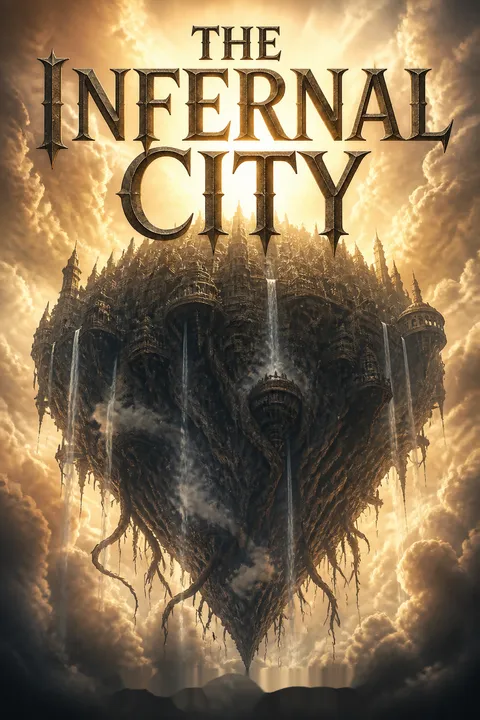
Aboard a ship off Black Marsh, Iffech feels the sea shudder, then sees a dark, cone-shaped mass emerge beneath green lightning. Its blast breaks the masts and kills much of his crew before the floating city draws near. Elsewhere, Sul wakes from a vision sent by Azura, a Daedric prince.
A face in the vision matches a portrait of Prince Attrebus, so Sul rides out to find him. Brief glimpses introduce Annaïg and Mere-Glim plotting an investigation in Lilmoth, and Colin being drawn into a murder for the Empire. The disaster has arrived, but its scattered witnesses do not yet know they share a story.
The opening makes catastrophe legible only in fragments. Iffech reads the sea through a sailor's senses, Sul interprets a dream through grief and divine guidance, and the brief introductions to Annaïg, Mere-Glim, and Colin show ordinary motives already in motion. The floating city is therefore not merely a threat approaching from the horizon. It is a rupture in several systems of knowledge: maritime instinct, prophecy, political service, and youthful curiosity. Sul's identification of Attrebus gives the vision a practical consequence, while the other glimpses suggest that the crisis will gather people who have no reason yet to trust one another.
Lilmoth's Crocodile Trail
Restless in her father's declining villa, Annaïg persuades her childhood friend Mere-Glim to help prove that a canal-side man is a were-crocodile. Their stakeout instead exposes a skooma smuggler working with criminal traders, and the pair escape the crumbling house using one of Annaïg's unreliable potions.
At home, Annaïg argues that the Empire could restore justice to Black Marsh, while Glim defends the An-Xileel and the Hist, the ancestral trees linked to Argonian life. Their debate ends when Glim reports that his cousin's ship saw a city floating toward Lilmoth. The news gives Annaïg the adventure she has been craving, but Glim's unease about the Hist and the city's approach turns her curiosity into a dangerous choice.
Annaïg treats danger as proof that life is finally happening; Glim treats survival as a sufficient achievement. Their failed were-crocodile theory matters because it shows how quickly Annaïg's imagination turns uncertainty into a story worth pursuing. The discovery of actual smuggling corrects her fantasy without curing her appetite for risk. Their political argument also grounds the adventure in Black Marsh's unsettled history: Annaïg wants an idealized imperial order, while Glim remembers Argonian power and distrusts anyone claiming to know what is best for others.
The Hist Goes Silent
Mere-Glim visits the Psijic priest Urvwen, who warns that something displaced from another world is nearing Lilmoth and may disturb the rules holding reality together. At a root of Lilmoth's Hist tree, Glim sees an ancient city and feels the tree's attention break away from him.
Annaïg's father, Taig, tries to put her on a ship to Leyawiin, but his guards seize her when she refuses to leave without him and Glim. Glim follows her using Coo, Annaïg's enchanted mechanical sparrow, and reaches the ship after it sails. He dives into the sea with her, carrying her through an attack by a huge sea-drake and onto the mangrove coast. They turn back toward Lilmoth, where their families remain.
The Hist's silence is both spiritual estrangement and a practical warning: Glim can no longer assume his people share one protective mind. Taig's attempt to save Annaïg through secrecy repeats the paternal logic she resents, yet his fear reveals that he knows more than he can explain. Glim's rescue changes their friendship from a bond that indulges Annaïg's adventures into one that bears their costs together. The sea-drake makes the crossing physical and immediate, while Coo becomes a fragile bridge between people who cannot safely remain in the same place.
The City Eats Lilmoth
From a high stone outcrop, Annaïg and Glim watch the approaching island descend toward Black Marsh. Annaïg's newly improved potion lifts them into a crevasse in the airborne mass, though Glim's mind has been seized by the Hist's command to go there. From the island's edge they see Argonians, humans, and sea creatures attack a plantation.
The invaders kill its defenders, then silvery threads draw from the bodies as the dead rise and join the advance. Glim understands that the Hist has aligned with the city against Argonians shaped by Imperial life, including his own family. Horrified, he agrees to help Annaïg act, even though neither knows what the flying city is or how to stop it.
The invasion transforms the pair's private disagreement about history into a visible political catastrophe. The dead do not simply disappear; their bodies become instruments of further violence, making the city's economy inseparable from its conquest. Glim's realization that the Hist has selected against the assimilated exposes the danger of treating ancestral authority as morally infallible. Annaïg's response is not a sudden mastery of events but a refusal to let uncertainty excuse inaction. Their decision to intervene begins as an ethical commitment made before they possess either adequate knowledge or power.
Two Captives, Two Systems
Inside the island, Annaïg and Glim learn from the disgruntled worker Wemreddle that Umbriel's larvae harvest souls from the dead, while a central machine uses those souls to keep the city moving. Rival kitchens compete for human captives and useful knowledge.
The chef Qijne claims Annaïg after a confrontation with another kitchen, then forces her to catalogue ingredients and cook under threat of mutilation. Glim is taken to the sump, where workers collect food and tend the process by which new inhabitants are born from soul-bearing forms.
He discovers that the people of Umbriel depend on painful vapors to breathe underwater, while the ingenium at the sump's deepest point powers their world. The two friends are now separated, each learning a different part of Umbriel's machinery.
Umbriel's horror is made more disturbing by its ordinary administration. Kitchens, work shifts, birth pools, and food deliveries turn soul theft into infrastructure rather than spectacle. Annaïg is valued for knowledge that might improve the system; Glim is valued because his body can perform labor others cannot. Their separate placements expose the same hierarchy from opposite ends, one organized around luxury and one around survival. The revelation that Umbriel's inhabitants are born and reborn within the city's cycle complicates any simple distinction between monsters and victims without making the harvesting of outsiders less brutal.
Attrebus Rides Against Orders
Coo reaches Prince Attrebus with Annaïg's warning that a flying city is killing people in Black Marsh. Emperor Titus Mede refuses a military expedition, judging the distant threat no immediate concern, so Attrebus secretly gathers his personal guard and rides south. He believes his reputation as a battle-tested hero will help him lead them.
On the road, Radhasa, the newest guard, betrays him: attackers kill the others, and she takes Attrebus captive to sell him in Elsweyr. Inspector Colin arrives at the massacre site and doubts that the headless, burned body marked with Attrebus's signet is the prince. A dead guardswoman confirms the prince was heading toward Black Marsh, giving Colin reason to suspect the evidence has been arranged.
Attrebus's choice is morally urgent but psychologically compromised: he acts against his father, yet still imagines himself as the hero of a familiar tale. Radhasa's betrayal strikes at both his life and his self-image, because he has mistaken a carefully managed public role for earned competence. Colin's forensic skepticism creates a counterpoint to the prince's impulsiveness. Where Attrebus acts on conviction, Colin asks what the evidence was designed to make people believe. The two men enter the same crisis from opposite failures of knowledge, one too trusting of his legend and the other trained to distrust appearances.
Sul Finds the Prince
Sul tracks Attrebus through Azura's vision, kills Radhasa's companions, and frees the prince. Attrebus learns that his victories were often staged: his guard and their opponents had been arranged to make his campaigns safe, while his companions mocked his ignorance. Sul says he needs Attrebus for the journey to Umbriel, but offers no comfort about the revelation.
The prince chooses to keep traveling with him rather than return home. In Elsweyr, the pair meet Lesspa and her free Khajiit clan, who need moon-sugar from Rimmen because the city's potentate bars them from buying it. Sul wants to use their hospitality and abandon the bargain; Attrebus insists on honoring it, even though doing so risks their mission.
The destruction of Attrebus's heroic self-image is not yet growth; it is disorientation. Sul's bluntness removes the protective story but cannot supply a new identity in its place. The moon-sugar bargain gives Attrebus a small, concrete test of character after grand claims about saving the world. By choosing to honor an agreement with people he barely knows, he begins to replace inherited reputation with observable conduct. Lesspa's clan also challenges his former assumption that Imperial subjects exist chiefly as allies in his personal campaigns.
A Prince Keeps His Bargain
Attrebus and Sul obtain the moon-sugar in Rimmen, where the public market exposes the costs of the potentate's control: Khajiit addicts crowd the streets, while free clans are excluded. On returning, the pair find regulators waiting to seize the contraband and threaten Lesspa's people. Attrebus identifies himself as the crown prince and uses the authority of his name to make the officers release the clan.
Lesspa, impressed that he returned with the sugar and defended them, agrees to continue with him. The prince's performance is still partly an act, but this time his command protects people rather than securing applause. Colin, meanwhile, follows evidence that someone inside the Imperial administration helped arrange the earlier ambush.
The scene gives Attrebus a first experience of authority that is not merely theatrical. His title works because the regulator still recognizes the Empire, but Attrebus uses that inherited power to defend a group the Empire's successor regime has marginalized. The distinction between performance and sincerity remains unsettled: he knows how to sound like a prince before he knows whether he can be one. Yet action changes the meaning of the performance. Lesspa responds not to a ballad about him, but to a decision with immediate consequences for her family.
Colin Tracks the Knife
Colin's investigation leads him to Letine Arese, an aide in the minister's office who failed to pass on Gulan's warning about Attrebus's departure. Colin follows her to a meeting with a criminal operative and hears that the prince's assassination was arranged from inside the palace. Arese says the killing failed and refuses to pay for another attempt.
Then an inhuman presence tears through the house, killing the criminal and his guards while Colin hides on the stairs. He escapes with the knowledge that Arese helped engineer the massacre, but cannot tell whether she acted alone or served a larger power. The attack makes the political plot feel connected to Umbriel, though Colin has no evidence to prove the link.
Colin's subplot tests whether an investigator can remain ethically awake inside an institution that rewards obedience. His early murder for the Penitus Oculatus taught him to suspend judgment; the prince's case makes that suspension untenable. Arese's conspiracy is a human attempt to control succession through violence, but the supernatural attack overwhelms the ordinary logic of political crime. Colin survives by resisting the impulse to flee, yet he leaves with only partial knowledge. His expertise can identify the hand that moved a knife without revealing the force that may have guided it.
Glim Maps the Sump
Glim adapts to sump work and saves Wert, a worker who nearly drowns when the breathing vapors fail. Exploring beyond his assigned routes, he climbs a vast tree in Umbriel's Fringe Gyre and meets Fhena, who tells him Annaïg is alive in Toel's higher kitchen. Before that, he finds Qijne's dead body and Annaïg's lost locket among the sump corpses.
Glim refuses to let grief stop him. After an overseer tortures him for challenging his authority, Glim helps Wert and other skraws organize a quiet work slowdown, using their control over births, food, and water as leverage. He arranges for the locket to reach Annaïg, turning a private keepsake into their only secure channel.
Glim's resistance grows from embodied knowledge rather than a theory of revolution. He understands that the sump workers control necessities because he has learned their labor from within, and he converts that knowledge into collective leverage. His encounter with Fhena briefly restores curiosity and pleasure, qualities Umbriel's hierarchy tries to reduce to utility. Finding Qijne's body threatens to collapse hope into grief, but the locket gives him a task that reconnects him to Annaïg. Glim's political awakening is therefore also relational: he acts not to become a hero, but to recover the possibility of acting together.
Annaïg's Kitchen Revolt
Annaïg's experimental dishes save Qijne's kitchen from losing its patron, but a rival kitchen attacks to claim her. Qijne dies in the fighting, and Chef Toel takes Annaïg and Slyr into his elite kitchen, where he rewards Annaïg's talent while testing whether she will sacrifice Slyr for advancement. Annaïg refuses to abandon her friend.
Slyr later poisons her, fearing that Toel's attention will displace her; Annaïg survives by instinctively mixing a stabilizer from nearby ingredients. Toel spares Slyr but warns her not to harm Annaïg again. After Glim's locket arrives, Annaïg recreates the flight tonic, meets him at the dock, and escapes with him into the air above Umbriel.
Toel offers Annaïg a seductive version of success: expertise, comfort, recognition, and a place near power. His condition is that she learn to treat attachment as an obstacle. Her choice to protect Slyr rejects that bargain, even after Slyr's betrayal makes loyalty costly rather than sentimental. The attempted poisoning forces Annaïg's alchemical knowledge to become survival instinct, not just intellectual play. Their escape depends on the same combination that has carried them through the story: Annaïg's improvisation and Glim's knowledge of Umbriel's hidden routes.
The Shortcut Through Oblivion
At Water's Edge, Attrebus finds his friend Florius Larsus and asks him to join the mission. Before they can leave, masked attackers kill Florius and a guard; one attacker is Riente, a man from Larsus's office. Attrebus blames himself for bringing his friend into danger, but Sul insists they must continue.
He explains that Umbriel's master, Vuhon, once helped build an ingenium to keep the Ministry of Truth suspended over Vivec City. The machine consumed souls, and when Sul tried to free Ilzheven, the ingenium broke, contributing to the disaster that destroyed the city and devastated Morrowind. To reach the ruins in time, Sul proposes a dangerous route through Oblivion. Attrebus goes with him and Lesspa's remaining clan.
The revelation about the ingenium replaces a distant fantasy of evil with a history of desperate choices and irreversible consequences. Sul's account is partial and emotionally charged, but it shows how a machine built to avert disaster can become the source of a greater one. Attrebus's grief for Florius intensifies his sense of responsibility, yet Sul refuses to let guilt substitute for action. The route through Oblivion makes the mission's moral urgency physical: they cannot reach the threatened world by safe, ordinary means, and every delay has a human cost.
Hircine's Relentless Hunt
Sul's portal deposits the travelers in Hircine's realm, where the Daedric prince's drivers pursue them through a vast forest. The Khajiit use their Senche-tigers to outrun the hunters, and Attrebus kills a bear-like beast when it pins him. Lesspa's brother dies holding off the pursuit, and the clan leads the survivors down a ravine as a stampede of enormous cattle crashes over the trail.
At night, Hircine joins the hunt with werewolves. Lesspa and the other Khajiit turn to fight, buying Sul and Attrebus time to reach the hidden passage. They plunge into a river gorge and arrive in the ruins of Vivec City. Sul searches the ash for Umbra, the sword cast through the old Oblivion rift, but finds it missing.
Hircine's realm turns the journey into a test of whether Attrebus can accept protection without confusing it with entitlement. The Khajiit fight with skill and chosen purpose, not as supporting figures in a prince's story. Their deaths make Sul's earlier warning about people dying for a leader painfully literal. Attrebus cannot repay the sacrifice by making it feel noble; he can only keep moving. The missing sword then refuses the relief of a completed quest. Survival has brought them to the right place, but history has already shifted the object they need.
The Sword Is Gone
At the Scathing Bay, Sul calls the spirit of Ilzheven, the woman he loved, and learns that Dunmer found Umbra after rain uncovered it. Its bearer wore a signet ring marked with a draugr and traveled north toward the Sea of Ghosts.
Before Sul and Attrebus can pursue the clue, Umbriel reaches the ruined city. Its dead army emerges from the boiling water, and the travelers fight toward the place where they entered the world. A conjured crocodile-headed Daedra helps Sul and Attrebus cut through the corpses, but they are surrounded and captured.
The dead carry them aboard Umbriel, where they are brought before the city's master. The sword's absence has redirected their mission, while the city's arrival has erased their chance to leave by the same path.
Ilzheven's appearance gives Sul a moment of tenderness without releasing him from vengeance. Her memory is not a solution but a reminder that the past contains more than its damage. The sword's movement north ties the old catastrophe to a new pursuit, yet Umbriel's arrival makes that pursuit secondary to immediate survival. The fight against the dead also reverses the usual battle fantasy: severed limbs and heads do not stop an army sustained by stolen souls. Captivity forces Attrebus and Sul to confront the intelligence behind the city rather than only its effects.
Vuhon's Beautiful Prison
Vuhon identifies himself as Umbriel's master and explains that he built the city into a self-contained world powered by an ingenium fueled by souls. He says Umbriel came to Tamriel because the city cannot safely exist in the other realms, and reveals a plan to seize the Imperial City and reach the White-Gold Tower.
He offers Attrebus safety and heroic status if he persuades Titus Mede to surrender. Sul rejects the bargain, and an enormous winged creature attacks Vuhon's glasslike restraints.
Sul summons a force from beyond them, shattering the prison; he and Attrebus vanish before either can settle the argument over Vuhon's account of the past. Meanwhile, Annaïg and Glim fly away from Umbriel, but their bodies begin to dissolve at the boundary. Unable to leave, they return to the city.
Vuhon's account turns Umbriel from a predatory machine into a political project. He claims to protect his own world, but his solution requires consuming another one and capturing its central symbol of power. His offer targets Attrebus precisely where he is vulnerable: it promises to convert shame about his false reputation into public heroism. Sul's escape interrupts both the bargain and the possibility of verifying Vuhon's version of the old disaster. Annaïg and Glim's failed departure makes the crisis intimate again: knowledge and courage cannot yet overcome the world's physical boundary.
Epilogue
Annaïg and Glim sit together after their failed attempt to escape Umbriel. Glim doubts that every loss can be repaired, but Annaïg decides they must return to the kitchens and keep searching for a way forward. Before she goes back to work, she imagines the capable, secretive person she might become and accepts that survival will require her to keep learning.
The Imperial City remains threatened, the sword remains elsewhere, and Attrebus and Sul have vanished from Vuhon's grasp. The story closes not with rescue, but with Annaïg choosing to stay engaged in a world that has taken her home from her.
The ending withholds closure on purpose. Annaïg and Glim have escaped immediate danger but not Umbriel, and their inability to cross the boundary makes the consequences of the city's unnatural existence bodily visible. Annaïg's decision to return to work is not acceptance of Toel's values; it is a strategic choice to remain close to knowledge and opportunity. The imagined future self, composed and competent, marks a change from her earlier belief that adventure itself would make her important. Now she understands that persistence, study, and responsibility are also forms of action.
Analysis
The novel makes catastrophe an argument about systems. Umbriel is terrifying not because it is inexplicable, but because its violence has become routine: souls are harvested, bodies are sorted, food is prepared, and new inhabitants are born into the same structure. The kitchens and sump give the floating city a social order, not merely a monster's appetite. That order helps explain why some of its inhabitants adapt, compete, or dream of advancement instead of resisting. Their accommodation does not erase their victimhood, but it shows how power recruits people through ordinary needs.
The book's parallel protagonists respond to compromised forms of authority. Annaïg distrusts the stagnation of Lilmoth and wants knowledge to produce justice, but she discovers that skill can be absorbed by a hierarchy unless she chooses what it serves. Glim's changing relationship to the Hist challenges the belief that ancestry guarantees moral wisdom. Attrebus, by contrast, begins with the authority of a title and the reputation of a hero, then finds that both were partly manufactured. Keeping Lesspa's bargain gives him a more grounded model of leadership: people trust the actions that protect them, not the stories told about a prince. Colin's investigation extends the question into the Empire itself, where obedience can disguise complicity and evidence can be deliberately staged.
Across these arcs, knowledge is valuable but never sufficient on its own. Annaïg can invent a flight tonic, Glim can map the sump, Sul can read the histories of Oblivion, and Colin can trace a conspiracy, yet every discovery exposes a larger force beyond their control. The characters' meaningful progress comes when knowledge becomes shared responsibility. Their loyalties, bargains, and acts of protection do not immediately defeat Umbriel, but they create alternatives to the city's logic of extraction. The ending preserves that tension: escape fails, the Empire remains in danger, and the sword is still missing. Hope rests not on a completed victory but on people continuing to learn, cooperate, and refuse the roles imposed on them.
Review Summary
The Infernal City received mixed reviews from Elder Scrolls fans. Many praised its exploration of the game's lore and unique setting, particularly the floating city of Umbriel. However, critics found the characters underdeveloped and the plot disjointed. Some felt it was inaccessible to those unfamiliar with the games, while others appreciated the immersive world-building. The writing style and pacing were criticized, with some finding it rushed or amateurish. Despite its flaws, many readers found it enjoyable, especially those invested in the Elder Scrolls universe.
People Also Read


Characters
Annaïg Hoïnart
Restless alchemistA young Breton from Lilmoth, Annaïg is curious, inventive, politically opinionated, and impatient with the narrowed life her family has endured since Black Marsh broke from the Empire. She reads constantly and believes knowledge should lead to action, which makes her brave but also prone to treating danger as an invitation. Her alchemy reflects her mind: she tests, combines, and revises rather than waiting for certainty. Her closest relationship is with Mere-Glim, whose caution challenges her without extinguishing her energy. Annaïg's deepest motivation is not fame alone; she wants proof that a person can make a difference. The tension between ambition and loyalty shapes the choices she faces in Lilmoth and beyond.
Mere-Glim
Argonian skepticMere-Glim is an Argonian and Annaïg's lifelong friend, shaped by the Hist and by a life between Argonian tradition and Imperial language. He is dryly humorous, observant, and wary of grand plans, especially when they come wrapped in claims of justice or progress. His caution is not cowardice; it comes from understanding how easily powerful people impose their desires on others. Annaïg is the person who can persuade him to cross boundaries he would otherwise avoid. Beneath his reluctance lies a serious capacity for loyalty and practical problem-solving. His thoughts about language, ancestry, and belonging reveal a character who experiences identity as layered rather than singular.
Attrebus Mede
Unseasoned crown princeThe son of Emperor Titus Mede, Attrebus is restless, sociable, and hungry for the kind of danger that will make him worthy of the stories told about him. He enjoys the company of his guard and believes their shared adventures have made them a family, but his confidence rests on an incomplete understanding of how his campaigns are arranged. He resists courtly confinement and wants to serve the Empire through action rather than ceremony. His charm can inspire people, though it can also mask entitlement and inexperience. The gap between the prince he imagines himself to be and the leader he hopes to become is central to his relationships with Sul, his soldiers, and the people he encounters.
Sul
Exiled Dunmer avengerSul is a guarded, battle-hardened Dunmer whose years in Oblivion have narrowed his attention to vengeance and survival. He understands forces that younger characters can barely name, but knowledge has not made him gentle or wholly trustworthy. He speaks to Attrebus with harsh impatience because he sees the prince's self-image as a danger to the mission. His grief for Ilzheven and his anger over Morrowind's destruction sit beneath a controlled, practical manner. Sul's competence makes him indispensable, while his secrecy and willingness to break obligations leave his motives open to question. He serves as both a guide through impossible terrain and a warning about what unresolved loss can make of a person.
Colin
Young imperial inspectorColin is an intelligent young recruit in the Penitus Oculatus, the Empire's secretive intelligence service. His training prizes discipline and technique, but his conscience keeps returning to the question of what an order makes him responsible for. He comes from poverty and sees imperial service as a chance to support his mother, which makes his new status both a genuine opportunity and a source of moral pressure. Unlike Attrebus, Colin distrusts narratives built around appearances; he studies bodies, tracks, and inconsistencies. His friendship with Nial gives him a rare space for candor outside the institution. Colin's storyline explores how someone trained to become an instrument might still preserve independent judgment.
Taig Hoïnart
Worried Lilmoth fatherAnnaïg's father is a once-wealthy Breton noble whose standing and fortune have eroded under the An-Xileel government. Since his wife's death, he has struggled to care for Annaïg while retreating into wine and exhaustion. His awkward tenderness often sounds like resignation, which frustrates his daughter, but he remains deeply protective of her. When danger approaches, he tries to secure her passage away from Lilmoth, acting on information he cannot bring himself to explain. His conflict is between preserving his child and remaining loyal to the place and political order that have defined his diminished life.
Titus Mede
Cautious emperorTitus Mede rebuilt the Empire after years of fragmentation and sees caution as a form of statecraft. He loves his son but distrusts Attrebus's appetite for grand adventures, especially when those adventures could put the restored Empire at risk. His refusal to send troops toward Black Marsh reflects a ruler's concern with distance, evidence, and limited resources, although that restraint may underestimate a threat before it reaches imperial borders. His relationship with Attrebus combines affection with control: he wants his son safe, but also expects him to accept the burdens attached to succession.
Gulan
Attrebus's steady captainGulan is Attrebus's trusted companion and a stabilizing presence among the prince's personal guard. He understands the risks created by Attrebus's impulsiveness and tries to temper them, though his loyalty also keeps him close to the prince's decisions. Gulan's practical judgment contrasts with Attrebus's desire for adventure, making him an important link between private friendship and military responsibility. His connection to the Imperial court gives his advice political weight as well as personal meaning.
Radhasa
Ambitious swordfighterRadhasa is a skilled Redguard fighter who joins Attrebus's personal guard because she wants real danger and action. She reads people sharply and has little patience for the prince's assumptions about heroism, friendship, and his own skill. Her confidence in combat is matched by an unsettling willingness to manipulate those around her. Radhasa embodies the difference between physical competence and moral trust: she can recognize Attrebus's weaknesses even as she uses them for her own purposes. Her presence forces him to question how much he truly knows about the people closest to him.
Lesspa
Free-clan Khajiit leaderLesspa leads a Khajiit clan living outside the control of Rimmen's potentate. She is poised, observant, and attentive to obligations, treating hospitality and reciprocity as serious social practices. Lesspa assesses Attrebus through what he does rather than the grandeur of his title, and she expects any alliance to involve a genuine exchange. Her pride in her people coexists with a clear understanding of the dangers facing them. She gives Attrebus a perspective on leadership rooted in kinship, collective survival, and mutual respect.
Slyr
Ambitious kitchen chefSlyr is a Dunmer cook who has spent years working in Umbriel's kitchens and wants to rise into a more privileged station. She is practical, sharp-tongued, and familiar with the informal rules that govern life under the chefs. Annaïg's arrival gives her access to new possibilities, but also threatens her sense of security. Her relationship with Annaïg shifts between assistance, envy, and dependence. Slyr's ambition is not abstract greed; in a system where status determines comfort and safety, advancement looks like protection. Her choices show how coercive institutions can make loyalty feel dangerous.
Qijne
Fearsome kitchen chiefQijne is a powerful chef whose authority rests on a fearsome reputation, volatile standards, and a weapon that is difficult to see. She treats cooking as competition for influence among Umbriel's lords and demands that those beneath her produce novelty on command. Her cruelty is direct rather than disguised: she makes the consequences of failure plain. Yet she also understands that talent has strategic value and recognizes Annaïg's usefulness. Qijne represents a workplace where creativity is prized only when it serves the appetite of those who hold power.
Toel
Cultivated master chefToel oversees an elite kitchen and approaches food, status, and people with the confidence of an artist who believes everything can be made useful. He recognizes Annaïg's inventive talent and offers her access to comfort and advancement. His attention can feel generous, but it carries expectations about ambition, obedience, and emotional detachment. Toel's calm manner makes his threats more disturbing, because he rarely needs to raise his voice to remind others who controls their future. He embodies Umbriel's capacity to make exploitation appear refined.
Vuhon
Dunmer powerbrokerVuhon is a cultivated Dunmer figure associated with Umbriel's highest reaches. He speaks with composure and takes evident pride in the intricate world around him. His manner suggests a person who has spent a long time making systems answer to his will, though the full history behind that control is contested. Vuhon's intelligence and self-possession make him a more unsettling presence than a simple tyrant: he can describe destruction as necessity and beauty in the same breath. His relationship to Sul is marked by an old, unresolved conflict.
Wemreddle
Midden dissidentWemreddle tends the foul Bolster Midden and resents the kitchen hierarchy above him. He offers Annaïg and Glim shelter, hoping their outside knowledge might help him change his position. His discontent is real, but his instinct for self-preservation complicates his usefulness.
Wert
Sump workerWert is a skraw worker who relies on painful breathing vapors to survive underwater labor. He is friendly and resourceful, but has learned to treat his poor conditions as ordinary. Glim's questions help him imagine that the sump workers might act collectively. His willingness to organize grows from practical concerns, especially bodily safety and fair treatment.
Fhena
Tree-dwelling UmbrielianFhena lives among the trees of Umbriel's Fringe Gyre and is eager to meet someone whose origins and experiences differ from her own. Her curiosity makes her a welcome contrast to the city's rigid hierarchies. She listens closely, asks questions, and helps Glim learn where Annaïg has been taken.
Urvwen
Ignored Psijic seerUrvwen is an elderly Psijic priest who tries to warn Lilmoth about the floating city's approach. His ideas about reality are difficult to follow, and the An-Xileel dismiss him as unreliable. Beneath his strange explanations is a serious concern that the world is becoming dangerously unstable.
Florius Larsus
Attrebus's old friendFlorius is a newly promoted Imperial captain and a childhood friend of Attrebus. He shares the prince's memories of youthful mischief, but has built a separate career within the army. His affection for Attrebus is genuine, even as imperial duty complicates what he can do for him. Their reunion reminds Attrebus of a time before court politics and public reputation crowded their friendship.
Letine Arese
Palace political aideLetine Arese works in the minister's office and moves through the palace's political world with more influence than her modest position suggests. She is calculating and careful about keeping her hands clean, relying on intermediaries to carry out violence. Colin's investigation reveals her as a dangerous figure within the imperial administration.
Ilzheven
Sul's lost belovedIlzheven is the woman Sul remembers with the greatest tenderness. His memories of her preserve a life of intimacy and ordinary beauty that stands in contrast to his years of violence and exile. She represents a personal past Sul has never been able to set aside.
Azura
Daedric guideAzura is the Daedric prince whose visions guide Sul toward Attrebus and the crisis around Umbriel. Her help is selective and often incomplete, leaving Sul to act without knowing whether she is aiding him or testing him.
Hircine
Prince of the HuntHircine is the Daedric prince who rules the realm Sul's party crosses on its way to Morrowind. His hunt gives his realm its law: the pursued may escape, but only if they survive the pursuit.
Plot Devices
Coo and the locket
Long-distance lifelineCoo is Annaïg's delicate mechanical sparrow, linked to a locket that can transmit images and sound between its bearer and the bird. Annaïg sends Coo to find Attrebus, giving him the evidence and personal appeal that prompt his journey toward Black Marsh. Later, the locket lets Annaïg and Attrebus communicate across the distance between Umbriel and Tamriel. After Annaïg loses it, Glim's discovery of the locket and return of a written message restore her contact with the outside. The device turns private trust into a practical communications network, but its limited light, reach, and availability keep it from solving the characters' problems by itself.
The Hist
Ancestral networkThe Hist are ancient trees whose roots connect the Argonians in a shared, partly collective relationship. Mere-Glim experiences that connection as a constant presence, while the An-Xileel claim political authority through their bond with the trees. When Lilmoth's city tree turns away from Glim and draws the assimilated Argonians toward Umbriel, the ancestral network becomes a source of threat as well as identity. The Hist complicate the story's ideas of community: shared origin does not guarantee shared judgment, and a collective voice can exclude those who do not fit its preferred way of life.
Umbriel's ingenium
Soul-powered world engineThe ingenium is the mechanism at Umbriel's heart. It keeps the floating city moving and sustains its cycle of matter, labor, death, and rebirth by processing souls taken from the world below. Annaïg first encounters its effects through the silver threads that rise from the dead; Glim learns where its conduit lies in the sump; Sul later connects it to the old catastrophe at Vivec City. The machine gives Umbriel material needs, political vulnerabilities, and a history that predates the invasion. It also makes the city's crimes structural: its inhabitants' survival is tied to a system that destroys other lives.
Annaïg's flight tonic
A way aboveAnnaïg's alchemical tonic lets its drinker rise and travel through the air, guided by desire and concentration. An early, imperfect version saves her and Glim from a fall, then carries them onto Umbriel. After Annaïg finds the ingredients in Toel's kitchen, she recreates the formula as a possible escape route. Its usefulness depends on more than chemistry: the drinkers must direct their movement, and the border between Umbriel and the ordinary world proves more dangerous than the potion can overcome. The tonic measures Annaïg's growth as an inventor, while showing that technical success cannot guarantee freedom.
Umbra, the sword
A missing weaponUmbra is an ancient sword connected to the ingenium, the Daedric prince Clavicus Vile, and the being Sul calls Umbra. Sul believes the weapon can affect the balance of power surrounding Umbriel and searches for it in the ash of Vivec City. A spirit tells him that Dunmer have already carried it north, toward the Sea of Ghosts. The sword's absence changes the route of the mission and leaves its importance unresolved. It is not simply a powerful object to retrieve; it holds the history of broken bargains and the possibility of changing who controls the city's engine.
Download PDF
Download EPUB
.epub digital book format is ideal for reading ebooks on phones, tablets, and e-readers.








