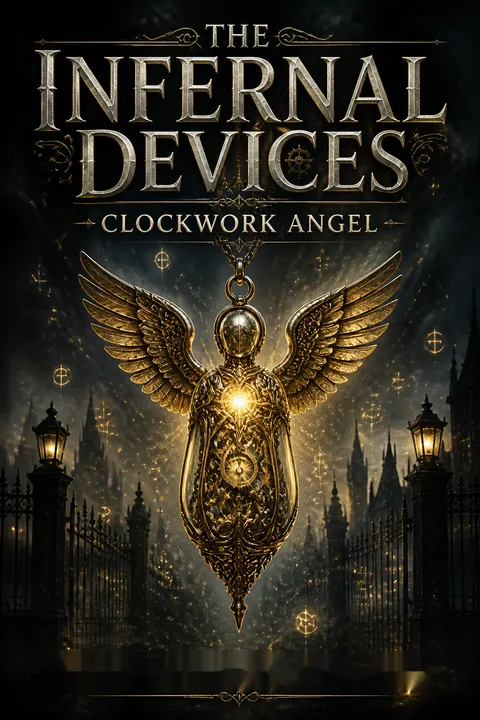


Plot Summary
Prologue
In a London alley, Shadowhunters Will Herondale and Jem Carstairs find a murdered girl after Will kills a pursuing demon. Jem notices the girl was stabbed elsewhere, and Will recognizes the double-serpent mark on the dagger beside her as an alchemical symbol. The clue points toward humans meddling in magic.
Weeks later, Tessa Gray arrives in England expecting to join her brother Nathaniel, but strangers sent in his name carry her instead to a locked house. The girl in the alley and the missing brother are already part of the same trap, though Tessa has not yet learned how tightly its threads are drawn.
The prologue braids a detective story into a rescue story before their protagonists meet. Will reads the alley as evidence, while Jem insists on the difference between a demon's pursuit and a human murder; their disagreement establishes both the pair's complementary temperaments and the novel's refusal to make supernatural evil the only source of violence. The ouroboros suggests a cycle, but its double form also signals an engineered mystery whose human makers are hidden behind occult imagery. Tessa's arrival then converts the clue into personal danger: what begins as an investigation into an unknown victim will become a question of kinship, coercion, and who has the right to define a person.
The Sisters Take Tessa
Tessa Gray crosses the Atlantic after her aunt's death, trusting a note that promises reunion with her brother, Nathaniel. At Southampton, the Dark Sisters claim Nate is delayed and usher her into their carriage, marked with the same double-serpent emblem Will found beside the murdered girl.
They lock Tessa in their house and threaten Nate's life until she obeys. Their lessons force her to Change into people whose belongings they provide, an ordeal that gradually becomes less physically overwhelming even as it strips away her confidence in her own identity.
When she inhabits Emma Bayliss, the dead girl from the alley, Tessa relives Emma's stabbing and learns a demon chased her. The Sisters decide Tessa is ready for their mysterious Magister.
Tessa's captivity is built from false intimacy: the Sisters exploit the trust she places in family, then make that trust the instrument of her obedience. Her power is not initially experienced as self-expression but as an invasion of self, because each successful transformation requires her to enter another person's memories and body. Emma's death gives the capacity an ethical dimension as well as a plot function. Tessa does not merely imitate the dead; she bears witness to violence they could not explain. The Sisters' praise and gifts complicate the abuse without softening it, showing how intermittent rewards can make coercion harder to name and escape.
A Jug Breaks the Prison
When Miranda, the Sisters' uncanny maid, tells Tessa she is to marry the Magister, Tessa understands that obedience will not keep her safe. She strikes Miranda with a brass globe, discovers the maid has no blood, and escapes into the street, only to be recaptured by the Sisters' coachman. Later, tied to her bed, Tessa remembers she can repeat a transformation she has already learned.
She becomes the smaller Emma, slips her wrists free, and attacks the intruder who enters her room. The stranger is Will Herondale, a young Shadowhunter investigating Emma's murder. He breaks the locked door with a rune, but the Sisters' house is surrounded. As they flee through its cellar, Tessa recognizes Emma's death story as the clue that led Will to her.
Tessa's first acts of resistance do not make her suddenly fearless; they show her learning to use the very skill imposed on her as a means of escape. Becoming Emma is both tactical and emotionally costly, since freedom requires Tessa to borrow a dead child's body again. Will's entrance offers rescue without instant trust: he knows the supernatural world, but not Tessa or her brother, and she must decide whether his actions deserve belief. Their flight turns the mystery into shared evidence. The dead girl is no longer a distant case, and Tessa is no longer only its surviving witness.
The House of Bodies
Will leads Tessa through a sealed cellar passage, where the Dark Sisters corner them in a room filled with butchered bodies and mechanical parts. Will's fellow Shadowhunters break through a wall; in the ensuing fight, he kills Mrs. Black, while Mrs. Dark escapes.
Tessa is injured and wakes at the London Institute, a hidden Shadowhunter stronghold run by Charlotte Branwell and her inventor husband, Henry. Charlotte explains the division between Shadowhunters, Downworlders, and ordinary people, then offers shelter while they search for Nate.
At dinner, Jessamine Lovelace dismisses Tessa as a supposed warlock, so Tessa proves her power by transforming into Jessamine. She feels a flash of the other girl's buried anger before returning to herself, leaving the household stunned.
The cellar makes the Sisters' private cruelty legible as a system: human bodies have become raw material, and the machinery points toward deliberate construction rather than spontaneous demonic violence. The Institute offers a moral contrast, but not a frictionless sanctuary. Its residents have rules, suspicions, and a claim to Tessa's information, so her caution remains rational. Transforming into Jessamine reverses the earlier use of Tessa's power: this time she chooses to reveal it, and the demonstration gives her agency while breaching another person's privacy. The moment makes her ability socially disruptive as well as useful, exposing how identity can be both intimate and observed.
A Girl in the Park
As Tessa learns the Institute's maze of rooms, she meets Jem Carstairs, Will's silver-haired parabatai and closest friend. Jem offers kindness without demanding Tessa explain herself, while Will alternates teasing with guarded hostility.
Charlotte and Henry visit Axel Mortmain, Nate's former employer, and learn he introduced the Gray family to the Pandemonium Club, a society of mundanes and Downworlders fascinated by magic. During a shopping trip, Jessamine admits she wants an ordinary life beyond Shadowhunter duties and proposes that Tessa become her respectable companion.
Their walk in Hyde Park turns dangerous when a goblin corners them on forbidden ground. Jessamine's parasol, secretly edged as a weapon, wounds it; shaken by her own violence, she collapses into Tessa's arms. Tessa sees the bravery beneath Jessamine's contempt for the life she was born into.
The park encounter makes Jessamine's contradiction physical: she longs to be protected as a conventional young woman, yet survives through the combat training she resents. Her sudden violence is not uncomplicated empowerment; she feels horror at what she has done, revealing the cost of denying a capacity that danger nevertheless demands. Tessa, meanwhile, begins to build relationships by listening rather than by trying to classify people as allies or threats. Jem's steadiness and Jessamine's confession offer different kinds of recognition. The scene also complicates the social world of the Institute: its inhabitants are not simply brave or cowardly, but people negotiating identities that their community assigns them.
The Automaton's Heart
Will and Jem return to the Dark House and find Miranda's body, which proves to be a human-skinned automaton with a hollow metal chest. Henry identifies the machine's construction, and Charlotte explains that the Sisters harvested human remains to build such creatures.
A marked mechanism inside Miranda links the work to vampire leader de Quincey. Meanwhile, Charlotte confronts Mortmain, who admits that Nate joined the Pandemonium Club and later worked for a powerful member.
He identifies de Quincey as the club's head, the Magister, after Charlotte finds Mortmain's cogs in the Sisters' cellar. Lady Belcourt, a vampire informant, warns that de Quincey secretly tortures humans at his parties. She offers a way to gather proof: Tessa can impersonate Camille, allowing her and Will to enter his house.
The automaton is a hinge between Gothic horror and industrial modernity. The horror does not come from machinery alone, but from a culture that treats the human body as replaceable parts and technological progress as morally neutral. Mortmain's cogs and de Quincey's seal appear to settle the investigation, but the evidence is conspicuously mediated by objects and testimony rather than direct observation. The Shadowhunters' desire for lawful proof is therefore both principled and vulnerable to manipulation. Tessa's ability becomes an investigative instrument, yet the plan asks her to risk another transformation after it was first forced upon her. Protection and exploitation begin to resemble one another in the eyes of someone who has already been deceived.
Camille's Borrowed Face
Tessa accepts Camille's necklace and learns how frightening it is to wear a vampire's body: her heart stops, her skin turns cold, and the borrowed instincts bring hunger with them. Jem steadies her by reminding her that the transformation has not erased her selfhood.
While she practices Camille's posture and voice, the Institute prepares an infiltration of de Quincey's party. Will will pose as her human subjugate, and Magnus Bane, Camille's warlock lover, will guide them inside.
On the journey, Will reveals that he uses fictional characters to face actions he dreads, briefly letting Tessa see the tenderness beneath his performance. At the party, de Quincey recognizes Camille and shows an intimate, possessive familiarity. Tessa's borrowed memories help her deflect his interest in biting Will and keep their cover intact.
The transformation makes identity an embodied problem rather than an abstract puzzle. Tessa can reproduce Camille's appearance and instincts, but her sense of self persists inside a body with different needs, forcing her to distinguish possession from performance. Jem's reassurance matters because it recognizes continuity without denying the physical shock. Will's vulnerability in the carriage creates a brief counterpoint to his public bravado, though their attraction remains entangled with the disguise: Tessa cannot be sure whether he sees her or Camille. The operation asks Tessa to use empathy as camouflage, drawing on another person's memories to survive a predatory social order.
The Party Turns to Fire
At de Quincey's house, Tessa sees vampires draw blood from human subjugates while Will waits for a clear breach of the Law. De Quincey brings out a hooded prisoner and cuts his throat before the watching crowd. When the hood comes off, Tessa recognizes Nate and orders Will to signal the Enclave.
Henry's Phosphor malfunctions, setting the curtains alight instead of sending its intended flare, and the Shadowhunters storm the house amid smoke and panic. Tessa runs toward Nate while Will fights vampires and kills a human servant who attacks him.
The Enclave defeats de Quincey's clan, but de Quincey escapes through a window. Tessa frees Nate, and Will returns to the Institute with vampire blood in his system, requiring holy water to prevent it from changing him.
The party converts spectatorship into complicity. De Quincey's guests treat a human's suffering as entertainment, and the Shadowhunters must wait until harm is visible before intervening under the Accords. Tessa's recognition of Nate breaks the operation's controlled distance: she acts not as Camille but as a sister, and her urgency helps expose the mission. The failed Phosphor emphasizes how fragile institutional plans can be when they rely on a single device and a narrow window of proof. Will's killing of the subjugate complicates the rescue's moral clarity, even as he protects others. The victory is real but incomplete, because the leader escapes and the rescued brother returns gravely ill.
The Bridge's Metal Hands
As Nate recovers, Tessa helps Will drink the holy water that expels de Quincey's blood, and the two share a kiss that Will abruptly ends. Jem later tells Tessa that a demon's poison killed his parents and left him dependent on a silver drug that slowly destroys him.
During a nighttime walk, Jem takes Tessa to Blackfriars Bridge, where the dead coachman and another apparent servant reveal themselves as clockwork machines. Jem fights them with the blade hidden in his cane, but he collapses when the strain overwhelms him.
Tessa reaches the Institute with him, only for the machines to use his blood to breach its wards. The Shadowhunters destroy most of the attackers, but one escapes after killing Agatha. The attack leaves Jem injured, the household in mourning, and the Institute exposed.
This sequence links intimacy to vulnerability without making either a cure for the other. Will's sudden retreat after the kiss shows how desire can activate fear rather than resolve it; Tessa is left interpreting his silence while facing a brother's illness and Jem's history. Jem's confession reveals a different relationship to suffering: he acknowledges dependence without reducing his worth to it. The automata then literalize the danger of treating bodies as access points. Jem's blood, the substance that marks his kinship with the Institute, becomes the means by which its defenses fail. The attack demonstrates that belonging can protect, but it can also make a person legible to an enemy.
Nate's Story Unravels
After recovering from the attack, Nate explains that he found pages from their mother's diary in a false bottom of her jewelry box. The pages showed that their parents had attended Pandemonium Club meetings after Mortmain introduced them to its occult circle.
Nate used that knowledge to approach Mortmain, then became addicted to the club's enchanted gambling drinks and fell into debt. He says de Quincey coerced him into summoning Tessa, but also reveals the vampire planned to animate an army of automatons at the full moon.
The Shadowhunters realize the deadline is that very night. Before they leave, Mortmain appears with intelligence about the Dark Sisters' Highgate workshop, persuading Will and Jem to go there while the Enclave targets de Quincey's supposed hideout.
Nate's account shifts the story from rescue to inherited secrecy. The diary shows that Tessa's parents encountered the Shadow World before she did, so the supposedly ordinary life she hopes to recover may never have been as separate as she imagined. Nate's gambling is both a vulnerability and a choice: enchantment exploits his appetite for risk, but his desire to win makes him easy to recruit. The apparent urgency of the full moon gives the deception its power, compelling the Shadowhunters to divide their forces. Mortmain's information feels useful because it fits what they already believe. The episode shows how a plausible story can become a weapon when fear makes verification seem like a luxury.
The Magister's True Face
At the Highgate mansion, Will and Jem find Mrs. Dark performing necromancy rather than preparing the automaton spell. She reveals that de Quincey was never the Magister and that she fears a different master. In the Institute, Mortmain enters with clockwork guards while Nate kneels to him as his chosen disciple.
The machines attack Agatha, and Tessa, Jessamine, Sophie, and Thomas try to defend the household. Nate turns on his sister, while Mortmain orders Jessamine and Sophie seized. Will rides back from Highgate after realizing the warning was a diversion; Jem follows by carriage.
Mortmain isolates Tessa and demands that she transform using a watch, hinting that he knows more about her origins than he has admitted. Tessa refuses unless he explains why he created her, then threatens to stab herself rather than submit.
This passage interweaves the Highgate discovery with the attack at the Institute, but does not claim that the events occur in a single location or in a simple sequence. The moments at the party, the bridge, and the beginning of the Institute siege are covered in earlier sections; this turn adds the Magister revelation and Tessa's confrontation with Mortmain.
Blood at the Sanctuary
Tessa presses Jessamine's knife into her chest and Changes into a woman whose fatal wound makes blood spread across her dress. Mortmain believes her dead and Will, arriving at the Sanctuary, attacks him; Mortmain vanishes before Will can strike.
Tessa returns to herself and explains how she used the transformation to survive. Outside, Jem and the returning Shadowhunters find Nate with Jessamine and Sophie captive, using an automaton to carry the Pyxis, a vessel for captured demon energy.
Jem fights the machines with Henry and Charlotte, freeing the two women, but Nate escapes with the Pyxis. The Enclave has killed de Quincey and destroyed the vampire clan, only to learn the supposed threat was a diversion. Agatha and Thomas are dead, Mortmain remains at large, and his weapon is now beyond the Institute.
The climax gives Tessa's power a new ethical shape: she uses a memory of another person's death not to satisfy a captor's demand, but to misdirect him and preserve her own agency. Her apparent death is a performance, yet its success depends on the body retaining real consequences: the transformation knocks her unconscious. Around her, the Shadowhunters win a fight without securing its object. Nate's escape with the Pyxis makes the victory strategically incomplete, while the deaths of Agatha and Thomas show that institutional loyalty cannot guarantee survival. The contrast between Tessa's improvised deception and Mortmain's calculated schemes also marks a shift: she is no longer merely the mystery others pursue.
A Place Among Shadows
After the funerals, Tessa expects Charlotte to send her away, but Charlotte asks her to stay and help preserve the Institute's alliances with Downworlders. Tessa accepts, then seeks Will on the roof.
He kisses her before cruelly presenting their closeness as a casual arrangement, and explains that a Shadowhunter cannot marry a warlock. Tessa leaves hurt, unsure whether Mortmain was right that she has no single true face. Jem finds her reading the Codex and offers to help uncover the truth of her origins, while reminding her that the Institute can become a family by choice.
Tessa decides she wants the truth. When Jem opens a window, her clockwork angel flies into her hands, its wings briefly unfolding before it settles against her palm, ticking.
The resolution refuses to equate belonging with romantic acceptance. Tessa chooses the Institute because its residents have become meaningful to her, even as Will's rejection wounds her and the future of her relationship with him remains uncertain. Charlotte's invitation is also strategic, reminding Tessa that hospitality can be sincere and still serve institutional interests. Jem offers a contrasting intimacy: he supports Tessa's search without claiming to solve her identity for her. The angel's flight provides an image of latent capacity, but not an explanation; the mystery remains open. The book closes its immediate crisis by giving Tessa a place from which to ask questions, rather than pretending she has already found a final answer.
Epilogue
At Camille's London home, Magnus Bane is waiting alone while Camille remains away after the violence at de Quincey's party. Will arrives soaked from the rain and asks Magnus for help, admitting that there is no one else he can approach.
Magnus sees a boy whose usual mask has cracked under some private anguish, but Will does not yet explain what has happened. The scene ends with the request still unanswered, turning the novel's final image away from the Institute's battered household and toward the secret Will has kept from his friends.
The epilogue changes the reader's access to Will without disclosing the secret itself. His drenched clothes and shaking hands make visible a distress that his practiced sarcasm has concealed throughout the novel. Choosing Magnus, a Downworlder, as the one person he can ask for help also complicates the divisions the Shadowhunters defend: in crisis, Will crosses the boundary their institutions maintain. Magnus's perspective recognizes the difference between beauty and emotional accessibility, suggesting that Will's mystery is not simply a puzzle to solve but a form of isolation. The ending preserves uncertainty deliberately, leaving the next movement of the story anchored in a confession not yet made.
Analysis
Clockwork Angel makes the act of naming a person one of its central conflicts. Tessa's power allows her to wear other faces and access memories, but it does not give her a stable account of her own origin. Mortmain turns that uncertainty into a tool of control: he claims to have made her, treats her capacity as property, and offers knowledge only in exchange for submission. Tessa's resistance therefore depends less on discovering a final identity than on asserting the right to withhold herself.
The novel also tests the boundary between human and nonhuman through repeated bodily comparisons. The Dark Sisters harvest human bodies for machines; vampires preserve themselves by feeding on people; Jem's body carries the continuing cost of demonic violence; and Tessa's transformations make another person's history physically present. None of these bodies is merely symbolic. Each bears consequences that the characters must confront, which prevents the supernatural from becoming an excuse to ignore material suffering.
Institutions fare no better than individuals when they mistake procedure for justice. The Accords restrain the Shadowhunters, but their rules require proof that Camille cannot safely provide. Mortmain exploits their prejudice and their appetite for orderly evidence, directing them toward de Quincey while dividing their forces. Charlotte's authority is challenged not because she lacks competence, but because competence does not automatically grant a woman institutional trust. The relationships offer competing models of care. Tessa's bond with Nate is loving but shaped by years of shielding him from consequences. Will protects others while hiding his motives, making his affection difficult to trust. Jem offers a more explicit ethic of recognition, seeing Tessa as a person before deciding what her power means. The Institute becomes a possible family not because it is free of conflict, but because its members can choose responsibility for one another. The ending preserves uncertainty about Tessa's parentage and Will's secret, while resolving a more immediate question: Tessa can belong without surrendering the right to define herself.
Review Summary
The Infernal Devices manga adaptation receives mostly positive reviews, with readers praising the artwork and enjoyment of revisiting the beloved characters. Many appreciate the visual representation of the story, though some find certain scenes confusing or rushed. Fans of the original series express delight in experiencing the story in a new format, while others feel it lacks depth compared to the novels. The manga serves as a quick, entertaining refresher for longtime fans and may interest new readers, though some suggest it's best appreciated after reading the original books.
Characters
Tessa Gray
The borrowed-face witnessAn American teenager who arrives in London believing she can rebuild a life with her older brother. Tessa is bookish, observant, and protective, with a strong instinct to resist being treated as helpless even when she is frightened. Her ability to transform into people whose belongings she holds makes questions of identity immediate and physical: she can enter another person's appearance and memories, yet remains uncertain what makes her herself. She values loyalty, but her attachment to Nate can make her defend him past the point where the evidence warrants it. Around the Institute, she begins to form connections through curiosity and compassion, while learning that independence does not require refusing every offer of help.
Will Herondale
The reckless bladeA young Shadowhunter whose dazzling confidence, irreverent humor, and appetite for danger make him difficult to read. Will deflects questions with jokes and often behaves as though no consequence can reach him, yet his loyalty to Jem is fierce and instinctive. He is a capable investigator and fighter, but his talent does not make him emotionally transparent; he is wary of being understood and uses provocation to keep others at a distance. Tessa's directness unsettles his usual performance, while his affection for his friends appears most clearly when he is protecting them. He is both magnetic and frustrating, a person whose bravado conceals more than it explains.
Jem Carstairs
The quiet steady handWill's parabatai, a Shadowhunter from Shanghai whose calm manner and musical sensitivity provide a counterweight to Will's volatility. Jem listens closely and tends to offer care without making it feel like a debt. His gentleness is not passivity: he is a skilled fighter who accepts danger as part of his chosen work. He has experienced profound loss and carries a private physical vulnerability, but he resists being reduced to either. Tessa is drawn to his willingness to ask who people are, not simply what they can do. His loyalty to Will is deep, though it does not prevent him from challenging his friend's decisions.
Charlotte Branwell
The Institute's resolute headThe young head of the London Institute, responsible for its residents, its operations, and the Shadowhunters' obligations to the wider supernatural community. Charlotte is physically small but commands a room through preparation, intelligence, and disciplined resolve. She believes that law and protection matter most when they restrain the powerful, though she must repeatedly defend her authority among people inclined to underestimate her. Her care for the Institute's young residents is practical rather than sentimental: she feeds, teaches, shelters, and expects them to contribute. She can be blunt and politically calculating, yet her instinct is to make room for those whom other institutions would abandon.
Henry Branwell
The inventive husbandCharlotte's husband and the Institute's endlessly curious inventor. Henry is genial, absent-minded, and more at ease with mechanisms than with political conversation, but his experiments arise from a genuine wish to protect the people around him. His inventions often malfunction, which makes him an easy target for mockery, yet his technical knowledge proves valuable in investigating mechanical threats. He and Charlotte have an affectionate but uneven partnership: she manages the Institute while he disappears into his laboratory, and his loyalty is clearest in the risks he takes when others are in danger. His awkwardness should not be mistaken for a lack of courage or care.
Jessamine Lovelace
The unwilling warriorA young Shadowhunter who longs for the sheltered, conventional future she believes her parents intended for her. Jessamine is beautiful, socially adept, and often scornful of the Institute's demands, but her contempt masks grief for a home and family she has lost. She resents being trained to fight and prefers to imagine herself as a lady rather than a warrior. That preference does not erase her competence or the conflicts between her ideals and her abilities. She can be cruel about class and appearance, yet also offers unexpected gestures of generosity. Her shifting behavior reflects a young woman trying to choose a life inside a world that has already chosen one for her.
Nathaniel Gray
Tessa's fragile brotherTessa's older brother, raised with her by their practical Aunt Harriet after their parents died. Nate is charming, imaginative, and drawn to visions of future success, but his dreaming can make him reckless about money and consequences. Tessa has long protected him, which gives their bond warmth and an imbalance: she often takes responsibility while he expects rescue. He is closely connected to the circumstances that bring Tessa to London and to the Shadow World, though he does not initially understand its rules. Nate's vulnerability and vanity coexist, making him harder to judge than Tessa's childhood memories allow.
Axel Mortmain
The industrial patronA wealthy industrialist and inventor whose company manufactures the mechanical parts used in clocks and other devices. Mortmain is polished, curious about occult practices, and accustomed to dealing with people who want access to his money or influence. His worldly ease makes him appear less threatening than the supernatural figures who openly display their power. He has a history with the Gray family through his employment of Tessa's father and later Nathaniel. Mortmain's interest in the Shadow World grows from an intellectual fascination with what lies beyond ordinary knowledge, a pursuit that places him in contact with forces he cannot assume he controls.
Sophie
The scarred housemaidA maid at the Institute who has the Sight and can perceive what ordinary people overlook. A facial scar marks her past mistreatment, but it does not define the intelligence, dignity, and dry humor with which she handles her work. Sophie is loyal to Charlotte, wary of Will, and quietly attentive to the people around her. Her position as a servant gives her a different view of the household's hierarchies, and she is not afraid to speak plainly when she believes someone has behaved badly. Her feelings for Jem remain guarded, shaped by both affection and the strict limits she places on herself.
Thomas
The loyal armorerA large, good-natured servant at the Institute who drives the carriage, maintains weapons, and assists the Shadowhunters in practical ways. Thomas comes from a family that has long served the Nephilim, but his closeness to the young fighters is personal as well as inherited. He is friendly without being foolish and treats Tessa with courtesy even when she startles or challenges him. His affection for Sophie is evident in the extra care he takes around her, though he does not presume to speak for her. Beneath his easy manner is a dependable courage that becomes especially clear when the household is threatened.
Axel de Quincey
The vampire clan leaderA powerful London vampire who leads the Night Children and moves easily among both Downworlders and members of the Pandemonium Club. De Quincey is cultured, politically experienced, and conscious of how the Accords constrain his authority. His polished manners do not make him gentle; they allow him to exercise power without appearing to strain for it. He has a long history with Camille Belcourt and an uneasy relationship with Shadowhunter leadership. Through him, the story shows how formal alliances can conceal resentment, and how an individual may invoke law when it protects his position while disregarding its obligations to others.
Camille Belcourt
The vampire informantA vampire baroness who provides information to Charlotte and moves through London society with practiced elegance. Camille is intelligent, self-possessed, and careful about revealing her motives. She knows how power travels through personal loyalties, clan politics, and old grievances, and she expects others to understand that every alliance has a cost. Her relationship with de Quincey is complicated by a past attachment and a loss she has not forgotten. Tessa's ability to borrow Camille's form briefly makes Camille's private memories part of the investigation, while also showing that the vampire's poise conceals intense feeling.
Magnus Bane
The glittering warlockA knowledgeable warlock with a flamboyant style, sharp humor, and an unusually perceptive understanding of supernatural politics. Magnus is Camille's lover and an occasional source of help to the Shadowhunters, though he does not mistake usefulness for equality. He can be teasing, but his wit does not prevent him from recognizing the danger in de Quincey's household or the strain Tessa feels when she transforms. He is comfortable crossing social boundaries that the Nephilim treat as fixed. His presence gives Tessa a first glimpse of a Downworlder who is neither captor nor monster, while reminding the Shadowhunters that cooperation must be mutual to mean anything.
Mrs. Black
The cruel trainerOne of the Dark Sisters, a warlock who helps imprison and train Tessa. Mrs. Black favors threats and force over persuasion, and regards Tessa's ability as a resource to be shaped for someone else's use. Her apparent concern for Tessa's progress is inseparable from her desire to be rewarded by the Magister. She participates in the Sisters' trafficking in bodies and supernatural services, making her house feel less like a home than a workshop of coercion.
Mrs. Dark
The persuasive trainerThe other Dark Sister, who often uses a coaxing manner where her sister uses open cruelty. She helps train Tessa's transformations and understands how praise, promises, and threats can all be used to secure compliance. Mrs. Dark's ambition is tied to the Magister's approval, and she treats Tessa as the means to that favor. Her household's human servants and hidden cellar reveal a brutal disregard for ordinary lives, even when she presents herself as patient or reasonable.
Brother Enoch
The Silent healerA Silent Brother, one of the Nephilim's healers, whose scarred, eyeless appearance frightens Tessa and Nate. He communicates mind to mind and approaches medical care with disciplined detachment. Brother Enoch is not interested in making his patients comfortable through appearances; he is interested in treating what endangers them. His knowledge gives him insight into Tessa's unusual nature, but even he cannot immediately explain it. He represents the Institute's unsettling truth that help may arrive in a form that looks more frightening than the threat.
Gabriel Lightwood
The proud young rivalAn eighteen-year-old Shadowhunter from a prominent family, sharp-tongued and quick to challenge Will. Gabriel values rank, reputation, and the approval of his father, though his views are not always identical to his family's. His hostility toward Will has a history that Tessa does not initially understand. In the Enclave, he argues for a role in the coming operation and presents himself as more responsible than his rival. His pride can make him unkind, but he is also shaped by the exacting expectations attached to the Lightwood name.
Benedict Lightwood
The status-minded Enclave elderGabriel's father and a senior Shadowhunter who questions Charlotte's judgment and worries about the political consequences of acting against de Quincey. Benedict is formal, ambitious, and protective of the authority held by established families. He is not eager to accept evidence from Downworlders, reflecting a strain of Nephilim culture that treats the Accords as a constraint rather than a shared obligation. His presence turns the investigation into a test of institutional power as well as a hunt for a criminal.
Agatha
The Institute's steady cookThe Institute's cook, a pipe-smoking woman with a calm manner and a touch of the Sight. Agatha helps make the fortress feel like a household, maintaining its routines amid the Shadowhunters' dangerous work.
Church
The rescued church catA gray Persian cat found among the Dark Sisters' ritual preparations. Jem rescues him, and the Institute keeps him as its resident church cat. Church's presence offers a small, stubborn sign of ordinary life amid the household's violence.
Plot Devices
The clockwork angel
A ticking talismanTessa wears the tiny brass angel that belonged to her mother, and its steady ticking comforts her during the Atlantic crossing and her captivity. It links her to a past she believes is ordinary, while its unexplained construction echoes the novel's interest in clockwork and human identity. The pendant later behaves in ways Tessa cannot explain, making it more than a sentimental keepsake. Its meaning remains unresolved at the close, but its return to her hand signals that her history may contain more than she knows.
The Change
Identity as evidenceTessa can transform into a person whose belonging she holds, taking on that person's appearance, voice, and manner, while also encountering their thoughts or memories. The Dark Sisters train her through coercion, but the ability becomes useful when Tessa chooses to reveal it at the Institute and later impersonates Camille to enter de Quincey's house. It lets her understand victims and infiltrate guarded spaces, but it also creates physical and psychological strain. The power makes Tessa difficult to classify, and its unexplained origin becomes one of the story's central unanswered questions.
The automatons
A manufactured armyHuman-shaped machines built from clockwork, metal, and harvested human remains. Early versions imitate human movement without possessing independent life; a binding spell is intended to animate them with demonic energy. Their blank faces and mechanical strength turn industrial invention into a physical threat. The automatons also provide the story's false trail: evidence connects them to de Quincey, while their makers and true purpose remain concealed. Their use of Shadowhunter blood to breach the Institute's wards demonstrates that the machines can exploit protections designed for living people.
The Pyxis
Captured demon energyA protected container used by Shadowhunters to hold the residual energy of demons they have killed. Its restriction to Shadowhunter touch seems to make it secure, but that security depends on a distinction between living beings and machines. The Pyxis becomes a target because Mortmain wants the energy inside it for his experiments. Its vulnerability exposes a weakness in the Institute's defenses and makes the Shadowhunters' assumptions about what counts as alive strategically dangerous.
The Accords
A law under pressureThe Accords govern peace between Shadowhunters and Downworlders, while Covenant Law defines what conduct the Nephilim may punish. They prevent the Shadowhunters from attacking de Quincey solely on Camille's accusation; they need to witness him harming a human. This demand for evidence gives Will and Tessa's infiltration its purpose, but the rules also become political instruments that powerful figures can exploit. The Accords represent a real attempt at coexistence, yet the novel shows that legal equality is fragile when one group controls enforcement and distrusts the testimony of another.
About the Author
Other books by Cassandra Clare




Download PDF
Download EPUB
.epub digital book format is ideal for reading ebooks on phones, tablets, and e-readers.








