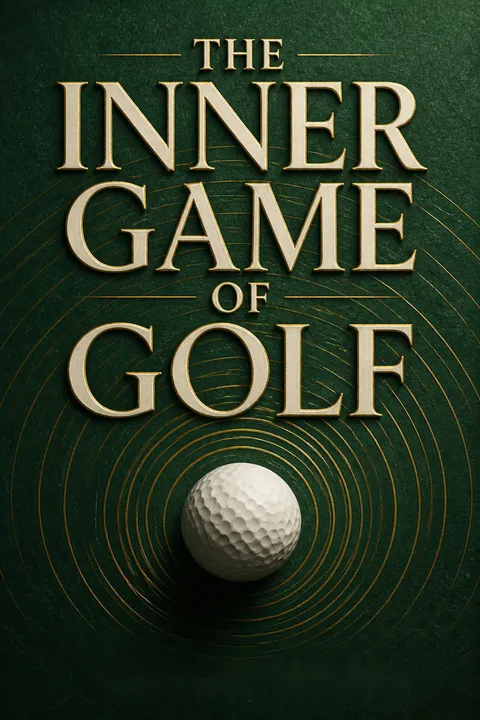


Key Takeaways
Improve your golf by reducing interference, not micromanaging every muscle.
Two selves, one swing. Gallwey describes Self 1 as the verbal, judging voice that issues instructions and criticism. Self 2 is the whole body, with its capacity to coordinate movement and learn from experience. The golfer’s task is not to make Self 2 obey more commands, but to quiet the interference that keeps it from acting well. Gallwey summarizes this as performance equaling potential minus interference, not potential multiplied by effortful control.
A beginner’s experiment. Returning to golf after years away, Gallwey fell into the familiar cycle: miss, diagnose, correct, tighten, and miss again. He had seen in tennis that one removed doubt could improve several parts of a player’s movement at once. Golf, he argues, offers the same lesson: mechanics matter, but they do not explain why a golfer often swings freely on the range and stiffens on the course.
The two-selves model is memorable because it separates useful information from the self-criticism attached to it. It also resembles modern accounts of skilled action as partly automatic: practiced movement depends on coordination that conscious narration cannot micromanage in real time. The model is best treated as a practical metaphor, not a literal division of the brain into two independent agents. Conscious thought still helps with planning and learning. Its trouble begins when it tries to supervise every millisecond of a complex swing.
Give your mind a beat to follow, then let your body swing.
Mark the moving club. Gallwey developed back-hit-stop to give attention a concrete job: notice when the club reaches the top of the backswing, when it contacts the ball, and when the follow-through ends. The words label moments; they are not commands to move. A four-beat version, using a repeated syllable, can mark the takeaway, backswing, impact, and finish. Feeling the clubhead provides both a focus and feedback about the swing.
Focus, not magic. Gallwey reports that this practice helped lower his average score from about 95 to 88. Dean Nims, a frustrated golfer, said a related hit-and-bounce focus accompanied a round of 76, after he had never broken 85. Such anecdotes illustrate the method, not a guaranteed result. The words lose their value if treated as lucky charms; their purpose is to occupy the mind with timely attention instead of swing control.
A well-chosen attentional anchor can reduce the mental bandwidth available for rumination while sharpening perception of the task. That combination is more useful than simply ordering oneself to concentrate. The clubhead is also a sensible focus because it moves and supplies immediate sensory information, unlike the stationary ball. Still, spoken cues are not universally comfortable, and too much self-monitoring can disrupt fluid action. The exercise is most useful when the cue keeps attention engaged without becoming another performance test.
Treat tension as a signal of doubt, not a swing flaw to attack.
Tightness blocks power. Gallwey uses overtightness to describe contracting more muscles than a movement needs, failing to release muscles at the right time, or contracting them at the wrong time. Each can restrict the swing. Tight shoulders may shorten the turn, while tense hands can interfere with the clubface. Because the swing involves too many finely timed actions to manage one muscle at a time, Gallwey advises noticing restrictions rather than trying to correct each symptom.
Make tension perceptible. Humming during a swing helped Gallwey hear when his body tightened: his voice strained or cut off around impact. He also describes briefly tightening a muscle group and then releasing it to make relaxation easier to feel. He links this response to doubt about the unfamiliar or uncertain, which can lead either to giving up or to trying too hard. Awareness, rather than a shouted order to relax, is his first step toward change.
The account connects mental threat with physical co-contraction, a plausible way for the body to brace when an action feels uncertain. Humming is a simple form of biofeedback: it makes a subtle change easier to notice without requiring a technical diagnosis. But not every slice or shank is a disguised emotional problem. Equipment, fatigue, skill, and mechanics also matter. The practical gain is not assuming that doubt explains every error, but checking whether tension is adding a second problem to the first.
Ask what happened before telling your body what it should do.
Notice before correcting. Gallwey calls a direction to attend to an experience an awareness instruction. Unlike a command such as “keep your head still,” it asks the golfer to notice how much the head moves, without labeling the movement wrong. The aim is to make sensations and results more discriminable, so the player can learn from them rather than struggle to obey a verbal recipe.
Turn mechanics into questions. To explore a swing path, a coach might ask the player to notice whether the club travels more inside-out or outside-in, then compare one swing with the next. Gallwey recommends focusing on one variable at a time and, when useful, rating degrees of difference. He says he used awareness instructions far more often than commands. His claim is that precise observation can prompt self-correction without the extra burden of remembering a list of rules.
This approach makes coaching less like issuing orders and more like designing an experiment. It resembles experiential learning: the learner attends to a difference, tries an action, and uses the result to update skill. The method also gives a coach information about what the player can actually feel. A useful nuance is that body-focused attention can become distracting, especially during performance. A golfer might explore bodily sensations during practice, then direct attention outward to the ball’s flight or target during a round.
Use swing mechanics as a map, not a script.
Technique begins as experience. Gallwey points out that instructions are descriptions of movements someone first learned by doing. Remembering a phrase about the swing is not the same as remembering its feel. He does not advise throwing out technical knowledge. Instead, use it as a hint about a possible destination, then explore whether that movement works for your body and current level of skill.
Learn from models selectively. Watching a skilled golfer can offer useful information, but copying every detail may impose a form that does not suit the learner. Gallwey’s preferred instructor understands both mechanics and natural learning: the instructor can identify a useful feature, invite the student to notice it, and let the student discover its effect. The result is neither blind imitation nor guesswork. It is technical knowledge tested against direct experience.
The distinction between knowing a movement verbally and being able to perform it is central to skill learning. A technical model can narrow the search space, while exploration helps the learner find a workable version rather than a carbon copy. This is a productive middle ground between rigid instruction and unguided trial and error. Research on motor learning often favors attention to the movement’s effect, such as the ball’s path, over detailed monitoring of body parts. The strongest coaching can move between both kinds of focus.
Train touch by predicting the putt before you look.
Play for feel first. Gallwey’s touch game changes the practice goal: putt without watching the ball, then estimate where it stopped relative to the hole. The point is not to miss or to sink the putt, but to improve awareness of distance and direction. He suggests separating those two judgments at first. Closing the eyes can make feel more noticeable, though it may make contact harder until practiced.
Read the green through evidence. Gallwey also recommends watching other players’ putts and predicting whether each ball will finish short or long. Rolling balls over a slope teaches how the surface affects their path. The short game matters because, as the book notes, putting and chipping account for nearly half the strokes in a round. A golfer can practice these skills on a carpet or lawn as well as on a course.
Predicting before checking turns practice into a calibration loop: sensation produces an estimate, the outcome reveals the gap, and attention becomes more precise. That feedback is valuable beyond golf because it trains the learner to notice how a movement feels, not merely whether it succeeded. Eyes-closed putting is an exercise, not a universal prescription. Vision helps align the stroke, and different golfers may benefit from different cues. The core idea is to test one’s feel against an outcome rather than chase success alone.
Let a handicap describe past scores, not your next shot.
Past results are not a forecast. Gallwey describes a slump as the belief that recent poor play will continue, and a streak as the belief that good play cannot last. Either story can pull attention away from the shot at hand. He warns that trying to repair a bad swing during a round can create fresh tension and overcorrection. A useful response is to register what happened, take any clear lesson, and give the next shot its own chance.
A misleading expectation. Harry Graham played golf alone for a year and often scored around par because he thought par was simply the expected average. After other golfers praised his talent and urged him to pursue professional play, he took lessons and began focusing on mechanics. He later said he had not broken 85 in four years and no longer enjoyed golf. The story shows how social expectations can change the way a player interprets both skill and error.
A handicap is useful information about past performance, but it becomes limiting when mistaken for a fixed identity. The same applies to a streak or slump: labels can guide attention toward confirming evidence. A more balanced view does not deny that scores have patterns. It treats them as probabilistic data for planning, not verdicts about what must happen next. The golfer can use a handicap to choose an appropriate challenge while refusing to let it decide what one particular swing can do.
Keep score without making the score your identity.
Golf carries borrowed stakes. The rules count strokes, but they do not say what a score proves about someone’s worth. Gallwey argues that pressure often comes from meanings attached to the game: status, reputation, fear of disappointing others, or a desire to validate a self-image. A touring professional he spoke with enjoyed nature, competition, and using her talent, but felt her hands tremble when she also treated golf as the source of her identity and an obligation to her fans.
Balance three goals. Gallwey calls the PEL triangle the relationship among performance, enjoyment, and learning. A good round can pursue a score while also making room for pleasure and discovery. He recalls Kathy, a beginner facing serious illness, playing for companionship and time outdoors, without letting strict scoring rules dictate the day. Her way of playing did not make performance meaningless; it showed that performance was not the only valuable outcome.
The PEL framework resembles a broader distinction between external rewards and activities valued for their own experience. Enjoyment and learning can sustain practice, while performance supplies a concrete challenge. The framework is especially useful when one goal crowds out the others. Yet pressure is not always imaginary: professional players may face real financial and career consequences. The distinction is between acknowledging those stakes and turning them into a judgment of personal worth. Competition can matter without making every missed putt a referendum on identity.
Choose the shot's feeling, not a formula you hope to repeat.
Attend to the moment. Gallwey calls relaxed concentration a state of alert, absorbed attention in which self-doubt and mental chatter recede. He describes its supporting skills as awareness, choice, and trust: notice what is happening, decide what matters, and allow practiced ability to act. The goal is not to force this state or reproduce a perfect swing. It is to give attention to the present shot and let the body learn from what happens.
A different kind of progress. Under pressure to break 80, Gallwey gradually came to value each shot’s felt quality rather than trying to preserve a good score. He later described playing freely and scoring 71 on a short course, with little of the excitement he once expected from a personal best. The final shift is not from technique to carelessness. It is from demanding a repeatable formula to using knowledge in the background while responding to the shot in front of you.
The book’s strongest closing move is to make attention, rather than a flawless score, the route to both better play and a richer experience. This is close to the idea of flow: action becomes more coherent when attention is absorbed in a meaningful task. But a golfer cannot summon flow on demand, and “trust” alone does not replace practice or sound instruction. The more grounded aim is to build skill, choose a clear target, and avoid adding self-judgment to the uncertainty that already belongs to golf.
Analysis
Gallwey’s central contribution is not a new theory of the golf swing. It is a theory of the learner under pressure. He argues that technical knowledge often fails at the point of use because the learner turns it into self-monitoring, judgment, and muscular tension. His answer is not to reject mechanics, but to change how they enter learning: use them to guide attention, then let experience test and refine them. This makes the book less anti-instruction than its most provocative passages may suggest. The narrative gives that argument persuasive shape. Gallwey starts as a tennis coach who expects inner-game principles to transfer, then discovers that golf’s still ball, slow pace, exact scoring, and long gaps between shots create distinctive opportunities for rumination. His reported progress from scores near 95 to breaking 80 supplies a personal case study, while stories such as Harry Graham’s show how social expectations can alter both enjoyment and performance. These accounts are vivid, but they remain anecdotes. They show how the method may work, not how reliably it works across golfers.
The book is most useful when read as a practical toolkit rather than a universal explanation. Its attentional drills, nonjudgmental observation, and separation of score from self-worth can help a player notice interference without becoming absorbed in it. Its broad claims deserve more caution. Not every error comes from self-doubt, and awareness alone cannot substitute for physical practice, technical correction, or appropriate coaching. The model of two selves is also metaphorical, not a literal account of separate mental agents. Taken in that spirit, the book offers a durable principle: combine sound external knowledge with a learning process that keeps the player attentive, experimental, and able to trust acquired skill.
Review Summary
The Inner Game of Golf receives high praise for its focus on the mental aspects of golf rather than technical instruction. Readers appreciate Gallwey's insights on relaxed concentration, overcoming self-doubt, and natural learning. Many report improved performance and enjoyment of the game after applying the book's principles. The concept of "awareness instructions" resonates with readers, offering a refreshing approach to golf improvement. Some find the ideas applicable beyond golf, while a few critics feel the book is repetitive or overly focused on tennis comparisons.
People Also Read








Glossary
Self 1
verbal self-interferenceGallwey’s name for the judging, verbalizing part of the mind that issues instructions, predicts failure, and criticizes performance. Self 1 is not a separate physical entity. It represents mental habits that can interfere when they try to control a complex movement moment by moment.
Self 2
the learning organismGallwey’s term for the whole person acting and learning through the body, including the ability to coordinate movement and absorb feedback. Self 2 is not simply an intuitive brain hemisphere. In the book, it names the natural capacity that can perform and improve when excessive conscious control is reduced.
P = p - i
potential minus interferenceGallwey’s compact model of performance: actual performance (P) reflects potential (p) reduced by interference (i). Interference includes doubt, self-judgment, distraction, and overcontrol. The equation is a coaching model, not a quantitative law; its purpose is to direct attention toward removing obstacles as well as building skill.
back-hit-stop
clubhead attention drillA concentration exercise in which the golfer notices the clubhead at three moments: the top of the backswing, contact with the ball, and the completion of the follow-through. The words mark events rather than command actions. The exercise aims to hold attention on movement and reduce intrusive swing instructions.
Law of Awareness
awareness enables changeGallwey’s principle that increased, accurate awareness of what is happening can promote learning and change. It asks a player to observe a movement, sensation, or result before trying to correct it. The claim is strongest as a learning principle, not as a guarantee that observation alone will fix every technical problem.
awareness instruction
attention-focused teaching cueAn instruction that directs attention toward an observable experience instead of telling a learner what action to perform. For example, a coach might ask a golfer to notice the movement of the head during a swing rather than order the golfer to keep it still. The aim is learning through perception rather than compliance.
touch game
putting feel calibrationA putting practice in which the golfer putts without watching the ball, then estimates where it stopped relative to the hole. Success means accurately sensing distance and direction, not necessarily holing the putt. The exercise redirects attention from outcome alone toward the feel and feedback of the stroke.
easy link
confidence through familiar actionGallwey’s technique for reducing doubt by associating a difficult golf action with a familiar, simple action that includes the target. A golfer might connect a putt with reaching toward the hole or a longer shot with throwing a ball toward a target. The association is intended to ease tension, not teach a substitute swing.
PEL triangle
performance, enjoyment, learningGallwey’s framework for three goals present in work and play: performance, enjoyment, and learning. He argues that they support one another. Emphasizing the score while neglecting enjoyment and learning can undermine sustained performance; balancing all three gives a fuller account of what makes an activity worthwhile.
ACT Δ
awareness, choice, trustGallwey’s grouping of three inner skills that support relaxed concentration. Awareness means noticing experience without judgment, choice means clarifying and committing to what matters, and trust means relying on developed capacity rather than self-doubt. The skills reinforce one another, and weakness in one can limit the others.
relaxed concentration
absorbed, alert attentionGallwey’s term for focused attention that is both engaged and relatively free of strain. In this state, the player is absorbed in relevant details, while doubt and excessive self-instruction recede. It is associated with effective performance, learning, and enjoyment, but cannot be produced reliably by force or formula.
FAQ
What's The Inner Game of Golf about?
- Inner vs. Outer Game: The book distinguishes between the mental aspects (inner game) and technical skills (outer game) of golf, emphasizing the importance of mastering the mental side for improved performance.
- Self 1 and Self 2: It introduces Self 1, the critical voice, and Self 2, the intuitive self, helping golfers manage their mental state during play.
- Learning Through Awareness: Advocates for learning through awareness rather than strict technical instructions, encouraging golfers to trust their instincts and develop a natural swing.
Why should I read The Inner Game of Golf?
- Improves Mental Game: Offers insights into overcoming mental obstacles like self-doubt and fear, providing practical techniques to enhance focus and concentration.
- Integrates Techniques: Combines traditional golf techniques with mental strategies, improving both physical and mental aspects of the game for consistent performance.
- Personal Growth: Principles can be applied beyond golf, promoting self-awareness and personal development in various life areas, such as work and relationships.
What are the key takeaways of The Inner Game of Golf?
- Inner Game Importance: Emphasizes that mastering thoughts and emotions is as crucial as technical skills for better performance.
- Awareness Instructions: Introduces focusing on sensations rather than mechanical control, encouraging learning from experiences.
- Self-Trust: Highlights the importance of trusting oneself and instincts, encouraging readers to let go of self-criticism and embrace natural abilities.
How does The Inner Game of Golf define self-doubt?
- Uncertainty of Mind: Described as mistrust in one’s abilities, manifesting as a critical inner voice undermining confidence.
- Cycle of Doubt: Explains how self-doubt can lead to trying harder, resulting in more mistakes, creating a detrimental cycle.
- Separation from Self: Encourages recognizing self-doubt as a separate entity (Self 1) that can be challenged to reduce its negative impact.
What is the back-hit-stop method in The Inner Game of Golf?
- Focus on Club Head: Involves saying "back" at the top of the backswing, "hit" at impact, and "stop" at the finish, keeping focus on the club head.
- Reduces Tension: Concentrating on these cues reduces mental interference and tension, allowing for a more fluid swing.
- Improves Consistency: Encourages trusting the body’s natural ability, leading to more consistent swings and better results.
What are awareness instructions in The Inner Game of Golf?
- Focus on Sensations: Direct attention to body sensations during the swing, promoting a natural learning process.
- Nonjudgmental Approach: Allows observation of movements without pressure, reducing anxiety and enhancing performance.
- Encourages Self-Discovery: Fosters a deeper connection with the body and swing, enabling golfers to discover their own techniques.
What is the significance of the "do-instruction" versus "awareness instruction"?
- Do-Instruction Limitations: Creates self-doubt and pressure, focusing on results rather than the learning process, leading to tension.
- Awareness Instruction Benefits: Encourages focusing on experiences and sensations, promoting a relaxed and effective learning environment.
- Integration of Techniques: Suggests balancing technical knowledge with awareness techniques for enhanced learning and performance.
What is the "touch game" in The Inner Game of Golf?
- Focus on Feel: Involves putting without looking at the ball, focusing on guessing its stopping point to enhance feel and awareness.
- Reduces Pressure: Shifts the goal from sinking the putt to enhancing feel, reducing pressure and allowing a more relaxed stroke.
- Increases Awareness: Develops a heightened sense of distance and direction, fostering a deeper connection with putting.
What is the "doctrine of the easy" in The Inner Game of Golf?
- Relaxed Approach: Encourages approaching the game with ease and relaxation, reducing pressure and self-doubt.
- Letting Go of Control: Emphasizes trusting Self 2 to perform without overthinking or controlling every aspect of the swing.
- Enjoying the Process: Focuses on enjoyment rather than results, improving performance while maintaining a positive mindset.
How does The Inner Game of Golf suggest dealing with pressure?
- Recognize Self-Imposed Pressure: Identifies pressure as stemming from meanings attached to the game rather than the game itself.
- Focus on the Process: Encourages concentrating on the playing experience rather than the outcome to alleviate pressure.
- Play Your Own Game: Suggests defining personal goals and motivations to reduce external pressures and enhance enjoyment.
What is the significance of the PEL triangle in The Inner Game of Golf?
- Performance, Enjoyment, Learning: Represents the interconnected goals of scoring well, having fun, and growing as a player.
- Balance is Essential: Emphasizes balancing these aspects for overall satisfaction and improvement in golf.
- Avoiding Overemphasis on Performance: Warns against focusing too much on performance, which can hinder enjoyment and learning.
What are the best quotes from The Inner Game of Golf and what do they mean?
- "The secret to increasing control over our bodies lies in gaining some measure of control over our minds.": Highlights mental mastery as key to physical performance.
- "Awareness itself is curative.": Emphasizes awareness in the learning process, improving performance and reducing self-doubt.
- "Whatever you’re trying to do, don’t.": Encourages letting go of control and trusting instincts for better results.
About the Author


Download PDF
Download EPUB
.epub digital book format is ideal for reading ebooks on phones, tablets, and e-readers.








