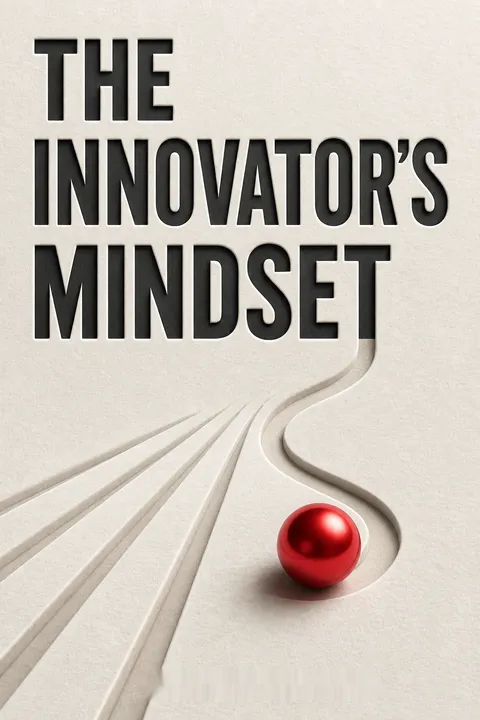


Key Takeaways
Define innovation by better learning, not by newer devices
New and better. Couros defines innovation as a way of thinking that produces something both new and better. It may be a fresh invention or a useful revision, but change for its own sake does not qualify. Technology can help, but it is not the innovation itself. A tablet used only to replace a worksheet may leave learning unchanged.
His father illustrates the mindset: after leaving school young and arriving in Canada with little money and no English, he kept learning, built a career, and helped run a restaurant for decades. By contrast, Blockbuster clung to its old business model while Netflix adapted to new ways people watched films. The lesson for schools is to keep asking whether a practice serves learners now.
The definition resists the common mistake of treating novelty as proof of progress. It also gives educators a practical test: name the learning improvement, not just the tool or program. The father’s story makes adaptation feel human rather than fashionable. Still, “better” needs a shared meaning. A change can help one learner while disadvantaging another, so improvement should be judged against explicit learning goals and the experience of different students, not simply by enthusiasm or appearance.
Turn what you know into something learners can make and improve
From growth to creation. A growth mindset treats abilities as developable through effort, teaching, and persistence. The Innovator’s Mindset extends that belief: learners can develop abilities and use them to create ideas that improve on what exists. The point is not merely to absorb information, but to do something with it.
Couros describes eight characteristics that support this work: empathy, problem finding and solving, risk-taking, networking, observation, creation, resilience, and reflection. Teacher Lisa Jones used several when she replaced an old mitosis lecture with student-made short videos. Her students learned the science by explaining it in their own productions, and every student passed the course. The tool mattered less than the shift from receiving content to making meaning.
The move from learning to creation is a useful distinction because recall and application are not interchangeable. Making something forces learners to select, organize, and explain ideas, while peer feedback can expose gaps that private study misses. The eight traits also describe habits of practice rather than innate gifts. Creation should not become a new performance demand, however. Students need instruction, materials, and feedback, not just a request to produce something impressive.
Ask what each learner needs before choosing how to teach
Begin with the person. Couros returns to a practical question: what would best serve this particular learner? The question shifts attention from the teacher’s preferred lesson to the student’s needs, interests, and ways of showing understanding. It also invites educators to look for problems that students themselves may not yet know how to name.
A teacher in the television series Educating Yorkshire noticed that a student’s stammer made speaking in class difficult. After seeing a film in which music helped a character with a stammer, the teacher tried a similar approach with the student. It helped him speak publicly. The example shows why educators need to test different routes to learning rather than assume that one familiar method works for everyone. Student feedback during the year can reveal what is and is not working.
Empathy here is more than kindness. It is a method of gathering information before designing an intervention. The student’s experience can reveal barriers that a lesson plan alone cannot show, and asking for feedback makes learners participants in improvement rather than subjects of it. Personalization does not require a separate curriculum for every student. It does require enough flexibility to vary supports, pathways, and ways of demonstrating understanding.
Build trust before expecting teachers to take worthwhile risks
Trust makes action safer. Couros argues that educators are unlikely to experiment when leaders tightly control decisions or treat every mistake as evidence of incompetence. Relationships create the conditions for people to try, learn, and share their work. In a school, trust is not a soft extra. It affects whether useful ideas can move beyond one classroom.
Kindergarten teacher Matt Gomez created a private Facebook page to show families what students were learning. Parents valued the updates, but administrators eventually shut the page down, partly because its success might create pressure for other teachers to do the same. Couros sees this as a warning: fear of added work can become a reason to suppress good practice. Leaders should address concerns, support responsible experimentation, and help spread effective approaches.
The example exposes a leadership paradox: a successful practice can threaten a system precisely because it reveals what is possible. Trust helps people disclose uncertainty and learn from attempts that do not work. But a permissive culture is not automatically a fair one. Leaders also need to consider workload, privacy, access, and whether the practice can be sustained. The useful response to a successful experiment is neither automatic adoption nor prohibition, but careful design for broader use.
Give students ownership, not merely a more entertaining lesson
Engagement is not agency. An engaging lesson can capture attention while leaving students dependent on the teacher to direct every step. Empowerment means giving learners enough knowledge, choice, and responsibility to pursue interests and take ownership of learning. It does not replace engagement; it asks what students can do with it.
When Couros found a grade seven health course dull, he rewrote the curriculum objectives in student-friendly language. Students formed groups, chose topics, and taught one another, while he advised and gave feedback. The required objectives remained, but learners had more control over the route. An annual Identity Day offered another form of ownership: students and adults shared something important to them, helping the school discover interests and experiences it might otherwise overlook. Such practices matter most when they shape ordinary learning, not just special events.
Agency can deepen motivation because learners see a connection between effort and decisions they actually control. The health-class example also shows that student choice need not mean abandoning shared goals. The design challenge is to make choice meaningful without making learning inaccessible to students who need more structure. Educators can preserve common standards while varying topics, roles, products, and degrees of support.
Lead from inside the learning, and remove the barriers you see
Experience before prescription. Couros urges leaders to spend time where teaching and learning happen. One educator shadowed high school students for two days and found that they sat for most of the day, listened passively in many classes, and often felt their contributions did not matter. The exercise challenged assumptions that adults could not see from their offices.
Couros also tried a digital portfolio himself before asking staff and students to use one. That experience helped him understand its value for reflection and sharing, as well as its practical difficulties. Professional learning should follow the same principle: educators need time to explore, collaborate, reflect, and apply ideas, not just attend a presentation. Leaders who see login delays, unreliable internet, or overloaded schedules can help remove obstacles instead of simply urging teachers to innovate.
This approach treats leadership as a form of inquiry. Observing users in context often reveals friction that a policy or dashboard hides, while trying a practice firsthand gives leaders better grounds for advice. It also models intellectual humility: authority does not guarantee understanding. Presence alone is insufficient, though. Visits should be non-punitive and followed by concrete action, or staff may experience observation as evaluation rather than support.
Develop people through their strengths, with coaching rather than neglect
Start with what works. A strengths-based approach builds on what a learner or educator already does well, rather than defining the person by a weak area. Couros does not suggest ignoring weaknesses. He argues that success can build confidence and competence, making further learning more possible.
He cites figures from Tom Rath’s workplace research: employees whose managers focused on strengths had a 1 percent chance of being actively disengaged, compared with 22 percent when managers focused on weaknesses and 40 percent when managers ignored them. Couros also describes a principal who shaped a teaching role around his skills and invited staff to describe their ideal positions. Some assignments could be adjusted to match teachers’ interests. The practical point is to know people well enough to offer both autonomy and useful guidance.
Strengths-based leadership is not flattery. At its best, it connects individual capability to shared work and provides a starting point for growth. The figures make a striking case for attention and recognition, but they should not be treated as universal predictions for every workplace. A strength can also become a blind spot if it is never challenged. Good coaching therefore pairs appreciation with specific feedback and opportunities to stretch.
Choose fewer tools and initiatives, then use them to transform learning
Depth beats tool collecting. Couros once flooded his staff with websites, tips, and articles, hoping that more options would accelerate change. Instead, teachers felt overwhelmed and used many resources superficially. He shifted to a few shared tools, including Google Apps, blogs as portfolios, and Twitter, so staff could explore their uses in depth.
He distinguishes three levels of technology use: literate means operating a device; adaptive means using it for a familiar task; transformative means doing something the old method could not support, such as sharing work with a global audience. A digital textbook may be adaptive, while a student video that invites outside feedback can create new learning possibilities. The first question should be how a tool serves learners. The next should be what unnecessary work or competing initiative can be removed to make room for it.
The sequence offers a better measure of technology integration than counting devices or apps. It asks whether a tool changes the learning relationship, audience, or form of creation. Limiting priorities also protects attention, a finite resource in schools. Yet transformation is not automatically beneficial: a new capability can introduce privacy, access, or distraction concerns. The learning purpose and the safeguards should be designed together.
Share practice openly so good ideas travel, change, and improve
Ideas grow through exchange. Couros describes open sharing as a way for educators to learn from colleagues near and far. Online communities and social media can make teaching visible, while writing or presenting an idea can sharpen the person sharing it. Visibility also gives others a chance to question, adapt, and improve the work.
He calls the productive mix of collaboration and competition “competitive collaboration.” In his example, two high schools shared classroom projects. When one school tried an activity the other had not, students at the second school adapted it and added improvements. Both schools gained ideas, and students benefited. This contrasts with secrecy that protects a school’s standing at the expense of learners. Sharing does not require every idea to be polished or universally applicable; it requires enough openness for others to learn from it.
Open exchange turns individual experiments into resources for collective learning. The strongest version is not copying a celebrated practice, but understanding its purpose and adapting it to local needs. That distinction matters because visibility can reward novelty and popularity as much as effectiveness. A useful sharing culture therefore includes reflection on what worked, for whom, and under what conditions, alongside permission to revise or reject an idea.
Co-create a vision, document real growth, and keep revising the work
Make progress visible. Parkland School Division involved educators, students, families, and local businesspeople in defining a vision for learning. Its resulting statement emphasized exploration, creativity, and imagination. The process mattered because people are more likely to act on a direction they helped shape. A vision also needs small, practical steps that connect broad aspirations to classroom choices.
Couros presents digital portfolios as one way to show learning over time. A learning portfolio records development; a showcase portfolio presents selected work a learner considers strong. In one example, a fourth-grade student wrote about a book, and its author responded online, showing the student that her ideas could reach a real audience. Portfolios can complement test results with evidence of growth, reflection, and communication. The work is never finished: what counts as better learning must be examined and revised as learners and circumstances change.
A shared vision becomes meaningful when it shapes routines, resource choices, and assessment, rather than remaining a polished statement. Portfolios can help connect those intentions to visible student work and invite families into the learning process. They also demand curation and thoughtful feedback; simply uploading assignments creates a digital storage bin, not evidence of growth. No single measure captures educational success, so portfolios are most useful alongside other evidence and clear learning goals.
Analysis
The book’s central argument is that innovation in education depends less on acquiring new equipment than on changing the relationships and assumptions that govern learning. Its examples repeatedly shift authority: the teacher listens to the student, the leader learns beside staff, and the school treats families and students as contributors to its vision. This gives the book an unusually coherent theory of change. Better learning emerges when people closest to the work have room to notice problems, test responses, and share what they discover.
The argument is strongest when it translates aspiration into observable practice: students make videos to explain mitosis, leaders shadow learners, teachers choose professional learning, and portfolios display development. These examples make innovation feel possible within ordinary constraints. The book also correctly treats time, trust, and attention as resources. A school cannot ask for experimentation while filling every available hour with disconnected initiatives.
Its main tension is between autonomy and common responsibility. Local choice can make learning relevant, but shared standards, safeguarding, and access still matter. The book acknowledges risks, yet its optimistic examples can make successful adaptation appear easier than sustained implementation. A leadership team must ask not only whether an approach works for its early adopters, but also who is excluded, what support it requires, and how evidence will distinguish improvement from novelty.
The most useful reading is therefore neither a recipe nor a mandate to modernize everything. It is a disciplined habit of inquiry: identify the learner’s need, test a response, observe consequences, and revise with others. Innovation becomes credible when it improves learning in ways that can be explained, examined, and sustained. The book’s lasting contribution is its insistence that this process belongs to the whole school community, not to a technology department or a handful of unusually bold teachers.
Review Summary
The Innovator's Mindset receives mostly positive reviews, with readers praising its balance of big-picture ideas and practical examples. Many find it inspiring and valuable for educators seeking to foster innovation in schools. Reviewers appreciate Couros' emphasis on creating a culture of continuous improvement and focusing on strengths. Some criticize the book for rehashing familiar concepts or relying too heavily on social media examples. Overall, readers recommend it as an essential read for educators, particularly those in leadership positions.
People Also Read





Glossary
Innovation
new and better thinkingIn this book, innovation is a way of thinking that creates something new and better. It can involve inventing something original or improving an existing practice. A change does not count as innovation simply because it is different, and technology alone does not make a practice innovative.
The Innovator's Mindset
learning that leads to creationThe belief that abilities, intelligence, and talents can be developed and used to create ideas that are new and better. It builds on a growth mindset by emphasizing not only learning and improvement, but also applying what has been learned to make something useful for learners.
Growth Mindset
abilities can be developedA belief that abilities and intelligence can grow through effort, persistence, and effective teaching. In the book, this mindset helps learners attempt difficult work without treating an early struggle as proof of fixed limits. It supports the Innovator's Mindset, which adds an emphasis on creating improved ideas from developed abilities.
8 Characteristics of the Innovator's Mindset
habits supporting innovationCouros's set of characteristics for educators and leaders who want to create better learning: empathy, problem finding and solving, risk-taking, networking, observation, creation, resilience, and reflection. The characteristics describe practices that can be developed and modeled, not innate qualities reserved for a few unusually creative people.
Crowd Accelerated Innovation
innovation amplified through visibilityA process in which people with a shared interest can see one another's work, learn from examples, and improve through visible participation. The book describes three conditions: a community of interested people, access to what others are doing, and a desire to practice and improve. Online video and social platforms can help make these conditions possible.
Competitive Collaboration
sharing that raises the barA combination of cooperation and friendly competition in which groups share useful work while also trying to improve on one another's ideas. In the book's school example, two high schools exchanged classroom projects, then adapted and extended what they saw. The intended outcome is better learning, not institutional advantage at students' expense.
Literate, Adaptive, Transformative
three levels of technology useA progression used to describe technology integration. Literate use means knowing how to operate a device. Adaptive use applies it to a familiar task, such as reading a textbook digitally. Transformative use enables a learning activity that was not possible in the same way before, such as creating and sharing work with a wider audience.
Learning Portfolio
evidence of growth over timeA collection of a learner's work that documents development across time. For example, recordings of a student reading at several points in a school year can show changes in fluency. A portfolio can support reflection and discussion among students, teachers, and families, rather than relying only on a grade or test result.
Showcase Portfolio
selected work at its bestA portfolio that presents work a learner chooses to represent their strongest achievement, similar to a curated collection of accomplishments. In Couros's approach, the learner selects the work and explains why it meets the desired criteria. It differs from a learning portfolio, which is designed to show growth over time.
FAQ
What's "The Innovator's Mindset" by George Couros about?
- Focus on Innovation: The book emphasizes the necessity of innovation in education, advocating for a shift from traditional methods to more creative and empowering approaches.
- Empowerment and Creativity: It illustrates how educators can unleash talents and lead a culture of creativity by adopting an innovator's mindset.
- Practical Guidance: Couros provides practical advice and strategies for educators to transition from an industrial model of schooling to an innovative one.
- Personal Stories and Examples: The book is filled with personal anecdotes and real-world examples to inspire educators to rethink and refocus their efforts.
Why should I read "The Innovator's Mindset"?
- Inspiration for Educators: It offers a compelling message on why innovation is necessary and possible in education, inspiring educators to embrace change.
- Practical Strategies: The book serves as a guide with practical strategies that school leaders can implement to foster innovation in schools and classrooms.
- Focus on Relationships: Couros emphasizes the importance of building relationships and creating a culture of trust to empower educators and students.
- Continuous Learning: It encourages educators to adopt a mindset of continuous learning and improvement, both for themselves and their students.
What are the key takeaways of "The Innovator's Mindset"?
- Innovation is a Mindset: Innovation is defined as a way of thinking that creates something new and better, not just about using technology.
- Empowerment Over Engagement: The book stresses the importance of empowering students to take control of their learning rather than just engaging them.
- Strengths-Based Leadership: Focus on building upon the strengths of educators and students to foster a culture of innovation.
- Open Culture and Sharing: Emphasizes the importance of sharing ideas and learning from others to accelerate innovation.
What is the "Innovator's Mindset" according to George Couros?
- Definition: The innovator's mindset is the belief that abilities, intelligence, and talents can be developed to create new and better ideas.
- Growth Mindset Extension: It builds on Carol Dweck's growth mindset by focusing on using acquired knowledge to create something new.
- Empathy and Creation: It starts with empathy for students and focuses on creating better learning experiences.
- Continuous Improvement: Encourages educators to constantly ask, "Is there a better way?" to improve learning outcomes.
How does George Couros define innovation in education?
- New and Better: Innovation is defined as a way of thinking that creates something new and better, not just change for the sake of change.
- Beyond Technology: While technology can be a tool for innovation, it's more about how it's used to enhance learning.
- Problem Finding and Solving: Innovation involves not just solving problems but also finding them, encouraging students to be self-starters.
- Empathy-Driven: It begins with understanding the needs of those we serve, focusing on what is best for each learner.
What are the "8 Characteristics of the Innovator's Mindset"?
- Empathetic: Understanding the needs and perspectives of students to create meaningful learning experiences.
- Problem Finders/Solvers: Encouraging students to find and solve problems, not just follow linear steps.
- Risk Takers: Willingness to try new things and question best practices to meet diverse student needs.
- Networked: Leveraging connections with others to share ideas and enhance learning opportunities.
How does "The Innovator's Mindset" suggest educators empower students?
- Shift from Engagement to Empowerment: Move beyond engaging students to empowering them to take control of their learning.
- Student-Centered Learning: Allow students to explore their passions and interests, giving them ownership of their learning.
- Identity Day and Innovation Week: Implement events that allow students to share their passions and work on projects that interest them.
- Focus on Skills for the Future: Teach skills like critical thinking, collaboration, and adaptability that are essential for future success.
What role do relationships play in "The Innovator's Mindset"?
- Foundation of Innovation: Relationships are crucial for creating a culture of trust and innovation in schools.
- Empowerment Through Trust: Trusting educators to make decisions fosters a culture where innovation can thrive.
- Classroom vs. School Teacher: Encourages educators to see all students as their own and share ideas to benefit the entire school.
- Personalized Professional Development: Building relationships helps tailor professional development to individual needs and strengths.
How does "The Innovator's Mindset" address the use of technology in education?
- Technology as an Accelerator: Technology should be used to accelerate and amplify learning, not just as a tool.
- Learner-Centered Decisions: Decisions about technology should be based on how it improves learning for students.
- Focus on Creation: Encourage students to use technology to create and share their learning, not just consume information.
- Open Culture: Promote an open culture where technology is used to connect and share ideas globally.
What are some practical strategies from "The Innovator's Mindset" for fostering innovation?
- Create a Shared Vision: Involve the entire school community in creating a vision for learning that inspires and empowers.
- Strengths-Based Leadership: Focus on building upon the strengths of educators and students to foster a culture of innovation.
- Less is More: Narrow the focus to a few key areas to allow for deep learning and innovation.
- Embrace an Open Culture: Encourage sharing and collaboration to accelerate learning and innovation.
What are the best quotes from "The Innovator's Mindset" and what do they mean?
- "Change is an opportunity to do something amazing." This quote emphasizes the positive potential of change and encourages educators to embrace it.
- "If students leave school less curious than when they started, we have failed them." Highlights the importance of fostering curiosity and a love for learning in students.
- "Innovation is not reserved for the few; it is something we will all need to embrace if we are to move forward." Encourages all educators to adopt an innovator's mindset to improve education.
- "Relationships are the most important element of schools." Stresses the foundational role of relationships in creating a culture of trust and innovation.
How can educators implement the ideas from "The Innovator's Mindset" in their schools?
- Start with Empathy: Focus on understanding the needs of students and creating learning experiences that resonate with them.
- Encourage Risk-Taking: Create a safe environment where educators and students feel comfortable trying new things.
- Promote Open Sharing: Use social media and other platforms to share ideas and learn from others globally.
- Focus on Continuous Improvement: Constantly ask, "Is there a better way?" to ensure ongoing growth and innovation.
Download PDF
Download EPUB
.epub digital book format is ideal for reading ebooks on phones, tablets, and e-readers.








