

Key Takeaways
IQ helps you process complexity, but it cannot guarantee sound judgment.
IQ has a real job. The tests Lewis Terman promoted measure abilities such as memory, vocabulary, and abstract reasoning. They help predict academic performance and can be useful in professions requiring complex learning. But they do not measure every capacity needed for good judgment. In Terman's study, only four of the 26 participants with IQs above 180 achieved high professional distinction. For lawyers, accountants, and engineers, IQ explained at most about 29 percent of variation in managers' performance ratings.
The famous exception proves nothing. Kary Mullis won a Nobel Prize for inventing a powerful DNA technique, yet also embraced astrology and denied established science. His brilliance in one domain did not automatically protect his judgment in others. The point is not to discard intelligence tests, but to stop treating them as complete measures of wisdom.
The useful distinction is between a measure's predictive power and its scope. A strong score can predict who learns technical material quickly without telling whether that person will weigh evidence fairly, manage conflict, or recognize uncertainty. This matters wherever a single score becomes a proxy for human potential. Still, replacing IQ with an undefined idea of broad talent would not solve the problem. A better assessment keeps measures tied to their purpose and adds direct evidence of judgment, practical reasoning, and learning behavior.
Use intelligence to test your beliefs, not build stronger defenses for them.
Reason can become a lawyer. Dysrationalia is a mismatch between intelligence and rationality: a person can reason abstractly well while forming beliefs poorly. Arthur Conan Doyle, the creator of Sherlock Holmes, accepted staged fairy photographs and fraudulent spiritualist claims, then used elaborate arguments to explain away objections. His analytical ability did not disappear; it was recruited to defend a cherished belief.
Identity changes the calculation. In Dan Kahan's gun-control study, participants interpreted the same numbers differently depending on whether the result supported their political outlook. Numeracy helped people reach the correct answer mainly when it agreed with their prior view. A practical check is to ask what evidence would change the conclusion, then apply the same standard to evidence on both sides.
Motivated reasoning is more subtle than simply refusing to think. A person may scrutinize evidence intensely, but distribute that scrutiny unevenly, treating friendly claims generously and opposing claims harshly. Because beliefs often signal group belonging, correction can feel like a social threat rather than a neutral update. The answer is not merely to supply more facts. Structured disagreement, explicit tests of what would change a mind, and shared goals can make scrutiny less threatening. Rationality measures also need care: they should assess evidence handling, not agreement with a particular political position.
Treat expertise as rapid pattern recognition, not immunity from error.
Experience builds shortcuts. Experts learn to recognize familiar patterns quickly, which makes skilled performance efficient. But those same habits can narrow attention and make unusual details harder to notice. In the Madrid bombing investigation, FBI fingerprint examiners declared a match between a smeared print and lawyer Brandon Mayfield, despite important differences. They explained away the mismatches, while Spanish police later identified an Algerian suspect whose prints fit the evidence. Mayfield was released and the FBI apologized.
Protect the evidence from expectation. The book describes procedures that reduce bias: examine the crime-scene print before seeing a suspect's print, keep a second examiner unaware of the first examiner's conclusion, and limit exposure to case details that could shape judgment. Expertise remains valuable. The lesson is to build checks around it, especially when evidence is ambiguous and consequences are serious.
Expertise is best understood as both an asset and a particular kind of vulnerability. Pattern recognition compresses complexity, but compression can discard the very detail that distinguishes a familiar case from a dangerous exception. The answer is not to distrust experts wholesale. It is to design reviews that preserve independent judgment and make disagreement possible before a conclusion hardens. The same principle applies outside forensic work: when a decision depends on ambiguous evidence, process safeguards can outperform confidence in any one person's objectivity.
Write both sides down before high-stakes choices harden into commitments.
Franklin slowed the decision. During the 1787 Constitutional Convention, delegates were deadlocked over how large and small states should be represented. Benjamin Franklin supported a compromise that balanced population-based representation in one chamber with equal state representation in another. His method for personal choices, which he called moral algebra, was similarly deliberate: list advantages and disadvantages, weigh their importance, cancel reasons that balance, then wait to see whether new considerations arise.
Make your assumptions visible. A quick pros-and-cons list can overvalue whichever arguments come to mind first. Writing the reasons down makes omissions easier to spot. For consequential choices, also argue the opposite position and ask whether the same evidence would seem persuasive if it favored another outcome. Explaining the decision to someone else can expose gaps that private reasoning leaves hidden.
Franklin's method is valuable less as arithmetic than as a defense against mental availability. Once reasons are externalized, they can be compared instead of competing invisibly for attention. The procedure also creates time for a first reaction to cool, which is useful when the choice carries emotional or financial weight. Its limit is equally important: assigning weights remains subjective, and a tidy ledger can make uncertain judgments look more precise than they are. The method clarifies a decision; it cannot make missing evidence appear.
Borrow an observer's viewpoint when your own problems make you defensive.
Distance can restore perspective. Solomon's Paradox describes a familiar imbalance: people may give thoughtful advice about someone else's dilemma, yet reason less wisely about their own. Igor Grossmann's research found that people show more humility and consider more perspectives when reflecting on another person's problem. Self-distancing applies that outside view to personal trouble: imagine watching the event from across the room, or describe it using your own name rather than speaking as yourself.
Perspective is not evasion. In studies, taking this distance helped people examine the reasons behind conflict and consider compromise. A brief self-distancing exercise given to married couples helped preserve relationship satisfaction over the following year compared with a control group. The practical move is simple: describe what happened as a fair observer might, then ask what each person involved could be feeling or trying to protect.
Distance changes the question from 'How do I defend myself?' to 'What is happening here?' That shift can make emotion easier to examine without pretending it is irrelevant. It is a useful middle path between being consumed by a conflict and suppressing it. The technique should not be used to excuse harm or erase responsibility. Its purpose is to widen the view enough to understand motives, evidence, and possible responses, while still acknowledging the consequences of what people did.
Use emotion as evidence, not as a verdict.
The body supplies clues. Interoception is the ability to sense internal bodily signals, such as a racing heart or a knot in the stomach. Antonio Damasio's work suggests that these signals can carry information from past experience before conscious reasoning catches up. People with damage to brain regions involved in emotion can retain factual knowledge and do well on intelligence tests, yet struggle to make sensible decisions. But bodily cues can mislead: Lisa Feldman Barrett once mistook the sensations of an approaching illness for romantic excitement.
Name the feeling before acting. Precise emotion labels can help distinguish anxiety from excitement, or anger from disgust, and make irrelevant influences easier to recognize. In one medical approach, doctors first record their initial intuitive diagnosis, then review the evidence and consider alternatives. This reflective step improved diagnostic accuracy in the studies described, by up to 40 percent.
This account avoids the false choice between cold analysis and gut instinct. Emotion can function as an early signal, but interpreting that signal requires context: a bodily response may reflect experience, fatigue, fear, or an unrelated mood. Naming the feeling creates a small space between sensation and action, allowing the decision-maker to ask what the signal is actually about. The medical example captures the balance well: preserve the expert's first impression, then test it. Intuition is most useful when it is neither ignored nor treated as proof.
Polished repetition can make falsehood feel true; verify before sharing.
Familiarity can masquerade as proof. Truthiness is the feeling that a claim is true because it is easy to process or seems familiar. In the Moses illusion, people often answer that Moses took animals onto the Ark, overlooking that Noah is the biblical figure associated with the Ark. Simple wording, rhymes, pictures, and repetition can all make claims feel more credible without adding evidence. Repetition can even make one person's opinion seem like a broad consensus.
Make corrections carefully. A correction that repeats a vivid myth may make the myth more memorable than the explanation. Cognitive inoculation offers another approach: teach people to recognize misleading tactics, such as fake experts or selective evidence, before encountering them in a new debate. Before sharing a claim, check who made it, what evidence supports it, whether independent sources agree, and what information is missing.
A useful consequence is that credibility has a design dimension. Readability and repetition affect whether a message feels true, even when neither changes its evidential value. This explains why careful communication matters for health and science, not just for marketing. Yet fluency and familiarity are not inherently bad guides; repeated, clear information can reflect genuine consensus. The safeguard is to separate the feeling of recognition from the question of verification, and to avoid treating a persuasive presentation as a substitute for independent evidence.
Build durable learning with spaced effort, retrieval, and productive confusion.
Easy practice can deceive. Desirable difficulties are learning challenges that may slow immediate performance while improving long-term memory. In a British Post Office study, workers who practiced typing for one hour a day mastered the skill in about 35 hours, compared with about 50 hours for workers practicing four hours a day. Spacing sessions created opportunities to forget and then retrieve the material, strengthening later recall. Mixing related problem types and attempting a question before seeing the explanation can also deepen learning.
Confusion can be useful. Japanese classrooms studied by James Stigler often asked students to wrestle with a problem before teaching a standard method, then compare different solutions. The struggle was treated as information about what still needed learning, not as proof of inability. For independent study, space sessions, quiz yourself before reviewing notes, and mix topics instead of repeating one easy exercise until it feels fluent.
The key distinction is between feeling fluent now and remembering later. Immediate ease can be a poor guide to learning because it reduces the effort of retrieving and reconstructing ideas. This principle also reframes mistakes: an unsuccessful attempt can prepare the mind to notice the correct explanation. But difficulty must remain productive. Confusion without guidance, feedback, or an eventual explanation can become discouraging rather than instructive. The best learning design introduces struggle, then helps the learner connect it to a clearer model.
Build teams around listening; star talent alone can lower performance.
Groups need more than IQ. Collective intelligence is a team's ability to perform across tasks such as generating ideas, judging options, negotiating, and coordinating work. In Anita Williams Woolley's studies, team performance was only weakly related to average IQ. Social sensitivity and a more equal distribution of speaking time were better predictors. When a few members dominate, useful information and alternative views can disappear from the discussion.
Coordination has a talent ceiling. Research on interdependent sports found that adding star players helped only up to a point; teams with too many could perform worse. Iceland's 2016 team, with few players from the richest clubs, beat England, whose squad was overwhelmingly drawn from elite clubs. This is not proof that stars are bad or that Iceland's success had one cause. It is a reminder to value cooperation alongside individual ability.
Team performance depends on what people do with one another's knowledge, not merely on how much talent sits in the room. Listening distributes information; domination hides it. The sports findings sharpen that point because coordination is essential in football and basketball, while the same talent ceiling did not appear in baseball, a less interdependent sport. The implication is contextual rather than universal: recruit for the task's actual demands. A brilliant specialist may be an asset in independent work and a liability if status competition blocks collaboration.
Treat near misses as warnings before luck normalizes the hazard.
A safe outcome can hide a bad decision. Outcome bias makes people judge a choice by what happened, while ignoring what might have happened under slightly different circumstances. Before the Deepwater Horizon explosion, the oil industry had experienced numerous smaller blowouts, and NASA had seen foam insulation break away on earlier launches. Because those incidents had not caused catastrophe, warning signs became easier to dismiss. At Deepwater Horizon, 11 workers died and more than 200 million gallons of oil entered the Gulf of Mexico.
Make weak signals visible. High-reliability organizations stay alert to failure, question simple explanations, keep close watch on operations, prepare to recover, and let frontline expertise reach leaders. Organizations can reinforce these habits by reporting near misses, rewarding candor, conducting pre-mortems, and examining the processes behind errors instead of simply blaming one employee.
Near misses are especially valuable because they reveal risk before the worst consequence arrives. Their danger is psychological: surviving an unsafe event can make the underlying practice seem safer than it is. A reporting culture turns those episodes into shared information rather than private embarrassment. The challenge is to maintain attention without pretending every risk can be eliminated. A good safety system makes uncertainty discussable, assigns responsibility for follow-up, and distinguishes unavoidable hazards from preventable failures in design, communication, or incentives.
Analysis
The book's central move is to separate mental horsepower from the habits that direct it. IQ helps explain who can process complex material efficiently, but it does not reliably explain who updates beliefs, learns from error, notices emotional distortion, or makes a group function well. This is not an argument against intelligence or expertise. It is an argument against treating either as self-correcting.
The book's narrative architecture makes that distinction vivid at several scales. Conan Doyle shows how reasoning can defend identity. The FBI's mistaken fingerprint identification shows how expertise can narrow perception. Franklin, Grossmann's research, and the medical examples offer practical ways to widen it. The shift from individual judgment to teams and organizations then shows that error is not only a personal weakness: hierarchy, incentives, and silence can amplify it until a whole institution behaves as if warning signs were invisible.
The most useful synthesis is procedural. When stakes rise, make judgments inspectable: record the first impression, seek disconfirming evidence, invite independent review, and preserve reports of near misses. In learning, measure durable recall rather than today's fluency. In groups, make room for participation and dissent. These practices turn humility from a personality ideal into a feature of decision design.
The evidence is varied. Some claims rest on controlled experiments; others rely on case studies, organizational histories, or small interventions whose durability is uncertain. Cultural comparisons also describe averages, not fixed traits of entire populations. Those limits matter, but they do not erase the book's core insight. They suggest using its techniques as testable safeguards rather than universal cures. Intelligence remains useful. Its safest form is intelligence operating inside systems that make revision, challenge, and learning possible.
Review Summary
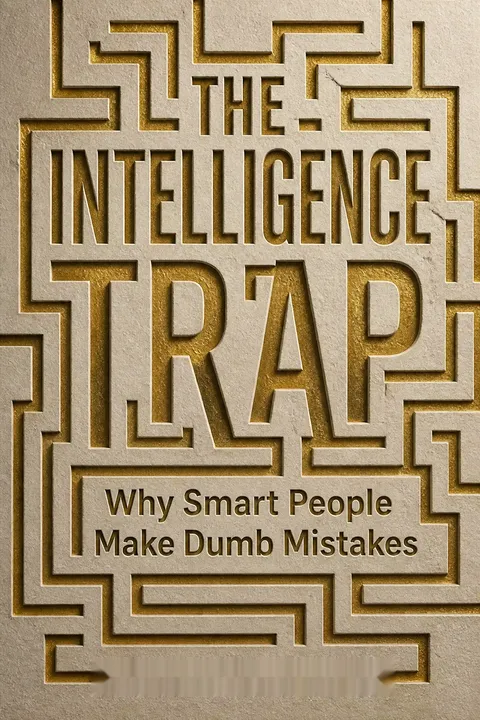
The Intelligence Trap explores why intelligent people make poor decisions. Readers found it insightful, with engaging examples and scientific backing. Some praised its accessibility and practical advice, while others felt it rehashed familiar concepts. The book discusses cognitive biases, intellectual humility, and evidence-based wisdom. It challenges traditional notions of intelligence and IQ tests. Many readers appreciated its lessons on critical thinking and avoiding common mental pitfalls. However, a few found it slow-paced or repetitive in parts.
People Also Read







Glossary
Dysrationalia
Intelligence without sound reasoningA mismatch between general intelligence and rationality. Someone may perform well on abstract reasoning or academic tests yet make poor decisions or hold beliefs unsupported by evidence. The term highlights that reasoning well requires more than cognitive ability, including suitable knowledge, reflection, and willingness to examine assumptions.
Motivated reasoning
Reasoning that protects a preferred beliefThe tendency to use reasoning in ways that support a desired conclusion, often one tied to identity or emotion. It can involve seeking confirming evidence, remembering supportive information, and scrutinizing opposing evidence more harshly. Greater intelligence may make the defense more elaborate without making it more accurate.
Intellectual humility
Awareness of one's limitsRecognition that one's knowledge and judgment are limited, and that conclusions may need revision. Intellectual humility includes acknowledging uncertainty, listening to other perspectives, and admitting mistakes without treating them as proof of personal inadequacy. In the book, it is a core ingredient of wiser reasoning and collaboration.
Moral algebra
A deliberate weighing of reasonsBenjamin Franklin's method for making difficult choices. He wrote advantages and disadvantages on separate sides of a page, weighed their relative importance, and crossed out reasons that balanced one another. He then waited to see whether further considerations emerged before deciding. The method makes reasons visible and reduces snap judgments.
Solomon's Paradox
Wisdom for others, not oneselfThe tendency to reason more wisely about other people's problems than about one's own. Personal stakes can trigger defensive, emotionally charged thinking, making it harder to consider alternatives or compromise. The book describes self-distancing as one way to gain the perspective people more readily use when advising someone else.
Emotional compass
Skills for interpreting feelingsA combination of interoception, emotion differentiation, and emotion regulation. Interoception is awareness of bodily signals; differentiation means identifying feelings precisely; regulation means managing their influence. Together, these abilities help people use emotional signals as information without mistaking unrelated moods or sensations for reliable guidance.
Truthiness
A feeling that something is trueThe subjective sense of truth that can arise when a claim feels familiar or is easy to process. Repetition, rhymes, readable presentation, and irrelevant images can increase this feeling without strengthening the evidence. Because people may not notice the influence, truthiness can make misinformation persuasive.
Cognitive inoculation
Practice spotting misleading tacticsA strategy for reducing susceptibility to misinformation by teaching people to recognize flawed arguments and deceptive methods in advance. Learning how a misleading claim works in one context can help people identify similar tactics elsewhere. It aims to prepare reasoning before exposure, rather than relying only on corrections afterward.
Desirable difficulties
Effort that strengthens later learningLearning challenges that can make immediate performance feel slower or less successful while improving long-term retention and understanding. Examples include spacing study sessions, retrieving information from memory, mixing problem types, and attempting problems before instruction. Difficulty is useful when feedback and explanation help turn struggle into learning.
Collective intelligence
A team's shared problem-solving abilityA team's ability to perform across varied tasks, including generating ideas, evaluating options, negotiating, and coordinating actions. Research described in the book finds that collective intelligence is only weakly related to members' average IQ. Social sensitivity and balanced participation are stronger predictors of how well the group works.
Functional stupidity
Workplace thinking without reflectionA narrow organizational style that discourages questioning assumptions, curiosity about the purpose of work, and consideration of long-term consequences. It can make work seem efficient in the short term because employees avoid debate, but it also suppresses criticism, learning, and creative problem-solving.
Collective mindfulness
Organizational attention to possible failureA set of organizational practices that keep people alert to weak signals, mistakes, and changing conditions. High-reliability organizations encourage reporting, resist overly simple explanations, stay attentive to daily operations, prepare to recover from errors, and let relevant expertise influence decisions regardless of rank.
FAQ
What's The Intelligence Trap about?
- Exploring intelligence and mistakes: The book investigates why intelligent people often make poor decisions, emphasizing that high IQ does not ensure sound judgment.
- Intelligence trap concept: David Robson introduces the "intelligence trap," highlighting cognitive biases and errors that can arise from greater intelligence and education.
- Strategies for improvement: It offers practical strategies to help individuals avoid these pitfalls and make better decisions in both personal and professional contexts.
Why should I read The Intelligence Trap?
- Understanding cognitive biases: The book helps readers understand cognitive biases that can mislead even the smartest individuals, improving decision-making skills.
- Practical advice: It provides actionable strategies, such as moral algebra and self-distancing, to enhance reasoning and critical thinking abilities.
- Broader implications: Insights are applicable to personal decisions and organizational behavior, making it valuable for leaders and team members.
What are the key takeaways of The Intelligence Trap?
- Intelligence does not equal wisdom: High intelligence can lead to overconfidence and a bias blind spot, making individuals less likely to recognize their own errors.
- Emotional awareness importance: Emotional intelligence, including interoception and emotion differentiation, is crucial for better decision-making.
- Reflective thinking cultivation: Techniques like self-distancing and moral algebra help navigate complex decisions and avoid the intelligence trap.
How does The Intelligence Trap define the "intelligence trap"?
- Cognitive errors from intelligence: The intelligence trap is when intelligent individuals make significant errors due to cognitive biases and overconfidence.
- Examples of intelligent mistakes: Real-life examples, like Kary Mullis, illustrate that intelligence does not protect against foolishness.
- Psychological mechanisms: The book explores psychological processes like dysrationalia and motivated reasoning that contribute to the intelligence trap.
What is moral algebra in The Intelligence Trap?
- Decision-making tool: Moral algebra, proposed by Benjamin Franklin, involves listing pros and cons to weigh options more effectively.
- Structured reasoning: Encourages careful consideration of each factor, reducing impulsive decisions and providing a balanced view.
- Practical application: Suggested for clarifying complex decisions, helping to avoid emotional reasoning pitfalls.
How does self-distancing help in decision-making, according to The Intelligence Trap?
- Gaining perspective: Self-distancing involves viewing situations from an outsider's perspective, aiding in objective analysis of emotions and thoughts.
- Reducing emotional bias: This technique helps detach from immediate feelings, leading to more rational decisions.
- Improving conflict resolution: By adopting a distanced viewpoint, individuals can better understand different perspectives and find compromises.
What is dysrationalia, as discussed in The Intelligence Trap?
- Cognitive mismatch: Dysrationalia is the inability to think rationally despite high intelligence, leading to poor decision-making.
- Influence of biases: Cognitive biases, like confirmation bias and myside bias, affect even intelligent individuals, causing irrational choices.
- Critical thinking importance: Recognizing dysrationalia is crucial for developing better reasoning skills and avoiding the intelligence trap.
How can emotional awareness improve decision-making in The Intelligence Trap?
- Understanding somatic markers: Somatic markers, or physical sensations, inform emotional responses, helping gauge intuitions.
- Enhancing interoception: Improved interoceptive awareness allows better recognition of bodily signals to inform decisions.
- Regulating emotions: Differentiating and regulating emotions leads to more thoughtful responses, reducing impulsive decisions.
What role does curiosity play in The Intelligence Trap?
- Enhancing learning: Curiosity drives individuals to seek new information and experiences, improving memory retention and understanding.
- Counteracting biases: Encourages exploration of alternative viewpoints and questioning assumptions, leading to balanced decision-making.
- Fostering creativity: Linked to creativity, curiosity prompts thinking outside the box and considering novel solutions to problems.
What is the significance of the growth mindset in The Intelligence Trap?
- Belief in development: The growth mindset posits that abilities can be developed through effort and learning, fostering resilience.
- Impact on performance: Research shows individuals with a growth mindset perform better academically and professionally.
- Encouraging curiosity: A growth mindset motivates seeking new knowledge and experiences, essential for overcoming the intelligence trap.
How does The Intelligence Trap relate to group dynamics and teamwork?
- Collective intelligence: Groups can harness collective intelligence for better decision-making, emphasizing equal participation and social sensitivity.
- Too much talent effect: Teams with excess star players may underperform due to status conflicts, highlighting the need for balance.
- Leadership qualities: Effective leaders encourage open communication and critical thinking, valuing humility and diverse perspectives.
What are the best quotes from The Intelligence Trap and what do they mean?
- “The greatest minds are capable of the greatest vices as well as the greatest virtues.”: Highlights that intelligence can lead to both exceptional achievements and significant errors.
- “I cannot help expressing a wish that every member of the Convention who may still have objections to it, would with me, on this occasion, doubt a little of his own infallibility.”: Emphasizes humility and open-mindedness in decision-making.
- “It is not enough to possess a good mind; the most important thing is to apply it correctly.”: Reflects the book's theme that intelligence must be coupled with effective reasoning to avoid errors.
About the Author

Download PDF
Download EPUB
.epub digital book format is ideal for reading ebooks on phones, tablets, and e-readers.








