

Key Takeaways
Free customers will outearn captive ones once they get their own tools
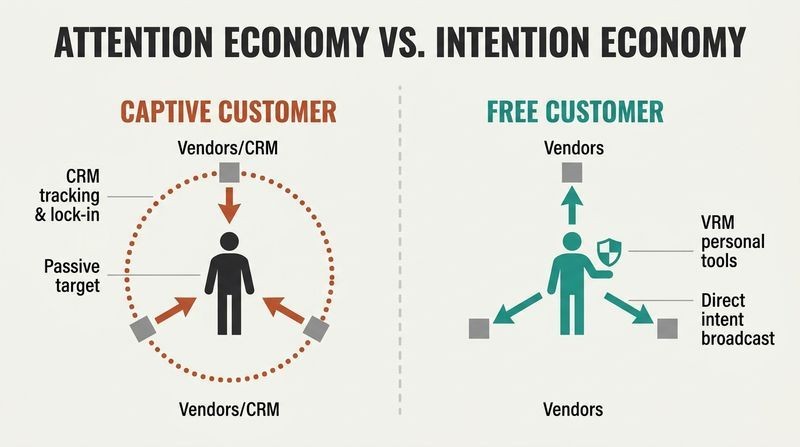
The book's central thesis is disarmingly simple: a free customer is more valuable than a captive one, to sellers and to themselves. Searls argues the internet's supply side already leapt forward with e-commerce, but the demand side stayed shackled. Customers still carry loyalty cards, click 'accept' on contracts nobody reads, and get tracked without consent.
His proposed fix is VRM (vendor relationship management), the customer-side counterpart to CRM. Where CRM is how one company manages many customers, VRM is how one customer manages many vendors, with personal tools that make individuals both independent of sellers and better able to engage them. When customers can express real intentions directly, guesswork collapses and a new Intention Economy replaces the Attention Economy.
Searls writes as a movement organizer, not a detached observer, which makes the book part manifesto, part progress report. The thesis echoes Albert Hirschman's Exit, Voice, and Loyalty: captivity suppresses the very signals that would let firms improve. What's striking is the timing bet. Writing in 2012, Searls underestimated how thoroughly platforms would deepen capture rather than loosen it. Facebook, Amazon, and Google grew more dominant, not less. Yet the underlying economic logic holds: coerced loyalty produces noise, genuine intent produces signal. The GDPR and data-portability laws that arrived years later validate his direction even as the market lagged his optimism.
Advertising is billion-dollar guesswork that survives only until better signals arrive

Searls frames advertising as one-way signaling built on guesswork from the start. He invokes the old lament that half of ad spending is wasted, but nobody knows which half. Online, tracking promised to fix this, yet click-through rates hover below 1 percent, meaning over 99 percent of ads are ignored.
He describes an 'advertising bubble' inflated by venture capital, herd mentality, and faith in endless growth. He also names the 'Chinese wall' inside the industry: one faction chases quantitative targeting, the other chases emotional engagement, and neither peeks at the customer's side where people loathe being followed. Polls he cites show 85 percent alarmed by tracking and 92 percent wanting a do-not-track tool. His prediction: when direct intention signals arrive, advertising shrinks to only what pure guesswork can do.
The bubble prediction was premature. Digital ad spend kept climbing past half a trillion dollars, and targeting got more sophisticated, not less relevant. But Searls identified a real fragility: advertising thrives in the absence of direct demand signals, and every improvement in customer-to-vendor communication erodes its rationale. His point that personalized advertising must become sales to fully personalize (crossing an 'existential bridge') is sharp. Economist Tim Wu's The Attention Merchants and the later backlash against surveillance capitalism both extend this critique. The nuance Searls misses: attention and intention are not zero-sum. Brands still need awareness before intent exists.
The commercial web treats you like livestock in a calf-cow economy

Searls uses a blunt metaphor for the client-server architecture of the web: servers are cows, clients (you) are calves, and cookies are the milk fed to keep you dependent. Each of the roughly 200 million domains runs its own login, its own data silo, its own one-sided relationship. You manage hundreds of passwords because the old corporate namespace problem became yours, multiplied by every site you touch.
The design is submissive-dominant by default. As Craig Burton quips, 'client-server' was invented so nobody had to say 'master-slave.' Business media reinforces this by celebrating companies that 'own' customers, as if human beings were trophies. Searls insists a real free market cannot mean merely 'your choice of captor.' Improving slavery does not produce freedom; only full emancipation does.
The calf-cow image is memorable precisely because it inverts the flattering language business uses about itself. Technically, Searls is right that HTTP's statelessness pushed all relationship memory onto servers, creating structural asymmetry. His critique anticipates the self-sovereign identity and decentralized-web movements (Solid, from web inventor Tim Berners-Lee, is a direct descendant). The counterpoint: centralization also delivered genuine convenience. Single sign-on reduced friction even as it concentrated power. The tension Searls names between independence and engagement is real, but users have repeatedly traded autonomy for ease. Any liberation tool must beat captivity on usability, not just on principle, or it stays a hobbyist project.
Contracts of adhesion make you a vassal who clicks 'accept' and prays
Searls resurrects legal scholar Friedrich Kessler's 1943 concept of the contract of adhesion: a take-it-or-leave-it agreement where one party writes all the terms and can change them anytime, while the other can only submit. On the web these became universal as terms of service and privacy policies, appearing on over a billion pages.
He illustrates with Deepa Praveen, whose paid Flickr account with 600 photos and thousands of comments vanished overnight with the message 'user no longer exists,' and no real explanation. Legally, Flickr owed her nothing. Searls calls the clause letting companies change terms at will the 'Vogon clause,' after the bureaucratic aliens in Hitchhiker's Guide who demolish Earth citing plans filed on a distant planet. His remedy: revive freedom of contract so customers assert their own terms too.
Kessler's insight, that mass production forced the abandonment of genuine mutual consent, remains underappreciated in tech-policy debates. Searls's proposed cure, standardized customer-side terms modeled on Creative Commons, is elegant because it routes around legislatures entirely: freedom of contract is already law. The weakness is enforcement asymmetry. A customer asserting terms means nothing unless vendors' systems can read and accept them, which requires adoption Searls could not command. Behavioral economics adds a wrinkle: even when given readable terms, people rarely engage. The 'biggest lie on the internet' studies show users click accept in seconds. Automating agreement, as he proposes, may matter more than readability.
Loyalty programs manufacture fake devotion while real loyalty needs no card
Searls dismantles the loyalty-card industry through his own overflowing keyring. Shaw's charges card holders 1.99 dollars for eggs and punishes everyone else at 2.99, so the 'discount' is really an overcharge on non-members. He argues these programs migrated virally from the cookie-based web to brick-and-mortar stores, a kind of marketplace zoonosis, spreading the logic of capture offline.
His counterexamples are Trader Joe's and Peet's, which built genuine loyalty by refusing gimmicks entirely. In his imagined Intention Economy, customers run their own loyalty programs and vendors become the members. Instead of carrying a wallet of plastic tags, you would hold reliable data about your own spending and reach out to tell a store how loyal you already are, flipping who tracks whom.
The distinction between coerced and genuine loyalty maps onto research in psychology on extrinsic versus intrinsic motivation: reward schemes can crowd out the authentic preference they aim to capture. Trader Joe's remains the strongest evidence for Searls's case, sustaining fierce devotion with no points, coupons, or cards while posting industry-leading sales per square foot. The challenge is scale and category. Loyalty programs persist because they work as switching-cost machines and data-collection engines, especially in low-differentiation categories like airlines and gas. Searls's vision of customer-run loyalty is appealing but assumes buyers want to invest effort in relationships most treat as purely transactional.
Treat the internet as a commons and a city, not a cable pipe
Searls insists the internet is not the same as the phone or cable systems that carry it. Its base protocols (TCP/IP) were designed with an end-to-end principle: every point sits at functional distance zero from every other, and the network itself is 'stupid,' caring only about moving packets, not billing them. He captures its ethos as NEA: Nobody owns it, Everybody can use it, Anybody can improve it.
He frames a fight between 'any' and 'only': net-heads who see limitless capacity versus bell-heads who see a metered service to control. Borrowing from physicist Geoffrey West, he notes cities scale superlinearly and rarely die, while all companies eventually do. The internet works like a worldwide city, growing more valuable with each person and device connected, which is precisely why it must stay open.
The city analogy is more than poetry. West's research found that doubling a city's size yields roughly 15 percent more wages, patents, and productivity per capita, a genuine superlinear return, while organisms and firms hit sublinear ceilings. Applying this to networks illuminates why open protocols outcompete walled gardens over long horizons. Searls's any-versus-only framing predicted the net-neutrality wars precisely. The tension he underplays: 'stupid' networks externalize intelligence to the edges, but someone must fund the dumb pipes, and infrastructure economics keep pulling toward the metered models he despises. His faith that openness wins 'in the long run' is a bet on time horizons, not a certainty.
Flip the buying process: broadcast your intent and let sellers compete
The founding image of the book is a personal RFP (request for proposal). Instead of a shopper flying silo to silo collecting hype like a bee, the buyer notifies the market of an intent to purchase and vendors compete for the business. Searls's original 2006 example: a traveler announces she needs a four-wheel-drive SUV in Park City for specific dates, names her loyalty memberships, and lets Avis, Budget, and Hertz bid.
In his near-future scenarios, a mother whose stroller is lost by an airline issues a personal RFP for a twin stroller within two hours, and nearby stores respond. This is the Intention Economy in one gesture: demand drives supply rather than supply chasing demand. The buyer, not the seller, is the first source of money and comes ready-made, no advertising required.
The personal-RFP concept prefigured reverse-auction marketplaces and, arguably, the intent-signaling that powers ride-hailing and instant-delivery apps. Priceline's name-your-price model was an early proof that buyers will broadcast intent when the payoff is real. What Searls got right conceptually was that structured demand is more valuable than inferred demand, a principle now visible in high-intent search advertising being worth vastly more than display. What proved harder was the infrastructure: a neutral, cross-vendor intent-casting layer never emerged, partly because incumbent platforms profit from keeping demand signals inside their own silos. The idea remains more powerful than any product that has yet embodied it.
Fourth parties will serve buyers the way agents already serve sellers
Business has long numbered its players: first and second parties sign the deal, third parties (credit card networks, app developers) serve the supply side. Searls names a missing role: the fourth party, an agent whose interests align with the customer and who carries out the buyer's intentions in the market.
They manage your relationships, hold your data, and dispatch your personal RFPs. Searls notes that some familiar businesses already qualify: buyers' agents in real estate, doctors, lawyers, and brokers all work primarily for the individual. He expects the category to expand dramatically, and predicts that companies flush from the advertising game (even Google or Microsoft) could pivot to helping customers buy rather than helping vendors sell. Key traits: substitutability, data portability, independence, and accountability to the person they represent.
The fourth-party concept is one of the book's most durable contributions because it identifies a structural gap rather than just a technology. Fiduciary duty, well established in law for financial advisors and attorneys, is the missing ingredient in consumer tech, where 'free' services are legally beholden to advertisers, not users. Later proposals for 'data trusts' and 'information fiduciaries' (legal scholar Jack Balkin's term) are direct intellectual heirs. The open question is the business model. Agents who truly work for buyers must be paid by buyers, and consumer willingness to pay for representation has been thin outside high-stakes domains like real estate and law.
Own your small data instead of feeding the big-data guesswork mills
Searls draws a sharp line between big data (what firms vacuum up about you, often wrong) and small data (what you know and control about yourself). He tested Rapleaf, the era's leading personalization firm, on his own huge online footprint. Despite thousands of tweets and 50,000 photos, its profile of him was mostly blank or wrong: incorrect zip code, inflated household income, errors still uncorrected six months later.
His point cuts deeper with two medical stories. Three providers spelled his name three different ways. His mother died after a stroke that better data-sharing between departments might have prevented. He champions personal data stores (also called lockers or vaults) where the individual becomes the point of integration and origination for their own records, granting access selectively rather than leaking it everywhere.
The small-data framing predates and outclasses much of the 'you are the product' discourse by focusing on remedy rather than outrage. The Rapleaf anecdote lands because it punctures the mythology of surveillance omniscience: much inferred data is expensive, stale, and inaccurate, a point later confirmed when researchers audited data-broker profiles and found accuracy often near coin-flip levels. The medical example reframes data control as a safety issue, not just a privacy one, aligning with patient-controlled health-record movements. The unresolved difficulty is liquidity: a personal data store is only useful if institutions will both write to it and read from it, which requires coordinated adoption individuals cannot force.
Turn companies inside out so their competencies face the market as APIs
Searls, channeling Craig Burton, argues the corporate 'fort' must be turned inside out. Instead of thick walls hiding operations, a company's core competencies should be exposed to the world as APIs (application programming interfaces), the code-level equivalent of a storefront that other systems can engage directly. Companies with exposed APIs become 'the new skyline of the web.'
He pushes further toward evented APIs, which are conversational and full-duplex (both ways at once, like a phone call) rather than request-response. Using Phil Windley's KRL rules language, he sketches a salesman named Bob whose personal cloud automatically books travel, files expenses, and greets him by name at the hotel, all by connecting his apps to vendors' APIs on his own terms. The individual, not the vendor, writes the rules.
The API-economy prediction aged well. Exposed programmatic interfaces did become the connective tissue of modern software, and Burton's 'inside-out' framing anticipated platform strategies from Amazon Web Services to open banking. Where Searls was ahead of his time, and still is, is the personal side: individuals commanding their own event-driven cloud of rules remains largely unrealized. The vision resembles the 'internet of things' plus personal agency, but consumer-facing rule engines never reached mass usability. His candor helps here. He repeatedly concedes the tools are at the 'hammer and screwdriver' stage. The gap between architectural elegance and everyday adoption is the book's recurring, honest refrain.
The best merchants are the customer's purchasing agent, like medieval Venice
Searls recovers a forgotten definition from Harvard's Jose Alvarez: the original purpose of the merchant was to serve as an agent for the customer. In 1250s Venice, a merchant fetched the wool or cotton you needed from elsewhere. Trader Joe's, he argues, still operates this way. Its former president Doug Rauch told him the company sees itself as a purchasing agent, refuses gimmicks and loyalty cards, carries about 4,000 items (versus 50,000 at a typical grocer), and has executives 'shop along with customers' on the floor.
He also distinguishes customers from consumers. 'Consumer' once meant one who wastes or squanders; consumers are herd animals seen from above. Customers are irreducibly individual. Zappos won by loving customers, treating conversation as an asset (its longest support call ran over eight hours) rather than a cost.
The etymological move, restoring 'merchant as agent,' reframes the entire buyer-seller relationship as fiduciary rather than adversarial, connecting this chapter to the fourth-party idea. Trader Joe's and Zappos function as existence proofs: gimmick-free, relationship-first retail can win at scale, generating roughly double the sales per square foot of rivals. The consumer-versus-customer distinction echoes Jerry Michalski's memorable phrase about being reduced to 'gullets with wallets and eyeballs.' The limitation is selection bias. Searls celebrates the outliers precisely because they are rare, and both companies were eventually absorbed by larger owners. Whether agent-style retail is a durable strategy or a founder-dependent culture remains genuinely uncertain.
Markets began as conversations, and the network lets them become so again
Searls closes with a metaphor of dancing. Today most markets are dance floors where thousands of companies shout moves through megaphones. What they should do is put down the megaphone and shop alongside customers, sometimes leading, sometimes following. He recalls the Cluetrain Manifesto's line that the first markets were filled with talk, where buyers and sellers looked each other in the eye and the sale was merely the exclamation point at the end of a sentence.
He layers in a moral dimension via Lewis Hyde's distinction between logos (rational exchange) and eros (the principle of attraction and giving without strict accounting). Companies like Apple, Trader Joe's, and Zappos succeed by blending both: rational transactions plus genuine gift-like generosity. The networked marketplace, still as young as 1920s radio, is finally ready to host real relationships again.
The 'markets are conversations' thesis, carried forward from Cluetrain, has become almost proverbial, though social media arguably delivered its dark mirror: conversation as performance and outrage rather than genuine exchange. Hyde's logos-eros framing adds unexpected depth, connecting commerce to anthropology of gift economies (Marcel Mauss's foundational work on the gift as relationship-builder sits directly behind Hyde). The dancing metaphor usefully corrects a one-sided reading: liberation is not customers dominating vendors but mutual leading and following. The honest caution is that genuine two-way relationship does not scale as cheaply as broadcasting, which is exactly why megaphone marketing persists despite everyone, sellers included, disliking it.
Analysis
The Intention Economy is best read as a manifesto disguised as a forecast, written by an insider-organizer rather than a neutral analyst. Doc Searls openly practices what Nassim Taleb calls 'epistemic arrogance,' admitting he is not merely predicting the future but trying to cause it through ProjectVRM. This dual role is the book's greatest strength and its central vulnerability. The diagnostic half is devastating and largely vindicated: the client-server web structurally subordinates individuals, contracts of adhesion void genuine consent, loyalty programs manufacture counterfeit devotion, and advertising rests on guesswork that customers actively resent. These critiques anticipated the surveillance-capitalism literature by half a decade.
The prescriptive half has aged less gracefully. Searls bet that customer-side tools (personal data stores, fourth-party agents, personal RFPs, evented APIs) would reach critical mass within five to ten years. They did not. The platforms he criticized grew stronger, targeting grew more sophisticated, and the advertising bubble he predicted would pop kept inflating past half a trillion dollars annually. The reason is a recurring blind spot: Searls consistently underweights the friction of adoption and the power of default convenience. Behavioral economics shows people click 'accept' in seconds and rarely manage relationships they view as transactional. Liberation tools must beat captivity on usability, not just on principle.
Yet the intellectual scaffolding remains remarkably fertile. The fourth-party idea prefigured 'information fiduciary' law. The small-data-versus-big-data distinction reframed privacy as an agency and even a safety problem. The city-versus-corporation scaling insight, borrowed from Geoffrey West, gives the open-internet argument empirical teeth. Regulatory developments Searls could only wish for (data portability, do-not-track, the UK's Midata) later moved his direction. The book's enduring thesis, that a free customer is worth more than a captive one, is less a proven fact than a standing challenge the market has yet to fully take up.
Review Summary
The Intention Economy received mixed reviews, with an average rating of 3.72 out of 5. Readers appreciated Searls' vision for a customer-driven internet economy and found the book thought-provoking. Many praised its thorough research and historical context. However, some criticized it for being overly optimistic, lacking practical implementation details, and occasionally redundant. Critics also noted that the book's ideas might be ahead of their time and challenging to realize. Despite these concerns, many readers found value in Searls' exploration of customer empowerment and data ownership.
People Also Read


Glossary
Intention Economy
Economy where buyers signal intentSearls's term for a marketplace where customers broadcast genuine purchase intentions and vendors compete to fulfill them, rather than sellers guessing at demand and chasing buyers with advertising. It is positioned as the successor to the Attention Economy, built around buyers as the first source of money and requiring customer-side tools to express demand directly.
VRM (vendor relationship management)
Customer-side counterpart to CRMA category of tools that make individuals both independent of vendors and better able to engage with them. Where CRM lets one company manage many customers, VRM lets one customer manage many vendors, providing personal means to hold data, set terms, express intent, and run relationships on the customer's own terms.
calf-cow model
Submissive-dominant client-server webSearls's metaphor for the commercial web's client-server architecture. Servers are cows, client browsers are calves, and cookies are the milk that keeps calves dependent. It describes a submissive-dominant structure where sellers control all relationship data and terms, leaving customers as captive livestock rather than independent actors.
contract of adhesion
One-sided take-it-or-leave-it agreementA legal term revived from Friedrich Kessler's 1943 work for a standardized contract where the dominant party writes all terms and can change them at will, while the submissive party can only accept or walk away. Web terms of service and privacy policies are near-universal examples, binding customers while leaving vendors free.
fourth party
Agent working for the customerA business whose interests align with the customer, acting as an agent or fiduciary on the buyer's side of the market. Distinct from third parties, which serve the supply side. Fourth parties manage a customer's data and relationships and carry out their intentions, exemplified by buyers' agents, brokers, and personal data services.
personal RFP
Buyer's broadcast intent to purchaseA request for proposal issued by an individual customer announcing an intent to buy, with conditions attached, so that qualified sellers compete for the business. Example: broadcasting a need for a twin stroller within two hours to nearby stores, inverting the usual pattern of shoppers hunting through vendor silos.
EmanciPay
Customer-controlled choosing and payment systemA ProjectVRM concept letting customers decide how much to pay, whether it is a pledge or payment, and what data accompanies it, then escrow that money for vendors to collect. Aimed first at public radio and music, it targets money-left-on-the-table where prices are voluntary or absent.
NEA (Nobody owns, Everybody uses, Anybody improves)
Ethos of open internet protocolsSearls's shorthand for the principles behind the internet's core protocols: Nobody owns them, Everybody can use them, Anybody can improve them. Applied to email, RSS, and TCP/IP, it explains why open, ownerless standards generate limitless economic activity while remaining substitutable and free.
advertising bubble
Overvalued, doomed ad-spending crazeSearls's diagnosis that online advertising is inflated by venture capital, herd mentality, low-quality personal data, and faith in endless growth, a condition he dubs 'advertimania.' He predicts the bubble deflates once direct customer intention signals make vendor guesswork obsolete, leaving advertising to do only what one-way guesswork can.
logos and eros
Rational exchange versus generous givingA distinction Searls borrows from Lewis Hyde's The Gift. Logos is reason and market exchange with strict accounting; eros is the principle of attraction and giving without expectation of return. Searls argues the most successful companies blend both, pairing rational transactions with gift-like generosity that builds genuine relationships.
FAQ
What's The Intention Economy about?
- Customer Empowerment: The Intention Economy by Doc Searls explores a future where customers control their purchasing intentions, shifting power from vendors to buyers.
- VRM Introduction: It introduces Vendor Relationship Management (VRM) as a counterpart to CRM, empowering customers to manage vendor relationships.
- Market Dynamics: The book envisions a marketplace where customers dictate terms, requiring vendors to adapt to meet customer needs.
Why should I read The Intention Economy?
- Market Evolution Insights: Gain insights into the evolving dynamics of customer-vendor relationships in the digital age.
- Empowerment through Knowledge: Learn about VRM tools and how they can enhance consumer control over purchasing decisions.
- Future-Proofing Business: Offers a roadmap for businesses to adapt to changing customer expectations and thrive in the future economy.
What are the key takeaways of The Intention Economy?
- Customer-Centric Approach: Emphasizes a shift to a customer-centric model where buyers express their intentions, fostering genuine relationships.
- VRM Tools Importance: Highlights the need for VRM tools that empower customers to manage their data and vendor interactions.
- Shift from Attention to Intention: Advocates moving focus from capturing attention to understanding customer intentions for more effective marketing.
What is Vendor Relationship Management (VRM) according to The Intention Economy?
- Customer-Side Management: VRM tools empower customers to manage their relationships with vendors, contrasting with CRM's vendor-focused approach.
- Empowerment and Independence: Designed to give customers control over their data and interactions, fostering genuine marketplace relationships.
- Facilitating Intent Expression: Enables customers to clearly express purchasing intentions, leading to more efficient vendor interactions.
How does The Intention Economy define the role of the Internet?
- Direct Communication: The Internet enables direct communication between customers and vendors, allowing real-time expression of intentions.
- Supporting VRM Development: Provides infrastructure for developing VRM tools that empower customer independence and agency.
- Creating a New Marketplace: Transforms market dynamics, creating a space where customers dictate terms and vendors must adapt.
What are the best quotes from The Intention Economy and what do they mean?
- "Free customers are more valuable than captive ones.": Suggests empowering customers leads to better market outcomes for both buyers and sellers.
- "The Intention Economy grows around buyers, not sellers.": Emphasizes the shift in power dynamics, with customers expressing needs and vendors adapting.
- "Free markets require free customers.": Highlights the need for systems supporting customer independence for true market freedom.
How does The Intention Economy propose to change advertising?
- Shift from Guesswork to Intent: Advocates for advertising driven by customer intentions rather than guesswork, leading to more relevant strategies.
- Reducing Wasted Resources: Focus on intentions can reduce costs associated with irrelevant advertising, improving marketing efficiency.
- Emphasizing Genuine Engagement: Prioritizes understanding customer needs and preferences over traditional targeting methods.
What are the current limitations of CRM according to The Intention Economy?
- Asymmetrical Relationships: CRM often creates imbalances, with vendors having more control over customer data and interactions.
- Limited Customer Insight: Focuses on tracking behavior rather than understanding intentions, missing opportunities for meaningful engagement.
- Dependence on Vendor Control: Primarily benefits vendors, limiting customer autonomy and potentially eroding trust.
How does The Intention Economy address the concept of customer loyalty?
- Redefining Loyalty: Argues for loyalty based on mutual respect and value rather than coercion through traditional programs.
- Customer-Driven Loyalty Programs: Suggests customers should manage their own loyalty programs for more meaningful relationships.
- Moving Beyond Captivity: Emphasizes loyalty based on choice and satisfaction, not coercive tactics.
What role do APIs play in the Intention Economy?
- Facilitating Interactions: APIs enable seamless interactions and data sharing, crucial for responsive marketplaces.
- Exposing Core Competencies: Allow businesses to create transparent services, fostering trust and engagement.
- Supporting Innovation: Drive innovation by enabling third-party developers to enhance customer experiences.
How does the Intention Economy affect customer privacy?
- Increased Awareness: Encourages customers to be more aware of their data usage, demanding transparency and control.
- Empowerment through Tools: VRM tools help manage data and privacy preferences, building marketplace trust.
- Shift in Business Practices: Businesses must prioritize data protection to maintain customer loyalty and trust.
What are the implications of the Intention Economy for businesses?
- Need for Adaptation: Businesses must embrace customer empowerment and develop systems for genuine engagement.
- Opportunities for Innovation: Presents opportunities to innovate and create value propositions that resonate with customers.
- Building Trust and Relationships: Prioritizes transparency, respect, and understanding customer needs to build trust.
Download PDF
Download EPUB
.epub digital book format is ideal for reading ebooks on phones, tablets, and e-readers.








