Key Takeaways
1. Robert Monroe: The Unlikely Pioneer of Consciousness Exploration
Bob Monroe was, on the face of it, an unlikely hero.
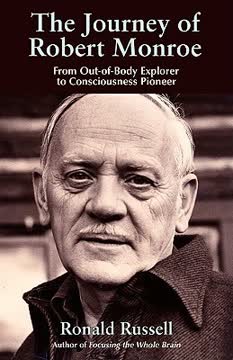
Conventional beginnings. Robert Monroe began his adult life as a quintessential American success story, rising from a Depression-era hobo to a wealthy and influential radio producer in New York, listed in Who's Who in America. His early passions included flying rickety aircraft, driving fast cars, and a keen interest in engineering and entertainment, which led him to produce popular radio shows like Rocky Gordon and High Adventure. This background established him as a pragmatic, no-nonsense individual, far removed from any mystical or spiritual pursuits.
Accidental awakening. At the height of his successful career in the late 1950s, Monroe began experiencing inexplicable physical seizures followed by vibrations, and then, startlingly, found himself floating outside his physical body. Initially fearing he was going insane, he sought medical and psychological evaluations, which found him perfectly sane. This forced him to confront a reality beyond conventional understanding, compelling him to embark on a solitary journey of self-exploration into these "out-of-body experiences" (OBEs).
Shifting purpose. What started as a personal quest to understand his own bizarre experiences gradually transformed into a mission to explore human consciousness. He realized his unique experiences could benefit others who shared similar, often frightening, phenomena. This marked a profound shift from his focus on mass entertainment and business ventures to pioneering research into the nature of mind and reality, laying the groundwork for what would become The Monroe Institute.
2. The Out-of-Body Experience (OBE): A Personal, Frightening Discovery
At first he thought he was dying—that somehow the vibrations were killing him.
Initial terror. Monroe's first conscious out-of-body experience was terrifying: he found himself floating against his bedroom ceiling, looking down at his own body lying in bed next to his wife. This led to intense fear and panic, as he grappled with the possibility of mental illness or impending death. His attempts to find answers from conventional medicine or existing literature proved fruitless, as OBEs were largely dismissed as hallucinations or associated with the occult.
Self-experimentation. Unable to find external guidance, Monroe committed to systematic self-experimentation, meticulously documenting his experiences in note form. He developed a "Second Body" concept to describe his non-physical self and the "Second State" for the out-of-body condition. His pragmatic approach, devoid of religious or mystical preconceptions, focused on verifying the reality of these experiences, such as attempting to observe distant events or interact with others while out-of-body.
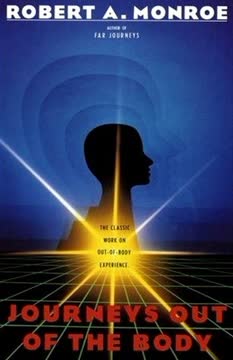
Validation and publication. His groundbreaking book, Journeys Out of the Body (1971), documented these early explorations, offering comfort and validation to thousands who had similar experiences but feared for their sanity. The book also caught the attention of parapsychologists like Charles Tart, leading to early scientific studies that, while not fully explaining the phenomenon, confirmed Monroe's psychological stability and the distinct nature of the OBE state.
3. Mapping Non-Physical Reality: Locales and Beyond
In this vastness lie all the aspects we attribute to Heaven and Hell, which are but part of Locale II.
Categorizing the unseen. Monroe systematically categorized the different environments he encountered during his OBEs, initially defining three "Locales."
- Locale I: The familiar physical world, where he attempted to gather verifiable data.
- Locale II: A non-material environment with different laws of motion and matter, encompassing what humans traditionally conceive as Heaven and Hell, inhabited by entities of varying intelligence.
- Locale III: An "alternative world" almost identical to Earth but without electricity or internal combustion, where he experienced a parallel life as an "I There" (an architect-contractor).
Beyond the physical. His explorations in Locale II revealed a spectrum of beings, from those trapped by earthly desires to serene "parks" where recently deceased souls rested. He also encountered a powerful, impersonal "intelligence force" and a profound sense of "Home," a place of pure peace and love, from which he was reluctant to return. These experiences profoundly altered his understanding of reality and the nature of existence.
The "I There" enigma. Locale III presented a unique challenge, as Monroe found himself merging with another individual's life, taking on their memories and emotions while retaining his own awareness. This raised deep questions about identity, parallel universes, and the nature of consciousness, pushing the boundaries of his rational understanding and hinting at a multi-faceted self.
4. Hemi-Sync: A Scientific Gateway to Altered States of Consciousness
Binaural beats require the combined action of both ears. They exist as a consequence of the interaction of perceptions within the brain, and they can be used to investigate some of the brain's processes.
Accidental discovery. Monroe's early experiments with sleep-learning tapes, designed to induce relaxation and enhance memory, inadvertently laid the groundwork for his most significant scientific contribution. The breakthrough came in 1973 when his associate, Dennis Mennerich, introduced him to the concept of binaural beats, a phenomenon where two slightly different frequencies played separately into each ear create a third, "phantom" beat perceived by the brain.
Brainwave entrainment. Monroe and his team realized that these binaural beats could induce a "frequency-following response" in the brain, causing both hemispheres to synchronize and entrain to specific brainwave states (e.g., Alpha, Theta, Delta). This process, which he named Hemispheric Synchronization (Hemi-Sync), allowed them to reliably guide listeners into altered states of consciousness, such as "mind awake, body asleep" (Focus 10).
Controlled exploration. Hemi-Sync provided a non-invasive, drug-free method to access states conducive to OBEs and other non-ordinary experiences. This technology became the cornerstone of The Monroe Institute's programs, offering a reproducible and controllable means for individuals to explore their own consciousness, moving beyond anecdotal accounts to a more systematic and verifiable approach.
5. The Monroe Institute: A Hub for Exploration and Transformation
He was seeking, he told them, some professionally qualified hard-core science and engineering types who could help him do proper research that would be acceptable to other scientists.
From personal quest to public mission. After documenting his early OBEs, Monroe felt a strong pull to share his discoveries and provide a safe environment for others to explore. He established the Whistlefield Research Laboratories, later renamed The Monroe Institute for Applied Sciences, building specialized "Controlled Holistic Environmental Chambers" (CHEC units) and recruiting scientists like Tom Campbell and Dennis Mennerich. This marked a transition from solitary exploration to a collaborative, science-based endeavor.
The Explorer program. A core component was the "Explorer team," a group of dedicated volunteers who underwent monitored Hemi-Sync sessions, documenting their experiences in non-physical realms. Explorers like Rosalind McKnight provided rich, detailed accounts of interactions with "Invisible Helpers" and insights into consciousness, which Monroe meticulously recorded and analyzed, often adapting their concepts into his training programs.
Gateway to consciousness. The Institute's flagship program, the "Gateway Voyage," was developed to teach participants to achieve and utilize various "Focus" states (e.g., Focus 10 for "mind awake, body asleep," Focus 12 for "expanded awareness"). These programs, initially conducted in hotels and later at the purpose-built Roberts Mountain facility, offered a structured, guided path for thousands to experience altered states, often leading to profound personal transformations and a new understanding of their own potential.
6. Far Journeys: Expanding the Cosmic Map and Understanding "Loosh"
All patterns of consciousness are nonphysical and hence not dependent on time-space.
Beyond local traffic. In his second book, Far Journeys (1985), Monroe moved beyond documenting "local traffic" OBEs (travel within Earth's time-space) to "interstate" journeys into vastly different energy systems and realities. He introduced concepts like the "Inspec" (intelligent species guiding him), "First-Timers" (souls new to Earth life), "Old-Timers," and "Last-Timers" (those on their final Earth incarnation).
The M Band and NVC. Monroe described the "M Band" as a chaotic energy spectrum of uncontrolled human thought surrounding Earth, which he learned to navigate. He also elaborated on "Nonverbal Communication" (NVC), a direct, instantaneous transmission of information, emotions, and experiences between intelligent energy systems, which he found challenging to translate into human language.
The "Loosh" concept. A particularly provocative revelation in Far Journeys was the concept of "Loosh," an energy generated by all organic life, especially humans, through emotion. This energy, he suggested, is harvested by non-physical entities. While initially unsettling, Monroe struggled to reconcile this with the concept of "Super Love," an indestructible, non-dependent form of love energy, which he believed was the ultimate purpose of human existence.
7. Ultimate Journey: The Quest for the "Missing Basic" and the Creator
There is no beginning, there is no end, There is only change.
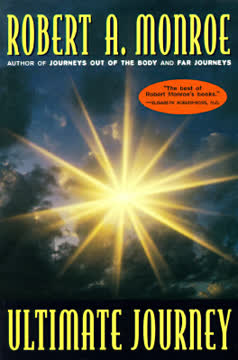
The yearning for Home. Monroe's final book, Ultimate Journey (1994), chronicled his deepest explorations, driven by a profound yearning to understand his ultimate destination, "Home." His initial visit to "Home" proved disappointing, revealing a beautiful but static existence without growth. This led him to seek a "Missing Basic" – a fundamental understanding he felt he had overlooked.
The Creator and the (M) Field. Through further "interstate" journeys and encounters with his "I There" (a cluster of his past-life personalities, including an architect-builder whose influence he saw in the Institute's tower design), Monroe came to a profound realization: the physical universe is an "ongoing creative process" designed by a "Creator" beyond human comprehension. He also gained a deeper understanding of the "(M) Field," a non-physical energy field permeating time-space, akin to the Zero Point Field in physics.
Completion and the poem. His ultimate journey culminated in a transcendent experience, revealing the "Emitter" – the source of all energy. He understood that individual souls are part of a "cluster" and seek "completion" by integrating all lost parts. This journey left him with the "Knowing" that consciousness is a continuum, not extinguished by death, and that the purpose of existence is to become truly One, ready for the "final journey into the Unknown." This profound insight was encapsulated in a poem, a gift of patience and understanding.
8. Lifeline and Going Home: Transforming the Fear of Death
This program would be called Lifeline.
A mission of service. Inspired by Nancy's progressive illness and his own profound OBEs, Monroe felt a new mission: to help others navigate the transition of death. He designed the "Lifeline" program, a "death insurance" that would guide participants beyond Focus 21 (the edge of time-space) into Focus 27, a "Park" or "way-station" for souls after physical death. This program aimed to demystify death and provide a means for conscious transition.
Beyond belief systems. Lifeline's premise was that consciousness is immortal and continues after physical death, moving through "belief system territories" (Focus 23-26) before reaching the Park (Focus 27). Participants, often professionals or those seeking deeper understanding, reported diverse, highly personal experiences, sometimes "retrieving" lost aspects of themselves or assisting others in transition, demonstrating that personal experience could transcend ingrained belief systems.
Supporting the bereaved. The "Going Home" program, a spin-off from Lifeline, was developed to support both the dying and their families and caregivers. It provided Hemi-Sync exercises and guidance to help individuals understand and accept the dying process, fostering communication with those in non-physical reality. This initiative, supported by figures like Elisabeth Kübler-Ross and Charles Tart, aimed to alleviate the fear and anxiety associated with death, offering comfort and a sense of continuity.
9. Monroe's Philosophy: Radical Empiricism and Consciousness as Focused Energy
Nothing is sacred to the point where it should not be investigated or put under inquiry.
Explore and question. Professor Joseph Felser summarized Monroe's philosophy with two core principles: "Explore everywhere!" and "Question everything!" Monroe embodied "radical empiricism," believing that knowledge is primarily based on direct experience, and "radical iconoclasm," challenging all taboos, myths, and established belief systems, whether scientific or religious. His approach was always to "go find out for yourself."
Consciousness as energy. Monroe's central philosophical tenet was that "Consciousness is Focused Energy." He viewed consciousness not as a product of the brain, but as a fundamental, non-physical continuum that extends beyond time-space and permeates all organic life. This "dynamic energy" manifests in various forms, with human waking consciousness being just a small segment of its vast spectrum.
Beyond dualism. Unlike Western science, which often struggles with the mind-body problem, Monroe's experiences led him to see consciousness as fundamental and irreducible. He believed that by perceiving and controlling this "focused energy," humans could achieve greater understanding and control over their physical, emotional, and mental systems, leading to a "massive evolution in the human species."
10. A Lasting Legacy: Hemi-Sync's Global Impact and Continued Evolution
Bob devoted the last thirty years of his life to sharing what he had learned with others, while he kept experimenting and learning himself.
Widespread applications. Robert Monroe's most tangible legacy is the Hemi-Sync audio technology, which has found diverse practical applications far beyond his initial scope. It is used globally in areas such as:
- Pain management and surgical support
- Accelerated learning and memory enhancement
- Treatment for ADHD, autism, and other learning difficulties
- Stress relief, sleep improvement, and emotional regulation
- Strengthening the immune system and supporting cancer patients
- Enhancing creativity and intuitive abilities
Transforming lives. The Monroe Institute, under the subsequent leadership of his daughter Laurie Monroe, continued to expand, offering a wide range of residential and outreach programs worldwide. These programs empower individuals to voluntarily access altered states of consciousness, fostering self-discovery, personal growth, and a profound shift in perspective, often leading to a reduction in the fear of death.
Enduring influence. Monroe's books and the Institute's work have provided comfort and validation to countless individuals who experienced anomalous phenomena, assuring them of their sanity and offering tools for exploration. His unique blend of scientific curiosity and personal courage, coupled with his accessible communication style, established a new paradigm for understanding consciousness, leaving an indelible mark on the fields of parapsychology, transpersonal psychology, and human potential.
Last updated: