Key Takeaways
1. Kindness is More Prevalent Than You Think
Humanity outweighs inhumanity – we just need to open our eyes to it and not be misled by the negativity that inevitably predominates in the news and on social media.
Challenge assumptions. Despite common perceptions and media narratives, humans are inherently kinder than often believed. From toddlers sharing marbles to older adults showing increased prosocial motivation, kindness is a fundamental aspect of human nature, not an exception. This challenges the long-held view that we are primarily selfish beings.
Innate goodness. Research, including the "Kindness Test" involving over 60,000 people from 144 countries, reveals that kindness is widespread and common across all age groups and cultures. Even young children demonstrate altruistic behaviors, taking pleasure in helping others, and this capacity for kindness generally increases with age. We are often driven by a "Light Triad" of personality traits—Kantianism, humanism, and faith in humanity—rather than just the "Dark Triad."
Contagious acts. Kindness is also highly contagious, creating a positive feedback loop where receiving kindness prompts individuals to pay it forward to others. This domino effect can proliferate through direct interactions and by influencing social norms. By actively looking for and acknowledging acts of kindness, we can counteract the negative bias in our perception and foster a more positive, connected world.
2. Being Kind Benefits You Too
Behaving compassionately improves the lives of others, it also improves our own lives.
Win-win scenario. Acts of kindness offer measurable boosts to both mental and physical health for the giver, not just the recipient. Studies show that performing kind acts increases job and life satisfaction, reduces stress and burnout, and can even contribute to a longer life. This "warm glow" of satisfaction is a genuine emotional gain, not a selfish one.
Neuroscientific rewards. Our brains are wired to reward kindness; the same reward centers activated by love, chocolate, or money are also stimulated when we give to others. This neural feedback loop reinforces prosocial behavior, making kindness intrinsically pleasurable. Spending money on others, for instance, often brings more happiness than spending it on oneself, regardless of the amount.
Eudaimonic fulfillment. Beyond immediate pleasure, kindness contributes to eudaimonic well-being, providing a sense of meaning and purpose in life. Volunteering, in particular, offers significant benefits by fostering social connections, increasing self-worth, and providing a sense of identity. These benefits are real and substantial, even if they don't magically solve all life's problems.
3. Mixed Motives Don't Diminish Kindness
If your action is well meant and genuinely benefits the recipient, the fact that you know it will give you a boost as well doesn’t diminish the action’s intrinsic good.
Purity is a myth. The idea of "pure" kindness, devoid of any personal gain, is largely a philosophical construct that doesn't reflect real-world behavior. Most acts of kindness stem from mixed motivations, including kin altruism, reciprocal altruism, and even competitive altruism, where people gain social status or a good reputation.
Impact over intent. What truly matters is the positive impact an action has on the recipient, not the precise purity of the giver's motives. Whether someone donates to charity for genuine empathy or to "show off," the charity still benefits. Neuroscientific studies even show that the brain's reward system is activated for both purely altruistic and strategically altruistic acts, suggesting that our biology encourages kindness regardless of complex intentions.
Strengthening action. Embracing mixed motivations can actually increase the likelihood of kind acts. When individuals acknowledge what they gain from helping others—be it joy, connection, or a sense of purpose—it strengthens their motivation to act. This perspective encourages more kindness in the world, rather than paralyzing it with unattainable ideals of selflessness.
4. Social Media Can Be a Force for Kindness
In fact, many of the posts and exchanges on social media show the kinder side of human nature.
Beyond the bile. While social media is often criticized for fostering negativity, abuse, and polarization, it also serves as a significant platform for kindness and support. From simple birthday wishes to elaborate mutual aid groups during crises, these platforms facilitate countless acts of "micro-kindness" and large-scale solidarity.
Amplifying good. Social media allows for the rapid spread of positive messages, support for those in need, and the sharing of uplifting content like memes and videos that bring joy and laughter. Neighborhood WhatsApp groups, for instance, have proven invaluable for community support, enabling quick offers of help and fostering local connections.
Conscious engagement. We have the power to shape our online experience by actively choosing to engage with and amplify kindness. By "kindness-scrolling"—seeking out and sharing positive content—and by unfollowing sources of negativity, we can counteract the algorithms that often promote outrage. This conscious effort can improve our own mood and contribute to a kinder online environment.
5. Kindness is a Strength, Not a Weakness
To be kind is not to be soft or gullible, but to be fair and consistent and trustworthy.
Successful leadership. The stereotype of kind people as dupes or losers is challenged by mounting evidence that kindness is a powerful asset, especially in leadership. Kind bosses, who prioritize staff well-being, fairness, and trust, often achieve higher productivity, greater employee loyalty, and better financial performance for their organizations.
Ethical advantage. Ethical leadership, characterized by agreeableness and conscientiousness, fosters a positive and collaborative work atmosphere where employees feel valued and motivated. This approach encourages staff to speak up, take risks, and work harder towards shared success, demonstrating that kindness is not a burden but a strategic advantage.
Beyond business. This principle extends beyond the workplace to competitive fields like elite sports and politics. Examples like triathletes sacrificing wins for rivals or political leaders like Jacinda Ardern prioritizing empathy show that decency and consideration can lead to different, yet profound, forms of success and admiration, proving that "kindness is power."
6. Empathy is the Foundation of True Kindness
To be truly kind towards others we have to be able to see things from their perspective.
Understanding others. Empathy, both cognitive (understanding thoughts) and emotional (sharing feelings), is crucial for genuine kindness. Our brains are wired to respond to others' pain and joy, allowing us to connect deeply. A lack of empathy, as demonstrated by the Trier Social Stress Test, causes significant distress.
Developing the skill. Empathy is not a fixed trait but a skill that can be learned and enhanced through active effort. Techniques like perspective-taking, where one actively tries to construct another person's arguments, can bridge ideological divides. Reading fiction is a powerful, often unconscious, training ground for empathy, allowing us to "feel what it is like to be another person."
Navigating challenges. While essential, empathy needs to be balanced. Excessive empathy can lead to burnout or skewed judgment, as seen in the "identifiable victim effect" where focus on one individual overshadows broader needs. We must also be wary of ingroup biases, actively working to extend empathy beyond those similar to us, recognizing our shared humanity.
7. Anyone Can Be a Hero (with preparation)
Everyone is capable of heroic acts and heroism is certainly not the preserve of an elite minority.
Everyday heroism. Heroism is not limited to soldiers or emergency services; ordinary civilians, across all ages and backgrounds, are capable of extraordinary acts of self-sacrifice. The Watts Memorial to Heroic Self-Sacrifice in London commemorates numerous "everyday heroes" who died saving others, demonstrating that bravery often arises from devotion to duty or a sudden opportunity.
Banality of heroism. Psychologists like Philip Zimbardo argue for the "banality of heroism," suggesting that heroic acts are often performed by seemingly unremarkable people who, when faced with a critical situation, act on instinct or training. This perspective normalizes heroism, making it more accessible and inspiring, rather than placing it on an unattainable pedestal.
Planned intervention. While spontaneous, heroic acts can be influenced by preparation. Thinking in advance about how one might safely intervene in an emergency—whether by tackling a criminal, filming an incident, or calling for help—can increase the likelihood of effective action. Overcoming the "bystander effect" often involves a conscious decision to take personal responsibility, even if it means risking embarrassment or misinterpretation.
8. Self-Compassion Fuels Kindness to Others
If you think it’s important to be kind to people, remember you are a person too, so don’t neglect being kind to yourself.
Essential self-care. Being kind to oneself is not selfish but a prerequisite for sustained kindness to others. Overly self-critical individuals experience more shame, anxiety, and depression, which depletes the energy and capacity to help others. Self-compassion, by contrast, is strongly linked to higher well-being, resilience, and healthier relationships.
Beyond self-indulgence. True self-compassion is distinct from narcissism or self-esteem; it involves acknowledging one's own suffering as part of the shared human experience, treating oneself with the same warmth and understanding one would offer a friend. This Buddhist-inspired perspective emphasizes that recognizing personal struggles is a step towards universal compassion.
Positive ripple effect. Research shows that individuals with higher levels of self-compassion are more likely to be empathetic towards others, have more harmonious relationships, and are better at apologizing for missteps. By nurturing our own well-being, we create a stronger foundation from which to extend genuine and consistent kindness to the world around us.
9. Cultivate Kindness Actively
It’s better to be kind in the way that suits you best rather than do nothing.
Conscious practice. Making the world kinder requires active, intentional effort, not just passive goodwill. This involves a range of practices, from observing and acknowledging kindness in daily life to actively seeking opportunities to be kind, tailored to one's own abilities and comfort levels.
Practical strategies:
- Become a kindness twitcher: Actively look for and record acts of kindness, both by others and yourself.
- Practice active empathy: Engage in perspective-taking and compassion training.
- Engage thoughtfully online: Choose to follow and amplify positive content, and pause before posting angry responses.
- Listen and read deeply: Cultivate understanding through attentive listening and immersive reading of fiction.
- Plan for heroism: Consider in advance how you might safely intervene in emergencies.
Personalized approach. Kindness doesn't demand saintly sacrifice or a complete overhaul of one's life. Even small, consistent acts—like starting conversations with strangers, leaving situations better than you found them, or simply being kind to yourself—can collectively make a significant difference. The goal is to integrate kindness authentically into your life, leveraging your unique skills and inclinations to contribute to a kinder world.
Last updated:
Review Summary
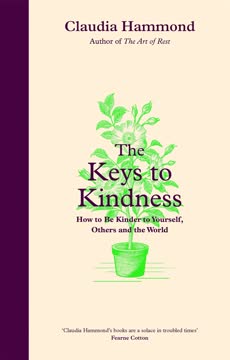
The Keys to Kindness receives generally positive reviews (3.7/5 stars), with readers praising its scientific rigor and practical approach to understanding kindness. Reviewers appreciate Hammond's accessible writing style and extensive research, noting the book avoids sentimentality while remaining inspiring. Many found it informative, learning about the vast field of kindness research and gaining actionable insights. Some critics felt it was occasionally repetitive or too long, with obvious conclusions. Overall, readers valued its empowering message, psychological insights, and practical tips for incorporating kindness into daily life, with several noting it restored their faith in humanity.