Key Takeaways
1. A Childhood Defined by Instability and the Search for Belonging
After a childhood that included stints in eleven foster homes, two years in an orphanage, and a mother locked up in a mental asylum, Marilyn has always felt deprived of a real home.
Early trauma. Norma Jeane Mortenson's early life was a relentless cycle of instability and neglect, profoundly shaping her future. Born illegitimate, her mother's mental health struggles led to her being shuttled between numerous foster homes and an orphanage, leaving her with a deep-seated fear of abandonment and a desperate longing for a stable family. This early deprivation instilled in her a lifelong quest for love and acceptance, often sought in the wrong places.
Physical transformation. At thirteen, a sudden physical maturation transformed her from "Norma Jeane the Human Bean" into the "Hubba-Hubba, Hmm Girl," attracting male attention that she initially mistook for genuine affection. This early experience of being valued for her physical appearance, rather than her inner self, laid the groundwork for her later public persona. She quickly learned to leverage her burgeoning sexuality, even if it meant sacrificing her true self.
Escaping the orphanage. The threat of returning to the orphanage loomed large, pushing her into an early marriage at sixteen to Jim Dougherty, a decision driven by desperation rather than love. This marriage, though providing a temporary escape, highlighted her vulnerability and her willingness to conform to external expectations to secure a semblance of belonging. Her childhood experiences left an indelible mark, fueling her ambition to create a new identity and a life far removed from her traumatic beginnings.
2. The Strategic Reinvention of Norma Jeane into Marilyn Monroe
I have a new name, Marilyn Monroe. I have to get born. And this time better than before.
Crafting a new identity. Norma Jeane's transformation into Marilyn Monroe was a deliberate and strategic act of self-creation, a conscious effort to shed her painful past and embrace a glamorous future. She meticulously honed her image, from bleaching her hair platinum blonde to undergoing subtle cosmetic procedures, all aimed at perfecting the "girl-next-door" look that captivated audiences. This reinvention was not merely superficial; it was a profound psychological shift.
Mastering the craft. Beyond her physical allure, Marilyn dedicated herself to learning the intricacies of the film industry, spending countless hours in acting classes, observing lighting technicians, and studying her photographs to understand her best angles. She absorbed knowledge voraciously, recognizing that talent alone was insufficient without a deep understanding of the craft. Her commitment to improvement was unwavering, driven by a fierce desire to prove her worth.
Publicity and perception. Marilyn actively participated in shaping her public narrative, often fabricating details about her orphaned childhood to evoke sympathy and create a compelling backstory. She understood the power of the press and skillfully manipulated it to her advantage, planting stories and posing for publicity shots that cemented her image as a rising star. This strategic approach to fame allowed her to control, to some extent, how the world perceived her, even as it distanced her from her true self.
3. The Relentless Pursuit of Artistic Credibility
I want to be an artist, not an erotic freak. I don’t want to be sold to the public as a celluloid aphrodisiac.
Fighting typecasting. Despite her meteoric rise as a sex symbol, Marilyn deeply yearned for recognition as a serious actress, constantly battling against the "dumb blonde" roles the studios pushed upon her. She sought out challenging dramatic parts, like Grushenka in The Brothers Karamazov, and invested heavily in acting lessons with esteemed coaches like Michael Chekhov and Lee Strasberg. Her ambition was to transcend her physical image and prove her intellectual and artistic depth.
Method acting immersion. Marilyn embraced Method acting, a technique that required deep self-analysis and emotional vulnerability, often drawing from her own traumatic past. She spent countless hours at the Actors Studio, studying plays and philosophy, striving to develop a "free voice and free body" to express complex characters. This dedication often clashed with traditional Hollywood production methods, leading to on-set tensions but ultimately enriching her performances.
Studio resistance. Her pursuit of artistic integrity frequently put her at odds with studio executives who primarily saw her as a bankable commodity. They resisted her demands for better scripts, creative control, and higher pay, often resorting to smear campaigns and suspensions. Yet, Marilyn's unwavering commitment to her craft, combined with her undeniable box-office appeal, eventually forced the studios to concede, marking a significant triumph for an actress in a male-dominated industry.
4. Love and Marriage: A Cycle of Hope, Disillusionment, and Loneliness
I didn’t want to give up my career and that’s what Joe wanted me to do most of all. He wanted me to be the beautiful ex-actress, just like he was the great former ballplayer.
Seeking stability. Marilyn's relationships, particularly her marriages to Joe DiMaggio and Arthur Miller, were marked by a profound longing for the stable family life she never had, often clashing with her burgeoning career ambitions. DiMaggio, a traditionalist, envisioned her as a devoted housewife, leading to intense conflict over her public image and professional commitments. Their marriage, though passionate, was ultimately unsustainable due to their differing expectations.
Intellectual connection. Her marriage to Arthur Miller, the acclaimed playwright, represented a hope for intellectual companionship and a shared artistic journey. Marilyn adored Miller, seeing him as a "serious man" who could provide the intellectual grounding she craved, and she embraced his family as her own. She even converted to Judaism, seeking a deeper connection and sense of belonging within his world.
Incompatibility and betrayal. Despite initial hopes, both marriages succumbed to the pressures of fame, conflicting ambitions, and personal insecurities. Miller, initially her protector, eventually struggled with her emotional fragility and reliance on pills, leading to his own disillusionment. Marilyn often felt betrayed, perceiving her husbands' criticisms as a rejection of her true self, perpetuating a cycle of loneliness and heartbreak that mirrored her early life.
5. The Perilous Dance with Fame, Exploitation, and Personal Demons
I have always been frightened by an audience, any audience. My stomach pounds, my head gets dizzy, and I am sure that my voice has left me.
The burden of fame. Despite her outward confidence, Marilyn harbored deep-seated insecurities and a crippling stage fright that intensified with her fame. She often felt like an "ornament," invited to events merely to "brighten up a dinner table," rather than for her intrinsic worth. This constant objectification, coupled with the relentless public scrutiny, fueled her paranoia and contributed to her emotional fragility.
Escalating drug use. Her struggle with insomnia and anxiety led to a dangerous reliance on a cocktail of prescription pills—barbiturates, uppers, and downers—often mixed with alcohol. This self-medication, initially a coping mechanism, spiraled into addiction, impacting her professional reliability and exacerbating her mental health issues. Doctors, including Dr. Ralph Greenson, struggled to manage her escalating drug tolerance.
Mental health struggles. Marilyn's fear of inheriting her mother's paranoid schizophrenia was a constant shadow, manifesting in episodes of paranoia, hearing voices, and deep depression. Her involuntary commitment to a psychiatric clinic, where she was confined in a padded room, was a terrifying realization of her worst fears, highlighting the severe toll her life was taking on her mental well-being. This constant battle with her inner demons was a private hell amidst public adoration.
6. Challenging the Studio System and Forging Her Own Path
The breakthrough deal is the first of its type. As a Hollywood businesswoman, she is truly a pioneer.
Defying the contract. Marilyn's decision to leave Hollywood and establish Marilyn Monroe Productions, Inc. (MMP) in 1954 was a revolutionary act of defiance against the restrictive studio system. Frustrated with being typecast and underpaid, she refused to accept another "dumb blonde" role, even if it meant suspension and legal battles with 20th Century-Fox. This bold move signaled her determination to control her career and artistic destiny.
Pioneering creative control. Through MMP, Marilyn secured an unprecedented seven-year contract with Fox, granting her creative control over her projects, including choice of director, story, and cinematographer, along with a substantial salary of $400,000 per film. This groundbreaking deal, the first of its kind for an actress, transformed her from a studio asset into a powerful businesswoman, paving the way for future stars to demand similar autonomy.
Strategic business acumen. Despite her public image as a naive starlet, Marilyn demonstrated shrewd business instincts, meticulously reviewing contracts, negotiating terms, and even personally approving publicity photos. Her collaboration with Milton Greene in establishing MMP, and later her strategic disengagement from him, showcased her growing understanding of the industry's power dynamics and her unwavering commitment to her own interests. She proved that she was not just a face, but a formidable force in Hollywood.
7. The Kennedy Entanglements: A Dangerous Liaison
I know a lot of secrets about the Kennedys. Dangerous ones.
Political allure. Marilyn's affairs with President John F. Kennedy and his brother, Attorney General Robert F. Kennedy, represented a new, dangerous chapter in her life, intertwining her personal desires with national politics. She was drawn to their power and intellect, seeing them as "extremely important men in government" who could offer a different kind of validation than Hollywood. These clandestine relationships, however, quickly became a source of immense personal and political risk.
National security concern. Her indiscretions, particularly her champagne-fueled conversations with suspected Soviet agent Frederick Vanderbilt Field, where she openly discussed sensitive political matters learned from the Kennedys, raised serious national security concerns for the FBI. J. Edgar Hoover meticulously documented her activities, viewing her as a potential liability who could compromise the president and attorney general. Her "Book of Secrets," containing notes from her conversations, became a highly sought-after item.
Rejection and fury. The Kennedys' eventual cold shoulder, orchestrated by Peter Lawford, left Marilyn deeply hurt and enraged, feeling "used" and "passed around like a piece of meat." Her desperate attempts to reach Bobby for an explanation, coupled with threats to expose their affairs to the press, escalated the situation into a volatile crisis. This final rejection, following a pattern of abandonment, pushed her to the brink, with dire consequences.
8. A Tragic End: The Unanswered Questions of Her Final Days
It was the most obviously staged death scene I had ever seen. The pill bottles on her bedside table had been arranged in neat order and the body was deliberately positioned.
A suspicious scene. Marilyn Monroe's death on August 5, 1962, at the age of thirty-six, was immediately shrouded in controversy, with LAPD homicide detective Sergeant Jack Clemmons describing the scene as "obviously staged." The neat arrangement of pill bottles and the deliberate positioning of her body raised questions about whether it was an accidental overdose, suicide, or even murder, fueling decades of speculation. The absence of pill residue in her stomach further deepened the mystery.
The missing diary. The frantic search for Marilyn's "little red book," her diary containing notes on "political things" and her conversations with the Kennedys, by Bobby Kennedy and Peter Lawford on the night of her death, added another layer of suspicion. Investigator Fred Otash's surveillance recordings allegedly captured a violent argument between Marilyn and Bobby, with her demanding an explanation for his abandonment and refusing to hand over the diary. Its disappearance remains a critical unanswered question.
Enduring legacy and grief. Despite the controversies, Marilyn's funeral was a private affair, meticulously organized by Joe DiMaggio, who famously banned members of the Rat Pack and the Kennedy family. Her makeup artist, Whitey Snyder, fulfilled his promise to do her makeup one last time, while Arthur Miller, though absent, penned a scathing essay condemning those who "destroyed her." Her death left a void, but her impact as a cultural icon, a symbol of both glamour and vulnerability, continues to resonate, forever embodying the complex interplay of fame, ambition, and profound loneliness.
Last updated:
Review Summary
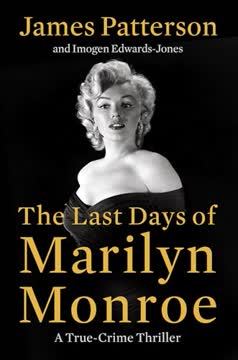
The Last Days of Marilyn Monroe receives mixed reviews averaging 3.8/5 stars. Most reviewers criticize the misleading title, noting the book covers Monroe's entire life rather than focusing on her final days. While some praise the well-researched, respectful approach and find it entertaining for newcomers, others complain it offers nothing new and isn't the "true crime thriller" advertised. Reviewers appreciate Patterson's signature short chapters and fast pacing but express disappointment in the shallow treatment of her death's mysterious circumstances and lack of fresh insights.