

Key Takeaways
Lead through your influence, even when your title carries no authority.
Leadership is an action. The book argues that assistants can lead without a senior title: they guide decisions, protect people’s time, and help teams do their work. Its central story makes the point through two crises. As a teenager, Burrows watched his brother slip into a crevasse while their family crossed a summer glacier without proper equipment. Years later, when his executive was suddenly fired, Burrows recognized a different kind of danger: he was burned out, isolated, and unprepared for a career change.
Prepare before the crisis. He traced that vulnerability to neglecting his own development, relationships, and health while prioritizing his executive. The book’s four-part approach asks assistants to build sound judgment, master practical work, invest in relationships, and protect their ability to keep working sustainably.
The book’s strongest redefinition is that leadership is not a prize bestowed by hierarchy. Assistants often have access to information, decisions, and relationships that give them real influence, even without formal authority. This resembles distributed leadership, where coordination and judgment can come from any position in a team. The framing also corrects an old status bias that equates leadership with commanding others. Its caution is equally important: informal influence should not become a rationale for limitless, invisible labor. A healthy organization recognizes the assistant’s contribution, gives the role clear boundaries, and shares responsibility for good outcomes.
Prepare for plausible surprises, then make decisions within earned trust.
Plan beyond the checklist. Burrows distinguishes proactive work, which prepares for something known to be scheduled, from anticipation, which prepares for a risk that may or may not occur. Booking a planned flight is proactive; considering a backup when winter weather could threaten a critical board meeting is anticipatory. The second requires understanding the executive’s priorities and thinking through what could derail them.
Build decision-making range. Assistants can begin with small choices, such as selecting a meeting room, then earn trust for bigger ones by explaining their reasoning. Burrows recalls staying quiet about a leadership candidate who seemed inauthentic. The hire later failed, and the team suffered. His lesson is to voice informed concerns rather than treating silence as loyalty. Good judgment includes knowing when evidence is incomplete and asking for another perspective.
Anticipation is valuable because it shifts support from completing requests to reducing the chance that important work gets derailed. In decision science, expertise often develops through repeated exposure to recognizable patterns, which can make an experienced assistant’s warning worth hearing. But a bad feeling is not proof: intuition can also reflect bias or incomplete information. The practical standard is to describe the observable concern, explain its possible impact, and invite scrutiny. That approach preserves the value of situated knowledge without turning instinct into an unquestionable veto.
Let mistakes teach you without letting work define your worth.
Confidence needs a deeper anchor. Burrows describes confidence not as certainty or bravado, but as believing one can learn while accepting that performance does not determine human value. Training, mentorship, and experience build competence; a separate sense of worth helps keep setbacks from becoming verdicts on the self.
Use errors as evidence. In one transaction, four people reviewed an offer letter that mistakenly listed $3.5 million instead of the intended $2.5 million. Burrows felt responsible, apologized, and acknowledged that he had relied on others to catch the error. The mistake was corrected, and the sellers did not want to proceed with the sale. He also recommends asking for criticism, taking time to consider it, and applying what is useful rather than reacting defensively. Humility means learning, not erasing oneself.
This distinction between self-worth and job performance makes feedback more usable. When an error threatens identity, people tend to defend themselves or hide the problem; when the error is treated as specific and correctable, accountability becomes easier. The story also shows why reliable work cannot depend on one person’s vigilance alone: multiple reviewers missed the same typo. A stronger lesson than simply being more careful is to improve the review process, especially for high-stakes documents. Personal humility matters, but good systems reduce the cost of ordinary human mistakes.
Automate repetition so human judgment becomes your strongest advantage.
Use technology to change the work. Burrows sees automation as a way to remove repetitive tasks, not as a reason to wait passively for roles to change. He describes an AI-based workplace platform answering routine questions, such as when the CEO is free or how to find travel details. Assistants can explore new tools, learn the company’s business, and use the time saved for more consequential work.
Keep developing human skills. The book highlights emotional awareness, empathy, thoughtful communication, problem-solving, and the ability to identify which problems matter. It also urges assistants to understand how their organization earns revenue or raises funds. Burrows recounts helping his startup secure its first multiyear contract through a business contact. The aim is not to turn every assistant into a salesperson, but to connect support work to organizational outcomes.
The useful question is not whether a machine can reproduce a task, but what value remains when that task becomes cheap. Automation can create room for judgment, context, and relationship repair, all areas where a small mistake may carry consequences beyond the task itself. This is a more durable career strategy than defending routine work from change. Still, the book’s emphasis on sales and revenue may fit some organizations better than others. In a nonprofit, public agency, or highly regulated workplace, risk reduction, service quality, and continuity may be equally persuasive measures of contribution.
Treat the executive calendar as a strategic asset, not an appointment grid.
Shape time around priorities. The book treats an executive’s calendar as a resource that affects focus, energy, and the organization’s ability to meet its goals. Burrows recommends designing an Ideal Week: a proposed pattern that reserves recurring time for meetings, focused work, email, breaks, or other priorities. Meeting requests can then be assessed against the executive’s goals and preferred working rhythms instead of filling every open slot.
Use evidence to adjust. A time audit can reveal how an executive’s actual schedule differs from the plan. Burrows gives an example: the company met its sales target in a quarter when the CEO spent 78 percent of his time in sales meetings, then missed its goal in a quarter when that share fell to 24 percent. Such data can prompt a useful review, though it does not by itself prove that meeting time caused the difference.
This approach turns calendar management into a form of resource allocation. The important move is from asking where a meeting fits to asking what the executive’s time should accomplish. A proposed weekly rhythm also makes trade-offs visible, which can help a team resist the assumption that every request deserves an hour. The quarterly figures are suggestive, not conclusive: sales results may depend on many factors besides the CEO’s schedule. A time audit is most useful as a starting point for inquiry, not as a simple causal explanation or performance score.
Capture interruptions, protect focus, and make low-value requests wait.
Give requests a place to land. An interruption does not always need an immediate answer. Burrows suggests asking colleagues to email a request, or recording it in a simple task list, so it can be reviewed later rather than interrupting the work in progress. He prefers a straightforward system to an elaborate one that consumes time maintaining categories and tags.
Set limits on access. Focus blocks, muted notifications, and a less-visible instant-message status can reduce the expectation of constant availability. Email can also be handled in planned windows instead of being checked reflexively throughout the day. When someone asks for time with the executive, the assistant can gather details and assess priority before committing. This creates space to decline, defer, or redirect work instead of letting every interruption become the next task.
The key design principle is to separate receiving a request from acting on it. That small delay can protect attention while still reassuring colleagues that the request has been recorded. It also makes prioritization a deliberate decision rather than a contest won by whoever interrupts most recently. However, focus rules need organizational agreement to work well. If colleagues depend on immediate access for genuine operational reasons, the team should define what qualifies as urgent and where urgent requests go. Otherwise, a personal notification setting may shift confusion onto others rather than solving it.
Turn invisible assistance into evidence of business value.
Describe outcomes, not busyness. Assistants often do work whose impact is easy to overlook. The book recommends connecting goals to the organization’s priorities and explaining results in language decision-makers understand. Rather than simply listing a task, show how it saved money, improved efficiency, supported a customer goal, or gave an executive time for higher-value work.
Prepare the evidence. For a compensation conversation, Burrows and Al-Husein Madhany advise gathering the original job description, the responsibilities added since hiring, market salary information, documented praise or reviews, and an updated resume. A written proposal makes the case clearer and helps the assistant ask directly. The book also warns that vague claims such as being helpful are weaker than specific examples. Metrics can strengthen the case, but not every important contribution can be reduced to a number.
Making work legible is not the same as exaggerating it. In organizations, decision-makers often see outputs more readily than the coordination that made those outputs possible. A concise record of responsibilities and outcomes can correct that visibility gap and improve both goal-setting and compensation discussions. The approach also invites a useful question: who benefits when essential work stays unmeasured? At the same time, metrics should support judgment rather than replace it. Trust, discretion, and preventing a problem may be difficult to quantify, yet can be central to the role’s value.
Build a partnership where questions, boundaries, and delegated outcomes are normal.
Make expectations discussable. Burrows recommends regular meetings with the executive to review priorities, clarify responsibilities, and surface problems before they grow. Useful questions include what would make the executive’s week less stressful, what aspects of the assistant’s work cause frustration, and which strengths are underused. The assistant should arrive with possible solutions, not only questions.
Delegate the result, not every move. In the book’s example, an executive repeatedly interferes while an assistant arranges a board dinner. The better approach is to state the outcome and constraints, then let the assistant choose the steps and seek help if needed. Assistants can also push back when a request conflicts with higher priorities. This partnership requires mutual respect. If an executive is abusive or persistently refuses meaningful communication, the assistant may need support or a different role.
A well-functioning assistant-executive relationship resembles a clear working contract: shared priorities, agreed channels, decision rights, and room for feedback. Asking direct questions can reveal assumptions that neither person knew were causing friction. Delegating outcomes also gives the assistant space to exercise judgment while leaving the executive accountable for defining success. But communication skills cannot repair every power imbalance. If the executive punishes reasonable questions or uses urgency to erase boundaries, the problem is not merely a misunderstanding. Practical advice should preserve the distinction between a fixable process and an unsafe relationship.
Grow a peer network before a career crisis makes isolation expensive.
Build relationships before needing a rescue. Assistants can be isolated because they work closely with one executive, handle confidential information, and may be treated as a route to someone more powerful. Burrows describes discovering that many workplace contacts were interested in access to his executive, not in knowing him. He recommends connecting with other assistants through local gatherings, professional groups, and online communities, while offering help without treating relationships as transactions.
Keep people human. The book also urges assistants to treat colleagues at every level with dignity and to help build a culture where people admit mistakes and apologize. Burrows recalls a manager who apologized after asking him to retrieve carts in extreme heat while wearing unsuitable clothing. That small act of accountability showed that respect is expressed through behavior, not job rank.
Peer networks provide more than job leads. They offer a place to compare norms, test interpretations, and discuss pressures that colleagues outside the role may not recognize. That makes connection a form of professional infrastructure rather than a social extra. The book’s emphasis on generosity also counters transactional networking, where contacts are treated as stored favors. Yet vulnerability should be calibrated: confidentiality, workplace politics, and uneven trust are real. A resilient network combines openness with judgment, so connection does not require sharing sensitive information or tolerating people who exploit access.
Schedule recovery before your helpfulness turns into burnout.
Notice the pattern early. Burrows describes working long hours, neglecting relationships, and accepting tasks that raised doubts about whether he was being taken advantage of. He did not recognize how depleted he had become until irritability and exhaustion were visible. The book identifies possible warning signs such as frequent illness, dread about work, numbness toward others, and difficulty making ordinary decisions. It also names common stressors: a poor fit with the executive or role, a change in the organization’s mission, life changes, broken trust, and persistent dissatisfaction.
Make recovery concrete. The proposed protections include agreeing on work-hour boundaries, maintaining a hobby, reducing unnecessary decisions, taking real time off, and asking for help from a trusted person or professional. Burrows emphasizes that rest is not a prize for finishing an impossible workload. It is part of staying capable of doing the work at all.
The book resists the familiar idea that exhaustion is proof of commitment. That matters in support roles, where availability can quietly become an expectation and overwork can be praised as loyalty. Its practical recovery habits are useful because they convert self-care from a vague intention into choices about time, access, and support. A necessary qualification is that burnout cannot always be solved individually. If chronic understaffing, abusive behavior, or unmanageable workload is driving distress, a hobby or better sleep is not a substitute for changing the conditions. Sustainable work requires both personal boundaries and organizational responsibility.
Analysis
The book combines a vocational argument with a working manual. Its central claim is not simply that assistants deserve more respect. It recasts the role as a form of leadership exercised through judgment, coordination, communication, and care, often without formal authority. The four-part structure gives that claim practical reach: personal qualities support tactical skill, relationships provide both influence and resilience, and self-care makes the other capacities sustainable.
Its most useful tensions are also its most revealing. Assistants are urged to be loyal but to challenge unethical conduct, flexible but assertive, service-minded but protective of their own time, and discreet while making their contributions visible. These are not contradictions to eliminate. They are recurring judgment calls that define the job. The book’s examples, from a mistaken property offer to a high-pressure travel decision, show that responsible performance is less about never erring than about noticing risk, communicating clearly, and learning without hiding.
The strongest organizational insight is that assistants can see across departmental boundaries and notice how work actually moves. That vantage point can improve schedules, processes, communication, and customer-facing decisions. The assistant is therefore not merely a personal productivity tool for an executive. The role can function as connective infrastructure for a team. The book’s advice becomes most powerful when executives treat that infrastructure as a partnership, with clear decision rights and reciprocal respect.
There is also a limit to the book’s individual-action emphasis. Many recommendations ask the assistant to anticipate, absorb interruptions, solve problems, generate revenue, and maintain composure. In a poorly designed workplace, those virtues can become a rationale for assigning more responsibility without authority, credit, or compensation. The book partly counters this by encouraging negotiation, boundaries, and exit from abusive relationships. Its fullest promise depends on organizations matching initiative with support. Read that way, the book is both a professional guide for assistants and a test of whether leaders know how to use their assistants well.
Review Summary
The Leader Assistant receives high praise from readers, with an average rating of 4.15/5. Reviewers appreciate its practical advice for executive assistants, covering topics like time management, leadership skills, and avoiding burnout. Many find it valuable for both new and experienced assistants. The book is commended for its relatable content, easy-to-read style, and actionable tips. Some readers note that certain sections could be more in-depth, and a few mention the author's occasional references to his paid services. Overall, it's widely recommended as a helpful resource for professional development.
People Also Read




Glossary
Leader Assistant
Assistant who leads through influenceBurrows uses this term to redefine the assistant role as leadership regardless of title or rank. A Leader Assistant supports an executive and organization through sound judgment, initiative, communication, and relationship-building, while developing professionally and protecting personal well-being. The term emphasizes leadership as a practice, not a position.
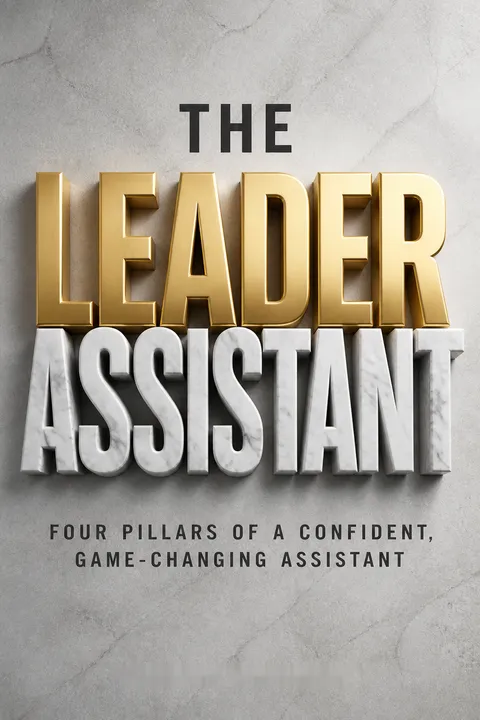
Four Pillars of a Confident, Game-Changing Assistant
Four-part professional development modelThe book’s organizing framework for developing as an assistant. Its four areas are embodying leadership characteristics, using effective work tactics, engaging in professional relationships, and exercising self-care. The model presents these as mutually supporting capacities: practical skill and influence are difficult to sustain when relationships or personal well-being are neglected.
Ideal Week
Planned weekly time patternA proposed recurring schedule built around an executive’s priorities and working preferences. It can reserve specific blocks for meetings, focused work, email, breaks, and other activities. Assistants use it as a guide when evaluating meeting requests, rather than allowing every open calendar slot to be filled without regard to goals or energy.
Burnout Creep
Gradual advance of burnoutBurrows’s term for burnout developing gradually enough to escape notice. A pattern of long hours, excessive availability, over-identification with work, and neglected relationships or health can become normal before its costs are obvious. The concept encourages assistants to monitor changes in energy, behavior, and attitude instead of waiting for a crisis to force a reset.
delegating results
Assigning outcomes, not stepsA delegation approach in which the executive explains the desired outcome and relevant constraints, then allows the assistant to decide how to accomplish it. The executive remains available for questions or obstacles without directing each action. The book contrasts this with task-by-task involvement, which can duplicate effort and limit the assistant’s ability to use judgment.
business case
Evidence-based compensation requestA written presentation used to support a request for increased compensation or an adjusted title. In the book’s approach, it documents how the assistant’s current responsibilities differ from the original role, provides relevant market salary information, and includes evidence of performance such as reviews or praise. It frames the request as a reasoned business discussion rather than an informal appeal.
Download PDF
Download EPUB
.epub digital book format is ideal for reading ebooks on phones, tablets, and e-readers.








