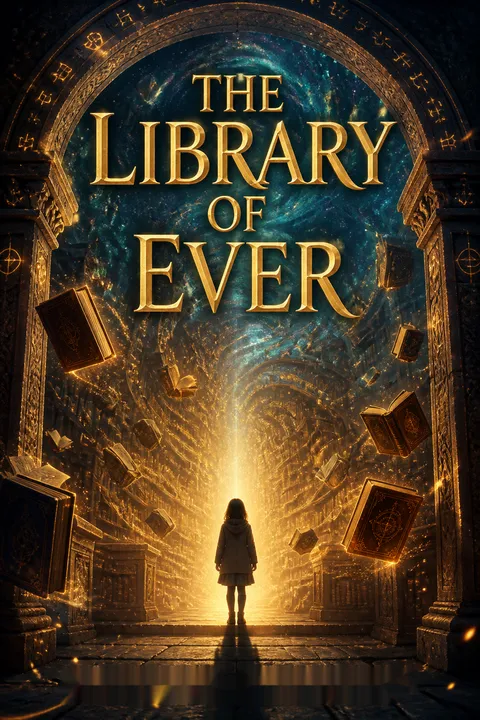


Plot Summary
The Library Behind Stone
Lenora, an intensely curious girl with wealthy but absent parents, is trapped in a limousine with a nanny who cares more about shopping than entertaining her. At a public library, Lenora slips away from the nanny and discovers a man blocking a young boy from reading astrophysics. His badge misspells librarian, and he dismisses the books as lies.
Lenora challenges his authority and sends the boy in to read. After the man vanishes, a stone archway appears in a blank wall, marked with a message about knowledge shining like light. Lenora follows its dark passage, trading the dull summer she knows for a place no one has told her exists.
Lenora’s first act of courage is not grand or planned. She notices that an adult is using authority to restrict a child’s curiosity, then acts despite her own fear. The false librarian’s misspelled badge makes institutional legitimacy something Lenora can inspect rather than accept blindly. Her boredom matters because it has not made her passive; it has sharpened her appetite for discovery. The hidden entrance answers that appetite with a world that treats questions as a vocation. The story begins by making curiosity both a personal need and a moral responsibility.
A Badge and a Desk
Beyond the arch, Lenora finds a library of towers, bridges, rolling ladders, and airborne book blimps. Malachi, its towering Chief Answerer, tests her willingness to work, learn, and defend knowledge, then hires her as a junior apprentice. She assigns Lenora to the Calendars Help Desk because Lenora cannot answer a question about Spain on October 5, 1582.
Lenora studies the shelves instead of pretending she knows, and discovers the date never occurred. Before she can use that fact, a courteous robot named Bendigeidfran arrives from the year 8000. His king needs help: a calendar display has failed, and an entire kingdom has forgotten how to identify the day.
Malachi’s test defines librarianship as disciplined uncertainty, not a storehouse of ready answers. Lenora is given a low-ranking role precisely because she lacks knowledge, and the assignment makes learning part of service. Her small intervention in the dictionary, adding a word she finds missing, also reveals an instinct to make language more usable. Bendigeidfran’s arrival then enlarges the stakes without changing the method: a practical question must be investigated, not guessed at. Lenora’s new badge gives her authority, but the chapter’s real initiation is the moment she accepts that she must earn what she does not yet know.
The Date That Never Was
In Starpoint Seventeen, Lenora finds citizens panicking beneath an error message in the sky. The king remembers the previous day as February 28, 8000, and his historian and mathematician insist the next date must be February 29. Lenora applies the calendar rules she has just studied: the year 8000 is divisible by 4000, making it a common year.
She persuades the king to set the date to March 1 and remove the display so the people will learn to track time themselves. A suspicious woman in a bowler hat then tricks Bendigeidfran into sending Lenora to the nonexistent October 5, 1582. Their time machine fails in the void, but Lenora uses its last power to escape to October 4 and return home.
The calendar puzzle is a compact lesson in how expertise can fail when it is fragmented. The historian knows precedent, the mathematician knows division, but neither understands the whole system; Lenora succeeds by joining their partial truths. Her deeper recommendation, removing the sky display, challenges the convenience that made the kingdom helpless. Dependence has replaced understanding. The bowler-hatted woman turns that intellectual danger into physical peril, showing that Lenora’s enemies can exploit knowledge as well as oppose it. Lenora survives not through strength but through careful attention to exceptions, a habit that becomes her defining form of bravery.
The Globe Without an Exit
Back at the library, Malachi sends Lenora to the Cartography section, where a departing librarian has left a crowd waiting beside an enormous raised-relief globe. A heartbroken patron wants to find the place with the world’s longest name so he can send a letter to the woman he loves. Lenora climbs into an unlabeled gas balloon, releases its anchor, and is swept into the globe’s strange gravity.
Unable to control the craft, she jumps onto the miniature coastline and watches the balloon race away. Looking for a starting point, she asks a pod of beluga whales for help finding Wales. They take her across the ocean, where she finds a famously long Welsh town name and records it, believing she has solved the patron’s question.
The globe makes information physical: geography is no longer a picture to consult but a terrain Lenora must cross. Her first approach is improvisation, and it gets her moving, but the balloon’s lack of instructions exposes the cost of acting before she understands a system. The belugas reward her willingness to ask for help, while their irritation with imprecise language makes naming itself part of the adventure. Lenora’s confidence is provisional rather than foolish; she writes down a plausible answer but has not yet verified it. The episode turns research into a journey where each apparent answer can become the next question.
The Globe Fights Back
Lenora cannot reach the walkways above the globe, and a bowler-hatted stranger sabotages her balloon before she can use it to escape. She rows onward, then spots penguins stranded in the northern region and turns back to help them, using a translator headset from a nearby box.
The penguins guide her toward Mount Everest, but its peak still falls short of the library walkways. They correct her: Mount Chimborazo, near Ecuador’s equator, is Earth’s highest point when measured from the planet’s center.
Lenora climbs it, pulls herself onto a walkway, and returns to the patron. Her Welsh answer proves incomplete when he recognizes a connection to Thailand, but Lenora has found a more convincing destination and learned to check before concluding.
Lenora’s progress depends on a change in priority. She could continue toward her own escape, but the lost penguins make her stop and perform the work she swore to do. That choice earns her information and, eventually, a route out. The globe also corrects a familiar misconception: what seems obvious from a map is not necessarily true from another frame of measurement. Lenora’s answer to the patron remains imperfect, yet the book treats uncertainty honestly rather than rewarding a lucky guess. Her notebook becomes a record of corrections, showing a mind willing to revise itself without losing momentum.
The Unknown Section
After her cartography success, Malachi sends Lenora through the pneumatic Tubes to a section wrecked by a tornado, whose subject no one remembers. While inspecting its scattered books, Lenora encounters a red ant who communicates by tracing letters in powdered sugar.
The ant needs help for a tiny acquaintance, so Lenora takes her through the Shrinking Room and follows her into Ant City. There, the ant, whom Lenora names Cinnamon, guides her past the bowler-hatted threat to a tardigrade building a spaceship.
The tardigrade wants to follow her brother to Alpha Centauri, but he took the books she needs for the journey. Lenora understands that the unknown section may contain the answers, though its ruined shelves seem impossible for one person to sort.
This assignment brings Lenora to the limit of individual competence. She cannot classify the section by intuition alone, so she follows evidence: the book titles, the ant’s message, and the tardigrade’s request. The sequence also broadens the story’s idea of librarianship beyond human readers. Cinnamon’s pheromone-based society and the tardigrade’s technical expertise are forms of knowledge that Lenora must approach with humility. Her willingness to shrink herself, enter an unfamiliar city, and accept help is not a retreat from agency. It is how agency becomes collaborative, a necessary precondition for solving a problem too large for one apprentice.
Ants Rebuild the Shelves
Lenora recognizes that Ant City’s wind turbines can carry Cinnamon’s message, so she recruits an army of ants to rebuild the wrecked section. Their speed lets Lenora sort the books, identify the department as Tardigrades, and gather orbital mechanics texts for the traveler. The tardigrade launches before Lenora can secure the borrowed books, carrying her into space.
Rather than stay aboard for the trip to Alpha Centauri, Lenora uses a repaired MOOSE, a padded experimental space-jump suit, and parachutes back to the library. Her badge promotes her, and Malachi tells her she can now choose her assignments. Lenora chooses the History of Science section, where a curious girl is waiting for the largest book available.
The ants turn Lenora’s insight into collective labor. She does not command them by status; she offers a clear purpose and coordinates skills they already possess. The tardigrade’s launch complicates her success with a genuine cost: Lenora has enabled another being’s journey but has not protected the library’s books or her own place in it. Her decision to return reveals that adventure is not the only good she values. Malachi’s promotion recognizes both her resourcefulness and her need to accept imperfection. Choosing her next assignment marks a shift from being placed by authority to taking responsibility for where her curiosity leads.
The Book They Fear
Lenora gives the eager girl a vast scientific history of the universe, then notices that the section has grown cold and silent. Two men in bowler hats confront her. One apologizes for the earlier attempts to stop her, while the other insists that scientific knowledge will unsettle the girl and later disturb millions. They demand that Lenora remove books they consider dangerous.
Lenora refuses to hide accurate knowledge, even after the men argue that frightening discoveries will cause conflict. The pair merge into a towering creature with sharp teeth, making clear that their polite concern was another form of coercion. Lenora tries to evacuate the patrons, but the creature darkens the room and advances on her.
The antagonist’s strongest weapon is not force at first but paternalism. By presenting censorship as protection, the smoother man asks Lenora to confuse emotional comfort with ethical care. His prediction that truth may cause distress is not entirely false, which makes the demand more seductive than a simple lie. Lenora’s refusal rests on a difficult distinction: protecting a reader from every unsettling idea would also deny that reader the capacity to think. The transformation of the men into one monster externalizes the violence concealed inside their reasonable language. When persuasion fails, the impulse to control knowledge reveals its predatory shape.
Light Against the Creature
The creature swells into a vast darkness, its torn coat showing images of books burned and libraries destroyed. Lenora’s body begins to glow, but the monster overwhelms the room before she can stop it. Malachi reaches her and shields her in a warmth the darkness cannot penetrate; the creature collapses and vanishes.
Malachi explains that the men belong to a force that seeks power by keeping people ignorant. She recalls losing battles at Alexandria and Baghdad, warning Lenora that librarians do not always win. Lenora vows to join the struggle, and Malachi accepts her as a member of the cause. Then she sends Lenora to Zoology, where a child needs help finding a lost kitten.
The revelation reframes Lenora’s earlier encounters as parts of a sustained conflict rather than isolated mishaps. The enemy has tried to bar a child from astrophysics, falsify a date, sabotage a rescue, and suppress a science book; each act narrows access to knowledge. Malachi’s intervention is crucial, but so is her admission of defeat in earlier battles. She gives Lenora neither a fantasy of invulnerability nor a solitary heroic burden. Lenora’s glow suggests that knowledge is not merely stored in books; it is also embodied in the people who defend inquiry. The lesson is commitment joined to humility and alliance.
Mister Sparkles in Egypt
In Zoology, Lenora settles a contest between a pocket shark and a bonsai tree, then meets a distressed boy whose kitten, Mister Sparkles, has escaped. She reasons that a cat would seek the library’s new Egyptian city diorama, and enters through a staff passage. A costumer disguises her as a cat, giving her the movement and senses she needs to follow paw prints across the display’s artificial desert.
At the Temple of Bubastis, Lenora climbs the outer wall and finds Mister Sparkles on the roof. She persuades him that the boy loves and misses him, and the kitten returns to his owner. Lenora’s badge adds another duty, but before she can report back, a trapdoor opens and drops her into darkness.
This episode makes empathy operational. Lenora does not scold the boy for bringing a kitten or assume the animal will behave like a person; she imagines the world from the kitten’s point of view and uses the diorama as a likely destination. Becoming a cat turns that imaginative act into bodily knowledge, though the transformation also briefly tempts her with the chase of a mouse. The reunion is earned through attention to both sides of the bond. The sudden trapdoor interrupts an apparently complete rescue, reminding Lenora that the library’s dangers do not wait for tidy chapter endings.
The Library of Lost Things
Lenora lands on pillows in a deserted vault and follows footprints past empty sections to a room of unreadable Minoan tablets. An unseen girl explains that she is the memory of a Japanese librarian who once built a manuscript collection, later destroyed by fire.
The vault holds lost works and knowledge, including material whose existence is remembered but whose contents remain inaccessible. The guide shows Lenora blank records of vanished writings, then leads her to a listening tube.
Through it, Lenora hears a man press Malachi to run the library as a business and discard less profitable books. When the guide warns that the enemy is coming, an armored swordswoman gives Lenora a fresh lantern and directs her toward a labyrinth, while staying behind to face bowler-hatted robots.
The forgotten vault gives censorship a longer and quieter history than the monster’s attack. Knowledge can disappear through deliberate destruction, but also through neglect, catastrophe, and the absence of anyone left to remember it. The Japanese librarian’s memory is therefore both a person and evidence of how fragile cultural inheritance can be. The overheard business plan extends the threat into ordinary institutional language: a book need not be burned if it can simply be judged unprofitable and removed. Lenora is forced to move before she can repair what has been lost, carrying the lantern as a fragile obligation to remember.
Lenora Finds Her Future
Lenora follows the labyrinth’s turns and finds Bendigeidfran waiting at its center; he has recovered his missing memory chip and lowers her into Genghis Khan’s tomb to evade the pursuing robots. Ants break through the earth and bury one attacker, while penguins carry Lenora across an icy cavern past others.
The battered swordswoman gives Lenora a glowing library card, then sends her through a hidden slide. Lenora emerges in the public library, where the nanny catches and carries her away.
As the secret entrance disappears, Lenora glimpses the swordswoman’s badge and recognizes her own name, with the simple title of librarian. The revelation tells Lenora that the ally is her future self. Though the nanny returns her to ordinary life, Lenora knows she will come back.
The escape is not a solo triumph. Each community Lenora has helped earlier now repays that care: ants open the way, penguins provide speed, and Bendigeidfran offers a route through danger. Her future self’s badge turns the adventure into a promise rather than a completed transformation. Lenora has not yet become the librarian she glimpses, and the nanny’s grip makes that distance painfully concrete. The public world can still reclaim her, but it cannot erase what she has learned. Her return to ordinary life ends the immediate journey while leaving the library’s calling intact.
Analysis
The Library of Ever treats curiosity as a form of action. Lenora does not merely admire books; she uses them to solve emergencies, correct confident authorities, reunite a child with a kitten, and challenge efforts to suppress knowledge. The episodic structure makes each section a different test of inquiry: calendars demand careful rules, cartography requires revision of familiar assumptions, and the Unknown section can only be understood through cooperation. Lenora’s recurring notebook is a quiet emblem of this process. It records not only discoveries but mistakes, reminders, and facts she must verify. Knowledge grows through correction rather than certainty.
The central conflict distinguishes care from control. The bowler-hatted agents justify censorship by predicting fear and social disruption, and the book grants their forecast enough plausibility to make Lenora’s decision meaningful. Facts can unsettle people; the ethical question is whether that possibility gives anyone the right to decide what others may know. The agents’ transition from polished argument to monstrous violence exposes the coercion beneath their paternalism. The library’s lost vault adds a second danger: information may disappear through fire, neglect, catastrophe, or institutional choices about profitability. Preservation therefore requires both memory and active defense.
Lenora’s development is also a movement away from isolation. At first, she wants a job because adults have denied her meaningful participation. Her early victories reward quick thinking, but later challenges teach her that courage includes asking for help and accepting the limits of her knowledge. Ants, penguins, a tardigrade, a robot, and Malachi all contribute forms of expertise she cannot supply alone. The ending makes this growth prospective rather than complete. Lenora returns to the ordinary world, but the glimpse of her future as a librarian suggests that the work ahead will be chosen, not merely assigned. The novel’s answer to the question of what knowledge is for is concrete: it helps people find their way, and it must be kept available to those who come after.
Review Summary
The Library of Ever receives mostly positive reviews, with an average rating of 3.77 out of 5. Readers praise its imaginative concept, whimsical adventures, and emphasis on the importance of knowledge. Many compare it to classic children's literature like The Phantom Tollbooth. Some criticize the disjointed plot and underdeveloped characters. The book appeals to young readers who enjoy fantastical stories and learning new facts. Critics appreciate the book's message about the power of libraries and librarians, though some find the execution lacking in cohesion and depth.
People Also Read
Characters
Lenora
Restless apprentice librarianLenora is an eleven-year-old only child whose wealthy parents and inattentive nanny leave her with time, comfort, and almost no agency. She wants to work, explore, and test what she can do, rather than be treated as too young to contribute. Her curiosity is practical: she takes notes, studies unfamiliar subjects, notices errors, and changes her mind when evidence demands it. Lenora’s courage is not fearlessness; she often feels frightened or overwhelmed, then acts because someone needs help. As a new librarian, she learns that answers require research, that independent problem-solving has limits, and that service includes readers very different from herself.
Malachi
Towering chief librarianMalachi is the library’s ten-foot-tall Chief Answerer, a precise and demanding guide who expects librarians to work hard, seek answers, and think for themselves. Her severity is not coldness: she gives Lenora difficult assignments because she believes challenge is how a novice becomes capable. Malachi values knowledge beyond its practical or financial use, and she understands that protecting it can involve real danger. Her authority is balanced by restraint. She does not solve every problem for Lenora, but she intervenes when the child faces a threat she cannot yet manage alone. She represents both institutional memory and the limits of individual heroism.
Bendigeidfran
Time-traveling robotBendigeidfran is a courteous robot from the year 8000, sent by his king to find help when a failed calendar throws his kingdom into confusion. A damaged memory unit makes him unreliable about dates, although he remains eager to serve and willing to admit mistakes. He respects Lenora’s judgment and becomes a useful ally in her journeys through time and the library. His predicament also makes him more than a technological guide: he is a friend who must learn to question instructions when they come from suspicious sources.
Cinnamon
Ant-city guideCinnamon is a red ant who first communicates with Lenora by writing in powdered sugar, then guides her through the sophisticated city of ants. She is quick, courageous, and deeply attentive to the needs of her community. Lenora gives her a human-friendly name after learning that ants communicate through pheromones. Cinnamon’s knowledge of the library’s hidden routes and her ability to rally other ants make her an ally whose strength comes from cooperation rather than size.
The armored swordswoman
Masked kendo fighterThe armored swordswoman first appears at a library kendo demonstration, skilled enough to command attention even behind a mask. She moves decisively, carries a real blade when danger rises, and seems to know more about Lenora’s circumstances than she can explain. Her guarded manner suggests that she is accustomed to acting under pressure and accepting risks without recognition. She functions as an enigmatic ally whose practical help arrives at moments when Lenora has few safe choices.
The bowler-hatted agents
Enemies of knowledgeThe bowler-hatted agents appear in different forms, but share a hostility to open inquiry. They block children from books, mislead Lenora’s companions, sabotage her progress, and present censorship as protection from unsettling facts. Some use intimidation, while others favor polished arguments about comfort, order, or efficiency. Their changing tactics make them difficult to dismiss as ordinary villains: they exploit both fear and reasonable-sounding concern to limit what people can learn.
The tardigrade
Self-taught spacefarerThe tardigrade is a determined inventor building a spaceship so she can follow her brother to Alpha Centauri. She is proud of her species’ survival abilities, technically gifted, and impatient to begin her journey. Her hurried launch creates trouble for Lenora, but her needs also reveal the purpose of the forgotten library section. She treats knowledge as equipment essential to exploration, not as an abstract possession.
The lost Japanese librarian
Keeper of vanished memoryThis librarian survives as a memory in the library’s vault of lost knowledge. Long ago, she gathered manuscripts left behind by travelers in her Japanese village, taught herself to read them, and built a collection for others to see. Her voice is gentle and wistful, shaped by the loss of both her library and the community that once surrounded it. She helps Lenora understand that knowledge can vanish without leaving a complete record of its disappearance.
The King of Starpoint Seventeen
Future kingdom’s young rulerThe king is a solemn young ruler whose kingdom depends on a broken calendar display. He wants to restore order but must rely on the competing claims of his historian, mathematician, and librarian. His willingness to hear Lenora’s reasoning gives her a chance to correct the date and address the deeper dependence that caused the crisis.
The kitten’s owner
Boy searching for his catThe young boy brings his kitten to the library because he wants to find books the animal might like. When the kitten escapes, he is frightened and distressed. His attachment gives Lenora a small but urgent problem to solve, and his devotion helps her persuade the kitten to return.
Mister Sparkles
Runaway library kittenMister Sparkles is the boy’s adventurous kitten, drawn to the library’s Egyptian cat diorama. He climbs to the roof of the Temple of Bubastis and mistakes the spectators for worshippers. Lenora’s cat disguise lets her approach him in a way he understands, helping him remember the boy waiting for him.
The nanny
Impatient summer caretakerLenora’s nanny is inattentive to the girl’s interests and spends their outings shopping and visiting friends. She represents the mundane adult world that assumes Lenora should follow along rather than choose her own work. Her practical concern with schedules and parental approval makes her oblivious to the extraordinary life Lenora has briefly found.
Lenora’s parents
Distant wealthy guardiansLenora’s wealthy parents are preparing for a trip and dismiss her requests for summer jobs because she is only eleven. Their absence helps place Lenora in the nanny’s care and establishes her frustration at being protected from meaningful responsibility.
The court historian
Keeper of old recordsThe court historian trusts the kingdom’s inherited records and argues that the calendar should follow the familiar leap-year rule. His confidence in precedent becomes an obstacle when the year requires a more complete calculation.
The court mathematician
Defender of calculationThe court mathematician insists that arithmetic supports February 29, 8000. Like the historian, she has one useful piece of the problem but treats it as a complete answer, making Lenora’s synthesis necessary.
The heartbroken patron
Seeker of a lost addressThis patron wants to write to a woman he loves but knows only that she moved to a place famous for its unusually long name. His urgency gives Lenora her first Cartography assignment, and his own memories help him assess whether her research points toward the right destination.
The young girl in History of Science
Relentless question askerThe girl arrives at the History of Science section with an appetite for questions and a restless need to explore. She asks Lenora for the largest book available, and Lenora responds by finding a scientific history of the universe. Her curiosity becomes central to a dispute over whether difficult knowledge should be withheld from children.
Plot Devices
The Library of Ever
World-sized knowledge systemThe library is an immense, interconnected institution containing sections for subjects, places, eras, and forms of life. Its towers, bridges, maps, Tubes, shrinking rooms, and specialized help desks make research an adventure through physical space. Each department presents a different challenge and gives Lenora a new way to learn how knowledge is organized, shared, or lost. The library is also vulnerable: forgotten rooms, disappearing works, and attempts to remove books show that its scale cannot guarantee that everything will be preserved.
The Librarian’s Oath
A promise tested by workMalachi’s oath commits a librarian to hard work, brave inquiry, practical problem-solving, and helping people who are lost. Lenora’s badge records her role and changes as she earns promotions and responsibilities. The oath is not merely ceremonial: it guides her decisions when she pauses her own escape to help penguins, takes a kitten’s owner seriously, and resists the demand to hide scientific books. Its tests show that librarianship requires judgment as well as accumulated knowledge.
The Bowler-Hatted Agents
Censorship in changing disguisesThe agents repeatedly obstruct Lenora’s work, sometimes through direct intimidation and sometimes through deception or plausible arguments about protecting people from fear. Their interventions connect the false librarian, the sabotage of Lenora’s journeys, the demand to remove books, and the larger force that attacks libraries. By changing their methods, they reveal how suppression can look like a rule, a helpful warning, or a business decision before its violence becomes visible.
The Library Tubes
Routes between strange sectionsThe pneumatic Tubes fire librarians between distant departments through labeled destinations, while special rooms allow people to shrink or return to normal size. A librarian’s key opens access to these systems and becomes a portable means of travel. The Tubes keep the sprawling library navigable but cannot answer every problem for Lenora; she still has to choose a destination, understand what she encounters, and sometimes find another route when danger blocks the official one.
The MOOSE Suit
An improvised return from spaceThe MOOSE is an experimental padded suit designed for a possible jump from a spacecraft, though it was never tested under the conditions Lenora faces. The tardigrade repairs it with a heat shield and rockets, allowing Lenora to leave the spaceship and return to the library. Its uncertain design makes the return a genuine risk, while its successful use adds a new distinction to Lenora’s badge and demonstrates how old inventions can become useful when someone adapts them.
The Library of Ever Series
Download PDF
Download EPUB
.epub digital book format is ideal for reading ebooks on phones, tablets, and e-readers.








