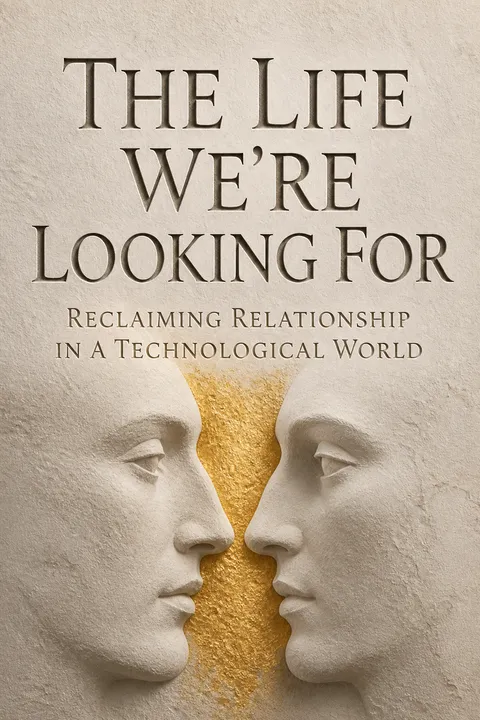


Key Takeaways
Recover the life you seek by choosing persons over personalized convenience
Recognition comes first. A newborn searches for a face that looks back. In psychologist Edward Tronick’s still-face experiment, caregivers briefly stop responding, and infants quickly become distressed. Crouch uses this to argue that attention from another person is not a luxury. It helps us discover who we are.
Personalized is not personal. A window company sent the author a convincing handwritten letter that was actually printed by a machine. Online feeds personalize content even more precisely, but they can do so without anyone knowing or caring about the person receiving it. Their appeal is powerful: they adapt to our preferences and keep us at the center, while real relationships ask us to make room for someone else.
The distinction clarifies why tailored experiences can feel intimate without providing intimacy. Personalization predicts preferences; recognition involves another person responding with attention and judgment. That difference matters in design: a digital service can make a relationship easier to sustain, but it cannot substitute for the other person’s presence. Attachment theory likewise treats responsive care as central to early development, not simply as a pleasant extra. Still, screens are not inherently hostile to connection. The sharper question is whether a technology helps people attend to one another, or mainly captures attention for its own benefit.
Treat each human as a person, not a function to exploit
Worth is not earned. Crouch distinguishes a person from a thing: a person’s dignity does not depend on achievement, status, or good behavior. Yet personhood also develops through being recognized by others. To contemplate someone is to attend to who they are, rather than ask what they can provide. To exploit is to reduce them to usefulness.
At Chicago’s O’Hare airport, Crouch walked the concourses, silently reminding himself that each stranger bore divine dignity. The exercise moved him because every face held a life he could not know. Ordinary routines often erase that awareness: a cashier becomes a checkout function, and a pedestrian appears as a blur on a camera display. Brief encounters can still change when people meet each other with attention.
This account holds together two ideas often separated in ethics: inherent dignity and relational formation. The first protects people who cannot communicate or reciprocate; the second explains why inclusion and attentive care matter in practice. The distinction between contemplation and exploitation also offers a useful test for institutions, not just individuals: does a system see the person behind a transaction, or only the data and labor that can be extracted? Complete attention to every stranger is impossible, and can even become intrusive. The point is not constant intimacy, but resisting the habit of treating people as invisible.
Trade effortless superpowers for effort that develops the whole person
Power can shrink us. Crouch calls the “superpower zone” an experience of increased capability with sharply reduced effort. Cars, calculators, and social platforms offer real advantages, but they can also sideline the body, attention, and relationships that make up a full human life. He contrasts this with “flow,” the absorption that comes through effortful activity. A long bicycle ride demands strength and focus, and often leaves him calmer and more alive.
Drawing on the biblical Shema, Crouch describes people as heart, soul, mind, and strength, designed for love. Technology that bypasses these capacities can feel exciting at first, then leave a hollow aftertaste. The distinction is not between using tools and rejecting them. It is between effortless consumption and activities that call the whole person into action.
The contrast resembles the difference between passive reward and mastery: an easy stimulus can feel good immediately, while demanding practice often builds competence and satisfaction. That makes the bicycle ride more than an anti-screen illustration. It shows how effort can be part of the benefit rather than an inconvenience to eliminate. Yet effort is not automatically ennobling. Tools that reduce exhausting or dangerous labor can protect human flourishing. The practical test is whether saved effort creates room for meaningful activity, or whether it simply removes us from the activity and relationship altogether.
Distrust magic that promises abundance without dependence on other people
The dream is older than Silicon Valley. Crouch traces today’s appetite for effortless technological power to alchemy, whose practitioners sought a philosopher’s stone that could turn ordinary metals into gold and, in their larger vision, free people from bodily limits. He argues that modern technology inherits the dream of commanding nature without dependence on others.
He calls the power behind this system “Mammon.” In Jesus’ teaching, Mammon is more than money: it is a rival allegiance that turns wealth into power detached from relationship. Money can make a service feel like magic. Friends who helped Crouch move remained bound to him through shared effort and gratitude; paid movers completed the same task, then departed without an ongoing tie. The exchange was fair, but relationally weightless.
The alchemy analogy is useful because it shifts attention from whether a device works to what kind of power people hope it will provide. The risk is not that money or technical knowledge is inherently corrupt. It is that systems optimized for scalable returns can make dependence on other people appear like a defect. Economic exchange can also support dignity, pay skilled workers, and widen access. Crouch’s critique is strongest when it asks what a transaction hides: who bears the costs, who gains control, and whether abundance for some rests on others becoming unseen.
Look behind frictionless technology for the workers carrying its burden
Automation does not erase labor. Crouch calls the likely future of artificial intelligence “boring robots”: systems that become useful at narrow tasks without becoming human-like minds. A generated newspaper essay appeared impressive, but editors assembled it from eight drafts, selecting and reshaping the output. The polished result depended on substantial human judgment.
The same hidden labor supports everyday convenience. Amazon’s delivery network replaced a familiar neighborhood driver with changing routes and workers tracked by handheld systems. Social media platforms rely on content moderators who review disturbing images, often under intense productivity monitoring. The user sees a fast service; the workers may experience exhausting and damaging conditions. The danger, Crouch argues, is not only what machines can do, but the temptation to treat human beings like machines when technology falls short.
This is a valuable corrective to debates that focus only on whether machines will replace people. Work can be displaced, intensified, or reorganized out of sight without any machine acquiring general intelligence. The relevant unit of analysis is the whole service system, including contractors, editors, moderators, and delivery workers. A limitation is that technological assistance can also remove drudgery and create safer jobs. Evaluations should therefore look beyond the task being automated: who gains control, how work changes, and whether workers have meaningful protection and voice.
Choose instruments that extend human agency instead of replacing it
A better tool draws people in. Crouch distinguishes “devices,” which deliver benefits while reducing the need for human skill or effort, from “instruments,” which extend a person’s capacities and invite participation. A robotic vacuum may replace a household task; a musical instrument enables a person to make something that did not exist before. Medical systems can work the same way: a surgical robot assists a surgeon’s judgment and dexterity rather than operating on its own.
A useful test considers four effects: what the technology enables, what it relieves people from doing, what capacity it may weaken, and what new demands it imposes. A computer can function as a passive entertainment device or as a creative instrument, depending partly on its design and use. The aim is to expand human ability without needlessly narrowing it elsewhere.
The instrument-device distinction is a strong design lens because it makes agency, not novelty, the key criterion. It also avoids the crude choice between embracing every technology and rejecting modern life. In education, for example, a tool that helps learners investigate and create differs from one that supplies answers while removing the work of thinking. Still, the categories are not fixed properties of objects. The same phone can enable collaboration or encourage passive consumption, and the maker’s incentives shape which use is easiest. Personal choice matters, but so does product design.
Build a household where people are known, needed, and safe
A household is more than relatives. Crouch uses the word for a small community whose members share a place and take responsibility for one another. Unlike family, a household can include friends, guests, or people without close kin. Its defining feature is not shared rent but shared knowledge and care: someone notices when a member is missing, understands their habits, and checks whether they are all right.
This community can be built through ordinary practices: cooking together, sharing responsibility, welcoming others into daily life, or making time for a walk or meal. Such closeness costs autonomy and privacy, and it can bring conflict. But Crouch argues that families become more resilient when they are part of a broader web of care, rather than isolated behind the walls of a home designed for a few consumers.
The household makes social connection concrete. Trust grows through repeated, low-stakes acts of mutual reliance, not merely through declarations of belonging. This resembles social infrastructure: the familiar places and routines that let people build relationships over time. The idea also needs careful handling. Shared life can reproduce unequal care work, coercion, or exclusion, especially when privacy and boundaries are dismissed. A healthy household requires negotiated responsibilities and genuine safety, not just proximity. The useful question is whether its members can depend on one another without losing their voice.
Center those deemed unuseful, and usefulness loses its power over you
Blessing is not a charm. Crouch distinguishes blessing, which can be present amid grief and dependence, from being “charmed,” or temporarily protected by health, status, beauty, or success. His friend David’s final days were full of loss, yet also of practical care and love. The experience challenged the idea that a fortunate life is the same as a flourishing one.
The author points to people whom an economy measures as unproductive: a child with profound disabilities, people excluded by illness or caste, and those who cannot earn or repay care. The Murrays’ community in India employed people marginalized by disease and social status to make beautiful goods. Such relationships make the value of a person visible beyond their usefulness, and free everyone involved from treating productivity as the measure of worth.
This principle challenges the moral logic of productivity by placing the limits of human life at the center rather than at the margins. Care ethics makes a related point: dependency is not an exception to human life but a condition people move through, often repeatedly. That insight can reshape how communities value time and contribution. It should not romanticize care, however. Disability and illness can involve profound hardship, and loving communities still need resources, respite, and competent support. Honoring people means meeting practical needs, not simply praising their symbolic importance.
Pass recognition forward through small communities, not spectacular impact
History can turn on an overlooked table. Around the first century, Gaius hosted a mixed community in Corinth. Paul dictated a letter, and the scribe Tertius added his own greeting, appearing as more than an anonymous worker. Phoebe carried the letter to Rome, bringing it through her own relationships. The gathering’s practice of treating people as siblings challenged a society structured by legal rank and slavery.
Crouch contrasts this patient work with “impact,” the fantasy of rapid cultural change through concentrated force. The early community’s influence was not obvious to Roman officials, yet its relationships and writings traveled across generations. The book closes with the image of a chain of people who cared for one another, linking the present to the past. Its practical invitation is modest and demanding: become a person who recognizes and cares for someone else.
The account offers a different scale for thinking about change. Social norms are reproduced through institutions, but they are also learned in repeated encounters, meals, and forms of welcome. Small communities cannot guarantee broad transformation, and history is not a simple reward for moral courage. Yet they can preserve practices and stories that larger systems neglect. The theological claim gives this account its particular force: the Christian community sees itself as the body of Christ. Readers outside that faith tradition can still examine the underlying proposal that durable change begins with people learning to treat one another differently.
Analysis
Crouch’s central move is to redefine the technology debate. Rather than asking whether a device is powerful, efficient, or new, he asks what kind of human relationships its use enables, and what kinds it makes unnecessary. That shift connects seemingly separate concerns: loneliness, automation, money, urban design, care work, and the treatment of disability. They become symptoms of a single cultural preference for power that does not require dependence.
The book’s most useful distinctions are practical rather than merely rhetorical. Personalized versus personal asks whether a system knows a person or only predicts their preferences. Devices versus instruments asks whether a tool displaces human capacities or develops them. Charm versus blessing distinguishes insulation from suffering from a life made meaningful through love and presence. Together, these distinctions let readers assess technologies without falling into simple technophobia. The same computer can support creative work or capture attention; the design and economic incentives around it matter.
The historical narrative gives the argument a moral scale. The household around Gaius, with Paul, Tertius, and Phoebe, embodies a counterpractice in a society where some people were legally treated as property. The point is not that small groups automatically defeat empires. It is that their practices can keep an alternative account of human worth alive, even when immediate outcomes are invisible.
The argument is strongest as a theological and ethical diagnosis, not as a complete empirical explanation of loneliness or technological change. Social isolation has many causes, and tools can both weaken and maintain relationships. The book sometimes treats economic exchange and reduced effort mainly as threats, though fair pay and labor-saving tools can protect people from hardship. Its own instrument ideal helps resolve that tension: convenience is not the enemy when it supports human agency and care. The demanding question is whether a system’s benefits are shared, whether its costs are visible, and whether people remain persons to one another within it.
Review Summary
People Also Read






Glossary
superpower zone
Effortless amplified capabilityCrouch’s term for experiences that increase a person’s power while greatly reducing effort. Cars, social platforms, and other technologies can offer a rush of control or stimulation, but may leave the body, attention, and relationships less engaged. He contrasts this state with flow, which involves effortful participation and tends to leave a person more grounded.
Mammon
Money as rival powerIn Crouch’s Christian interpretation, Mammon is more than money or wealth. It is the spiritual and social power that uses money to separate abundance from dependence and power from relationship. Mammon describes an economy that can turn persons into instruments of profit and make impersonal exchange seem like freedom.
device paradigm
Technology that displaces effortA pattern of technological design in which a device delivers a result while reducing the need for human skill, effort, or direct involvement. Crouch contrasts this with instruments, which extend people’s capacities and invite their participation. A device can also weaken abilities or impose new habits, even while promising convenience.
instruments
Tools that develop human agencyTechnologies that extend human capacities while keeping people actively involved in creative or skilled work. Instruments may be highly sophisticated, such as scientific equipment or surgical systems, but they do not simply operate in place of a person. They help people perceive, make, understand, or care in ways they could not manage alone.
household
A community of shared careA group of people linked by a shared place and sustained responsibility for one another. In Crouch’s usage, a household is broader than a family: it can include friends, guests, or others who depend on one another in daily life. Its defining practice is mutual recognition, practical care, and shared vulnerability.
canopy of trust
Safety built through trustCrouch’s metaphor for the trust that lets people lower their defenses, take risks, and create together. A household can provide the first and most enduring canopy, while workplaces, communities, and civic institutions create wider forms of trust. Without trust, cooperation depends more heavily on coercion and becomes harder to sustain.
community of the unuseful
Community beyond productivityA community that gives central value and belonging to people who cannot earn, produce, or repay care according to economic standards. Crouch argues that including people with disabilities, illness, or other forms of vulnerability reveals that human worth does not depend on usefulness. Such a community also teaches its members to receive and give care.
heart-soul-mind-strength complex
The whole personCrouch’s description of human beings as integrated people with desires and emotions, a distinctive inner life, the capacity to think, and physical strength and energy. Drawing on the biblical Shema, he argues that these dimensions belong together and are designed for love. Technologies or environments that develop one dimension while neglecting the others can leave people diminished.
About the Author
Download PDF
Download EPUB
.epub digital book format is ideal for reading ebooks on phones, tablets, and e-readers.








