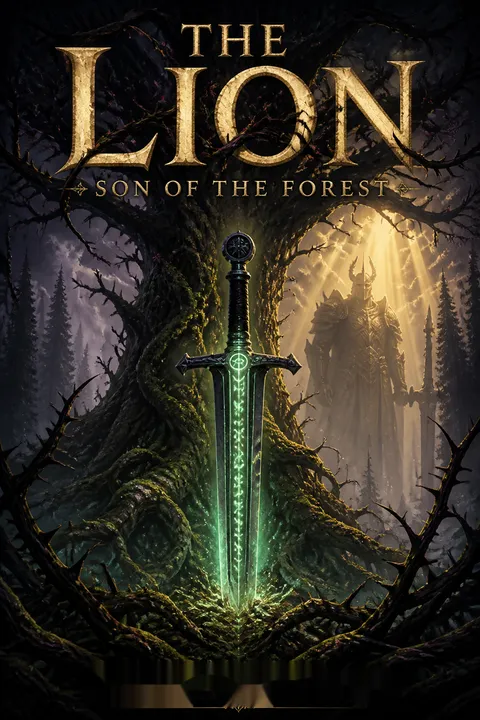


Plot Summary
The Hunter Wakes
A grey-haired giant in black armour1 awakens beside a river with no memory of his name, his past, or how he came to be there. A hooded Watcher warns him away from a pale building, but a foul scent draws him into a hunt instead. In Camarth’s altered jungle, he kills three monstrous predators attacking Sutik,16 Halin,17 and the child Biba.18
The refugees lead him to their hidden camp, where a battered Space Marine named Zabriel2 has protected them from the world’s invaders. When Zabriel2 raises his pistols at the stranger,1 the sight of the Dark Angel’s armour cracks open the giant’s1 memory. He recognizes Zabriel,2 and himself: Lion El’Jonson,1 primarch of the Dark Angels, returned to a galaxy he does not know.
The opening makes identity a consequence of action rather than recollection: the Lion discovers what kind of person he is by choosing to protect weaker strangers before he knows his own name. His instinctive violence is not yet attached to an institution or a cause, which separates protection from conquest. The Watcher’s warning introduces a second kind of strength, one based on restraint and self-knowledge. Memory arrives only when the Lion sees Zabriel, suggesting that identity here is relational: he becomes himself again through recognition by a son he had once lost.
A Father Faces His Son
The Lion1 pins Zabriel2 after mistaking him for an enemy, but Zabriel’s2 accusation that his primarch1 abandoned Caliban unsettles the returning memories. Zabriel2 explains that the warp scattered him through time, leaving him hunted for centuries by the Dark Angels’ descendants.
He also describes an Imperium split by the Great Rift, with the Emperor20 worshipped as a god and the loyal primarchs presumed gone. Before accepting Zabriel’s2 account, the Lion1 asks whether he remained loyal to humanity; Zabriel2 swears he did.
Zabriel2 then demands the same assurance from the Lion.1 The Lion1 gives it, admitting his own uncertainty and accepting that his sons may have been deceived. He turns from vengeance toward a more immediate duty: freeing Camarth’s survivors from the Ten Thousand Eyes.
Their reciprocal oaths replace rank with a fragile form of accountability. Zabriel will not let biological parentage settle the question of trust, while the Lion accepts scrutiny instead of demanding obedience. The scene reframes their ancient conflict as a failure of communication compounded by inherited suspicion. The Lion’s grief over the vanished Imperium remains sharp, but it does not become a mandate to rebuild his father’s order by force. His decision to protect Camarth is narrower, more answerable, and therefore a meaningful departure from the certainty that once governed him.
Redmoon Keep Falls
The Lion1 and Zabriel2 slip through a breach in Redmoon Keep, the ruined fortress of Camarth’s slaughtered Space Marine defenders. Inside, a cultist’s unnatural scream summons a horde, which the Lion1 tears through while Zabriel2 covers his back.
Their fight leads them to a sorcerous chamber and two swollen Chaos Space Marines; the Lion1 survives by finding a powerblade, Fealty, hidden beneath the fortress’s distorted appearance. After the battle, he and Zabriel2 discover nine Ruby Crescents chained up and transformed into mindless, blood-drinking creatures.
The Lion1 kills them to end their torment, then destroys the machinery draining their blood for an unknown experiment. Back at camp, he tells Zabriel2 the campaign will continue. A dying heretic’s remark confirms what the Lion1 feared: the ten thousand years have aged him.
The fortress turns the enemy’s corruption into a physical system: captured defenders become raw material for an experiment, and their blood powers machinery whose purpose is hidden even from its victims. The Lion’s mercy is therefore not simply a battlefield virtue. He recognizes when continued existence has been reduced to forced suffering and accepts responsibility for ending it. His own discovery of age creates a counterpoint: unlike the Ruby Crescents, he remains able to choose and act, but his body is no longer exempt from time. Protection must now include judgment about limits, not confidence in invulnerability.
Camarth Rises Again
The Lion1 organizes Camarth’s scattered survivors into a guerrilla force, persuading frightened civilians that their earlier defeat does not make resistance pointless. With captured weapons, improvised vehicles, and Zabriel’s2 experience, they drive the Ten Thousand Eyes from city after city.
At Kallia City’s spaceport, the Lion1 clears the control room so Magos Valdax14 can assess the damaged systems and the chance of reaching ships in orbit. Then an unexplained pull draws the Lion,1 Zabriel,2 and the Lion Guard12 into a misty forest that resembles Caliban.
Their instruments fail, the path refuses to lead back, and howls close behind them. Following the Lion’s1 instincts, they emerge in a dry grove on Avalus, where a local driver identifies the planet and summons its authorities.
Camarth’s liberation grows out of practical coordination, not a miraculous reversal: the Lion supplies organization, while ordinary people provide the bodies, knowledge, and vehicles that make resistance possible. His insistence that victory belongs to the citizens prevents his presence from erasing their agency. The sudden passage to Avalus breaks the campaign’s familiar cause and effect. The Lion can lead a rebellion, but he cannot yet explain the force that transports him. His new role therefore begins with a paradox: immense authority in battle, paired with genuine ignorance about the road ahead.
Avalus Welcomes Its Lion
At Avalus’s capital, Marshal Seena ap na Haraj13 has seer Shavar examine the stranger1 who claims to be the Lion.1 The psychic verification leaves Shavar shaken but certain, and the gathered officials celebrate a primarch’s return. Haraj13 offers him the planet; he refuses to rule it and instead asks to direct its forces against the threats beyond their system.
He reorganizes the defenses and orders the astropaths to spread news of his return, despite Shavar’s warning that enemies may hear. The Lion1 also learns of an unexplained, empty landing craft and suspects a lost Dark Angel may be hiding in the city. Since the Lion1 cannot search openly, Zabriel2 agrees to follow the old Legion’s secret signs and find the stranger.
The confirmation scene puts political legitimacy on display, then immediately tests what the Lion will do with it. Haraj is prepared to surrender sovereignty, yet the Lion distinguishes command for a crisis from ownership of a population. That boundary matters because the people’s faith could easily make his military authority appear sacred. His decision to broadcast his return accepts the danger of visibility in exchange for the chance to connect isolated worlds. The search for the hidden Dark Angel extends the same ethic inward: the Lion seeks not only new subjects or troops, but estranged sons whose histories deserve a hearing.
Three Sons Choose
Zabriel2 follows the coded marks through Xerxe’s streets and finds his former instructor Aphkar,6 the swordsman Kai,5 and the guarded plasma gunner Lohoc.7 Aphkar6 distrusts the Lion,1 while Lohoc7 already believes their primarch1 did not betray them; Kai5 agrees to meet him but insists on testing him in combat.
At the palace, Kai5 attacks the unarmoured Lion1 with a power sword. The Lion1 disarms him without killing him, proving he can restrain the force Kai5 expects him to unleash.
Lohoc7 pledges himself, and Aphkar6 follows after the Lion1 promises not to condemn other sons without evidence. The four warriors begin planning a campaign together, while Zabriel’s2 report confirms that the Lion’s1 attempt at reconciliation has reached more than one isolated survivor.
Kai’s duel makes trust legible through restraint. The Lion could end the challenge lethally, but chooses to defeat its premise instead: he demonstrates power while refusing to treat suspicion as an insult that must be punished. Aphkar’s hesitation shows how little a verbal apology can repair after centuries of fear, while Lohoc’s earlier faith makes him a bridge rather than a spokesman for easy forgiveness. Their reunion does not erase the old split. It creates a provisional group whose members can cooperate without pretending that they share one settled account of the past.
The Fleet Turns Back
A Chaos fleet bearing down on Avalus outnumbers the planet’s defenders, so the Lion1 arranges the Imperial ships in layered formations and uses nova-cannon fire and torpedoes to disrupt the attackers. The maneuver damages the enemy but costs Avalus several ships, and the Lion’s1 flagship is boarded by blood-mad Terminators.
He kills the boarding party, then broadcasts their defeat to shake the enemy’s confidence. As the remaining Chaos ships prepare to press toward the planet, a pirate flotilla commanded by Borz One-Eye9 arrives and attacks the enemy flagship, the Lord of Dominion.
Borz9 reveals that his crew includes other ancient Dark Angels and offers their ships to the Lion.1 The combined forces rout the invaders. Watching from the Eye of Malevolence, Baelor4 recognizes the Lion’s1 voice and withdraws to report to Seraphax.3
The battle shows the Lion’s command working through prediction rather than superior resources. He uses the enemy’s impatience and internal violence to create openings, but tactical brilliance cannot prevent losses; the defenders pay in ships and wounded bodies. Borz’s arrival changes the result because an isolated, morally compromised group can still choose whom to resist. That choice complicates the easy division between loyal institution and outlaw. Baelor’s retreat preserves him for the coming conflict, but his recognition of the Lion makes denial harder: the old Legion’s history has returned as a present military fact.
The Breaking Was Their Choice
Following rumors on Trevenum Gamma II, Zabriel2 finds two Dark Angels, Launciel and Galad,11 who command the moon’s defenses, then travels to a mountain retreat to meet Bevedan,8 a former Librarian. There he encounters Baelor,4 now serving Seraphax3 and the Ten Thousand Eyes.
Bevedan8 reveals that Caliban’s commanders planned to fire on the Lion’s1 returning fleet. Some feared punishment, others suspected betrayal, and many resented years of exile while the galaxy burned. Their resentment became a deliberate attack, not a defensive accident.
Baelor4 struggles with this account but refuses to abandon Seraphax.3 Bevedan,8 however, regrets his silence and agrees to see the Lion.1 Launciel and Galad11 also accept Zabriel’s2 invitation, though their loyalty to the people they protect makes leaving difficult.
Bevedan’s account destroys the comforting idea that the catastrophe was merely a misunderstanding. The sons were wronged by exile, but their grievance became a collective justification for firing on their own kin, including warriors who may not have known the plan. Responsibility is distributed without being dissolved: command secrecy helped breed suspicion, while obedience and resentment made violence possible. Baelor’s reaction matters because he has spent centuries building an identity around Seraphax’s judgment. Evidence threatens not only his belief about Caliban, but the structure that has allowed him to avoid reconsidering what his loyalty serves.
A Brotherhood Reforms
While Zabriel2 searches Trevenum, the Lion1 reaches the alien-built Echo Station and meets seven Dark Angels under Captain Guain. The garrison fears that the returning primarch1 has come to kill them, but Kai5 describes what isolation has done to the scattered sons and argues that the Lion1 offers a larger purpose.
The Lion1 promises not to judge them by rumor and asks them to help protect humanity; several pledge their weapons, including the Techmarine Ectorael15 and the assault warrior Lamor.
Their agreement remains unsettled when an astropath brings a distress call from Camarth. The Lion1 learns that the world he freed has been attacked again, and turns his growing band toward the planet. Zabriel,2 meanwhile, brings Launciel, Galad,11 and Bevedan8 into contact with the Lion’s1 forces.
The Echo Station encounter makes belonging a choice with practical consequences. Kai speaks for the value of a shared mission, but the Lion does not pretend that one appeal can resolve centuries of distrust. His promise to judge conduct rather than inherited accusation offers a different standard from the modern Dark Angels’ pursuit of the Fallen. The distress call immediately tests whether the nascent brotherhood is more than an idea: Camarth’s need interrupts recruitment and demands action. By returning to a world already liberated once, the Lion accepts that protection cannot be measured as a single victorious campaign.
Markog Names Sable
The Lion1 returns to Camarth and finds the forests burning across much of the continent. The Ten Thousand Eyes have devastated the world but left Redmoon Keep standing amid the destruction, so he takes a force of his reunited sons to investigate. At the ruined fortress, Markog,10 commander of Seraphax’s3 Dolorous Guard, waits with a message for the Lion.1
He demands that the Lion1 strike him and accept a return blow before he reveals Seraphax’s3 location. The Lion1 refuses to indulge the ritual and has Zabriel2 cut off Markog’s10 head instead. Markog10 survives, lifts his severed head, and vanishes, leaving his message unheard by most of the group. Zabriel2 alone understands the silent words: Seraphax3 is on Sable and expects the Lion1 to come.
Camarth’s second ruin turns rescue into an unfinished obligation. The enemy has chosen a place tied to the Lion’s first victory and uses its destruction to reach him personally, making the planet both a battlefield and a message. Markog’s challenge tries to impose a ritual of violence on the encounter, but the Lion refuses to let the enemy dictate its terms. Zabriel’s ability to interpret the silent warning also shows how the campaign depends on accumulated trust and shared history. The sons are no longer simply following the Lion’s strength; they contribute distinct knowledge he lacks.
Seraphax Reaches for Godhood
The Lion1 takes a small ship to Sable, then leads his sons through the strange forest passage into the governor’s palace. They fight through beastmen and the Dolorous Guard, while Seraphax3 draws the Lion1 into a ritual designed to split his soul from his body.
The sorcerer intends to use the Lion1 as a weapon against the Emperor,20 whose death he believes would unleash a new human crusade. A silver mirror anchors the spell, and Seraphax3 binds the Lion1 with blood-made chains.
Bevedan8 turns his own psychic power against the sorcerer, disrupting his concentration long enough for the Lion1 to break free. As the mirror corrupts Seraphax,3 Baelor4 stabs his former commander with the Feverblade. The Lion1 kills the dying Baelor4 at his request, then orders the ritual site burned.
Seraphax’s plan is not simple destruction: he imagines that killing the Emperor will liberate humanity, and treats atrocity as a legitimate instrument toward that promised future. His certainty mirrors the old Legion’s willingness to erase worlds for a grand design. The mirror and chains turn this political logic into bodily coercion, stripping the Lion of agency so he can be repurposed. Bevedan’s intervention reverses that violence through a deliberate use of the very psychic capacity he had long suppressed. Baelor’s final action breaks his dependence on Seraphax, but the Lion’s mercy remains bounded by responsibility: he grants the death Baelor asks for.
The Forest Tests the Lion
After Seraphax’s3 defeat, the Ten Thousand Eyes fractures, and the Lion’s1 protectorate expands through worlds that choose his protection. He returns to the misty forest seeking control over the paths that carried him between planets.
There, apparitions of his brothers attack him with accusations about his failures, his secrecy, and the devastation he caused. The Lion1 answers that he served the Emperor’s20 design but accepts that this does not erase his own responsibility.
When the dead Curze attacks from the dark, the Lion1 finds the Emperor’s Shield, whose protective power destroys the warp-born imitation. He returns to the work of defending isolated human worlds, carrying a new weapon and a less absolute view of his past. The forest remains mysterious, but no longer only a place that acts upon him.
The forest trial converts political history into an internal reckoning. Each brother embodies a different charge against the Lion, forcing him to distinguish service from innocence: obedience explains his choices but cannot absolve their consequences. His response to Curze is especially important because he rejects the dead primarch’s fatalism without claiming that the Emperor’s plan was flawless. The shield functions as more than protection; it gives the Lion a way to resist a past that keeps returning in distorted form. His growth lies not in resolving every uncertainty, but in acting without treating certainty as a prerequisite for responsibility.
Epilogue
The Lion’s1 scattered worlds have heard no reliable news of the wider Imperium, until an arriving fleet identifies itself as Blood Angels. Its commander, Dante,19 recognizes the Lion1 and explains that Roboute Guilliman has returned, revived from stasis and leading a crusade through the divided galaxy.
The Lion1 had feared that his protectorate was humanity’s last isolated refuge. Now he learns that another primarch lives and that the Imperium still fights beyond his reach. He orders his forces to stand down and receives Dante,19 confronting the possibility of alliance, recognition, and a reunion with the brother whose name still carries old grievances.
Dante’s arrival answers the book’s opening uncertainty on a larger scale. The Lion began without even his own name; now he has recovered a political identity and learns that he is not alone in a broken galaxy. The revelation does not erase danger. His protectorate may still be judged suspiciously, and his history with Guilliman remains emotionally charged. Yet the news changes isolation from a permanent condition into a temporary one. The ending offers connection rather than closure: the Lion can re-enter a wider human struggle, but must meet it as a changed leader rather than simply resume his former place.
Analysis
The novel’s central problem is not simply whether the Lion1 can defeat Chaos. It is whether a being designed to obey a grand purpose can learn to exercise judgment after that purpose has collapsed. His awakening strips him first of memory, then of the institutions that once made his identity legible. What remains is a repeated choice: protect these people, listen to this son, or use force because it is available. The conflicts over Caliban expose how secrecy and abandonment can turn legitimate grievance into self-justifying violence. The Lion1 does not resolve that history by declaring everyone innocent. Instead, he changes the standard by which he judges his sons, asking what they do now while remaining accountable for what he did then.
The scattered Dark Angels mirror the fractured Imperium. Each survivor has improvised a local identity, from Zabriel’s2 solitary defense of refugees to Borz’s9 piracy and Launciel and Galad’s11 rule over a vulnerable moon. Their reunion is not a return to the old Legion so much as an experiment in voluntary allegiance. That distinction gives the Lion’s1 refusal to rule thematic weight: command can be necessary without becoming ownership, and protection can respect the agency of those protected.
Seraphax3 offers the seductive counterargument. He also claims to serve humanity, but treats people as material for a future that only he can define. His ritual makes that authoritarian logic literal, attempting to strip the Lion1 of his soul and convert him into an instrument. Bevedan’s8 intervention and Baelor’s4 break with Seraphax3 show that moral change remains possible, but not costless. The ending therefore offers no repaired Imperium and no uncomplicated restoration of family. It offers a more modest achievement: the Lion1 accepts responsibility without mistaking it for infallibility, gathers allies who choose him, and learns that a broken world is not the same as a finished one.
Review Summary
The Lion: Son of the Forest received mostly positive reviews, with readers praising its portrayal of Lion El'Jonson's return and character development. Many appreciated the book's exploration of the Dark Angels' lore and the Lion's adaptation to the 41st millennium. Some critics found the scope limited and villains underdeveloped. The audiobook narration was highly praised. While some longtime fans loved the new direction, others felt it lacked the epic scale expected for a Primarch's return. Overall, it was considered a solid addition to Warhammer 40,000 fiction.
Characters
Lion El’Jonson
The returning protectorPrimarch of the Dark Angels and a weapon made to defend humanity, the Lion awakens after an unexplained absence with his memory shattered and his body visibly aged. He is decisive, suspicious, and more comfortable with action than emotional negotiation. Yet his reunion with Zabriel2 forces him to hear how his choices looked from the other side of a Legion divided by secrecy. He rejects worship and rule, preferring to command only those who choose to follow him. His central tension is between the certainty of a military instrument and the moral responsibility of a leader whose old orders no longer provide a complete answer.
Zabriel
The exiled first sonA veteran of the First Legion, Zabriel has spent centuries surviving alone while protecting people the Imperium has abandoned. His experience has made him cautious, resourceful, and wary of authority, especially the authority of the primarch1 he once believed had condemned him. He is the first of the scattered Dark Angels to meet the Lion1 and becomes his interpreter, scout, and conscience without surrendering his independence. Zabriel values action over inherited loyalty, but his willingness to risk himself for reconciliation shows that solitude has not extinguished his desire for brotherhood.
Seraphax
The ambitious sorcererOnce a Dark Angel commander, Seraphax now leads the Ten Thousand Eyes through charisma, strategic patience, and mastery of warp sorcery. He presents himself as a man who can make terrible means serve a greater human future. That self-conception lets him treat loyalty as something he can demand while making other lives expendable. His connection to the Lion1 is both familial and political: he remains shaped by the Legion’s old purpose even as his methods violate its professed ideals. Seraphax is most dangerous when his vision sounds coherent enough to make cruelty appear necessary.
Baelor
Seraphax’s veteran lieutenantKnown as the Imposter, Baelor is an accomplished warrior who has served beside Seraphax3 for centuries. He is practical rather than visionary, trusting his commander to supply the purpose he cannot formulate for himself. His discomfort with the Ten Thousand Eyes’ excesses reveals that obedience has not erased his moral judgment, though he often treats doubt as a weakness to suppress. Baelor’s history reaches back to the Great Crusade, giving him a living connection to the Legion’s past and making his loyalties part of the story’s larger struggle over what brotherhood requires.
Kai
The proud swordsmanA former knight-commander and gifted duelist, Kai hides uncertainty beneath flamboyant confidence and teasing bravado. He tests people through action, believing that a blade reveals more than promises. His bond with Aphkar6 and Lohoc7 is built on years of mutual reliance, argument, and humor. Kai is not simply vain: his performance helps preserve a shared identity among warriors who have lost their Legion and their place in history. He responds to the Lion1 when the primarch1 proves capable of restraint as well as force.
Aphkar
The wary old instructorA knight-sergeant who once trained Zabriel2, Aphkar carries the habits of a disciplined instructor and the resentment of a son who believes his primarch1 abandoned them. He is careful about whom he trusts and initially treats reconciliation as a claim that must be tested. His judgment matters to Kai5 and Lohoc7, whose small group has depended on his steadiness. Aphkar’s caution is not cowardice; it is a response to a history in which unquestioned authority and incomplete information helped turn brothers against one another.
Lohoc
The silent plasma gunnerKnown as the Red Whisper, Lohoc is a guarded warrior who keeps his face concealed and speaks sparingly. His fellow survivors accept his habits because his actions have repeatedly protected them. Unlike Aphkar6, he has long believed that the Lion1 did not betray the Legion, and he is willing to act on that conviction before the others are persuaded. Lohoc’s restraint makes him difficult to read, but his loyalty is expressed plainly through the risks he accepts and the precise force he brings to battle.
Bevedan
The withdrawn former psykerA former Librarian of the First Legion, Bevedan has withdrawn from battle and lives alone in the mountains of Trevenum Gamma II. He is thoughtful, melancholy, and more willing than most to examine how passivity can make a person complicit. His psychic abilities give him a history he does not advertise, while his missing hand marks a life shaped by loss. Bevedan’s solitude is partly refuge and partly a way of avoiding decisions whose consequences might expose his earlier failures.
Borz One-Eye
The pirate captainBorz commands the Honour’s Edge and a loose fleet of outlaws who survive by raiding across isolated systems. Ruthless enough to remain alive in a hostile galaxy, he is also a capable leader who understands the value of a larger cause. His affiliation with the Lion1 does not make his past harmless, and the primarch1 recognizes that Borz’s protection of humanity must be measured by what he does next. Borz’s humor helps ease tension among warriors who have spent too long expecting betrayal.
Markog
The hungry bodyguardCommander of the Dolorous Guard, Markog is a towering Chaos warrior whose altered body reflects his devotion to a power that prizes sensation and appetite. He treats violence as both pleasure and ceremony, and his confidence makes him a threatening representative of Seraphax’s3 force. His personal fixation on settling a score with Zabriel2 gives the larger conflict a deliberately intimate edge. Markog is not a strategist on Seraphax’s3 scale, but his ability to survive punishment makes him dangerous in close combat.
Launciel and Galad
Paired system defendersThese two Dark Angels have built a life protecting the people of Trevenum Gamma II. Launciel is direct, persuasive, and alert to the practical value of joining the Lion1; Galad is more reserved and deeply protective of his brother. Their bond makes them reluctant to leave the community that trusts them, even when they recognize that a wider alliance could better defend it. Together they show how isolated warriors have improvised new forms of command and loyalty in the absence of their Legion.
M’kia
Captain of the Lion GuardA Camarthan survivor who becomes captain of the Lion Guard, M’kia is loyal, determined, and unwilling to let reverence turn into passivity. She treats the guard as a meaningful bond with the Lion1, not as proof that he needs protection from ordinary people. Her insistence on accompanying him reflects both courage and a desire to remain responsible for the choices made by her own people. M’kia helps keep the Lion’s1 growing legend connected to the humans whose lives his campaigns are meant to defend.
Seena ap na Haraj
Avalus’s wartime marshalMarshal Haraj leads Avalus’s defense forces and governs during a prolonged emergency. She balances hope in the Lion’s1 return with the skepticism required of someone responsible for an entire system. Rather than blindly accepting his identity, she asks for verification, then gives him operational command when the evidence satisfies her. Her response makes clear that trust need not mean surrendering judgment. Haraj remains a political and military partner, not merely an admirer of the returning primarch1.
Magos Valdax
Camarth’s wary mechanicA tech-priest from Camarth, Valdax brings technical skill and a prickly, recognizably human personality to the survivors’ efforts. The damaged systems left by the invasion require careful assessment rather than faith in old machinery, and Valdax is candid about what can and cannot be made reliable. Their work helps the Lion’s1 forces reclaim the planet and consider how to reconnect it with other worlds. Valdax represents practical knowledge as a form of resistance against both Chaos corruption and institutional decay.
Ectorael
The ancient TechmarineAn old Dark Angels Techmarine with extensive bionic augmentation, Ectorael repairs the Lion’s1 armor and brings deep suspicion toward the Imperium’s surviving institutions. He sees its superstition and rigidity as evidence that the old project has failed, and asks why anyone should defend it. His technical skill and blunt skepticism challenge the Lion1 to distinguish the people of the Imperium from the system that governs them. Ectorael is neither a simple cynic nor an unquestioning servant; he wants a purpose worthy of the cost.
Sutik
Camarthan refugeeSutik is one of the survivors gathering firewood when the Lion1 first encounters the refugees. Nervous but capable, he explains the danger of cutting trees that might reveal the camp to their pursuers. His practical knowledge helps the Lion1 understand how fear has shaped ordinary life on Camarth.
Halin
A cautious camp survivorHalin travels with Sutik16 and the child Biba18 through Camarth’s dangerous forest. He is frightened of the Lion1 but still shields the child18 and explains what the invasion has done to their world. His mixture of fear and hospitality introduces the human cost that the Lion1 chooses to take on.
Biba
The frightened childBiba is a child traveling with Sutik16 and Halin17 when the Lion1 intervenes against the predators. Their terror makes the danger concrete and reminds the Lion1 that the people he protects are not abstractions or military assets.
Dante
The Blood Angels commanderCommander of the Blood Angels, Dante is an ancient warrior whose bearing carries the authority of a long-serving leader. His arrival brings news of a wider Imperial resistance and gives the Lion1 a human connection to his brother Sanguinius. Dante approaches the meeting with respect but also the measured judgment expected of someone responsible for a Chapter. He is a potential ally whose presence reopens the possibility of cooperation across the scattered Imperium.
The Emperor
The absent creatorThe Emperor is the creator of the primarchs and the distant center of the Imperium’s faith and political history. The Lion1 remembers him as a father and commander, while the present-day Imperium worships him as a god. His silence leaves his sons to interpret the purpose for which they were made, and Seraphax’s3 plans turn the question of his survival into a dangerous political and spiritual dispute.
Plot Devices
The mist forest
A path between worldsThe Lion1 repeatedly encounters a mist-shrouded forest resembling Caliban, where ordinary instruments fail and familiar distances become unreliable. It carries him and his companions between planets, though neither its rules nor its maker are explained. The forest also holds the Lion’s1 private encounters with memory, temptation, and judgment, so it works as both a means of travel and a space where his inner life takes physical form. Its recurring presence links the opening awakening, the shift to Avalus, the attack on Sable, and the later meeting with the Emperor’s Shield.
The Great Rift
A galaxy cut apartThe Great Rift divides the galaxy and makes long-distance travel and communication perilous. It explains why Camarth and Avalus have been isolated, why relief arrives too late, and why small forces must make decisions without reliable knowledge of the wider Imperium. The same instability that strands the Lion1 and Zabriel2 also allows ancient warriors to emerge after radically different spans of experienced time. It is not merely a setting detail: the broken network of worlds creates the conditions in which local protectors, pirates, warlords, and the Lion’s1 loose protectorate can arise.
The silver mirror
An anchor for soul theftSeraphax3 uses a massive silver mirror as the focus for a ritual intended to separate the Lion’s1 soul from his body. The mirror is placed above the governor’s throne on Sable and linked to a bone structure made from the planet’s dead. Its reflective surface draws the Lion1 toward surrender by making the scale of the galaxy and his apparent powerlessness feel inescapable. When the Lion’s1 sons damage it, Seraphax’s3 magic changes and the sorcerer himself is transformed. The device makes Seraphax’s3 grand political ambition concrete: he wants to turn the Lion1 into a weapon capable of reaching the Emperor20.
Fealty
The Lion’s chosen bladeFealty is the powerblade the Lion1 discovers in the distorted Ruby Crescents fortress. It gives him an effective weapon when the ordinary tools and weapons of his new era are scarce, and it remains his primary close-combat weapon as he gathers his sons. Its name reflects the Lion’s1 changed sense of obligation: not merely obedience to a father or institution, but a chosen responsibility toward humanity and the warriors who trust him. The blade is also practical setup for later conflicts, where it can cut through armor and confront enemies that ordinary weapons cannot reliably stop.
The Emperor’s Shield
Protection against the warpThe Lion1 finds the Emperor’s Shield within the strange forest during an encounter that forces him to face images of his brothers and the consequences of his past decisions. Its power repels the warp-born Curze imitation that attacks him, ending the trial’s immediate danger. The shield links the Emperor’s20 presence to protection rather than command: it helps the Lion1 resist a supernatural assault, but does not decide what he should do with his history. Its appearance also deepens the mystery of the forest and suggests that the Lion’s1 travels are connected to forces he does not yet understand.
FAQ
Synopsis & Basic Details
What is The Lion: Son of the Forest about?
- Primarch awakens lost: The story follows Lion El'Jonson, primarch of the Dark Angels, who awakens in a mysterious forest with no memory of his identity or how he got there, centuries after the events of the Horus Heresy.
- Reunion with scattered sons: As his memories return, the Lion seeks out and gathers some of his estranged sons, the "Fallen", who were scattered across the galaxy during the destruction of their home world, Caliban.
- Fighting Chaos in a fractured Imperium: United by the Lion, these veterans of a bygone era fight against the forces of Chaos preying on isolated human worlds in the Great Rift-torn galaxy, seeking a new purpose in protecting humanity.
Why should I read The Lion: Son of the Forest?
- Deep dive into a legendary character: The novel offers an unprecedented look into the internal thoughts, struggles, and evolving perspective of Lion El'Jonson after millennia of absence, exploring his reaction to the grim darkness of the 41st millennium.
- Exploration of loyalty and redemption: It examines complex themes of loyalty, betrayal, and the possibility of redemption through the interactions between the Lion and his "Fallen" sons, revealing their diverse fates and continued dedication (or lack thereof) to the Emperor's vision.
- Action-packed narrative with strategic depth: Beyond the character study, the book features intense combat sequences, from the Lion's solo hunts to large-scale void battles, showcasing his legendary tactical prowess and the enduring might of the First Legion veterans.
What is the background of The Lion: Son of the Forest?
- Set in the 41st Millennium: The story takes place roughly ten thousand years after the Horus Heresy, in the current era of the Warhammer 40,000 universe, specifically after the galaxy has been split by the Great Rift.
- Focus on the Dark Angels' schism: It directly addresses the central mystery of the Dark Angels Legion: the rebellion on Caliban led by Luther against the returning Lion, which resulted in the planet's destruction and the scattering of the "Fallen" through time and space.
- Post-Great Rift Imperium: The narrative explores the state of the Imperium Nihilus, the half of the galaxy cut off by the Great Rift, where isolated systems struggle for survival against Chaos and xenos threats without reliable warp travel or astropathic communication.
What are the most memorable quotes in The Lion: Son of the Forest?
- "There is no peace amongst the stars, for in the grim darkness of the far future, there is only war.": This quote, from the standard Warhammer 40,000 introductory text, sets the tone for the brutal, unending conflict that defines the galaxy the Lion awakens into.
- "My father was a conqueror, and I became a conqueror on His behalf, but that is not my nature. I kill enemies, and all of humanity's enemies are my enemies.": The Lion declares his core purpose after learning the state of the Imperium, revealing a shift from grand conquest to fundamental protection.
- "The galaxy might call them Fallen, but I call these sons of mine the Risen.": The Lion renames his gathered sons, signifying his forgiveness and their newfound purpose and redemption under his leadership.
What writing style, narrative choices, and literary techniques does Mike Brooks use?
- Third-person limited perspective: The narrative primarily follows the Lion, offering deep insight into his thoughts, fragmented memories, and reactions, occasionally shifting to other characters like Zabriel or Baelor to provide contrasting viewpoints.
- Descriptive and atmospheric prose: Brooks employs rich descriptions, particularly for the mysterious forest realm and the corrupted landscapes, using sensory details to build atmosphere and reflect internal states.
- Integration of internal monologue and flashbacks: The Lion's internal struggles and returning memories are woven into the narrative through internal monologue and fragmented flashbacks, revealing his past trauma and evolving understanding of the present.
Hidden Details & Subtle Connections
What are some minor details that add significant meaning?
- The Watcher in the Dark's cryptic guidance: The small, robed figure appearing in the mysterious forest offers minimal, non-verbal communication ("Home," "Do not take that path," "You are not yet strong enough"), hinting at a deeper, perhaps protective, connection to the Lion and the strange realm.
- The changing nature of the forest realm: The forest shifts from damp, mossy woods resembling Caliban to dry, sandy terrain resembling Avalus, suggesting this realm is not a fixed location but a conduit or reflection tied to the Lion's journey or psychic state.
- The significance of names and titles: The Lion naming his sword 'Fealty' underscores his renewed dedication to the Emperor and humanity, while the Chaos lord calling him the "Flawed Knight" reveals how the warp perceives his internal struggles or past failures.
What are some subtle foreshadowing and callbacks?
- The wounded king by the river: The image of the old, bleeding king fishing in a boat, ignored unless the "correct question" is asked, strongly echoes Arthurian legend (the Fisher King) and subtly foreshadows the state of the Emperor and the Imperium – wounded, stagnant, and requiring a specific catalyst (the Lion?) for healing.
- The Lion's recurring disorientation: The Lion's moments of dizziness or sensory distortion when encountering warp-tainted areas or symbols subtly callback to his initial state of amnesia and hint at the lingering effects of his time lost or the nature of the realm he traversed.
- Markog's unusual resilience and disappearance: Markog's ability to survive decapitation and then vanish foreshadows the unnatural nature of Seraphax's allies and their connection to warp powers, hinting that conventional combat might not be sufficient against them.
What are some unexpected character connections?
- Baelor's hidden loyalty to Seraphax: Baelor, presented initially as a conflicted Fallen, is revealed to be Seraphax's loyal lieutenant, a connection surprising both the reader and other Fallen like Zabriel, highlighting the complex and sometimes disturbing bonds formed during exile.
- The Echo Station Fallen's alien base: The discovery that Knight-Captain Guain and his brothers inhabit a station of non-human design, adapted for their use, is unexpected and reveals the pragmatic (or desperate) measures some Fallen have taken for survival, contrasting with the Lion's inherent distrust of xenos technology.
- Borz One-Eye's pirate fleet: The revelation that Borz, a former Dark Angel Knight-Captain, leads a fleet of pirates is a surprising turn, showcasing the varied and morally ambiguous paths some Fallen have taken, yet he still retains enough loyalty to rally to the Lion.
Who are the most significant supporting characters?
- Zabriel, the first Risen: As the first Fallen the Lion encounters and convinces, Zabriel serves as the primary point of contact between the Lion and his scattered sons, his loyalty and perspective shaping the Lion's understanding of the post-Heresy galaxy and the fate of the Fallen.
- Seraphax, the twisted son: Seraphax acts as the primary antagonist, a former Dark Angel sorcerer whose warped vision and powerful sorcery provide a significant challenge to the Lion, embodying the potential for corruption among the Fallen and forcing the Lion to confront the darker aspects of his Legion's legacy.
- Baelor, the conflicted lieutenant: Baelor's role as Seraphax's second-in-command and his eventual decision to betray the sorcerer are crucial to the plot, highlighting the internal conflicts within the Ten Thousand Eyes and providing a complex example of loyalty, disillusionment, and last-minute atonement.
Psychological, Emotional, & Relational Analysis
What are some unspoken motivations of the characters?
- Lion's need for validation: Beyond duty, the Lion's drive to gather his sons and protect humanity is subtly fueled by a need to atone for past failures (Caliban, trusting traitors) and perhaps prove his worth in a galaxy where his original purpose was seemingly rendered moot.
- Fallen's craving for belonging: Many of the Fallen, having spent centuries isolated and hunted, are implicitly motivated by a deep-seated need for brotherhood and purpose, which the Lion's return offers, even if they express it through skepticism or gruffness.
- Seraphax's desire for control: Seraphax's elaborate plan to manipulate the Emperor's ascension, while framed as saving humanity, is driven by a profound need for control and mastery, a twisted reflection of the Legion's secretive and controlling nature.
What psychological complexities do the characters exhibit?
- Lion's struggle with aging and perceived weakness: The Lion, a being of immense power, grapples with the physical and mental effects of age and his time lost, exhibiting frustration and self-doubt when he feels less capable than his memory dictates, adding a layer of vulnerability to his primarch nature.
- Zabriel's weariness and renewed purpose: Zabriel displays the psychological toll of centuries spent hiding and fighting alone ("weary beyond all reason"), contrasting sharply with the surge of purpose and faith he experiences upon reuniting with the Lion, showcasing the transformative power of renewed loyalty.
- Baelor's cognitive dissonance: Baelor exemplifies the psychological complexity of maintaining loyalty to a corrupted leader (Seraphax) while retaining elements of his former identity, leading to internal conflict and a delayed, but ultimately decisive, act of defiance.
What are the major emotional turning points?
- Lion's recognition of Zabriel: The moment the Lion sees Zabriel and his memories flood back is a major emotional turning point, shifting him from a state of amnesiac confusion to one burdened by the weight of his past and the revelation of ten millennia lost.
- Zabriel's decision to follow the Lion: Despite centuries of bitterness and distrust towards the Lion, Zabriel's choice to follow him marks a significant emotional shift, driven by a sense of faith and the hope for a worthy cause after long isolation.
- Baelor's betrayal of Seraphax: Baelor's final act of stabbing Seraphax is the culmination of his internal struggle, a powerful emotional turning point where his fundamental identity as a Dark Angel and his bond with his brothers (the Risen) finally override his loyalty to the corrupted sorcerer.
How do relationship dynamics evolve?
- Lion and the Fallen (Risen): The relationship evolves from initial distrust and confrontation (Lion vs. Zabriel, Kai's challenge) to cautious acceptance, then to a burgeoning sense of brotherhood and shared purpose, culminating in the Lion renaming them the "Risen" and accepting Baelor despite his past.
- Baelor and Seraphax: Their relationship is presented as one of deep, albeit complex, loyalty ("You are the only one on whom I can totally rely"), but it deteriorates as Baelor witnesses Seraphax's increasing corruption and twisted goals, leading to a tragic end.
- The Fallen amongst themselves: Relationships between the Fallen (e.g., Kai, Aphkar, Lohoc; Launciel, Galad, Bevedan; the Echo Station crew) show varied dynamics forged in exile – from pragmatic cohabitation and mutual reliance to genuine camaraderie and protection, which are then tested and strengthened by the Lion's return.
Interpretation & Debate
Which parts of the story remain ambiguous or open-ended?
- The nature of the forest realm: The mystical forest realm through which the Lion travels remains unexplained – its origin, its connection to Caliban, the warp, or the Lion's own psyche, and the role of the Watcher in the Dark are left open to interpretation.
- The fate of the Emperor: While Seraphax claims the Emperor lives and seeks to manipulate His ascension, the true state of the Master of Mankind on the Golden Throne and the validity of Seraphax's theological/sorcerous claims remain ambiguous, rooted in the mysteries of the 40k setting.
- The future of the Lion's Protectorate: The ending establishes the Lion's growing alliance of systems, but its long-term viability, its potential interaction (or conflict) with the wider Imperium under Guilliman, and the ultimate fate of the Risen are left unresolved.
What are some debatable, controversial scenes or moments in The Lion: Son of the Forest?
- The Lion's initial attack on Caliban: The book presents conflicting accounts of the Breaking of Caliban – the Lion's belief that Luther fired first vs. Bevedan's assertion that the Fallen commanders planned to prevent the Lion's landing – leaving the true instigator and the extent of Luther's treachery open to debate among the characters and readers.
- Seraphax's plan to "free" the Emperor: Seraphax's belief that killing the Emperor's mortal form will allow Him to ascend as a true god is a highly controversial theological concept within the 40k universe, sparking debate about the nature of the Emperor and the validity of Chaos-influenced interpretations.
- The Lion's acceptance of the "Fallen": The Lion's decision to forgive and rally the Fallen, who are considered traitors and hunted relentlessly by the modern Dark Angels, is a controversial act that directly challenges the dogma and secrecy of his own Legion's successors.
The Lion: Son of the Forest Ending Explained: How It Ends & What It Means
- Seraphax's defeat and Baelor's sacrifice: The climax sees the Lion and the Risen confront Seraphax, who attempts to steal the Lion's soul. Bevedan's psychic intervention weakens Seraphax, allowing Baelor, Seraphax's lieutenant, to fatally stab him with the Feverblade, sacrificing himself in the process. This signifies the defeat of a major Chaos threat and Baelor's atonement.
- The Lion's Protectorate established: The epilogue shows the Lion has successfully rallied isolated systems into a "Protectorate," defending them against Chaos and other threats. He has renamed his gathered sons the "Risen", integrating them into his command structure and giving them new purpose.
- Reunion with the wider Imperium: The arrival of Blood Angels led by Commander Dante, who recognize and accept the Lion, signals the potential for the Protectorate to reconnect with Roboute Guilliman's Indomitus Crusade, offering hope for a larger alliance and the Lion's reintegration into the Imperium's leadership after ten millennia.
Download PDF
Download EPUB
.epub digital book format is ideal for reading ebooks on phones, tablets, and e-readers.








