

Key Takeaways
Use the oracle as a perspective, not a permission slip
A prompt, not a verdict. Deng’s relationship with the I Ching began as a teenager, when he consulted it so often that he felt unable to decide without it. He eventually put the book away, hoping to absorb its principles and act without depending on divination. Decades later, he asked whether to buy rural land and drew the Well hexagram. He first took its warning about reaching the water literally. Only years afterward did he see another meaning: the property was too far away for him to make use of it.
Interpretation takes time. For Deng, the reading did not issue a fixed prediction. It offered an image that changed in meaning as life unfolded. The deeper purpose is to learn the classic’s way of seeing, then bring that judgment into daily decisions.
The well episode makes the method vivid while also exposing its ambiguity. A symbol can help someone notice neglected constraints, such as distance and upkeep, but its flexibility also makes it easy to fit a reading to events after they occur. The soundest use is therefore practical: treat the image as a question that broadens deliberation, then check it against observable facts. That preserves the book’s value as a tool for reflection without turning a meaningful coincidence into proof of foreknowledge.
Read change as cycles, not a straight road
Opposites make motion. The book begins with wuji, meaning limitlessness before distinctions, and taiji, the first emergence of distinctions. From taiji come yin and yang: complementary qualities such as dark and light, yielding and firm, or rest and activity. Neither is inherently good or bad, and neither exists alone. Their relationship shifts with context: a hill is high beside a valley, but low beside a mountain.
Extremes turn. The Four Images represent yin and yang combinations, including the idea that a condition at its peak starts moving toward its opposite. A full moon wanes; winter’s darkest point gives way to longer days. The book applies the same pattern to personal and political fortunes: success can contain the beginnings of decline, while a low point can become the start of recovery.
This model is useful because it shifts attention from labels such as success and failure to direction and momentum. Instead of asking only whether circumstances are good, a reader can ask what is growing, what is weakening, and what pressure may be building. The cycle is a lens, not a timetable. Seasons have observable rhythms, but careers, relationships, and governments do not reverse on a predictable schedule. The model encourages vigilance without guaranteeing that every setback contains an imminent recovery.
Combine symbols to diagnose a situation, not decode a fixed fate
Build meaning in layers. The Eight Trigrams are three-line symbols associated with heaven, earth, water, fire, thunder, wind, mountain, and lake. The bagua is their eight-part arrangement. Deng’s book guides readers through eight circles, beginning with limitlessness and moving through yin and yang, the trigrams, and the hexagrams toward what he calls the oracle’s voice.
Context changes the image. Fu Xi’s Early Heaven arrangement emphasizes opposing pairs, while King Wen’s Later Heaven arrangement links the trigrams to seasons, directions, and family roles. Pairing two trigrams creates a hexagram of six lines. Its image is not a code with one answer: water above thunder, for instance, can suggest danger meeting sudden growth. The question and the reader’s circumstances help determine which associations matter.
The layered symbolism resembles a map more than a dictionary. A map does not dictate a destination; it helps locate relationships and possible routes. That makes the system adaptable across personal and social questions, but adaptability has a cost: almost any situation can be made to resemble some image. Interpretations become more disciplined when symbolic readings are compared with concrete conditions, competing explanations, and consequences that can actually be observed.
Let ritual interrupt panic, then make the decision yourself
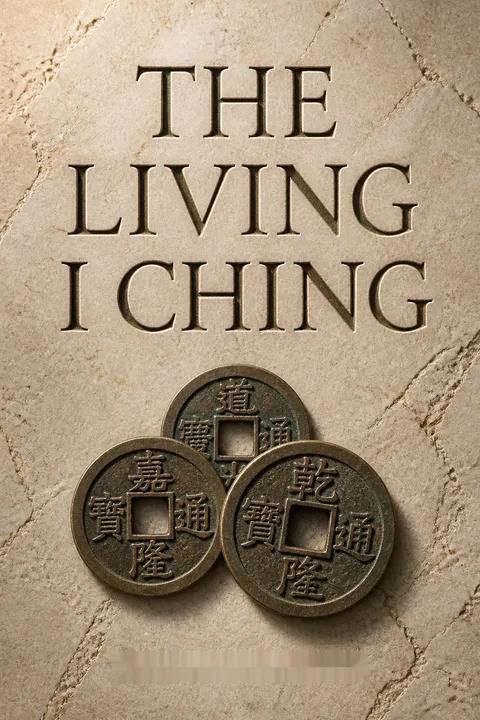
Ask with care. Deng describes a simple coin ritual: settle in a quiet place, write a specific question that is not a forced either-or, then cast three coins six times, recording each line from the bottom upward. Each set of six lines forms a hexagram. The more elaborate yarrow-stalk ritual takes longer, giving the questioner more time to consider the problem.
Read movement, not certainty. Some lines are changing lines. Reverse each changing yin or yang line to form a second hexagram. The first hexagram describes the present situation, its changing lines add detail, and the second points to a possible development. Deng does not claim that a god supplies the answer. Chance selects a passage from accumulated human wisdom; the inquirer must still interpret it and choose what to do.
Ritual can create a useful pause between anxiety and action. Writing the question clarifies what is actually troubling the person, while a random result can interrupt habitual thinking and supply an unfamiliar angle. Neither step establishes that the result predicts the future. The most responsible reading treats the hexagram as a structured prompt: What does this image reveal, what does it leave out, and what evidence should guide the choice? That approach retains reflection while keeping responsibility with the decision-maker.
Meet good fortune with modesty, and misfortune with honest review
Character shapes consequences. The Changes repeatedly recommends humility, reverence, kindness, and service. It presents a cultivated person as alert to cycles: during good times, that person is grateful, consolidates gains, and watches for emerging risks. During hardship, the person examines their own actions rather than reflexively blaming others, then learns what can be learned and acts carefully.
Agency is not omnipotence. The book rejects a fixed future: individual conduct can influence what happens next because people affect one another and their communities. Its account of fortune is not simply luck bestowed from outside. Favorable conditions matter, but so do preparation and conduct. The ideal is to align action with circumstances and avoid using power selfishly, since selfish acts can isolate people and feed destructive patterns.
The emphasis on self-examination turns ethics into a practical method: a person who can admit error can adjust before a small mistake becomes a larger pattern. It also connects personal conduct to social effects rather than treating virtue as private purity. A necessary limit is that hardship is not proof of personal failure. Self-review is most constructive when it distinguishes controllable choices from illness, injustice, accident, and forces outside a person’s reach.
Wait actively until conditions turn preparation into timely action
Patience has a job. In the hexagram Waiting, clouds gather but rain has not arrived. The advice is not to manufacture what cannot yet be forced; it is to maintain confidence, use the delay to prepare, and act when conditions become favorable. Waiting can mean patient development, as when young people need time and guidance, or strategic timing, as when a venture is not ready to begin.
King Wen models restraint. In Deng’s account, the Zhou leader King Wen spends seven years imprisoned by the Shang ruler. Rather than rush into a doomed revolt, he studies and reorganizes the trigrams and hexagrams, then builds support after his release. The story makes timing active: he preserves his purpose while developing the insight and alliances needed for effective action.
This distinction between waiting and passivity is powerful in work that depends on timing, from negotiation to long-term projects. Preparation keeps a delay productive, while a clear sense of what would change the situation helps prevent endless postponement. The King Wen narrative also carries the weight of tradition and legend, so it works best here as a model of strategic restraint, not as independently verified biography. Patience is wise when it preserves options, not when it conceals fear.
When blocked, change your posture instead of forcing the same route
Adaptation is part of strength. Several hexagrams describe different responses to difficulty. Hindered presents a path obstructed by danger; its advice is to turn inward, cultivate virtue, and seek help from a wise person or allies. Releasing follows with the image of pressure lifting, like rain ending a drought. When a genuine opening appears, the task is to move toward new possibilities rather than remain trapped by the old struggle.
Persistence is not always progress. The book distinguishes resilience from stubbornness. It advises withdrawing when confrontation would deepen harm, returning to one’s own path after mistakes, and leaving a damaging situation when escape becomes possible. The right response depends on the stage of events. The same action can be sensible in one phase and harmful in another.
This is a more flexible account of resilience than the familiar command to keep pushing. It treats retreat, recovery, and renewed action as legitimate parts of a response rather than signs of weakness. The difficult question is how to tell strategic withdrawal from avoidance. The book’s emphasis on timing, character, and conditions offers clues, but no symbol can settle the question by itself. Real-world risks, obligations, and available support still need careful assessment.
Spend power and prosperity on the people who make them possible
Leadership depends on support. In the hexagrams on Joining and Great Holdings, a group’s strength depends on trust, shared purpose, and a leader who does not confuse authority with personal ownership. Abundance brings responsibilities: wealth, influence, health, and learning should be used to benefit others, not merely accumulated.
King Wen’s rule is the example. Deng portrays him as providing land, schools, visible laws, and support for vulnerable people. His growing alliances came from the appeal of his government, not only from military power. The book’s image of a mountain resting on broad earth makes the point: those at the top depend on those below. Generosity and fair conduct can strengthen that base, while hoarding and arrogance make it easier for support to disappear.
The argument anticipates a central problem in leadership: formal authority cannot substitute indefinitely for legitimacy. People cooperate more readily when they see benefits shared and rules applied fairly. The book’s ideal ruler is benevolent, but benevolence alone does not guarantee accountability; a leader may sincerely believe that personal judgment serves everyone. The principle is strongest when paired with institutions and relationships that allow those affected by decisions to speak and challenge power.
Read ancient social roles as metaphors, not modern instructions
History shapes the imagery. The Changes grew from a feudal society, so its stories feature kings, armies, patriarchal families, and women in subordinate marriages. Deng argues that readers should look for the human situation beneath these images instead of copying the social arrangement. For example, he interprets the hexagram Marrying Sister as a picture of a person trapped in a compromised, subordinate relationship, not as advice to reproduce concubinage.
Translation also involves choices. The ancient text is compressed, its words carry several meanings, and different editions and translators make different decisions. Deng favors an accessible reading while acknowledging that no translation can preserve every association. Readers need both the concrete force of the old images and the judgment to distinguish enduring insight from outdated hierarchy.
This is essential for using a classic without treating historical power relations as timeless nature. Metaphors can travel across cultures, but they can also smuggle their original assumptions into modern advice. Deng’s reinterpretation opens the text to broader situations, though the source remains shaped by gender and class hierarchies that cannot be erased by translation alone. A careful reader can preserve its attention to change, humility, and responsibility while rejecting its inherited social limits.
Analysis
The book’s central achievement is to redirect the I Ching from an answer machine toward a discipline of attention. Its divination ritual matters, but not because a random cast proves that the future has been disclosed. The ritual slows the questioner, supplies a symbolic counterpoint to familiar assumptions, and returns responsibility to the person who must act. That interpretation makes the book usable without requiring belief in supernatural intervention.
Its organizing image is change as patterned interaction. Wuji gives way to distinctions; yin and yang generate movement; trigrams and hexagrams turn that movement into a symbolic vocabulary. The vocabulary’s strength is also its hazard. A rich image can illuminate parts of a situation that a narrow question conceals, but flexible symbols can invite retrospective fitting. The book itself acknowledges ambiguity in translation and interpretation. A grounded reading therefore needs two kinds of attention: openness to metaphor and skepticism about claims that cannot be checked.
The ethical dimension prevents the system from collapsing into clever prediction. Timing, withdrawal, persistence, and leadership are judged by their effects on people and communities. Fortune is not simply a prize from fate; it emerges from the meeting of character, preparation, and circumstances. This is a compelling account of agency under uncertainty, although it risks assigning too much moral responsibility to individuals when adversity comes from forces they cannot control.
The historical material requires equal care. The text’s authority rests partly on traditions about Fu Xi, King Wen, the Duke of Zhou, and Confucius, while the book also explains that authorship, transmission, and wording remain uncertain. Those stories work as philosophical narratives, but should not be confused with settled history. Likewise, the classic’s feudal imagery can carry insight without making feudal gender roles or political hierarchy desirable. The most durable lesson is not to imitate ancient society, but to learn how to read conditions, revise one’s interpretation, and choose a responsible next action.
Review Summary
The Living I Ching receives mostly positive reviews, with readers appreciating its balance of historical respect and modern practicality. Many find it clear and helpful for Taoist practice, praising its accessibility for Western readers. Some prefer other translations, like Wilhelm's, but still value this version. A few reviewers mention it may not be ideal for beginners. Overall, readers appreciate the author's approach to illuminating the I Ching's background, culture, and philosophy, making it a worthy addition to any I Ching enthusiast's library.
Glossary
Wuji
limitless undivided originWuji means no limits. In the book, it names the undivided emptiness or potential that precedes distinctions such as yin and yang. It is not presented only as a remote cosmic idea: Deng also uses it to describe the open beginning from which a person can create, choose, or begin a day.
Taiji
first differentiated conditionTaiji is the great limit, the point at which distinctions emerge from wuji. In Deng’s account, this transition introduces yin and yang and therefore the world of relationships and movement. Taiji is not a separate object or force; it names the beginning of differentiated experience.
Yin and yang
interacting complementary qualitiesYin and yang are paired ways of describing changing relationships, such as dark and light, yielding and firm, or rest and activity. Neither quality exists independently or is always superior. Their meaning depends on context, and their shifting balance produces the movement that the Changes seeks to understand.
Four Images
four paired line patternsThe Four Images are the four possible pairings of yin and yang lines. Deng associates them with time and changing conditions: doubled yin or yang marks an extreme, while mixed pairs show a different balance. They introduce the idea that a condition at its limit begins to turn toward its opposite.
Eight Trigrams
eight three-line symbolsThe Eight Trigrams are combinations of three yin or yang lines, each linked with a natural image: heaven, earth, water, fire, thunder, wind, mountain, or lake. The trigrams act as a symbolic vocabulary for environment, energy, growth, and social relationships. Two trigrams combine to form a hexagram.
bagua
eight-trigram arrangementBagua means eight trigrams and refers to an octagonal arrangement of the Eight Trigrams. Deng describes two major patterns. The Early Heaven arrangement places trigrams in opposing pairs, while the Later Heaven arrangement associates them with directions, seasons, and family positions to express cyclical change.
Hexagram
six-line change patternA hexagram is a formation of six yin or yang lines, built from two trigrams. The Changes contains sixty-four hexagrams, each with a title and traditional texts that describe its situation and offer guidance. The lines are read from the bottom upward, representing stages or positions within a changing circumstance.
Changing lines
lines that reverse polarityIn coin or yarrow-stalk divination, some lines are designated as changing. Each changing yin line becomes yang, and each changing yang line becomes yin, producing a second hexagram. Deng reads the first as the present situation, the changing-line texts as qualifications, and the second as a possible development rather than a guaranteed outcome.
Early Heaven Eight Trigrams
opposing trigram patternThe Early Heaven arrangement, associated with Fu Xi, places the Eight Trigrams in pairs of opposites: heaven and earth, water and fire, thunder and wind, mountain and lake. Deng uses it to show fundamental polarities. Its purpose in the book is primarily structural and philosophical, rather than a direct set of divination instructions.
Later Heaven Eight Trigrams
cyclical trigram patternThe Later Heaven arrangement, associated with King Wen, organizes the Eight Trigrams as a cycle and connects them with directions, seasons, and family roles. Deng presents it as a model in which change moves through recurring phases and human beings participate in, rather than merely endure, those changes.
Eight Circles of Change
book’s staged learning pathThe Eight Circles of Change are Deng’s structure for guiding readers through the Changes. Beginning with wuji, the sequence moves through yin and yang, the Four Images, the two trigram and hexagram arrangements, and culminates in considering the oracle’s voice. The circles frame study as a pilgrimage that returns the reader to ordinary life with a changed perspective.
FAQ
What's The Living I Ching about?
- Exploration of Ancient Wisdom: The Living I Ching by Ming-Dao Deng explores the I Ching, an ancient Chinese text known as the Book of Changes, offering guidance on personal growth and understanding life's transformations.
- Practical Application: The book emphasizes applying the I Ching's wisdom to modern life, providing insights into decision-making, relationships, and self-awareness through its hexagrams.
- Integration of Philosophy and Ritual: It combines philosophical insights with practical advice, highlighting the importance of rituals and meditation in connecting with the I Ching's teachings.
Why should I read The Living I Ching?
- Timeless Relevance: The insights from the I Ching are timeless, making the book relevant for anyone seeking guidance in personal or professional matters.
- Comprehensive Understanding: It offers a thorough exploration of the hexagrams and their meanings, providing a deeper understanding of oneself and the world.
- Accessible Wisdom: Ming-Dao presents complex ideas in an accessible manner, making it easier for readers unfamiliar with the I Ching to grasp its concepts and apply them in their lives.
What are the key takeaways of The Living I Ching?
- Embrace Change: The book emphasizes the inevitability of change and the importance of adapting to it for personal growth and harmony.
- Inner Confidence: Cultivating inner confidence and moral integrity is essential for effective leadership and personal fulfillment.
- Balance of Yin and Yang: Understanding and integrating the opposing forces of yin and yang is fundamental to achieving harmony in life.
How does The Living I Ching approach meditation and self-cultivation?
- Meditation as Stillness: Ming-Dao emphasizes meditation as a means of achieving inner stillness and clarity, crucial for self-understanding.
- Practical Techniques: The book offers practical techniques for meditation, encouraging readers to incorporate these practices into their daily lives.
- Connection to the I Ching: Meditation is linked to the teachings of the I Ching, allowing for greater insight into the hexagrams and their applications.
What is the significance of the hexagrams in The Living I Ching?
- Symbolic Representation: Each hexagram represents a unique situation or state of being, encapsulating various human experiences and natural phenomena.
- Guidance for Decision-Making: Hexagrams provide insights and guidance for making decisions, helping individuals navigate challenges.
- Dynamic Interactions: They illustrate the dynamic interactions between yin and yang, emphasizing balance and life's cyclical nature.
How does The Living I Ching address the concept of leadership?
- Calm Character: Effective leadership is rooted in a calm and composed character, inspiring trust and respect.
- Insight and Adaptability: Leaders must be attuned to changing dynamics and the needs of their followers.
- Moral Integrity: Acting with honesty and fairness is essential for fostering a positive influence on communities.
What role does ritual play in The Living I Ching?
- Cultural Significance: Rituals connect individuals to their cultural heritage and the wisdom of the I Ching, reinforcing community bonds.
- Facilitating Change: They facilitate personal transformation and help navigate life's changes more effectively.
- Integration of Wisdom: Engaging in rituals allows individuals to internalize the teachings of the I Ching, making the wisdom more accessible.
How can I apply the teachings of The Living I Ching in daily life?
- Reflect on Change: Regularly reflect on life changes and consider how the I Ching's teachings can guide your responses.
- Practice Meditation: Incorporate meditation into your routine to cultivate inner stillness and clarity.
- Engage in Rituals: Create personal rituals that resonate with you to reinforce your connection to the teachings.
What is the relationship between the I Ching and the Five Phases in The Living I Ching?
- Interconnected Systems: The I Ching and the Five Phases (Wood, Fire, Earth, Metal, Water) are interconnected systems in Chinese metaphysical thought.
- Dynamic Interactions: The relationship illustrates the cyclical nature of change and transformation in life.
- Holistic Perspective: Integrating the Five Phases with the I Ching provides a comprehensive approach to personal growth and decision-making.
How does the divination process work in The Living I Ching?
- Simple Rituals: The book outlines a simple method for divination using three coins or yarrow stalks to create hexagrams.
- Interpreting Hexagrams: Each hexagram corresponds to specific meanings, guiding the reader in understanding their situation.
- Personal Reflection: The process encourages reflection and meditation, helping individuals connect with their inner wisdom.
What are the Eight Circles of Change in The Living I Ching?
- Structured Learning: The Eight Circles represent a structured approach to understanding the I Ching, starting from the origin of change.
- Key Themes: Each circle addresses different themes, such as yin and yang, the Four Images, and the hexagrams.
- Holistic Perspective: The circles collectively provide a holistic perspective on change, emphasizing life's interconnectedness.
What are the best quotes from The Living I Ching and what do they mean?
- "A dragon flying in the sky. Gain by seeing a great person.": Emphasizes learning from those with wisdom and insight for personal growth.
- "All endings are only transitions.": Reflects life's cyclical nature, encouraging embracing change rather than fearing it.
- "The noble one acts with self-restraint in the face of punishing hardship.": Highlights the value of patience and composure during difficult times.
Download PDF
Download EPUB
.epub digital book format is ideal for reading ebooks on phones, tablets, and e-readers.








