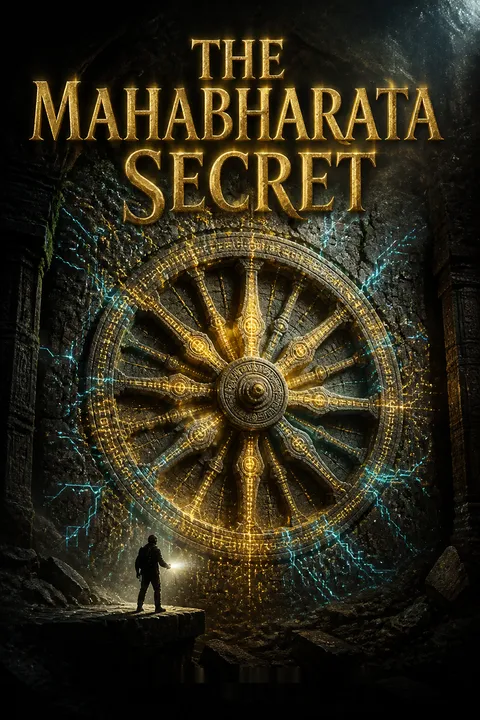


Plot Summary
Prologue
In 244 BC, Emperor Ashoka and his courtier Surasen discover a cavern holding a power so dangerous that Ashoka forms the Nine Unknown Men to guard it and orders the Mahabharata's forbidden Vimana Parva erased from public memory.
Centuries later, the guardian Pala flees with the brotherhood's texts and a metal disk, but dies before reaching safety, leaving them buried near Bamiyan. In 2001, the Taliban destroy the giant Buddhas there, exposing caves and an ancient skeleton. The discoveries connect a vanished brotherhood, a suppressed epic, and a secret that has survived by hiding in plain sight.
The prologue makes concealment the story's first act of protection and its first source of danger. Ashoka does not merely hide a weapon: he tries to remove the cultural instructions that might lead anyone to it, showing how knowledge can become hazardous when separated from judgment. Pala's death turns the archive into a fragile inheritance, while the destruction at Bamiyan reveals how political violence can unintentionally uncover what earlier generations buried. These historical fragments establish that the modern characters are entering a long chain of guardianship, but the chain has already been broken by secrecy, loss, and ambition.
Vikram's Last Message
At his fortified ancestral home, retired nuclear scientist Vikram Singh sees armed intruders defeat his security and enter his study. He knows they want a secret he has guarded for decades, so he sends five baffling emails to his nephew Vijay in California, including instructions to seek out the Nine and speak with archaeologist Greg White.
Farooq, the clean-cut leader of the attackers, takes Vikram's laptop and reveals an ancient weapon before killing him. Days later, Vijay reaches Jaungarh and learns that his uncle was decapitated without leaving blood on the floor. The unnatural wound, the stolen laptop, and Vikram's strange messages convince Vijay that the murder was meant to obtain something specific.
Vikram's choice to send clues rather than a plain warning preserves the secret but transfers its danger to Vijay. His silence is not simply secrecy for its own sake: he is trying to protect his nephew while ensuring the knowledge does not die with him. Yet the coded inheritance imposes a burden Vijay has not chosen and cannot yet understand. The bloodless killing makes the conflict material before its mythology is explained. It signals that the past is not safely past, and that the search for knowledge has already produced a technology capable of making murder look impossible.
The Highway Ambush
Vijay's closest friend and business partner, Colin Baker, arrives from California to help him make sense of Vikram's death. While driving from Delhi toward Jaungarh, the two notice a black SUV tailing them; coordinated vehicles force their BMW off the road, and armed men drag them away. In a locked room, Farooq demands a key Vijay has never heard of and insists Vikram's emails contain clues to it.
Vijay pretends he has not deciphered anything, buying a night to escape. Colin patiently loosens Vijay's restraints, and together they overpower Farooq and his guard Maroosh. They flee under gunfire in the damaged BMW and reach the fort at dawn, carrying the first clear proof that Vikram's killers are still hunting them.
The kidnapping converts Vijay's private bereavement into a shared physical ordeal. Colin's practical patience balances Vijay's instinct to act, establishing their friendship as a working partnership rather than mere comic relief. Vijay's deception also marks his first step from confusion toward agency: he cannot solve the mystery yet, but he can manage what the enemy believes. Their escape is a temporary victory, not safety. By targeting Vijay before he has understood the clues, Farooq makes the inheritance active; the mystery now advances because its pursuers are willing to force an answer.
A Brotherhood in Ashes
At Jaungarh, former Maharaja Bheem Singh and American archaeologist Greg White explain why Vikram's murder matters. White has studied a diary kept by Bruno Beger, a German anthropologist whose expedition recorded ancient Sanskrit texts at a remote monastery.
Those texts describe the Nine Unknown Men, a brotherhood founded by Ashoka to keep destructive discoveries from military hands. The monastery's archive later vanished in a massacre, leaving Beger's notes among the few surviving records.
Vikram believed the Nine had existed and knew their true purpose, while the legend's other claims remain uncertain. When Vijay mentions Farooq's demand for a key and a metal disk, Bheem and White recognize that the attackers are following the brotherhood's puzzle, and warn that Vijay is now in danger.
The meeting gives Vijay a historical framework without offering a simple answer. The Nine's purpose resembles a form of scientific restraint, but the story also shows how easily a protective institution can become inaccessible to the people it hopes to protect. Beger's diary is doubly compromised: it is evidence gathered through a Nazi expedition, yet it preserves information that the original custodians tried to erase. Bheem's authority and White's scholarship lend the legend credibility, but neither can explain the secret itself. The gap between knowing that something existed and knowing what to do with it becomes the engine of the coming investigation.
The Vault Door Falls
Vikram's lawyer, Homi Mehta, reveals that the scientist rented a private Delhi locker and left its key among his papers. Vijay, Colin, and Radha travel there and uncover a dark metal disk engraved with movable rings and ancient writing. Homi phones from his office, struggling to warn them that the address has been compromised; moments later, gunmen seal the vault door and blast it open with a strange bow-shaped machine.
Vijay and Colin trigger the sprinklers, then use a ladder as a battering ram to charge past the attackers and escape with the disk. Homi survives a serious assault. The machine and the metal's unfamiliar material make clear that Farooq's group has access to more than ordinary weapons.
The locker transforms an abstract history into an object that can be held, stolen, and fought over. The attack also exposes the danger of treating research as a private puzzle: Homi is harmed simply because his legal work intersects with Vikram's hidden life. Vijay's escape depends on improvisation and cooperation, not mastery of the artifact, preserving the difference between courage and understanding. The disk offers a route forward while the bow-shaped machine hints at a technology whose age and power unsettle modern categories. Knowledge here is both archive and weapon, and its physical custody determines who can interpret it.
The Nine Lines Align
Dr. Shukla, Radha's father and a scholar of ancient languages, reads the disk's Magadhi inscriptions as a verse about nine sites associated with Ashoka. Vijay recognizes that Vikram's email hides an anagram of karma and points back to his uncle's study. There, the Buddha painting contains a nine-spoked wheel that lifts free and fits the disk, locking its rings into the correct order.
The clues identify edict sites from Kandahar to Dhauli; plotting them on a map reveals their lines intersect at Bairat. Vijay, Colin, Radha, and Shukla decide to investigate before telling Bheem, wary of drawing more attention. Vikram's cryptic messages have become a usable route, but each solved clue carries the group farther from safety.
The puzzle makes interpretation a collective act. Vijay recognizes his uncle's habits, Radha notices a punctuation clue, and Shukla supplies linguistic knowledge, so no single character possesses the whole method. This structure echoes the Nine's distributed guardianship while revising it: cooperation, rather than secrecy between individuals, is what allows the present group to proceed. The nine-spoked wheel is a compact emblem of the story's method, joining religious imagery to mechanical function. Yet success creates a moral risk. The group chooses secrecy to protect the search, but that choice also leaves them without the institutional support that might keep them safe.
Bairat Opens Below
At Bairat, the group finds an ancient Buddhist complex whose gear-shaped structure matches the disk's design. A second alignment separates the disk into layers and supplies a map to a concealed trapdoor beneath a marked brick.
Below, a cavern lined with empty book niches confirms that the Nine once kept an archive there. A pedestal carries a riddle, and its key mechanism opens a second route to a hidden chamber containing an inscription about the lost Vimana Parva and a polished stone sphere.
Farooq's men arrive, threaten Shukla's daughter, and collapse the entrance behind the group. Vijay retrieves the key from the pedestal and uses it to escape through an upper trapdoor. They leave with the sphere and a new clue, while the ancient library remains inaccessible.
Bairat gives the search its first physical answer and immediately denies the comfort of completion. The empty niches make absence visible: the archive has been removed or lost, so the group encounters the outline of knowledge rather than its contents. The sphere's smooth surface becomes a portable promise whose function is still unknown. Farooq's attack reveals the cost of pursuing the trail without protection, while Vijay's return to the key shows that careful attention can matter more than force. The site embodies preservation and erasure at once. It preserves the architecture of the Nine's learning even as the texts that once filled it have vanished.
The Caves Point South
Back in Jaungarh, Radha recognizes that the Bairat structure's twenty-seven teeth match the disk's gear. At the Barabar caves, the team studies the polished chambers and finds the Nine's symbol in a smaller inner room. When Vijay rolls the sphere from Bairat into one of two wall openings, it dislodges a second sphere carrying the next verse.
The clue directs them south from the echoing caves, past an elephant carving at Dhauli, then over a forested region and a reclining Mother Goddess. Colin and the others identify Sitagarha Hill on the Hazaribagh plateau as the likely destination. The journey now depends on geography, Buddhist imagery, and the odd mechanics of the spheres, while their time to protect the clue's captives is shrinking.
The sphere demonstrates that the Nine designed discovery as a sequence of dependencies: one object releases another, and the seeker must understand the landscape as well as the mechanism. The Barabar caves turn echo into a literal feature of the clue, making ancient architecture participate in the act of remembering. Radha's observation and Colin's synthesis keep the investigation from becoming Vijay's solitary inheritance. At the same time, the Mother image shifts the puzzle from imperial geography toward a living landscape. The search's intellectual elegance is increasingly difficult to separate from its danger, because every successful interpretation gives the pursuers a clearer route.
The Maharaja's Hidden Arsenal
While Vijay's party investigates Barabar, Intelligence Bureau officer Imran Kidwai links the kidnapping to Farooq Siddiqui, a missing Pakistani nuclear scientist shown in an Al Qaeda video. Suspicious that Bheem is suppressing the case, Imran enters the Maharaja's farmhouse during a visit by the American vice president.
He overhears Bheem, the vice president, and Austrian businessman Christian Van Klueck discussing Farooq, a planned takeover of world governments, and a prototype built from ancient designs.
Bheem catches Imran in the hidden weapons chamber and demonstrates the spinning Sudarshana Chakra, the same device that killed Vikram without blood. Commandos raid the farmhouse; Imran survives when the weapon's spinning blade kills Bheem during the struggle. The conspiracy is real, but Farooq remains at large.
Imran's investigation supplies the political scale that the archaeological quest alone cannot reveal. Bheem's farmhouse joins modern surveillance, elite diplomacy, and ancient weaponry in one secret space, exposing how power can borrow the authority of history while pursuing contemporary control. Imran's hunch is ethically precarious because it places him against a politically protected figure, yet his willingness to test it becomes essential. Bheem's death is accidental, not a planned execution, which complicates the triumph: the truth emerges through a weapon that destroys its own keeper. The investigation confirms that the secret's danger lies not only in its technology but in the institutions prepared to exploit it.
Farooq Names the Secret
In Patna, Farooq's men seize Vijay and Radha separately, then bring them together. Farooq explains that he was once invited into the Nine by Vikram, but joined Al Qaeda after the attacks of September 11 and later worked with Lashkar-e-Taiba.
He says he murdered the other members, took the disk from one of them, and killed Vikram after Vikram discovered his allegiance. The ancient cache found near Bamiyan supplied weapons and incomplete plans; the missing secret is a technology that can bend light around aircraft, making them invisible.
Farooq intends to use it in an attack on the G20 summit, while his wealthy partners plan to install compliant governments. Vijay and Radha realize Vikram's murder was the final betrayal of a brotherhood already broken from within.
Farooq's history turns the Nine from a distant legend into a failed human institution. His entry into the brotherhood begins as a gesture of shared scientific responsibility, but his political grievance recasts that trust as a tool for a different cause. His account is self-justifying, presenting mass violence as a response to injustice and ambition as destiny. The intended invisibility technology literalizes the story's concern with concealed power: the attack can arrive without being seen, while its political sponsors hide behind a terrorist front. For Vijay, the revelation is personal as well as strategic. His uncle's trust in Farooq made betrayal intimate before it became global.
The Mother in the Forest
With forty-eight hours to save Vijay and Radha, Colin rereads the final verse and uses a travel brochure to connect its reclining Mother Goddess to Sitagarha Hill. Imran reaches the hotel, explains Farooq's threat, and urges the group to keep him talking while commandos move toward the hideout.
In captivity, Radha escapes when a power cut lets Vijay attack Farooq, but Farooq's men lock her in a storage room and set the building alight. Imran's team finds her through a heat sensor and carries her from the fire. Meanwhile, Colin, Shukla, and the man they believe is Greg White leave Patna under Farooq's orders. The group has found the destination, but it is split, and the supposed historian is not who he claims to be.
This section makes interpretation a race against an explicitly human deadline. Colin's breakthrough comes not from specialist scholarship but from noticing an ordinary brochure, suggesting that knowledge can be distributed across institutions and chance encounters. Radha's escape is a decisive act of agency, not a rescue arranged by Vijay; she acts when the blackout gives her a narrow opening. Imran's intervention, however, depends on bureaucratic coordination, surveillance, and emergency logistics. The separation of the characters creates a fragile alliance between intellectual discovery and operational force. The false identity accompanying Colin also warns that trust, like the clues, can be manipulated by those who understand how others expect authority to look.
Murphy's Mask Falls
On the road to Hazaribagh, Vijay learns that the man traveling as Greg White is Terence Murphy, the contract operative who abducted and killed the real archaeologist. Farooq's convoy reaches Sitagarha Hill with Vijay, Colin, and Shukla as prisoners.
The first entrance described in the old record has disappeared, so Vijay recalls that the clue also mentioned a stupa. Searching the forest, Farooq's men find one marked with the Nine's wheel. Its aligned stone pillar points to a second pillar that slides aside, exposing stairs into the hill.
Inside, nine archways carry inscriptions from Hindu and Buddhist teaching. Shukla reads them, but Farooq cannot identify the safe route and strikes him in frustration. Colin connects the central word, karma, to Vikram's earlier clue and leads Vijay through the correct arch.
The reveal of Murphy's identity dismantles the group's last source of scholarly security. His disguise is effective because the others have relied on Greg's presumed expertise, showing how credentials can become a vulnerability when they are not independently verified. At Sitagarha, the Nine's physical safeguards transform interpretation into a test with immediate bodily consequences. Farooq responds to uncertainty with violence, while Colin returns to Vikram's email and treats memory as a form of evidence. The contrast is sharp: Farooq has weapons and resources, but he lacks the patience to read the system he hopes to possess. The correct path is opened by a clue that rewards continuity rather than command.
An Island of Truth
Beyond the karma arch, Vijay and Colin find a cavern that appears to hold floating pillars above a black lake. Remembering Vikram's references to illusion and truth, they infer that invisible supports form a crossing to a hidden island. The key opens its concealed door, but the platform begins sinking and a spiked ceiling descends.
They discover that the room's eight central columns form a wheel representing the Buddhist Wheel of Law, and turn it counterclockwise to halt the trap and raise the platform. Their success opens the second archway, bringing them through a passage to the enormous cavern containing the Nine's secret. Farooq and the other captives remain behind, while commandos and Radha close in on the underground complex.
The illusion chamber converts the story's metaphors into an engineering problem: invisibility is at once a literal technology and a test of how perception can be corrected. Vijay and Colin survive by recalling earlier clues and applying them under pressure, so memory becomes an instrument of physical survival. The eight-column wheel also revises the Nine's recurring symbolism, showing that a different tradition can supply the missing solution. Their escape is not a victory over danger so much as proof that the hidden system can be read. The sequence makes the central ethical distinction tangible: seeing clearly requires attention, but it also requires humility about what the eye alone can establish.
The Invisible Fleet
In the main cavern, Vijay and Colin discover a fleet of ancient, pilotless aircraft and metal plaques carrying the designs Farooq needs to reproduce the invisibility shield. Farooq orders his men to load the material and refuses to release the captives.
Indian commandos enter the cavern and exchange fire with the terrorists. A grenade meant for an enemy position goes astray, striking the aircraft instead. The blast triggers a chain of explosions, including among craft concealed by the invisibility technology, and the hill erupts.
The shockwave tears through the forest and damages Hazaribagh, though Imran had arranged the town's evacuation and warned nearby villages. The cavern, its fleet, Farooq's operation, and the commandos are caught in the disaster; the book leaves their individual fates unclear.
The climax makes the technology's destructive capacity impossible to separate from the conditions required to control it. The commandos enter to stop an attack, but the weaponry is so unstable that intervention itself becomes perilous. The accidental grenade prevents Farooq from carrying out his plan, yet the result is catastrophic rather than cleanly victorious. Imran's evacuation efforts show a different form of protection from the Nine's secrecy: institutions can reduce harm when they act on uncertain evidence before it is too late. The explosion also destroys the object of the search, leaving no simple transfer of power. The secret is withheld from Farooq, but its human cost remains unresolved.
Vikram's Last Inheritance
After returning to Jaungarh, Vijay cannot reconcile Vikram's warnings with the dangerous trail he followed. Alone in the fort, he rereads the emails and notices that the Gita clue points not only to karma but to a second nine-spoked wheel, hidden in a mural of Krishna instructing Arjuna.
Using the disk's key, he opens a concealed chamber in the hillside. Inside, climate-controlled shelves preserve microfilm of the Nine's accumulated scientific library, along with Vikram's translations and a letter.
Vikram reveals that he was the brotherhood's last surviving member and asks Vijay to take up its duty, while urging him not to seek the destroyed weapon. Vijay accepts the responsibility. The search ends not with possession of the secret weapon, but with custody of the knowledge meant to outlast it.
The ending corrects Vijay's understanding of the entire journey. He had mistaken Vikram's clues for an invitation to pursue the hidden weapon, when they were designed to bring him to the library and the responsibility attached to it. This distinction separates knowledge from spectacle: the destroyed aircraft were only one dangerous fragment of a much larger intellectual inheritance. Vikram's final choice respects Vijay's judgment but still imposes a burden without consent, preserving the emotional ambivalence of succession. Vijay's acceptance converts grief into stewardship rather than conquest. The brotherhood survives not as an unchanged institution, but as a duty transferred to someone who has witnessed the consequences of ignoring its purpose.
Analysis
The novel builds its thriller from a conflict over who should control knowledge and what responsibility comes with possessing it. Ashoka responds to a destructive discovery by creating a secret order and erasing the text that might lead others to it. That choice prevents immediate access, but it also makes the guardians dependent on fragmented clues, fragile archives, and personal trust. When Vikram sends Vijay coded instructions, the same secrecy meant to protect the world creates room for misinterpretation. Vijay's mistaken pursuit of the weapon is therefore not a simple failure of intelligence. It exposes the danger of inheriting a system without knowing its purpose.
The book sets two modes of power against each other. Farooq and his political partners treat advanced technology as leverage for ideological and commercial domination. Their plan relies on invisibility, proxy organizations, and controlled political succession. Imran's counterstrategy is less glamorous but more ethically grounded: intelligence gathering, institutional coordination, and evacuation of civilians. The explosion at Sitagarha prevents the weapon from being captured, but the catastrophe refuses the clean satisfaction of a conventional victory. The town survives because its people were moved in time, while the commandos' individual fate remains unknown.
The puzzle's solutions also argue for interdependence. Vijay contributes familial knowledge, Colin improvisation, Radha scientific attention, and Shukla linguistic expertise. Their collective method contrasts with Farooq's coercive hierarchy, where useful people are threatened rather than trusted. Yet the ending complicates the celebration of teamwork: Vijay receives a responsibility he did not request, just as Vikram once carried a burden in silence. His acceptance is meaningful because he has seen the cost of both secrecy and uncontrolled disclosure. The novel's deepest distinction is not between ancient knowledge and modern science, but between knowledge treated as a shared obligation and knowledge treated as ownership.
Review Summary
The Mahabharata Secret received mixed reviews. Some praised its intriguing plot, blending mythology and thriller elements, while others criticized weak character development and predictable twists. Readers appreciated the historical research but found the pacing slow at times. The secret weapon premise intrigued many, though some felt the ending was disappointing. The book drew comparisons to Dan Brown's works, with divided opinions on its execution. Overall, it was considered an entertaining read for those interested in Indian mythology and conspiracy thrillers, despite its flaws.
Characters
Vijay Singh
The burdened heirVijay is an Indian-born technology entrepreneur living in California and the nephew of nuclear scientist Vikram Singh. His parents' early death bound him closely to his uncle, who taught him stories of ancient India and encouraged his curiosity. Vijay is athletic, inventive, and more cautious than his irrepressible friend Colin, but grief and danger push him into decisions before he has the full picture. He often treats a problem as something to solve through persistence, a strength that can become tunnel vision. His relationship with Radha grows from childhood familiarity into an adult intimacy grounded in mutual competence. At heart, Vijay wants to honor the people who trusted him without letting their expectations erase his own judgment.
Vikram Singh
The guarded scientistVikram, Vijay's uncle, is a retired nuclear scientist, scholar of ancient Indian languages, and guardian of a history he cannot safely share. He raised Vijay after the deaths of the boy's parents and maintained their bond through weekly calls and stories. His scientific training gives him a modern vocabulary for danger, while his study of the Mahabharata connects him to India's intellectual past. Vikram is disciplined and protective, but his instinct to keep burdens private leaves others to interpret clues under pressure. His life is shaped by a conflict between loyalty to family and loyalty to a larger obligation, and he tries to honor both by preparing Vijay without explaining the full cost.
Colin Baker
The fearless cofounderColin is Vijay's American business partner and closest friend, whom he met at MIT. A tall, sociable athlete with a taste for risk, Colin contrasts with Vijay's more reserved temperament, but their differences make them effective together. He jokes under pressure, yet his humor does not diminish his persistence: he works at Vijay's restraints until they come loose and repeatedly spots connections others miss. Colin's loyalty is active rather than sentimental; he helps by taking physical risks, asking practical questions, and refusing to leave Vijay alone. His appetite for adventure brings him into the mystery, while his capacity to improvise helps keep it from overwhelming him.
Radha Shukla
The lucid physicistRadha is a nuclear physicist with India's Department of Atomic Energy and the daughter of scholar Dr. Shukla. She and Vijay were childhood friends who reconnect as adults, and she becomes a trusted member of the search because she combines scientific discipline with a keen eye for physical details. Radha notices what others overlook, from the unusual wheel in Vikram's painting to the geometry linking the clues. She is compassionate without being passive and can challenge Vijay when his protectiveness threatens to exclude her. Her attraction to him develops alongside shared work and danger, so their closeness rests on respect as much as romance.
Farooq Siddiqui
The driven nuclear scientistFarooq is a Pakistani nuclear scientist whose intellect and political convictions pull him toward increasingly ambitious ideas. He is controlled and persuasive when it suits him, but his composure can fracture when events resist his plans. Farooq believes that technological power can reorder political reality, a conviction that lets him frame coercion as strategy and grievance as justification. His presence forces the other characters to confront the difference between understanding a technology and possessing the moral judgment to use it. He is a formidable reader of people and resources, but his impatience with uncertainty repeatedly exposes the limits of his control.
Bheem Singh
The royal patronBheem Singh is the former Maharaja of Rajvirgarh, a prominent businessman and politician who commands respect in government circles. He funds Greg White's research and presents himself as an informal, modern royal, though he remains conscious of rank and influence. Bheem is confident, strategic, and accustomed to shaping events through personal networks rather than public institutions. His interest in ancient history is connected to his family's long record of preserving its own past. He is a persuasive host and a powerful intermediary, qualities that make it difficult for others to know where his public generosity ends and his private ambitions begin.
Imran Kidwai
The instinctive investigatorImran is an Additional Director in India's Intelligence Bureau, a fit and perceptive investigator who trusts his instincts but knows that a hunch must be turned into evidence. He connects the kidnappings, Vikram's murder, and Farooq's history when official leads remain thin. Imran is willing to bend procedure when he believes a threat is real, yet he understands the cost of acting without proof, especially when political power is involved. His dry confidence masks the pressure of decisions made with incomplete information. He offers a modern counterpoint to Vijay's archaeological investigation: where Vijay reads symbols, Imran reads institutions, surveillance, and human behavior.
Dr. Shukla
The scholar fatherRadha's father is a close friend of Vikram and a scholar of Sanskrit, Magadhi, and other ancient languages. His learning gives the group access to inscriptions that would otherwise remain opaque, but his importance is not merely technical: he brings a father's concern into a quest increasingly dominated by violence. Dr. Shukla is patient, modest about his expertise, and deeply moved by the possibility of recovering ancient knowledge. He supports Radha's independence while remaining protective of her, embodying the tension between intellectual curiosity and personal vulnerability.
Greg White
The invited historianGreg White is an American professor of archaeology and history whose specialty includes ancient India and the Magadha empire. He accepts Bheem Singh's invitation because the project promises evidence about Ashoka and the Nine. White is curious, professionally open to extraordinary discoveries, and personally affected by the murder of his friend Vikram. His role illustrates the value and limits of academic expertise: careful research can establish where a clue came from, but history alone does not guarantee safety or certainty in the field.
Terence Murphy
The hired operativeMurphy is an American contract operative whose work has included surveillance, coercion, and lethal assignments. Experienced and pragmatic, he is more comfortable with operations than with the historical material that increasingly governs his mission. Murphy is observant about the people around him and understands that force does not always solve a problem; sometimes it is more useful to let others lead the way. His professional detachment makes him an unsettling presence, especially when the assignment demands cooperation with people whose motives differ from his own.
Emperor Ashoka
The remorseful emperorAshoka is the Mauryan emperor whose discovery of a dangerous ancient power changes the course of the story. Associated with the aftermath of the Kalinga war and a turn toward Buddhist principles, he seeks to prevent scientific knowledge from becoming an instrument of mass destruction. His response is both visionary and authoritarian: he creates a secret brotherhood and suppresses the record that might reveal its purpose. Ashoka's choice establishes the moral question inherited by every later guardian, namely whether secrecy can protect humanity without also depriving it of informed judgment.
Surasen
The emperor's loyal courtierSurasen is Ashoka's trusted courtier and the first witness to the hidden cavern. He records the discovery without naming its contents, obeying the emperor's demand for secrecy while preserving enough context to guide future guardians.
Pala
The fugitive guardianPala is a court astronomer who secretly serves as a custodian of the Nine's materials. When the stone book is discovered, he tries to carry the texts and metal disk to another member of the brotherhood, placing the mission above his own safety.
Bruno Beger
The compromised recorderBeger is a German anthropologist on a Nazi-sponsored expedition to Tibet. His diary records the discovery of ancient texts at a monastery, preserving evidence whose later importance he does not fully understand.
Michael Blake
The American intelligence liaisonBlake is a CIA officer who brings the American intelligence service's information about Murphy and Farooq to Imran. He is analytical and candid about uncertainty, making him a useful partner as the investigation crosses national boundaries.
Arjun Vaid
The cautious bureau chiefVaid directs the Intelligence Bureau and supervises Imran's investigation. He weighs national security against the political and professional consequences of acting on incomplete intelligence, while still making room for Imran to test his suspicions.
Imtiaz
Farooq's watchful lieutenantImtiaz is one of Farooq's associates and helps manage the kidnappings and search for Vikram's key. He is observant and efficient, serving as a practical extension of Farooq's organization.
Maroosh
The armed enforcerMaroosh is one of Farooq's armed men, a physically imposing guard who helps control captives. His blunt use of force makes him a direct expression of the threat surrounding Vijay and Colin.
Plot Devices
Vikram's coded emails
Clues inside an inheritanceVikram sends Vijay a sequence of cryptic emails shortly before his murder. References to the Nine, Ashoka, the Bhagavad Gita, karma, truth, and illusion guide the search toward the disk's key and later reveal a hidden chamber in Jaungarh. Their wording invites more than one interpretation, and Vijay initially follows the clues toward the dangerous weapon rather than directly to his uncle's intended destination. The emails make the story's central problem one of reading correctly: information can be present and still be misunderstood when its recipient does not know what question to ask.
The Nine's four-part puzzle
A trail that needs many mindsThe search depends on a metal disk, its separate key, a polished stone sphere, and a series of riddles. The disk's movable inscriptions identify Ashoka's edict sites; its key is hidden in a nine-spoked wheel; the sites map to Bairat; and the sphere reveals further instructions at Barabar. Each object requires a different kind of knowledge, including language, history, geometry, and close observation. The structure prevents any single clue from giving away the destination, but it also means the investigators must rely on one another and repeatedly risk the objects falling into Farooq's hands.
The lost Vimana Parva
Myth concealing a weaponThe Vimana Parva is a missing section of the Mahabharata that describes a king's effort to build flying machines and a devastating weapon. Ashoka orders the text erased from public versions of the epic because it points toward a dangerous discovery. Farooq and his partners interpret its account as evidence of aircraft protected by an invisibility shield, then use recovered designs to construct a prototype. The lost text binds religious and literary memory to engineering and political violence, while leaving room for characters to debate how much epic language describes literal technology and how much works through metaphor.
The invisibility shield
Power hidden from sightThe secret technology bends light around an object, concealing both the object and its shadow. Farooq's network intends to apply it to aircraft and combine it with radar evasion, making an attack difficult to detect. The technology is introduced through Farooq's scientific explanation, then confirmed by the ancient fleet hidden beneath Sitagarha. Its literal invisibility also gives the story's repeated concern with illusion a physical form: appearances cannot be trusted, and the ability to control what others can perceive becomes a source of political power.
The Sudarshana Chakra
A weapon disguised as legendThe spinning metal weapon associated with Lord Krishna is presented as a legendary object, then shown to be a working device that can cut while cauterizing blood vessels. Its unusual effect explains the bloodless wound on Vikram and confirms that ancient designs have survived into the modern conflict. Bheem's use of the chakra against Imran also makes the weapon's danger immediate. The device collapses the distance between myth and physical evidence, but its presence does not prove that every epic account is literal; it proves that dismissing inherited stories outright can be as reckless as believing them without question.
FAQ
Synopsis & Basic Details
What is The Mahabharata Secret about?
- Ancient Secret, Modern Threat: The story begins with the brutal murder of reclusive nuclear scientist Vikram Singh, whose cryptic emails to his nephew, Vijay, ignite a thrilling quest to uncover a 2,300-year-old secret. Vijay, an American engineer, is drawn into a world of ancient Indian mythology, advanced science, and a shadowy brotherhood known as the Nine Unknown Men.
- Race Against Time: As Vijay and his friends decipher a series of intricate riddles hidden in Ashokan edicts and ancient texts, they are relentlessly pursued by Farooq Siddiqui, a rogue Pakistani nuclear scientist allied with a global terrorist organization. Farooq seeks the same secret, believing it holds the key to a world-altering weapon.
- Unraveling a Conspiracy: The pursuit leads them across India, from fortified forts to ancient caves, revealing layers of betrayal, hidden alliances, and a vast international conspiracy involving powerful politicians and businessmen. The true nature of the Nine's secret, a technology of unimaginable power, becomes clear, forcing Vijay to confront the ethical dilemmas of knowledge and its potential for destruction.
Why should I read The Mahabharata Secret?
- Mythology Meets Modern Thriller: Readers are drawn into a unique blend of ancient Indian history, the epic Mahabharata, and a high-stakes contemporary thriller, offering a fresh perspective on historical fiction and conspiracy narratives. The novel seamlessly integrates scientific concepts like invisibility cloaks with mythological elements, making for a truly original plot.
- Intellectual Puzzle & Adventure: The story functions as a complex, multi-layered puzzle, challenging readers to decipher clues alongside the protagonists, from ancient Magadhi inscriptions to geographical alignments of Ashokan edicts. This intellectual engagement is coupled with relentless action, car chases, kidnappings, and covert operations, ensuring a gripping pace.
- Themes of Knowledge & Power: Beyond the thrilling plot, the book delves into profound themes: the ethical responsibility of guarding dangerous knowledge, the corrupting influence of unchecked power, and the enduring relevance of ancient wisdom in a modern world. It prompts reflection on humanity's capacity for both creation and destruction, making it a thought-provoking read.
What is the background of The Mahabharata Secret?
- Ashokan Era Foundation: The core of the story is rooted in 244 BC, when Emperor Ashoka the Great discovers a terrifying secret and establishes the Nine Unknown Men to safeguard it, ordering the destruction of all related texts, including the Vimana Parva of the Mahabharata. This historical context provides a rich tapestry of ancient Indian culture, philosophy, and early scientific thought.
- Blend of History and Speculation: Christopher C. Doyle meticulously weaves historical facts about Ashoka's edicts, ancient languages like Magadhi and Kharosthi, and geographical locations across India with speculative elements of advanced ancient technology. This creates a plausible, yet fantastical, world where myths hold scientific truths, enhancing the novel's appeal for readers interested in "ancient Indian history explained."
- Global Geopolitical Stage: The modern-day narrative is set against a backdrop of international terrorism and political ambition, involving organizations like Lashkar-e-Taiba (LeT) and a powerful consortium of global figures. This contemporary geopolitical context grounds the ancient mystery in urgent, real-world anxieties, exploring "themes in The Mahabharata Secret" related to global power dynamics and national security.
What are the most memorable quotes in The Mahabharata Secret?
- "The myth must disappear from the knowledge of men, just like the secret it mentions. The world will know the Mahabharata but it will never know the dark secret it carries deep within." (Prologue): This quote, attributed to Emperor Asoka, encapsulates the central premise of the novel – the deliberate concealment of a profound truth within the fabric of legend. It highlights the immense power of the secret and the lengths taken to protect humanity from it, setting the stage for the entire "Mahabharata Secret analysis."
- "In an ocean of maya, there is always an island of satya." (Chapter 2): Sent by Vikram Singh to Vijay, this cryptic line becomes a guiding philosophical principle and a literal clue, emphasizing the novel's core theme of distinguishing truth from illusion. It foreshadows the challenges of perception and the need for deeper understanding to uncover the "hidden meaning" of the Nine's legacy.
- "The world can't defend itself from what it can't see! An invisible plane, carrying a deadly payload—how can any security agency in the world detect and stop it?" (Chapter 41): Farooq Siddiqui's chilling boast reveals the terrifying potential of the invisibility technology and the scale of the threat. This quote underscores the novel's exploration of "invisibility cloak explained" and the vulnerability of modern defenses against ancient, perfected science, driving the high-stakes conflict.
What writing style, narrative choices, and literary techniques does Christopher C. Doyle use?
- Pacing and Suspense Building: Doyle employs a fast-paced, action-driven narrative, characterized by short chapters and frequent cliffhangers that propel the reader forward. This "thriller writing style" is enhanced by constant threats, narrow escapes, and the ticking clock of Farooq's deadline, maintaining high tension throughout the "Mahabharata Secret plot."
- Interweaving Dual Timelines: The novel skillfully alternates between ancient historical accounts (Ashoka's era, Pala's journey) and the present-day quest, using these dual timelines to provide crucial context and deepen the mystery. This technique allows for gradual revelation of the Nine's history and the secret's origins, enriching the "historical fiction" aspect.
- Intricate Puzzle Construction: Doyle's narrative relies heavily on a multi-layered puzzle structure, where each clue (emails, disk inscriptions, edict locations, riddles) requires a specific type of knowledge—linguistic, historical, geographical, and philosophical—to solve. This "cryptic clue analysis" engages the reader intellectually, mirroring the protagonists' journey of discovery and making the "Mahabharata Secret explained" a rewarding experience.
Hidden Details & Subtle Connections
What are some minor details that add significant meaning?
- The Nine-Spoked Wheel Motif: The repeated appearance of a nine-spoked wheel, first in Vikram's "Karma" painting (Chapter 10) and later on the Barabar caves' pedestal (Chapter 19) and the Sitagarha stupa (Chapter 42), subtly reinforces the omnipresence of the Nine. This detail, contrasting with the traditional eight-spoked Buddhist Wheel of Law, serves as a consistent, hidden marker for the brotherhood's influence and their specific clues, a key element in "The Mahabharata Secret symbolism."
- Murphy's Flight Connection: The seemingly throwaway detail that Murphy (posing as Greg White) was on the same flight as Vijay from O'Hare to Delhi (Chapter 7) subtly foreshadows his role as an infiltrator and spy. This early, almost imperceptible, "character connection" indicates the cabal's meticulous planning and their immediate targeting of Vijay, highlighting the depth of the "conspiracy analysis."
- The Barabar Caves' Echo: The specific mention of the Barabar caves' "extraordinary echo" (Chapter 22) directly links to the riddle's line "From the chambers that echo," transforming a geological feature into a crucial, literal clue. This detail exemplifies how the Nine integrated natural phenomena into their "ancient riddles," making the environment itself part of the "Mahabharata Secret puzzle."
What are some subtle foreshadowing and callbacks?
- Vikram's "Accidental" Death: Vikram Singh's initial paranoia about his parents' car crash not being accidental (Chapter 1) subtly foreshadows the ruthless, systematic nature of the cabal and their willingness to eliminate anyone who stands in their way. This early hint of a deeper, personal threat adds a layer of tragic irony to Vikram's own murder, deepening the "Vikram Singh motivations" analysis.
- Farooq's Initial Doubt: When Vikram defiantly tells Farooq that the key "doesn't belong to you, Farooq. And you won't find it by killing me anyway. Your options are limited. You need me alive," Farooq experiences a "flicker of doubt" (Chapter 1). This brief moment foreshadows his later reliance on Vijay to solve the riddles, indicating that despite his power, Farooq lacks the intellectual key to the secret, a crucial element in "Farooq Siddiqui analysis."
- The "Two Tongues" Edict: The ninth line of the disk's verse, "The ninth speaks in two tongues," refers to the bilingual Kandahar edict (Chapter 14). This detail subtly foreshadows the international scope of the Nine's influence and the global nature of the threat, hinting that the secret transcends geographical and linguistic boundaries, a key aspect of "The Mahabharata Secret themes."
What are some unexpected character connections?
- Bheem Singh's "Former Subjects": Bheem Singh's casual remark, "It won't do for my subjects to know that I am so accessible to anyone" (Chapter 3), subtly reveals his deep-seated monarchical ambition and his perception of himself as a ruler, not just a politician. This "Bheem Singh character analysis" hints at his true, self-serving motivations and his desire to restore a dynastic rule, aligning with the cabal's goals.
- The Travel Agent's Unwitting Clue: The seemingly insignificant travel agent in Patna (Chapter 35), in his eagerness to sell tours, inadvertently provides the crucial "Mother Goddess" clue that leads to Sitagarha Hill. This "minor character influence" highlights how vital information can come from unexpected sources, underscoring the interconnectedness of the world and the subtle ways destiny guides the protagonists.
- Murphy's "Hollywood Fixation": Colin's frequent jests about Murphy's "Hollywood fixation" (Chapter 26) and his knowledge of thriller tropes, while initially humorous, become ironically significant when Murphy is revealed as a mercenary. This "character quirk analysis" subtly hints at Murphy's professional background, where such scenarios are part of his operational reality, adding a layer of dark humor to his betrayal.
Who are the most significant supporting characters?
- Dr. Shukla, the Linguistic Bridge: Beyond his explicit role as a translator of ancient languages like Magadhi and Kharosthi, Dr. Shukla serves as a vital "cultural and historical anchor" for the group. His deep knowledge of the Mahabharata and Buddhist philosophy provides the interpretive framework necessary to understand the Nine's complex clues, making him indispensable for "ancient text analysis."
- Imran Kidwai, the Intuitive Investigator: Imran Kidwai, the IB officer, is crucial not just for his investigative skills but for his "intuitive leaps" and willingness to challenge bureaucratic inertia (Chapter 23). His ability to connect seemingly disparate events—Vikram's murder, Farooq's kidnapping, and the G20 threat—demonstrates the power of instinct in solving complex "global conspiracies," providing the necessary government intervention.
- Chunnilal, the Local Lore Keeper: The local guide at Bairat, Chunnilal (Chapter 15), provides seemingly superstitious "local legends" about the Pandavas playing dice on the hill and its "special powers" to imbue knowledge. These tales, initially dismissed, offer crucial interpretive context for the site's true purpose as a hidden library, highlighting the value of indigenous knowledge in "mythological parallels."
Psychological, Emotional, & Relational Analysis
What are some unspoken motivations of the characters?
- Farooq's Personal Vendetta: While Farooq explicitly states his ideological and global ambitions (Chapter 33), his intense cruelty towards Vijay, particularly after Vijay's attack (Chapter 46, "You will pay for this"), reveals a deep-seated, unspoken personal vendetta against Vikram Singh and his lineage. This "Farooq Siddiqui motivations" analysis suggests a psychological need for retribution beyond mere strategic objectives.
- Vikram's Burden of Guilt: Vikram Singh's reclusive life and elaborate security measures (Chapter 1) are not solely for protecting the secret, but also stem from a profound, unspoken "psychological burden" of guilt. His letter (Chapter 50) reveals he was the last of the Nine and had "killed the other eight" (referring to the traitor), implying a heavy conscience over the fate of his brotherhood and his inability to prevent their demise.
- Radha's Drive for Justice: Beyond her loyalty to Vijay and her father, Radha's fierce determination to escape captivity (Chapter 36) and her insistence on joining the commandos (Chapter 38) are fueled by an unspoken "emotional drive for justice." Witnessing Farooq's brutality and understanding the scale of the threat ignites a deep desire to prevent further harm, showcasing her "Radha Shukla character analysis."
What psychological complexities do the characters exhibit?
- Vijay's Reluctant Heroism: Vijay's journey is marked by a complex psychological arc, moving from initial grief and bewilderment to a "reluctant heroism" (Chapter 50). His moments of despair (Chapter 10, "no closer to finding the secret") and rage (Chapter 46, attacking Farooq) reveal a deeply human struggle with overwhelming responsibility, contrasting with his eventual acceptance of the mantle of the Nine.
- Colin's Humor as a Coping Mechanism: Colin's constant stream of pop culture references and lighthearted banter (Chapter 26, "Gollum's going to pop out") serves as a "psychological coping mechanism" against the extreme stress and terror of their situation. This "Colin Baker analysis" highlights his resilience and his role in maintaining morale, even as he grapples with fear and the gravity of their quest.
- Bheem Singh's Dual Persona: Bheem Singh exhibits a complex "dual persona," publicly presenting as a respected politician and patron of history, while secretly orchestrating a global power grab (Chapter 24). This "character complexity" reveals a Machiavellian mind, capable of profound deception and driven by a deep-seated, almost ancestral, ambition for control, making him a compelling antagonist.
What are the major emotional turning points?
Download PDF
Download EPUB
.epub digital book format is ideal for reading ebooks on phones, tablets, and e-readers.








