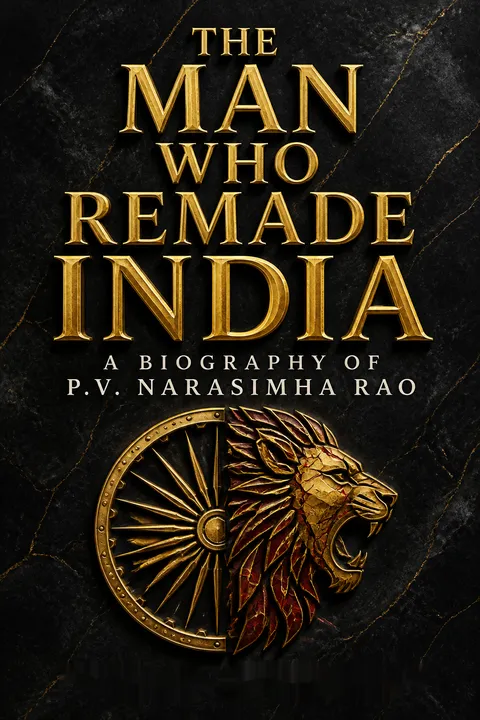


Key Takeaways
Turn political weakness into room to maneuver, not an excuse to retreat.
A life of contradictions. P.V. Narasimha Rao grew up between village traditions and a multilingual political world, became a socialist reformer, and learned politics inside a party organized around powerful factions. As Andhra Pradesh chief minister, he pushed land reform so aggressively that opponents united against him and he was removed. In exile, he studied his mistakes: change creates enemies, and a leader must understand their strength before choosing a fight.
Three ways to lead. As prime minister, Rao lacked a majority, a personal party base, and public charisma. The book describes his political range through three animal roles: the lion uses force, the fox uses strategy, and the mouse stays unobtrusive. This flexibility helped him lead reforms that moved India from crisis to 7.5 percent growth by 1996.
What's striking is that Rao's apparent lack of a fixed persona became a governing asset. Political science often describes leaders as operating among veto players, groups able to block change. Rao's skill was not simply persuading them, but shifting his method to fit the obstacle. That resembles adaptive leadership: diagnose whether a problem calls for authority, negotiation, or restraint. Yet flexibility has a cost. If tactics change without clear public principles, citizens may see expedience rather than judgment. Rao's career makes adaptability look powerful, but also raises the question of what should remain non-negotiable.
Use a crisis to unlock reforms that vested interests have blocked.
A narrow window. When Rao became prime minister in June 1991, India had enough foreign currency for only about two weeks of imports. To obtain emergency dollars, the government sent roughly twenty-one tonnes of gold to the Bank of England as collateral. The crisis had immediate causes, including expensive oil and debts coming due, but the deeper problem was an economy constrained by licences, monopolies, and barriers to trade.
A swift reversal. Rao had not entered office as a committed liberalizer. After reading an eight-page briefing on the danger, he quickly chose Manmohan Singh as finance minister and backed major changes. The crisis made action politically defensible, but it did not dictate one inevitable solution. Rao used urgency to advance reforms that earlier governments had discussed and failed to enact.
A crisis can loosen what political scientists call policy lock-in: institutions and interest groups make an existing arrangement hard to change even when it performs badly. Rao's case shows why a shock can create room for action, but also why crisis alone is not a plan. Leaders still choose which costs to impose, who bears them, and which alternatives to reject. Describing reform as unavoidable can obscure those choices. The more useful lesson is to treat emergencies as brief openings for considered change, while making the reasoning visible enough to earn public trust.
Wrap a sharp break in familiar language to make it governable.
Change in old clothing. In July 1991, Rao's government ended industrial licensing for most industries, reduced restrictions on large companies, and allowed greater foreign investment. The measures attacked central pillars of the licence-permit-quota raj, the system of official permits, quotas, and controls that limited what businesses could produce and import.
Rhetoric as a tool. Rao knew that his own Congress party remained attached to socialism. He presented the reforms as compatible with Nehru's earlier industrial vision and connected them to Rajiv Gandhi's legacy. A preamble linking the new policy to Congress history helped win Cabinet and party support. Rao also let Manmohan Singh become the public face of the budget, while he kept the industry portfolio and protected the policy's substance.
Framing is not merely cosmetic. Research on political communication suggests that people judge policies partly through the values and identities attached to them. Rao made reform legible to a party that might otherwise have rejected it as betrayal. The strategy also resembles institutional change through conversion: old rules acquire new purposes without being discarded all at once. The risk is that continuity language can blur accountability. When leaders describe a genuine reversal as an unchanged tradition, citizens may struggle to identify who chose the policy and who should answer for its effects.
Build a capable team, then keep reform moving through political resistance.
A team with competing views. Rao chose Manmohan Singh and other market-oriented officials for economic reform, while appointing committed socialists to develop welfare programmes. In the prime minister's office, principal secretary Amar Nath Varma coordinated regular meetings that turned proposals into decisions. Rao kept the process close enough to his office to maintain momentum, while relying on specialists to supply expertise he did not have.
Survival was work. His government lacked a parliamentary majority and faced repeated challenges. Rao negotiated with opposition leaders, cultivated legislators who might abstain, and accommodated rivals in his Cabinet. In July 1993, his government survived a no-confidence vote by only fourteen votes, with breakaway opposition MPs helping it through. The same political management that protected reform also involved questionable deals, including later allegations of bribery.
The strongest version of Rao's method is not solitary genius but orchestrated expertise. Complex policy depends on teams that possess different knowledge and can disagree without paralyzing execution. Keeping economic reformers and welfare specialists in the same government also made its competing goals harder to ignore. Still, rivalry is not automatically productive. It can generate useful scrutiny, or reward factional loyalty and secrecy. Rao's narrow parliamentary survival shows the distinction between having enough support to govern and having a transparent mandate for every bargain used to secure it.
Growth can finance welfare, but only delivery makes it real.
Revenue is a beginning. Rao said his model was social democracy: private economic growth should expand government revenue, which could then support education, health, and protection for the poor. During his term, central government revenue rose by about 22 percent in real terms. He increased education spending and expanded Navodaya residential schools, intended to give rural children access to better schooling.
The last mile failed. More money did not guarantee effective service. Rao's Renewed Public Distribution System targeted subsidized food to poorer districts, yet a survey of twenty-one villages found that no surveyed consumer had received the subsidized grain. His national employment assurance scheme lacked sufficient funding and enforceable rights. Corrupt intermediaries and weak frontline administration blocked benefits before they reached families.
This distinction between fiscal capacity and state capacity is central to development. A government needs revenue to provide public goods, but it also needs competent staff, sound programme design, and reliable local administration. Economists sometimes call this the implementation gap: policy commitments lose force as they pass through institutions. Rao's experience usefully resists two easy conclusions. Growth alone does not ensure social progress, while poorly delivered welfare does not prove that public spending is pointless. The harder test is whether citizens can actually use the service they are promised.
Protect constitutional values before a crisis becomes irreversible.
A decision deferred. The Babri Masjid in Ayodhya was threatened by a large gathering of Hindu activists on 6 December 1992. Rao could have dismissed Uttar Pradesh's BJP government under Article 356, which allows central rule when a state government cannot function constitutionally. Officials warned that a takeover close to the event could endanger the mosque and cause bloodshed. Rao sought assurances from political and religious leaders instead, believing they would prevent an attack.
Trust proved insufficient. The mosque was demolished while police and state forces failed to intervene. The book finds no persuasive evidence that Rao plotted or welcomed its destruction, and reports that he was monitoring events. Its criticism is sharper: he overestimated his influence over the activists and placed political caution above a more forceful preventive response.
This episode exposes a hard problem in constitutional government: preventive action can itself be abused, yet waiting for certainty may make protection impossible. Rao faced real legal and political risks, but the costs of delay fell most heavily on people whose place of worship was under threat. The episode invites a distinction between legality and responsibility. A leader may have defensible reasons for hesitating and still bear responsibility for a preventable failure. Good institutional design must clarify not only who may intervene, but how to act when credible danger is imminent.
Broaden foreign ties without forcing every old relationship to break.
A changing world. The Soviet Union, India's principal Cold War partner, was collapsing as Rao took office. He sought closer relations with the United States while maintaining links with Russia, and established full diplomatic relations with Israel in January 1992 after publicly welcoming Palestinian leader Yasser Arafat. The sequence signaled change without presenting it as abandonment of an old friend.
New directions. Rao's government signed a 1993 agreement with China to maintain peace along the disputed border, separating that unresolved problem from other relations. His visits to South Korea and Southeast Asia advanced what became known as the Look East policy, a shift toward economic and diplomatic ties with East Asia. He also used foreign visits to attract investment, making economic diplomacy part of the prime minister's work.
Rao's approach resembles portfolio diversification: a country reduces dependence on one partner by building several relationships, while avoiding needless rupture. Separating a dispute from areas of possible cooperation can also keep diplomacy productive when a final settlement is distant. This is not the same as treating all partners as interchangeable. Geography, security concerns, and domestic politics constrain a state's options. The useful principle is selective flexibility, not neutrality for its own sake. Rao's opening to new partners worked because it responded to material changes in India's economic and strategic position.
Pair economic strength with credible security, while preserving strategic choice.
A capability in stages. India already had nuclear technology when Rao became prime minister, but it still needed reliable ways to deliver a weapon. Under his government, scientists advanced the Prithvi and Agni missiles and tested whether aircraft could carry a nuclear device. Rao supported the programme while avoiding an immediate test that could trigger sanctions and jeopardize India's fragile recovery.
A disputed final step. In late 1995, preparations for tests reached an advanced stage, and American satellites detected activity at Pokhran. Rao postponed the test. He considered testing again in 1996, but the election result changed his course. The book establishes his close involvement, but cannot resolve whether the first preparations were a genuine test attempt or also a way to buy scientists time. Rao briefed incoming prime minister Atal Bihari Vajpayee on the programme's readiness.
The episode illustrates a security dilemma: one state's effort to deter attack can make other states feel less secure, prompting pressure or countermeasures. Rao tried to preserve a nuclear option while avoiding the economic costs of declaring it openly. That restraint may have protected room for manoeuvre, but secrecy makes motives difficult to assess and democratic oversight difficult to exercise. Deterrence depends on credible capability, yet legitimacy depends on more than technical readiness. The narrative is strongest where it distinguishes documented preparation from speculation about what Rao intended.
Do not confuse political loyalty with moral responsibility.
A grave failure of duty. In 1984, Rao was India's home minister when mobs attacked Sikhs in Delhi after Indira Gandhi's assassination. The book describes how police reports were redirected to the prime minister's office, leaving Rao bypassed. Even so, he held formal responsibility for the Delhi Police and could have challenged the order, demanded action, or publicly pressed for protection. An official count recorded 2,733 people killed. The author calls this the worst hour of Rao's career.
Survival has a price. Years later, Rao's government survived a 1993 confidence vote after opposition MPs switched sides. He was convicted in a case involving alleged bribery of Jharkhand Mukti Morcha legislators, though a higher court overturned the conviction. The case leaves a stain even as the legal outcome matters. His political instincts helped him govern, but they did not excuse every choice made to stay in power.
This distinction matters because political systems often reward loyalty upward while diffusing responsibility downward. Administrative chains can explain how a minister loses control, but they do not erase the obligation to use whatever authority remains. Rao's case also shows why leaders should be judged on process as well as results. A successful policy does not cancel a failure to protect citizens, and an overturned conviction is not equivalent to proof of political innocence. Historical judgment gains credibility when it can recognize achievement without turning biography into a pardon.
Hide your authorship to pass reforms, and others may erase it.
Credit was a political cost. Rao often let Manmohan Singh receive the public credit for economic reform, while invoking Rajiv Gandhi and Nehru to make the policies acceptable to Congress. This helped shield a fragile government from criticism, but also left the party room to tell a different story about who had transformed economic policy.
Memory followed power. After Rao's death in 2004, his body was not allowed inside Congress headquarters, and Sonia Gandhi did not attend his funeral in Hyderabad. The book presents this humiliation as a symbol of his weak political constituency after office. His reforms shaped everyday India, yet his party largely excluded him from its account of them. The biography restores his role while acknowledging the mistakes that complicate his legacy.
Political memory is not a neutral archive. Parties, families, and governments decide which names receive ceremonies, monuments, and textbook space. Rao's choice to minimize his visible ownership may have helped the policies survive in the moment, but it left later interpreters with fewer public claims to contest. This is a genuine tradeoff for leaders who must sell unpopular change. Still, authorship need not mean self-congratulation. A durable record can credit collaborators, disclose costs, and preserve evidence so that political convenience does not become historical fact.
Analysis
The biography's central argument is that Rao mattered because he could translate constraint into action. The economic crisis, the Soviet collapse, and the maturation of reform proposals created an opening, but they did not determine what India would do. Earlier governments faced related pressures and failed to move as far. Rao's distinctive contribution was political: he understood when a policy could survive, who might block it, and how to reduce the cost of opposition. His methods included careful sequencing, symbolic continuity, delegation, and silence.
That argument is persuasive when it treats institutions as both limits and instruments. Rao could not command Parliament, his party, or state governments, so he relied on executive action, technocrats, alliances, and carefully timed public language. Yet the same account risks making political maneuver appear more coherent than it was. Some outcomes were failures, not clever strategies in disguise. The Babri demolition exposes the danger of treating informal assurances as a substitute for enforceable protection. The weak results of food and employment programmes show that a prime minister's attention cannot repair administrative capacity by itself.
The book also complicates the familiar opposition between market reform and social protection. Rao's model linked growth to public revenue, then public revenue to social programmes. That logic is sound as a fiscal argument, but it is incomplete as a theory of development: the quality of schools, clinics, and local administration determines whether additional resources produce meaningful gains. The biography's most valuable balance is therefore its refusal to make Rao either savior or villain. He was an unusually consequential strategist whose reforms changed India's trajectory, but strategic skill did not guarantee justice, competent delivery, or political integrity. His record suggests that durable reform requires both tactical intelligence and institutions strong enough to make the resulting promises real.
Review Summary
Half Lion: How P.V. Narasimha Rao Transformed India is highly praised for its meticulous research and engaging narrative. Readers appreciate the book's balanced portrayal of Rao's achievements and controversies, particularly his role in India's economic liberalization. Many express newfound respect for Rao's political acumen and leadership during a critical period in Indian history. The book is commended for shedding light on Rao's lesser-known contributions and challenging popular misconceptions. Reviewers consistently recommend it as an essential read for understanding modern India's economic and political landscape.
Glossary
lion, fox, mouse
Force, strategy, and restraintA metaphor for the different political roles Rao used according to circumstance. The lion represents confronting opponents with authority, the fox represents maneuver and careful reading of political traps, and the mouse represents staying unobtrusive. The image captures the biography's argument that Rao's effectiveness came from shifting tactics rather than relying on one fixed leadership style.
licence-permit-quota raj
State control of businessThe system of government controls that shaped much of India's economy before the 1991 reforms. Businesses often needed official licences to enter industries, permits to expand production, and quotas governing imports or materials. The system protected some domestic firms and gave officials broad discretion, while restricting competition, investment, and consumer choice.
nominated chief minister
A leader chosen without a baseA chief minister selected by national party leaders rather than emerging from an independent state power base. The choice was meant to secure loyalty to the central leadership. Rao's appointment in Andhra Pradesh illustrated the contradiction: he was chosen because he seemed politically weak, but was expected to exercise enough authority to carry out contentious reforms.
upayas
Methods of political statecraftIn the Arthashastra tradition discussed by the book, upayas are techniques a ruler can use to manage opponents and secure an objective. The named methods include conciliation, gifts, division, deception, deliberate inaction, and punishment. The biography uses this vocabulary to describe Rao's flexible approach to political conflict, not as a single fixed formula.
Renewed Public Distribution System
Food aid targeted by districtA food subsidy programme introduced under Rao that directed cheaper grain toward selected, poorer districts. It was meant to improve on the existing public distribution system by focusing support geographically. The programme demonstrated the gap between policy design and delivery: in a survey cited by the book, consumers in the sampled villages reported that they had not received its subsidized grain.
Look East policy
Stronger ties with East AsiaRao-era foreign policy that increased India's diplomatic and economic engagement with East Asian countries, including South Korea and Southeast Asia. It reflected recognition that the region had become economically influential while India had remained distant from it. The policy promoted investment and commercial links alongside a broader reorientation of India's foreign relations.
strategic ambivalence
Capability without open declarationIndia's approach of developing nuclear technology and, over time, delivery systems without immediately declaring itself a nuclear weapons state through a test. The stance aimed to preserve a military option while limiting diplomatic isolation and economic penalties. Rao maintained this balance while the programme advanced, and the book emphasizes that his precise intentions around planned tests remain disputed.
FAQ
What's The Man Who Remade India about?
- Biography of P.V. Narasimha Rao: The book is a comprehensive biography of P.V. Narasimha Rao, who served as India's Prime Minister from 1991 to 1996. It covers his life, political career, and the transformative reforms he implemented.
- Economic Liberalization: It details Rao's pivotal role in liberalizing the Indian economy, moving away from socialist policies, and opening up markets to foreign investment.
- Political Maneuvering: The narrative explores Rao's political strategies, his navigation of Congress party dynamics, and his survival tactics in a minority government.
Why should I read The Man Who Remade India?
- Insight into Leadership: The book provides a deep understanding of Rao's impact on modern India, showcasing his leadership style and decisions that shaped the country's future.
- Economic Reforms Understanding: It offers a detailed account of the early 1990s economic reforms, essential for understanding contemporary India.
- Political Strategy Lessons: Rao's political acumen and strategies offer valuable lessons in governance and leadership, illustrating how he implemented significant reforms despite challenges.
What are the key takeaways of The Man Who Remade India?
- Economic Liberalization Importance: The book emphasizes the necessity of economic reforms for India's growth, highlighting how Rao's policies transformed the economy.
- Political Resilience: Rao's ability to survive in a minority government and navigate party politics is a central theme, illustrating the importance of adaptability and strategic thinking.
- Legacy of Social Democracy: It discusses Rao's vision of coupling economic growth with welfare schemes, laying the groundwork for future policies aimed at reducing poverty.
What are the best quotes from The Man Who Remade India and what do they mean?
- “A prince . . . must imitate the fox and the lion.”: This Machiavelli quote highlights the duality of leadership, suggesting that effective leaders must be both cunning and strong.
- “Desperate maladies call for drastic remedies.”: This encapsulates Rao's approach to the economic crisis, emphasizing the need for bold actions in times of crisis.
- “Change is the only constant.”: Reflects Rao's understanding of adaptability in politics, underscoring his belief in continuous evolution for progress.
How did P.V. Narasimha Rao become Prime Minister?
- Political Context: Rao became Prime Minister after Rajiv Gandhi's assassination in 1991, amidst political turmoil and a fragmented Congress party.
- Support from Key Figures: His ascension was facilitated by influential Congress leaders who saw him as a unifying figure.
- Timing of Events: The political landscape required a steady hand to guide the country through an economic crisis, making Rao a stabilizing choice.
What were the major economic reforms introduced by Rao?
- Liberalization of Trade: Rao's government abolished many licensing requirements, allowing greater foreign investment and competition.
- Devaluation of the Rupee: The rupee was devalued to make exports more competitive and attract foreign investment, stabilizing the economy.
- Privatization Initiatives: Steps were taken towards privatizing state-owned enterprises to improve efficiency and reduce the fiscal burden.
How did Rao manage to survive as a minority Prime Minister?
- Political Acumen: Rao built coalitions and negotiated with various political factions, often playing rival parties against each other.
- Crisis Management: The economic crisis provided a platform to rally support, gaining credibility and support from the public and allies.
- Strategic Silence: Rao often remained silent on contentious issues, avoiding direct confrontations and maintaining party unity.
What challenges did Rao face during his tenure?
- Economic Crisis: A severe economic crisis required immediate and bold reforms, navigating complexities while managing public sentiment.
- Political Opposition: Significant opposition from within his party and rival factions required careful negotiation and compromise.
- Social Unrest: Communal tensions and violence, particularly post-Babri Masjid demolition, needed addressing while ensuring reform progress.
How did Rao's background influence his policies?
- Early Life Experiences: His upbringing in Telangana shaped his understanding of social justice and economic equity, influencing land reforms and welfare policies.
- Political Career: Long tenure in various roles provided insights into governance, informing his pragmatic approach to reforms.
- Intellectual Curiosity: Love for literature and languages made him a reflective leader, crafting policies innovative yet rooted in socio-economic realities.
What role did the Babri Masjid demolition play in Rao's tenure?
- Crisis Management: The demolition was a significant crisis, testing Rao's leadership and crisis management skills amidst widespread riots.
- Political Fallout: Rao faced criticism for his handling, affecting his legacy and marking a turning point in his career.
- Rallying Secular Forces: Post-demolition, Rao sought to rally secular opposition, illustrating his commitment to India's secular fabric.
How did Rao's foreign policy differ from his predecessors?
- Pragmatic Approach: Focused on national interests, building relationships with Western powers and traditional allies.
- Economic Diplomacy: Emphasized foreign investment and partnerships to support liberalization efforts, marking a shift from ideological policies.
- Engagement with Israel: Establishing diplomatic relations with Israel aimed at strengthening ties with the US and enhancing security.
What impact did Rao's leadership have on India's nuclear policy?
- Nuclear Deterrent Development: Rao advanced India's nuclear weapons program, laying groundwork for eventual tests in 1998.
- Balancing International Pressure: Maintained strategic ambiguity while preparing for potential tests, balancing nuclear capabilities with international relations.
- Legacy of Nuclear Policy: His decisions established India as a recognized nuclear power, influencing subsequent policies and diplomatic relations.
Download PDF
Download EPUB
.epub digital book format is ideal for reading ebooks on phones, tablets, and e-readers.








