

Key Takeaways
Use the Map as a mirror for growth, not a scientific verdict.
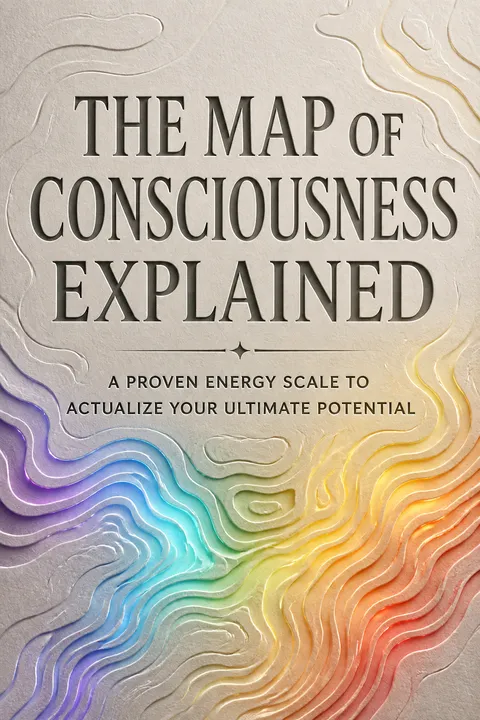
A scale for inner life. Psychiatrist David Hawkins developed the Map of Consciousness to connect emotions, beliefs, and behavior with stages of spiritual development. Its scale runs from 1 to 1,000 and is logarithmic, meaning that each step upward represents a claimed increase in energetic power, not a simple arithmetic increment. Hawkins proposed muscle testing as a way to assign these numbers: a person’s arm supposedly stays strong when considering truth and weakens when considering falsehood. He described the Map as a practical guide to experience, not a moral ranking of people.
The story behind it. Hawkins traced his project to decades of psychiatric work and a profound spiritual experience during a life-threatening illness. He sought a framework that could make inner change intelligible to both spiritual seekers and scientifically minded readers. The scale’s central thresholds are Courage at 200 and Love at 500.
The Map’s appeal lies in its compactness: it gives readers a vocabulary for shifts they may already recognize, such as moving from paralysis toward action or from resentment toward care. Its numbers, however, should not be mistaken for validated psychological measurements. Muscle testing has not established a reliable way to detect universal truth or quantify a person’s consciousness. The framework is most useful as a reflective prompt: What state am I acting from, and what would a more constructive response look like? That practical question survives even if the proposed measurement system does not.
Cross the Courage threshold by replacing blame with responsible action.
The turning point. In Hawkins’s model, levels below Courage, marked 200, are dominated by force and constriction; above it, people become more able to act with integrity and contribute. The levels below 200 include Shame, Guilt, Apathy, Grief, Fear, Desire, Anger, and Pride. Above Courage come Neutrality, Willingness, Acceptance, Reason, Love, Joy, Peace, and Enlightenment. These are broad patterns, not fixed personality labels. A person may show Courage at work but feel Fear in a relationship.
One scene, many lenses. Hawkins asks readers to imagine an unhoused man on a city street. One observer sees a threat, another a tragedy, another a neighbor worth helping. The man has not changed; the observer’s emotional and moral lens has. The Map’s practical use is noticing that lens and choosing a more capable response.
The threshold is memorable because it translates growth into a behavioral test: stop making other people the sole authors of one’s choices. In psychology, an internal sense of agency is associated with persistence and problem-solving, while learned helplessness can shrink both. Yet responsibility must not become blame. Poverty, illness, trauma, and discrimination are not simply products of someone’s mindset. The street-corner example works best when it expands compassion for both observer and observed, while still recognizing that social conditions can demand material solutions.
Treat emotional states as lenses, not permanent identities.
A changing landscape. Hawkins presents the levels as attractor patterns, meaning recurring arrangements of emotion and perception that tend to organize behavior. He cautions that the journey is not a tidy climb. Grief can follow a death, anger can surface during conflict, and fear can return even for someone usually able to act with courage. A person’s overall pattern matters more than a single difficult moment.
From judgment to curiosity. At each level, the same situation can appear to have a different meaning. Someone in Grief may see only what has been lost; someone in Acceptance may be able to consider what can be done now. The Map invites readers to ask which emotion is shaping their interpretation, rather than deciding that a passing feeling defines their character or their future.
This distinction resembles a useful idea in cognitive therapy: thoughts and feelings influence interpretation, but noticing them creates room to respond rather than react. It also guards against turning the Map into a status ladder. Hawkins explicitly warns that claiming to occupy a lofty level can become spiritual vanity. A further safeguard is to treat the categories as provisional descriptions, not diagnoses. Grief, anger, and fear can be proportionate responses to real events. Growth is not the absence of those emotions; it can mean feeling them without letting them dictate every next move.
Build influence through life-serving principles, not forceful control.
Start with the source. Hawkins calls the inner organizing principle behind an endeavor its “ABC ”: the intention and values that shape outward results. He argues that durable success comes from serving something beyond personal status or gain. His model moves from having, where possessions signal worth, through doing, where achievement defines it, toward being, where presence and service matter more than titles.
Make value visible. A patient who loved crafting dollhouses had been miserable in a prestigious career. After trying to sell his work, he found customers and built a business around something he enjoyed that also brought delight to children. Hawkins’s broader guidance is to choose work that is enjoyable, genuinely useful, thoughtfully presented, dependable, and fair to the people it touches. Courtesy, honest quality, and sharing credit help create trust more reliably than aggressive self-promotion.
The dollhouse story makes a sound point about the overlap between intrinsic motivation and public value. Enjoyment alone does not guarantee a viable business, and demand alone may not make work fulfilling, but combining personal commitment with a real need can sustain effort. Modern organizational research similarly treats trust and reliability as assets built through repeated behavior, not slogans. Hawkins’s language of an inner field doing the work is metaphysical; a grounded interpretation is that values guide decisions, shape reputation, and influence how others choose to respond.
Let beliefs shape coping, but never mistake mindset for medical cure.
Mind and body interact. Hawkins argues that beliefs and emotions can influence bodily experience. He points to placebo effects, hypnosis, laughter, and changes in symptoms associated with different mental states. He urges readers to notice sensations without immediately turning them into catastrophic stories, and to approach illness with self-compassion rather than shame. His self-healing method involves attending to the felt experience, easing resistance, and reconsidering fearful assumptions.
Keep care in view. The book also acknowledges that depression may require professional treatment, medication, and close supervision. That qualification matters because some of its stronger claims suggest that disease is created or sustained by belief, or that changing belief can make a person immune to illness. Those claims are not established medical facts. The reflective practices may support coping, but they should not replace diagnosis, prescribed treatment, or urgent help.
The useful insight is that expectation, stress, attention, and social support can affect how symptoms are experienced and how people engage with care. Placebo research supports limited effects on subjective symptoms, not a general power to erase disease through belief. The distinction is crucial: a patient can benefit from agency without being made responsible for becoming ill. Advice to dismiss allergies, infections, or chronic conditions as mental programming could be dangerous. A safe reading keeps the compassion and reflective attention while rejecting any implication that medical conditions are failures of consciousness.
Recover by replacing the borrowed high with a shared source of support.
The feeling beneath the habit. Hawkins interprets addiction as an attempt to reach peace, relief, or joy through an external substance. In his account, the substance temporarily suppresses painful states, but the relief fades and leaves consequences behind. The film Lost Horizon supplies his metaphor: a traveler who has tasted an idyllic refuge risks everything to return, not realizing that the refuge he seeks is an inner state.
Recovery needs company. Hawkins connects the Twelve Steps to a progression from admitting loss of control, through honesty and repair, to spiritual practice and helping others. He emphasizes that recovery groups offer belonging and sustained support, not merely advice. In his framework, Courage begins when a person tells the truth about the problem. The process is not a test of willpower alone; it involves other people, practical help, and repeated choices that make sobriety possible.
The strongest practical point is social: recovery is more durable when a person has a community, accountability, and a way to contribute. Peer groups can interrupt isolation and offer models of change that a person may not yet believe are possible. The book’s spiritual account of addiction can reduce shame by treating the search for relief as understandable. Still, addiction also involves biology, withdrawal, access, trauma, and social context. Framing it only as a quest for higher consciousness risks understating those forces. Peer support can complement evidence-based treatment, not substitute for it.
Find the payoff behind resistance, then practice letting it go.
Resistance has a reward. Hawkins suggests that habits persist partly because they provide some benefit, even when they also cause harm. He calls the ego’s seeking, judging, and claiming of experience the “experiencer.” To move past a stuck pattern, he recommends identifying what it delivers: avoiding embarrassment, feeling morally right, or staying with the familiar. One example involves a man who believed he could not dance. When he stopped resisting and focused on his partner’s movement, he began to enjoy dancing and felt freer in other parts of life.
Notice before forcing. Hawkins also recommends observing a repetitive behavior instead of attacking it with guilt or willpower. His example is counting how many cookies one eats each day. The point is to bring attention to the pattern before demanding instant change. In his account, surrender means loosening the grip of fear, pride, and control so that a more flexible response can emerge.
Looking for a behavior’s payoff is a practical form of functional analysis, a method used in behavioral therapy to identify what triggers and reinforces an action. The dance story dramatizes how reduced self-monitoring can free performance, much as musicians and athletes describe entering a state of flow. The idea of surrender can be helpful when it means accepting a feeling without obeying it. It becomes less useful if it means passivity toward abuse or avoidable harm. Awareness is not magic, but it can expose the function a habit serves and reveal alternatives.
Choose spiritual teachers by integrity and freedom, not charisma.
Look past the spectacle. Hawkins offers a checklist for assessing teachers and teachings. In his account, trustworthy guidance is inclusive, transparent, noncoercive, and not built around a leader’s wealth, status, or control of followers. Students should be free to leave, and spiritual authority should not depend on secret formulas, theatrical displays, or demands about private life.
Match guidance to need. Hawkins says no single teaching suits everyone, and a lofty-sounding doctrine is not necessarily the most useful one for a particular person. His advice is to distinguish spiritual insight from paranormal claims or marketed promises of instant transformation. That warning fits the book’s own emphasis on humility: spiritual vocabulary can become another way to feel superior. The safest starting point is to ask whether a group supports honesty, autonomy, and care for others.
This section offers a valuable abuse-prevention framework. High-control groups often use isolation, escalating commitments, personal adulation, and penalties for dissent; transparency and freedom to leave are meaningful safeguards. The checklist is stronger when applied to observable conduct rather than a numerical calibration system. No muscle test can reliably certify a teacher’s moral character. Nor does a calm presentation prove integrity. Independent relationships, clear financial practices, accountability, and permission to question are more practical signals than charisma, titles, or claims of extraordinary powers.
Practice kindness as a daily discipline, not a claim of enlightenment.
The path begins ordinarily. Hawkins describes dramatic mystical experiences, including a childhood moment of overwhelming love during a winter storm and a later spiritual crisis that changed his sense of self. Yet the practical direction he draws is less spectacular: cultivate kindness, humility, forgiveness, and service in everyday life. He encourages readers to make ordinary tasks expressions of care, to notice beauty, and to release the need to be right.
Aim at the work, not the rank. In the book’s highest stages, Peace and Enlightenment describe a diminishing sense of separation between self and world. Hawkins insists that such states cannot be claimed just by reading about them. The ordinary reader’s task is not to announce a level or imitate a mystic’s behavior, but to practice the qualities that reduce cruelty and self-absorption. For him, spiritual progress is less an achievement than a gradual clearing of what blocks love.
The narrative of Hawkins’s spiritual life gives the abstract Map an experiential anchor, while the everyday practices keep the book from being only a theory of rare states. Its best ethical test is simple: does a claimed insight make someone more compassionate, honest, and responsible? Mystical experience alone cannot establish that a person’s interpretation is true, and intense states can have many causes. The book is most persuasive when it treats kindness as a discipline open to anyone, rather than using extraordinary experience or spiritual rank as proof of authority.
Analysis
The book is best read as a spiritual and self-help synthesis, not as a validated scientific account of consciousness. Its architecture is unusually broad: Hawkins moves from a numbered map of emotion and behavior into health, work, addiction recovery, and the claims of mystical experience. The recurring practical thread is that people can notice what is driving them, take responsibility where possible, and act with more honesty, compassion, and steadiness. The scale gives that thread a memorable image, especially at Courage, where the model places the transition from helplessness to agency.
The central tension is that an evocative metaphor is presented as a measurement system. Hawkins attributes precise values to people, ideas, and societies, and describes muscle testing as a universal truth detector. Those claims require evidence beyond anecdotal demonstrations and the book’s own calibration procedure. The model also risks turning hardship into a moral verdict: if consciousness determines experience, it can seem that victims caused their own suffering. A careful reading rejects that inference. Circumstances, biology, institutions, and chance matter, even when personal interpretation affects coping.
The book’s most durable contributions do not depend on accepting its metaphysics. Its account of addiction highlights the search for relief and the importance of supportive communities. Its advice on success values usefulness, reliability, and respect over image. Its teacher checklist puts autonomy and noncoercion ahead of charisma. Its spiritual practice favors humility over self-congratulation. These ideas can be tested in daily relationships without accepting claims about logarithmic energy fields or universal consciousness. Read the Map as a reflective vocabulary, retain its humane practices, and treat its numerical and medical claims with skepticism.
Review Summary
The Map of Consciousness Explained receives mixed reviews. Some readers find it life-changing and insightful, praising its approach to spiritual development and consciousness levels. Others criticize it as pseudoscientific, lacking empirical evidence, and oversimplified. Supporters appreciate the book's framework for personal growth and understanding emotions, while critics argue it's delusional and not scientifically supported. Many reviewers note that the book's concepts may be challenging for some readers to grasp, and its effectiveness may depend on one's openness to spiritual ideas.
People Also Read







Glossary
Map of Consciousness
Scale of emotional and spiritual statesHawkins’s chart of levels from 1 to 1,000, associating each level with characteristic emotions, self-views, views of life, and patterns of behavior. It places Courage at 200 as a dividing point between force and power, and Love at 500 as a gateway to spiritual experience. The scale is the book’s organizing model, not an independently validated psychological measure.
Consciousness calibration
Muscle-test-based ratingHawkins’s term for assigning a numerical level on the Map of Consciousness to a person, statement, object, or other subject. The method uses a manual muscle test, interpreting a strong response as truth or a level above 200 and a weak response as falsehood or a lower level. The claimed ability to detect universal truth or consciousness is not scientifically established.
Attractor pattern
Recurring organizing fieldA pattern that Hawkins proposes organizes experience and behavior beneath visible events. He draws on nonlinear dynamics terminology to argue that recurring states such as fear, anger, or love shape how people interpret situations and act. In his framework, patterns differ in power and can influence weaker patterns. The book extends this idea beyond its established mathematical uses into spiritual and psychological claims.
Fields of dominance
Stronger patterns influencing weaker onesHawkins’s term for the proposed influence of a more powerful attractor pattern over a weaker one. He compares it to a large magnetic field affecting a smaller field and uses it to explain why love, integrity, or courage can counter patterns such as fear or resentment. The concept functions as a spiritual explanation in the book, rather than a demonstrated mechanism for social or clinical change.
ABC of success
Inner principles behind outcomesHawkins’s label for the underlying intention and organizing values that shape a person’s outward work and results. He argues that success is more durable when it begins with a purpose that serves others, aligns with work one enjoys, and is expressed through usefulness, quality, reliability, and generosity. The ABC refers to the inner source of the endeavor, in contrast with its visible outcomes.
Experiencer
Ego’s interpreting functionHawkins’s name for the ego’s rapid process of evaluating experience for benefit, threat, familiarity, and personal payoff. He describes it as the part that claims ownership of thoughts and actions and interprets events through personal preferences. In his spiritual framework, letting go of identification with this function helps loosen rigid habits and opens awareness beyond the separate self.
Entrainment
Alignment with a repeated patternHawkins uses entrainment to describe how people can be influenced by the emotional and behavioral patterns around them. He compares it to synchronization in physical systems and applies it to recovery groups, spiritual communities, and exposure to media or music. In practical terms, it emphasizes that company and environment can reinforce habits, though the book’s claims about measurable energy transfer are not established.
FAQ
What's The Map of Consciousness Explained about?
- Understanding Consciousness Levels: The book introduces a scale from 0 to 1,000 to measure human consciousness, linking each level to specific emotional states and behaviors.
- Practical Applications: It provides ways to apply the Map in daily life to improve health, happiness, and success, emphasizing spiritual growth.
- Spiritual Evolution: The journey from lower states like Shame to higher states like Love is discussed as a path to realizing one's ultimate potential.
Why should I read The Map of Consciousness Explained?
- Transformative Insights: Gain insights into your consciousness and the factors affecting your emotional and spiritual states.
- Practical Tools: Learn techniques for overcoming negative emotions and achieving higher consciousness, including self-healing methods.
- Universal Appeal: The concepts are applicable to everyone, regardless of spiritual beliefs, fostering understanding and compassion.
What are the key takeaways of The Map of Consciousness Explained?
- Levels of Consciousness: Each level has distinct characteristics and emotional states, helping individuals identify their current state and how to progress.
- Power vs. Force: True power comes from higher consciousness levels, while force leads to conflict and suffering.
- Self-Responsibility: Emphasizes taking responsibility for one's consciousness and actions for personal growth and positive influence.
What are the best quotes from The Map of Consciousness Explained and what do they mean?
- “What we hold in mind tends to manifest.”: Highlights the power of intention and thought in shaping reality.
- “Love brings up its opposite.”: Suggests that pursuing love uncovers fears and negative emotions, encouraging healing.
- “The body obeys the mind.”: Illustrates the connection between mental beliefs and physical health, promoting positive thoughts.
What is the Map of Consciousness and how does it work?
- Calibration Scale: A logarithmic scale from 0 to 1,000, with each level representing a specific energy field and emotional state.
- Muscle Testing Method: Uses muscle testing to determine consciousness levels, discerning truth from falsehood based on body response.
- Attractor Patterns: Each level has patterns influencing behavior and perception, with higher levels linked to positive energies.
How can I apply the principles from The Map of Consciousness Explained to my life?
- Self-Reflection: Assess your current consciousness level and identify areas of lower energy states for growth.
- Letting Go of Negativity: Release negative emotions and beliefs to access love and joy.
- Aligning with Higher Principles: Focus on intentions and actions aligned with higher consciousness levels for fulfilling relationships and purpose.
What is the significance of the critical level of 200 in the Map of Consciousness?
- Transition Point: Level 200 marks the shift from negative energy (force) to positive energy (power).
- Empowerment: Crossing this threshold signifies true empowerment, enabling courage and integrity.
- Collective Impact: Individuals above level 200 can counterbalance negativity, highlighting the importance of raising consciousness for collective good.
How does intention play a role in The Map of Consciousness Explained?
- Power of Intention: Intention drives personal transformation and spiritual growth, aligning with higher consciousness levels for positive outcomes.
- Manifestation: Our intentions shape reality, emphasizing the cultivation of positive thoughts and desires.
- Spiritual Practice: Intention is linked to practices like meditation, helping connect with higher selves and universal principles.
How does The Map of Consciousness Explained relate to addiction recovery?
- Understanding Addiction: Addiction is seen as a search for higher consciousness, often through substances.
- Twelve Steps Connection: The Map's principles align with the Twelve Steps, emphasizing personal responsibility and community support.
- Healing Through Love: True healing comes from aligning with love and compassion, facilitating recovery and lasting change.
What are the emotional states associated with different levels of consciousness in The Map of Consciousness Explained?
- Emotional Correlates: Levels are linked to emotions like Shame (20) and Love (500), helping identify current states and work toward higher levels.
- Impact on Behavior: Lower levels lead to destructive behaviors, while higher levels promote positive actions and relationships.
- Pathway to Growth: Recognizing and addressing emotions tied to current levels aids in elevating consciousness.
What is the process of letting go as described in The Map of Consciousness Explained?
- Surrendering Control: Letting go involves accepting life as it is, leading to peace and acceptance.
- Releasing Negative Emotions: Release negative emotions through practices like meditation and self-reflection.
- Embracing Higher States: Letting go of lower states allows experiencing higher consciousness, such as love and joy.
What is the role of Grace in the journey towards higher consciousness in The Map of Consciousness Explained?
- Divine Assistance: Grace helps transcend limitations and ego, available to those who seek it sincerely.
- Transformative Power: Grace can lead to sudden consciousness transformations, shifting awareness and understanding.
- Support in Surrender: Embracing Grace involves surrendering personal will, facilitating the journey to enlightenment.
About the Author
Other books by David R. Hawkins



Download PDF
Download EPUB
.epub digital book format is ideal for reading ebooks on phones, tablets, and e-readers.








