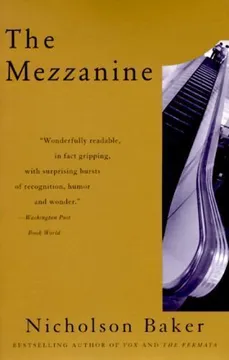


Plot Summary
The Broken Laces
Near one o'clock, Howie carries a paperback and a stapled pharmacy bag toward the mezzanine; inside are replacement laces, bought because both originals failed within a day. The puzzle began at his desk. His untied left shoe slipped off so he could rub his socked foot over the soft carpet. He bent to retie it, greeted three departing colleagues, then pulled hard enough to snap the lace.
The right one had broken the day before. Both belonged to shoes his father gave him when he began his first job two years earlier. Howie knots the damaged ends and studies the coincidence. Perhaps his routine wore the laces evenly, but he cannot know how often either shoe came untied and had to be retied.
The broken lace is a small but exact disturbance: a familiar action ends differently, and Howie cannot leave that difference alone. His attempt to assign wear to repeated habits converts an inconvenience into a problem of evidence. The shoes also link his private routine to his father and first job, so the break carries a faint sense of time passing. Yet his inquiry is not really about footwear alone. It shows how Howie seeks reassurance by making the ordinary measurable, even when the necessary record of his own life has vanished.
Eight Small Graduations
As he repairs the lace, Howie remembers his mother setting a lamp beside him so he could learn to tie shoes, then his father showing him how to tighten each crossing before making the bow. He later invented small refinements of his own.
The memories belong to a private list of life advances that also includes brushing his tongue, discovering that sweeping could lift his mood, and ordering an address stamp to simplify bills. At twenty-three, four months into his office job, he found a way to apply antiperspirant through a single undone shirt button without dressing again.
On the subway, that clever fix made him feel unexpectedly finished as a person. He later calculates that childhood memories may not be outnumbered by adult ones until around forty.
Howie treats development as a series of usable techniques rather than a climb toward some grand, final self. Shoe-tying matters because it begins as instruction, becomes automatic, and eventually acquires his own refinements. His improvised grooming trick carries the same structure into adulthood, but his sudden sense of being finished exposes the anxiety underneath his cataloguing. He wants maturity to be a countable threshold, then invents a future date when adult thought might finally dominate childhood memory. The list is both comic self-portrait and an attempt to give a shape to change.
Flowers for Ray
At Tina's desk, Howie learns that Ray, the building worker who empties office bins, hurt his back moving a toddler's swimming pool for his grandniece. Tina has organized a flower-covered get-well poster, and Howie chooses a discreet place to sign, wary of appearing too close to his manager's name.
Their small talk turns to coincidence: Tina recalls that one household smoke detector failed, then the second failed the following day, although the first was closer to the kitchen and sounded more often.
The comparison gives Howie's paired shoelace failures a new angle. Before returning to her phone duties, Tina points him toward a nearby CVS as a likely source of replacement laces. The conversation supplies both an errand and a second household example of objects failing in pairs.
Tina's poster makes office life visible as more than hierarchy and paperwork. Howie calibrates where to place his signature because even a gesture of sympathy can be read as a social claim. Tina's smoke-detector story then gives his private puzzle a companion without solving it. Their exchange depends on practical intimacy: they share observations that would be too small to count as formal conversation, yet useful enough to be remembered. Ray's injury also shows the hidden labor supporting the office's polished routines, a fact Howie notices most clearly when that labor is interrupted.
The Restroom Laboratory
In the corporate bathroom, Howie stalls at a urinal beside Don Vanci, embarrassed by the possibility that a colleague will hear him fail to urinate. He uses a mental trick learned in a crowded theater restroom, imagining an absurdly forceful stream aimed at the other man, and his body finally cooperates.
At the sinks, washing his face with warm paper towels brings the shoelace question back into focus. He compares the shoes: both repaired laces broke at the left top eyelet.
That matching side points toward the unequal pulls of his hands while tying, not the symmetrical flexing of his feet as he walks. His manager, Abelardo, appears and answers the puzzle with a deliberately ridiculous story about custom-imported laces. Howie recognizes the joke and leaves with a provisional explanation.
The bathroom concentrates Howie's conflict between bodily privacy and the social fact of sharing space. His solution to the urinal pause is not confidence but an elaborate act of imagination that lets him bypass self-consciousness. The same room then becomes a place of genuine observation: warmth interrupts his train of thought, and the shoes supply a concrete test. The result is useful but limited. Howie can identify the more likely source of wear, yet he still cannot reconstruct how often each lace was pulled or retied. His reasoning advances without granting him complete control.
A Pharmacy Bag
Outside, Howie buys popcorn from a street vendor and reaches the CVS, where the shoelaces hang in the cleaners aisle beside shoe polish. He counts five pairs of eyelets and selects the corresponding length, then joins the line of the cashier whose practiced movements he trusts to be fastest.
On the walk back, he eats a hot dog and buys a large chocolate-chip cookie. The cookie makes him want milk, so at Papa Gino's he asks the clerk, Donna, for a small bag around the carton. It is not only discretion or courtesy.
With the book, cookie bag, and pharmacy bag already in hand, the milk bag lets him gather everything together while leaving one hand free to touch railings and street fixtures. Donna's initially uncertain bagging becomes part of the day's small social choreography.
The errand gathers several of Howie's habits into one practical decision. He selects a cashier by watching her technique, matches lace length to eyelets, and arranges his food and book so that walking remains comfortable. Asking for a bag also revises an older pose: he once refused bags to signal that he had nothing to hide, but now accepts the convention because it helps him move through the city. The purchase is mundane, yet it shows how personal identity is built through repeated adjustments between bodily preference, public etiquette, and the objects available.
Aurelius at Lunch
On a green bench in the sun, Howie opens the Penguin paperback he has carried through lunch: Marcus Aurelius's Meditations. A passage reducing mortal life to decay strikes him as false and needlessly bleak.
He takes alternating bites of cookie and sips of cold milk, enjoying the ordinary combination rather than submitting to the emperor's severity. The line that first attracted him to the book had promised that any condition of life could support philosophy, so he turns the claim toward his own afternoon.
Instead of defining himself by a grand belief, he tries to estimate how often particular thoughts recur. He compares his own mental loops with L.'s remembered riddles and favorite images, and sees that even an intimate partner carries a largely separate inventory of recurring thoughts.
The bench gives philosophy a test it can actually fail: Aurelius's severity meets a man enjoying milk, cookie, warmth, and a few minutes away from work. Howie does not reject reflection; he rejects the idea that reflection must begin by despising ordinary life. His proposed frequency chart seems scientific, but its deeper purpose is relational. He wants to know what a person is made of when broad labels such as beliefs and personality prove too coarse. The contrast with L. matters because familiarity does not erase the private architecture of another mind.
Bob, the Rail, the Ride
Back in the lobby, Howie spots Bob Leary, an office acquaintance he has never properly met, approaching on the opposite escalator. Rather than endure the brief, awkward recognition they both know is overdue, he circles the lobby and passes the mailroom staff.
At the escalator's base, a maintenance worker presses a cloth against the moving rubber rail so the mechanism polishes it for him. Howie asks after Ray and learns the injury may not be serious, though the substitute worker is slower.
He finally boards, standing still rather than climbing. A year of daily rides has softened his old belief that passengers should walk. He watches sunlight travel across the lobby and, at the top, sees a cigarette butt tumble against the comb plate before waving to the worker below.
Howie's detour around Bob is a small act of avoidance, but it clarifies how much social life depends on gestures people postpone until they become conspicuous. The maintenance worker offers a counterpoint: his task is repetitive, public, and quietly skilled, while Howie's attention makes that labor newly legible. The escalator itself has changed in Howie's mind. Repeated use has loosened his certainty about how it ought to be ridden, allowing stillness to become a chosen pleasure rather than a failure of effort. The closing wave turns observation into a modest human acknowledgment.
Nostalgia Loses Its Claim
Years later, after leaving the mezzanine job, Howie drives behind a green truck hauling compressed garbage. Against the clear sky, its rust, paint, canvas cover, and taut straps bring back a childhood discovery: rough objects look newly significant when placed against a clean background.
He decides that the insight still belongs to his adult mind, not merely to a sentimental past. His reflections on milk follow a similar path. He remembers glass bottles delivered to his family's home, then the gradual changes in dairies, containers, and schedules until home delivery ended and supermarket cartons took over.
His parents continued the service even as it became inconvenient, partly out of habit and attachment. Howie sees how easily remembered details turn a history of changing systems into a story colored by loss.
The garbage truck lets Howie separate the persistence of a childhood perception from the sentimentality that can distort it. He does not disown the past; he questions the assumption that an idea matters only because it began there. The milk-delivery history makes the problem more difficult. A service can vanish through mergers, new packaging, and changing routines without one clean moment of loss, yet personal memory supplies exactly that kind of emotional center. Howie's attention preserves the material sequence while admitting that memory cannot keep history free of affection.
The Shoelace Researcher
Long after the lunch-hour inquiry, Howie encounters technical writing about the deterioration of ropes and follows it toward textile research. He learns that rope behavior cannot simply explain the wear of woven shoelaces, then searches further and finds an abstract for a Polish study describing machines that test lace abrasion and knot slippage.
The discovery does not reveal exactly why his two laces failed at matching eyelets, nor does it settle the competing effects of hand-pulling and walking.
It does something smaller and more satisfying: it shows that another person has made the same unglamorous question an object of sustained study. Howie's private puzzlement can now join a body of work, and he leaves the library relieved that the problem has not been abandoned.
The final satisfaction is not a definitive answer but the discovery that curiosity can outlive its original occasion. Howie had treated the snapped laces as a problem his own limited memory could not fully resolve. The technical study confirms that the question has dimensions beyond his personal case, while also preserving uncertainty about the exact forces involved. This ending resists the familiar reward of mastery. What comforts Howie is not control over every cause, but the existence of patient work elsewhere, carried out by someone willing to give an ordinary failure serious attention.
Analysis
The Mezzanine builds its narrative from a modest disturbance rather than a conventional conflict. A shoelace breaks, and Howie tries to identify the forces that wore it down. That effort provides a plot spine, but the book's real movement is in how attention travels: from a damaged lace to childhood instruction, from a bathroom routine to workplace etiquette, from a milk carton to the disappearance of home delivery. Each association is concrete enough to feel private and broad enough to reveal a shared material world.
Howie's close observation is neither pure celebration nor simple eccentricity. It gives him pleasure, but it also manages uncertainty. He counts eyelets, estimates recurring thoughts, and studies the sequence of cashier movements because measurement promises a stable edge around experience. The book repeatedly shows where that promise fails. Memory loses the record of thousands of ordinary shoelace ties; a thought chart cannot capture the shifting texture of thought; nostalgia preserves a vanished service while distorting its chronology. The narrator's intelligence is strongest when he recognizes these limits without giving up inquiry.
The office setting makes the supposedly minor socially consequential. Howie worries about where to sign Ray's poster, avoids Bob's gaze, and struggles to urinate beside Don. These scenes show people navigating proximity through tiny rules and rituals. Meanwhile, Ray's work and the maintenance worker's care of the escalator reveal the labor that keeps corporate comfort functioning. The building's clean surfaces are not automatic. Someone empties the bins, replaces supplies, and polishes the rail.
The book's mature claim is that ordinary life need not be justified by grand philosophy or childhood sentiment. Howie can reject Aurelius's harsh judgment of mortal life while still practicing thought on the lunch he actually has. His final relief comes not from solving every cause of lace failure, but from learning that another researcher took the question seriously. Curiosity becomes a form of companionship: a way of joining private attention to the larger, unfinished work of understanding.
Review Summary
People Also Read

Characters
Howie
Microscopic office observerHowie is a young office worker whose attention settles on small operations other people pass without noticing: a bag being opened, a lace wearing through, a machine advancing its parts. He turns these observations into theories, partly from intellectual pleasure and partly to make his own habits feel less arbitrary. His self-scrutiny can be comic and socially cautious, especially when he worries about how a signature, greeting, or bodily sound will be interpreted. At the same time, he is not merely collecting trivia. He wants to understand how memory, work, intimacy, and aging accumulate inside ordinary routines. His defining tension is between the wish to explain experience and the pleasure of letting it remain vivid before it is explained.
L.
Intimate intellectual partnerL. is Howie's beloved partner and an important companion in his domestic and intellectual life. Their conversations range across relationships, cities, habits, and ideas, while their private thought patterns remain distinctly their own. Her everyday routines sometimes teach Howie new ways of doing things, and her memories give him a useful counterpoint to his assumptions about what people share. She is affectionate without being an extension of his mind, a distinction Howie both values and tries to measure.
Tina
Practical mezzanine confidanteTina is a secretary in Howie's department, alert to both office procedure and the minor needs of the people around her. She organizes a get-well poster for Ray and passes along useful information during a conversation that might otherwise have remained routine. Her quick anecdote about two smoke detectors failing close together gives Howie a parallel to his own puzzle. Tina's warmth is practical rather than grand; she sustains workplace connection through small acts of attention.
Abelardo
Manager with comic licenseAbelardo, whom Howie calls Abe, is Howie's manager. His standard exchanges with Howie create a familiar, low-pressure rhythm within the office. Outside business matters, Abelardo enjoys offering elaborate absurdities with a straight face, and Howie understands that humor as part of their working rapport. His presence shows how professional relationships can acquire warmth without becoming intimate.
Ray
Office's invisible infrastructureRay is the building worker responsible for emptying office wastebaskets and restocking bathroom supplies. Howie associates his steady route with the end of the working day and notices the efficiency of his small techniques. Ray's role is mostly practical, but the coworkers' concern for him reveals how much an office depends on labor that usually remains in the background.
Howie's mother
First teacher of techniqueHowie's mother teaches through demonstration and patient repetition. She helps him learn to tie his shoes and encourages the explanatory, material way of thinking that he later carries into adulthood. Her reassurance about aging brain cells also gives him a model for interpreting change as connection rather than simple loss.
Howie's father
Practical craft mentorHowie's father contributes hands-on instruction, including a careful method for tightening shoelaces, and buys the dress shoes that later become part of Howie's working life. He represents a practical inheritance: skills and objects passed between generations, then quietly absorbed into a child's habits.
Sue
Colleague who sweeps to copeSue is one of Howie's colleagues. Her practice of cleaning her apartment when depressed gives him an unexpected example of action changing mood. Howie's later discovery that sweeping can make him cheerful becomes one of the personal advances through which he measures adult life.
Bob Leary
Unintroduced office acquaintanceBob Leary works in the same large company as Howie. Their names and faces are familiar from office documents and corridors, but they have not performed the small social ritual that would make them acquaintances. His presence exposes Howie's unease about brief, obligatory encounters.
The maintenance worker
Caretaker of moving partsThe unnamed maintenance worker temporarily covers Ray's duties and polishes the escalator handrail by letting its movement do the work. He speaks plainly about Ray and the demands of the job. Howie's interest in his technique makes him a vivid example of skilled labor hidden inside a polished office building.
Don Vanci
Coworker at the urinalsDon is a colleague whose arrival at a nearby urinal intensifies Howie's self-consciousness in the corporate bathroom. Their ordinary silence becomes, for Howie, a test of whether he can act naturally under observation.
Les Guster
Toothbrush-carrying vice-presidentLes is a vice-president whom Howie sees brushing his teeth at work. His mundane, slightly private routine makes Howie consider how business decorum follows people even into the bathroom, where colleagues try to preserve small boundaries without acknowledging one another.
Donna
Milk counter clerkDonna works at the Papa Gino's counter and is still learning the rhythms of service. Howie notices her uncertainty as she opens a bag for his milk, treating the brief exchange as part of the social meaning carried by ordinary packaging.
Plot Devices
The paired shoelaces
Small failure, large inquiryThe two laces fail within a day, giving Howie a concrete problem to revisit throughout the lunch hour. Their matching break positions let him test whether repeated hand-pulls or the motion of walking caused more wear. The evidence favors hand-pulling, though it cannot reconstruct every retie or settle the full question. The laces connect his present routine with childhood instruction, his father, and a later encounter with textile research. Their significance lies in how a trivial object invites a genuine method of inquiry. The device includes a result, so it contains a spoiler.
The escalator
Machine as memory frameThe escalator carries Howie between lobby and office while giving the book a recurring structure for observation. Its moving steps prompt memories of childhood transport systems, safety rules, and changing habits. Daily rides gradually change Howie's attitude: he once believed passengers should climb, but eventually finds pleasure in standing still. The maintenance worker's polishing of the handrail makes the machine's upkeep visible. The escalator therefore joins physical movement to mental movement without turning either into a simple symbol.
Everyday objects
Memory's material triggersBags, milk cartons, paper towels, vending machines, and office tools trigger memories that are both personal and historical. Howie uses them to track changes in design, work, and domestic custom, such as the shift from delivered glass milk bottles to supermarket cartons. Their small differences resist broad, abstract accounts of the past. At the same time, each object risks pulling memory toward nostalgia, which Howie learns to question. The device lets the story make material culture intimate without pretending that one person's recollections provide a complete history.
Thought periodicity
A map of recurring attentionHowie imagines measuring how often particular thoughts return, from concerns about L. and work to vending machines and shoelaces. The chart promises a more truthful portrait than a list of stated beliefs because it tracks the mind in motion. Yet he soon recognizes that thoughts are difficult to name, classify, and compare. The exercise still clarifies a central point: people who know each other well can carry very different private inventories. The proposed measure is deliberately imperfect, revealing both Howie's analytical drive and its limits.
About the Author
Other books by Nicholson Baker

Download PDF
Download EPUB
.epub digital book format is ideal for reading ebooks on phones, tablets, and e-readers.








