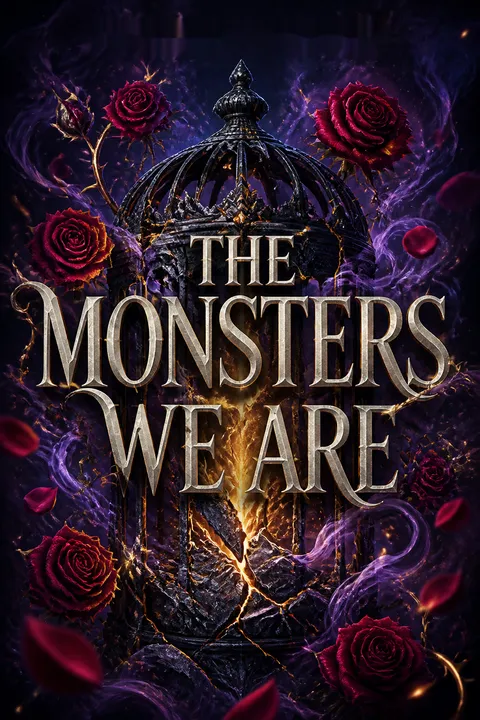


Plot Summary
Adam's Face in the Clouds
At a Halloween party, Wynter Dellavale, a revenant witch, celebrates with her newly formed Bloodrose Coven and her lover Cain, one of Devil's Cradle's seven Ancient rulers. A face appears in the clouds: Adam, the last ruling Aeon, demands that Wynter and Cain surrender to him. He blames Wynter for cursing Aeon's land and threatens to punish the town until they comply.
His million-dollar bounty gives residents a second reason to consider betraying them. Cain recognizes the ultimatum as a trap, not a peace offer. The Ancients are imprisoned inside Devil's Cradle by a barrier made with their own blood, and Adam hopes that fear and greed will turn their sanctuary against its protectors.
The threat is designed to make a refuge police itself. Adam cannot simply seize Wynter or Cain, so he makes their neighbors imagine that safety depends on their surrender. His rhetoric casts coercion as fairness, while the bounty translates that argument into a personal temptation. The scene also establishes the novel's central tension: Wynter and Cain are both powerful and vulnerable, not because they lack force, but because their attachment gives their enemies leverage. The Halloween setting makes the demand feel grotesquely apt: monsters are gathered to celebrate, then a political monster addresses them from the sky.
No Surrender to Adam
At a meeting of the Ancients, Cain and the others see the bounty as part of Adam's strategy to shrink their population before attacking. They discuss a riskier answer: use All Hallows' Eve, when their power peaks, to pierce the invisible prison. Seth proposes waking Abaddon, an Ancient who has been in a coma-like Rest since the old war. The next morning, Cain speaks to Devil's Cradle's residents.
He admits that Wynter cursed Aeon after its rulers condemned her mother and tried to kill her, but argues that surrender would leave the town weaker, not safer. He pledges to defend the people in his service and warns that anyone who targets Wynter will face her, her monster, or him. The crowd's anger shifts from suspicion toward resistance.
Cain's speech is both disclosure and strategy. By admitting Wynter's role in the curse, he deprives Adam of a secret that could be used to divide the town, then places that act in the context of Aeon's violence. His appeal is not that Wynter is innocent, but that the town should judge the whole chain of cause and consequence. This is a distinct form of leadership from command by fear: Cain still threatens traitors, yet he gives residents a reason to stay beyond obedience. The proposed escape plan also marks a shift from surviving inside the prison to imagining life beyond it.
A Table of Enemies
At dinner in Seth's Keep, Wynter meets Eve, Adam's former consort, and Eve's grandchildren Noah and Rima, both Aeons. Rima challenges Wynter's dark magic and questions the Ancients' plan to attack Aeon. Noah is more curious than hostile, and Eve apologizes for her earlier failure to protect Cain. When Cain explains that Abaddon might help fracture the prison, Eve volunteers her power.
Noah follows, despite Rima's fear that the war will destroy the only home she has known. Wynter recognizes that Rima's resistance is rooted in grief for her mother, who suffered under Adam and Abel. By acknowledging that loss rather than treating it as an excuse, Wynter helps soften Rima's position, though Rima does not yet promise to fight.
The dinner turns a strategic question into a family conflict. Eve's offer matters because she had remained neutral while Cain and the Ancients were imprisoned; helping now means accepting responsibility for a past she could not undo. Noah's decision is practical, but it also separates him from Adam's authority. Rima's refusal, meanwhile, is not simple loyalty to the Aeons. Her attachment to Aeon is entwined with memories of her mother, so destroying the place feels like another loss. Wynter's response shows her capacity to recognize pain without excusing cruelty, a skill that distinguishes her from the old rulers who treated suffering as a license to dominate.
The Bonfire's Bloody Warning
The Ancients gather at Cain's temple and pour their power into the hot spring where Abaddon Rests, but repeated attempts do not wake him. At a crowded Halloween maze, members of the Oasis Coven drug Wynter and drag her toward a waiting car, hoping to collect Adam's bounty and avenge their former Priestess, Demetria.
Wynter waits until the attackers are away from the crowd, then lets her inner monster take control. It tears the witches apart. Her coven finds her alive among the remains, and Wynter refuses to hide what happened.
They carry a severed head back to the bonfire and throw the bodies into the flames, making the danger of approaching her unmistakable. Cain is furious, but Wynter insists that fear will protect her better than guards.
The failed attempt to wake Abaddon is answered by a very different kind of force: Wynter's monster does not negotiate, restrain, or seek recognition. Its violence protects her, but it also leaves her to manage the social consequences of being feared. Her choice to display the evidence is not merely bravado. Because her revenant nature is doubted, the spectacle supplies proof that ordinary threats cannot contain her. The scene also exposes the price of Cain's protective instinct. Guards would signal that Wynter is vulnerable and dependent, while she believes that demonstrating her danger will deter opportunists. Their disagreement is a conflict over strategy, not affection.
The Town Under Snow
A week after the first attack, Adam's message turns into a sudden blizzard. Wind, snow, and hail batter Devil's Cradle, injuring Wynter and her coven as they struggle to reach shelter. Cain counters the storm with power of his own, transforming the hostile elements into a swarm that sweeps away over the mountains.
Soon afterward, Adam offers the Ancients a bargain: hand over Cain and Wynter, and he will leave the others alive. The Ancients reject it, knowing Adam would still seek revenge for his son Abel and that surrender would make them easier to destroy. Wynter sees the weather attacks as proof that Adam is already making war by proxy. She tells Cain she will join the eventual assault on Aeon, refusing to be left behind.
The storm makes Adam's threat bodily. Residents do not have to believe his words to feel the force of his politics in their skin, and Cain's intervention demonstrates both the scale of the danger and the limits of deterrence: he can stop one assault, not prevent the next. Adam's offer repeats the same false choice as his bounty, presenting betrayal as a route to safety. Wynter's insistence on joining the counterattack answers that logic with agency. She will not be protected by being removed from the struggle, especially when Cain himself refuses to withdraw.
Iron Sends Her Away
While working in her weapons shop, Wynter is teleported to open country by Shelia, an aide to the Ancient Ishtar. Four vampires wait with a gun loaded with iron bullets, which can weaken a revenant. Wynter fights back, but Claud shoots her in the head. Her soul reaches the netherworld, where the goddess Kali explains that Wynter's revenant nature and purpose are more complicated than she knew.
Kali says the bullet cannot permanently kill her and reveals that Wynter is bound to this realm by a purpose, as well as by Cain. Wynter returns to her body, kills the vampires, and begins the long journey home in their vehicle. When she runs out of fuel, she walks until a dragon shifter finds her and carries her back to Cain.
The bullet converts a political threat into a confrontation with the limits of Wynter's own knowledge. Her return is not simply another display of toughness: the netherworld scene makes clear that she has been living inside a design whose terms she does not fully understand. Kali's explanation offers reassurance, but it also sharpens the unease by confirming that Wynter serves a purpose chosen by a deity. Her physical journey home restores choice at ground level. After being moved like an object by Shelia and the vampires, she refuses to wait passively for rescue and keeps walking until she can return to the people she chose.
Shelia's Last Payment
Back in Devil's Cradle, Wynter identifies Shelia as the person who delivered her to the vampires. Ishtar initially doubts the accusation, but when Shelia arrives she recognizes that her aide is lying.
Ishtar permits a public punishment, though Cain insists that he will deliver the killing blow because Shelia nearly cost Wynter her life. Ishtar tortures her with power before Cain transforms that power into bees that swarm and kill her.
The execution warns residents that helping Adam carries consequences, but it also shows Wynter the full severity of Cain's vengeance. Rather than recoil, she takes his hand and goes home with him. Their intimacy remains strong, though Wynter's experience has revealed how dangerous his fear of losing her can become.
The confrontation tests whether loyalty can survive evidence. Ishtar does not absolve her aide to protect her own authority; she recognizes the lie and accepts that betrayal of one Ancient threatens all of them. Cain's insistence on the final blow, however, makes the execution personal. His violence is meant to avenge Wynter, but it also exposes how easily love becomes fused with possession and punishment in his moral world. Wynter's willingness to take his hand does not make his actions harmless or uncomplicated. It shows that intimacy, for them, includes seeing each other's worst capacities without pretending those capacities are virtues.
Sand Over Everything
Adam sends a wall of supernatural sand across Devil's Cradle, trapping Wynter and her coven in the open and leaving several residents dead. Cain and the other Ancients clear the grit and stop the storm, but the damage makes the impending battle impossible to dismiss.
At the Halloween arena, Wynter's coven enters a zombie gauntlet after Xavier signs them up without asking. They fight through the magically animated corpses, each using a distinct strength: Wynter's sword, Delilah's claws, Hattie's crow form, Xavier's blade, and Anabel's deadly focus.
They finish the course together. The contest lets the town see them as a capable unit rather than an unstable collection of fugitives, and it gives Cain another reminder that Wynter is a fighter, not someone he can safely keep behind him.
The sandstorm and the gauntlet place disaster and play side by side. Adam's attack kills people, while the contest turns staged danger into a shared test of competence. That contrast matters: the coven's readiness is not the same as invulnerability, but their coordination gives them a way to act together under pressure. Wynter's role as Priestess is visible in how she keeps the group moving without erasing its members' individual abilities. Cain's difficulty accepting her battlefield agency reflects a protective impulse that can become controlling. The gauntlet gives her, and the audience, concrete evidence that her presence in the coming war will be an asset.
Abaddon Wakes
During another episode of sleepwalking, Wynter follows an unfamiliar voice into the hot spring beneath Cain's temple. She touches the water, and a surge of power passes through her before Abaddon rises from it. Cain recognizes that his uncle has awakened after centuries in a coma-like Rest.
Abaddon is disoriented and grieving, but he controls his rage when he learns that the Aeons imprisoned the Ancients and that the war is not over. Cain later tells the residents that an additional Ancient will fight beside them, presenting Abaddon's long absence as a voluntary Rest rather than a weakness.
The news strengthens Devil's Cradle before the battle. Abaddon, meanwhile, begins learning what has happened since the slaughter that drove him into the spring.
Abaddon's return gives the Ancients a new source of power, but it also restores a witness to the original catastrophe. He wakes into a world where vengeance has advanced without him, and must hold his grief in check long enough to understand the present. Wynter's role in his awakening remains partially obscure even to her, which reinforces the book's tension between chosen action and divine orchestration. Cain's public explanation protects Abaddon's standing, since weakness could invite opportunists. The two approaches to truth differ: privately, the family must face the damage of the past; publicly, leadership carefully controls what the community can safely know.
Deities Behind the War
After Abaddon joins the household, Wynter tells Cain that her monster briefly merged its soul with hers while she touched the spring, helping wake him. She fears the entity might one day pull her beyond Cain's reach, and makes him swear not to confront Kali impulsively. She also reveals that the goddess has kept crucial information from her.
Soon Adam summons them to a psychic meeting and offers to spare Wynter if she will undo Aeon's curse. When that fails, he claims to hold Wynter's unknown father as leverage. She refuses to trade the people of Devil's Cradle for a stranger and reminds Adam that his son Abel condemned her mother to death. Cain recognizes the father's story as a bluff. Adam then raises the bounty to two million dollars.
This section brings the private and political plots together. Wynter does not merely disclose what happened; she anticipates Cain's response and binds him to a promise because she understands that his protective rage could endanger both of them. Her refusal to let Adam define her through an absent father is similarly deliberate. She does not need to prove that she feels nothing; she chooses not to let a manufactured family bond outweigh the people who have actually stood beside her. The deity's withheld knowledge remains ethically troubling, while Adam's false leverage shows how he mistakes intimacy for a weakness he can purchase.
The Bounty Doubles
After Adam doubles the price on Wynter, two fey use a glamor to make her believe Cain and Seth are escorting her home. The illusion carries her through the Keep and toward an elevator, while her monster and Kali's warnings fight to reach her. Wynter finally recognizes the deception, stops the elevator, and lets her monster kill the kidnappers.
Cain questions the fey court and discovers that three members knew of the plot but stayed silent. He and Azazel torture them for their complicity, while Wynter asks Cain not to punish an entire court for the actions of a few. She argues that indiscriminate revenge would make innocent people pay for fear and greed. Cain accepts her reasoning, though he remains furious.
The illusion works by recruiting Wynter's own expectations: the fey do not simply disguise themselves, they make her imagination finish the deception. Her recovery depends on recognizing a mismatch between the people she loves and the emotional truth of the scene. Cain's response then poses a parallel danger. He can punish the guilty with precision, but his anger tempts him to extend punishment to everyone around them. Wynter's intervention is not an appeal to softness; it is an argument about accuracy and responsibility. Her willingness to restrain Cain's power is one of the ways their relationship differs from the coercive alliances that rule Aeon.
The Cage Gives Way
At the Samhain gathering, Cain leaves the feast with Wynter to attempt the prison's breach. Eve and Noah join the seven Ancients, and Rima unexpectedly adds her power as well. Working together, the group focuses their combined strength on one point of the transparent barrier.
Abaddon's power sharpens their attack, and Wynter's dark magic curls around it until the prison's fabric tears open. The Ancients step through for the first time in ages.
Instead of rushing straight to Aeon, they make a plan and prepare an army, with Wynter's knowledge of the current city and its inhabitants. Eve, Noah, and Rima volunteer to take part in the invasion, though the Ancients remain wary of their motives. The breach changes their goal from escape to a deliberate counterattack.
The prison is undone by cooperation among people whose histories give them every reason to distrust one another. The breach does not erase those differences; it makes a shared action possible without requiring instant reconciliation. Wynter's magic matters alongside the Ancients' strength, and the Aeons' contribution matters despite their contested loyalties. This is a counter-image to Adam's divide-and-rule strategy. His power has kept enemies apart; the escape depends on precisely the kind of alliance he assumes cannot hold. Yet the group does not confuse cooperation with trust. Their decision to proceed cautiously reflects hard-won political judgment rather than a sentimental declaration of unity.
Noah Opens the Hidden Door
Two days into the journey to Aeon, Wynter and her coven use themselves as bait to draw the keepers away from the city. They fight the guards, then allow the larger Devil's Cradle force to close in. During the invasion, Noah betrays Wynter and takes her to Adam in the underground city.
There, Adam chains her with iron and tries to force her to reverse the curse. Wynter discovers that Noah knows a hidden entrance, and reveals that she knew Kali had foreseen his betrayal.
She rots the iron collar and the foundations beneath the temple, freeing the long-tortured Baal, Cain's uncle, from beneath it. As the temple collapses, Wynter escapes with Noah's severed head. Baal rises in monstrous form, turning Adam's carefully ordered defense into chaos.
Wynter's apparent defeat is part of a plan, but the cost is real: she must endure capture and trust that events will unfold around her without being able to control every detail. Noah's betrayal confirms that knowledge and kinship do not guarantee allegiance. The hidden door makes the invasion possible, while the temple's foundations conceal a history Adam has tried to bury. By freeing Baal, Wynter transforms the architecture of imprisonment into the source of the enemy's collapse. Her power here is not only destructive. She reads what a structure is hiding, accepts risk, and acts before the people who built it can decide what she is allowed to know.
Adam Burns Away
Baal's fire scatters the Aeons, while the Ancients and Devil's Cradle residents attack across the ruined city. Cain confronts Adam, whose protective shield is weakening, and goads him into lowering it for a duel. They trade elemental attacks until Adam is knocked down and exposed.
Cain lets his inner Leviathan take control, honoring its claim on the vengeance. It burns Adam to death. The fighting leaves Inanna dead, and Ishtar collapses into grief beside her sister.
Wynter's Rephaim emerges during the battle and summons others of its kind, who attack indiscriminately before returning through a portal. Cain and Seth pull Wynter back from its edge. The Aeons are defeated, but victory costs lives, and the Ancients must reckon with the destruction of Aeon and the loss of Inanna.
Cain's victory is both personal and political. He kills the man who made the prison and embodied its logic, yet the moment is not a clean restoration of justice. The Rephaim's indiscriminate violence and Inanna's death make clear that force cannot be perfectly directed once released. Wynter's near-passage through the portal also turns her hidden nature into an immediate risk to the relationship she has built with Cain. Ishtar's grief complicates the triumph further: an enemy's death cannot return a sister. The battle ends Adam's rule, but it does not restore what war has taken, nor does it leave its survivors unchanged.
A Bond Chosen Freely
After the battle, the surviving Ancients burn the fallen with respect, and Wynter stops her curse from spreading further through Aeon's land. The group returns to Devil's Cradle, where Baal is placed in the spring to Rest and recover. Cain admits that he loves Wynter, and she accepts the words without asking him to become gentler or less himself.
Later, after Kali confirms that binding their life-forces will not harm either of them, Wynter agrees to let Cain's monster bite her for the third time. The bond gives the creature its own claim on her. The epilogue finds the pair traveling beyond their home, then considering a return to Devil's Cradle and Wynter's coven. Their freedom is real, but home remains a choice they make.
The ending resolves the emotional question opened by the bounty: whether attachment makes Wynter a hostage or a willing participant in her own life. The bond with Cain's monster is permanent, but Wynter chooses it after seeking knowledge and weighing the risks. That distinction separates commitment from the coercive claims made by Adam and the gods. Cain's admission of love does not erase his possessiveness; instead, the relationship makes room for both his darkness and Wynter's refusal to be controlled by it. The final return toward home also resists the fantasy that freedom requires escape from community. They can travel because the place they built remains theirs to come back to.
Epilogue
In a park far from Devil's Cradle, Khloë Wallis watches her friend Devon struggle to keep her toddler, Anaïs, from grabbing people by the throat. The child is a hellpup with a dangerous streak, and Khloë's teasing only encourages her.
Nearby, Wynter and Cain discuss whether to continue traveling or return to the Keep and the Bloodrose Coven. Cain has little interest in the wider world, while Wynter misses both home and the people who may already be causing trouble there. They walk on together, free to choose their destination, as Anaïs turns her attention back to Khloë.
The epilogue shifts from the finished war to a smaller, comic image of supernatural life continuing beyond it. Anaïs's unruly aggression echoes the novel's recurring question of what makes a monster: nature, upbringing, or the choices others make around it. Khloë treats danger as familiar, while Devon tries to impose limits without denying her daughter's nature. In the background, Wynter and Cain's conversation gives the main story its final measure of freedom. They are no longer forced to stay or flee. Their debate about travel is ordinary precisely because the barriers that once dictated their choices are gone.
Analysis
The novel makes sanctuary a political achievement rather than a neutral setting. Devil's Cradle shelters fugitives, criminals, witches, and beings rejected elsewhere, but that protection is purchased through soul contracts and maintained by rulers whose power is frightening. Adam's campaign attacks this fragile social arrangement indirectly. He offers money, threatens civilians, and presents surrender as the reasonable way to save a town. The Ancients' answer is not simply greater force. They must persuade residents to remain, make alliances with former enemies, and eventually coordinate across species to escape the barrier.
Wynter stands at the center of competing claims. Cain owns her soul by mutual agreement, Kali has shaped her into an agent of vengeance, and the monster inside her can overwhelm her own control. These claims are not equivalent. The story repeatedly asks whether devotion becomes coercion when one person decides what risks another may take. Cain's love is sincere, but his desire to guard Wynter can treat her competence as a problem to manage. Wynter's insistence on joining the battle is therefore not a rejection of intimacy. It is a demand that intimacy include her judgment.
The supernatural violence gives these questions material consequences. Iron weakens Wynter, her curse alters a homeland, the Ancients can inflict pain through soul ownership, and the Rephaim can destroy friend and foe alike. Power is never merely symbolic; it changes what bodies can endure and who can choose. Yet the book does not equate power with freedom. The Ancients are mighty and imprisoned, Wynter is hard to kill but subject to divine design, and Adam's authority cannot secure him against the alliances he dismisses.
The ending offers neither innocence nor a return to an untouched past. Aeon is destroyed, Inanna is lost, and Baal must recover from the violence that shaped him. Wynter and Cain's chosen bond matters because it follows disclosure, debate, and consent, not because it erases their danger. The final movement toward home makes freedom concrete: they can leave, return, and decide together.
Review Summary
The Monsters We Are concludes the Devil's Cradle trilogy with mixed reviews. While some readers enjoyed the intense romance, action, and mythology, others found it repetitive and lacking character development. The relationship between Cain and Wynter remains a highlight, along with the humorous coven interactions. However, pacing issues and predictable plot elements disappointed some fans. The book wraps up loose ends and provides closure, though the epilogue hints at potential future stories. Overall, readers appreciated Wright's writing style but had varying opinions on this series' execution.
People Also Read



Characters
Wynter Dellavale
Revenant coven leaderWynter is a witch, a revenant, and the Priestess of the Bloodrose Coven. She is sharp-minded, self-possessed, and more comfortable taking risks than accepting protection she has not chosen. Her dark magic and inner monster make her frightening to others, but she treats power as a responsibility rather than a license to rule. Her relationship with Cain is intensely physical and emotionally committed, yet she challenges his possessiveness when it conflicts with her judgment. She is also shaped by the losses and injustices of her childhood, especially the fate of her mother. Wynter's defining strength is not fearlessness so much as her ability to act while afraid, angry, or uncertain without surrendering her own decisions.
Cain
Ancient protector and loverCain is one of the seven Ancient rulers of Devil's Cradle, a powerful and feared being who has spent ages separated from the wider world. His reserve comes from long isolation and a life in which emotional attachment has seemed more dangerous than useful. Wynter disrupts that detachment. He becomes fiercely devoted to her, though his instinct to protect can slide toward control, especially when she is in danger. Cain's relationship with his brother Seth and his mother Eve carries old wounds, while his bond with Wynter gives him a rare experience of being chosen without qualification. He is capable of cruelty and strategic patience, and he does not pretend otherwise. His central struggle is learning that loving someone cannot mean deciding every risk on their behalf.
Adam
Ruling Aeon antagonistAdam is the last ruling Aeon and the architect of the Ancients' imprisonment. Proud, calculating, and skilled at presenting coercion as reasonable policy, he prefers to weaken opponents through fear and division before facing them directly. His concern for Aeon is bound up with his status and authority, while his conflicts with Cain are fueled by old resentments and wounded pride. Adam can control his expression, but that composure does not make him impartial. He interprets other people's loyalties as vulnerabilities to exploit and assumes that money, threats, or family leverage will eventually secure compliance. His certainty in his own superiority is both his political method and his most persistent blind spot.
Abaddon
Ancient war survivorAbaddon is an Ancient warrior and Cain's uncle, known for formidable power and fierce loyalty to his family. His long history with the Ancients gives him a personal stake in the conflict with Aeon, but he is not simply a weapon waiting to be used. He has to absorb a changed world and confront grief that remains vivid despite the centuries that have passed. Abaddon can be blunt and impatient, yet he understands the danger of letting rage dictate every decision. His relationship with Cain is grounded in familial trust, and he is quick to assess the people who matter to his nephew. He values strength, but also expects it to include self-command.
Seth
Cain's brother and strategistSeth is Cain's brother and an Ancient whose ability to think beyond immediate anger helps move the group toward a practical escape plan. He proposes waking Abaddon and encourages cooperation with the Aeons who seek sanctuary. His bond with Cain is affectionate but not deferential; he can challenge his brother without threatening their loyalty. Seth also tries to rebuild a relationship with Eve, despite the history between them. He combines strategic patience with a clear understanding of what imprisonment has cost the Ancients.
Eve
Cain's estranged motherEve is an Aeon, mother to Cain and Seth, and grandmother to Noah and Rima. She is cautious and peace-seeking, but her earlier neutrality left Cain feeling abandoned. At Devil's Cradle, she tries to repair that relationship through actions rather than claims of innocence. Eve recognizes that her past choices have consequences, though fear can still shape how she judges others. Her willingness to help the Ancients reflects both remorse and a desire to protect the family she has left.
Noah
Practical Aeon grandsonNoah is Eve's grandson and Rima's twin brother. He is curious, observant, and more pragmatic than his sister, often weighing survival alongside questions of loyalty. His conversations with Wynter show a willingness to ask direct questions and revise his assumptions. Noah's relationship with Rima is close, though their responses to the conflict do not always align. He understands that Adam's authority and Aeon's traditions can demand more than he is willing to give.
Rima
Grieving Aeon twinRima is Noah's twin and Eve's granddaughter. She is proud, defensive, and deeply attached to Aeon, which makes her wary of the Ancients' plans to destroy it. Her grief over her mother has hardened into resentment, and she initially treats Wynter as a convenient target for that pain. Rima is not simply loyal to Adam; she struggles to separate the place she calls home from the people who made it cruel. Her connection to Noah provides a counterweight to her isolation.
Ishtar
Ancient with a jealous streakIshtar is one of the Ancient rulers and Inanna's younger sister. She is proud, sensual, competitive, and accustomed to making her beauty and social influence part of her power. Her jealousy of Wynter is sharpened by her history with Cain, but she is also a political leader who understands the consequences of betrayal. Ishtar's bond with Inanna is central to her emotional life, even when she resists her sister's advice. Beneath her sharpness is a deep need to feel valued and secure.
Inanna
Ishtar's composed sisterInanna is an Ancient ruler and Ishtar's older sister. Poised and perceptive, she often recognizes the emotional or political issue beneath an argument and guides others toward a workable compromise. Her steadiness balances Ishtar's impulsiveness, though she does not simply control her sister. Inanna also helps the Ancients think strategically about trust, alliances, and the people whose support they may need. Her calm carries the weight of long experience.
Delilah
Coven's feline forceDelilah is a Bloodrose witch who can shift into a powerful black cat. Confident, flirtatious, and quick to provoke, she makes potions and cosmetics for the coven's shop and is often the first to turn irritation into a practical response. Her belief in karma reflects both a mischievous streak and a desire to make people answer for what they do. She trusts Wynter as her Priestess and treats the coven as family, even while arguing with nearly everyone in it.
Xavier
Coven's unreliable conjurerXavier is a Bloodrose witch who can work with the dead and fight effectively with a sword. He lies habitually, invents identities when flirting, and often mistakes provocation for entertainment. Beneath the chaos, he is loyal to Wynter and protective of the coven. His willingness to reanimate corpses and summon dangerous help makes him useful in battle and difficult to supervise. Xavier's humor can be a way of avoiding responsibility, but it also keeps the group from becoming paralyzed by fear.
Anabel
Coven's potion experimenterAnabel is a Bloodrose witch and a skilled potion maker who repeatedly tests new mixtures on herself, often with comic or alarming side effects. Her anxiety makes danger feel close even during ordinary outings, but she is not weak or helpless. When battle comes, she can become frighteningly decisive, and her possible connection to Bloody Mary gives her another, less predictable edge. Anabel's care for her coven sits alongside a tendency to repeat mistakes she genuinely regrets.
Hattie
Crow-shifting poisonerHattie is an elderly witch who can transform into a crow. She bakes for the coven's shop, reads romance novels with intense devotion, and asks startlingly candid questions about sex. Her genteel manner conceals a history of poison and violence, as well as a firm belief that broken vows deserve consequences. Hattie is loyal to Wynter and protective of the coven, though her romantic life and appetite for mischief often generate their own hazards.
Baal
Cain's warrior uncleBaal is an Ancient warrior, Cain's uncle, and a member of the family that survived the old slaughter of the Leviathans. He is remembered for power, courage, and fierce loyalty to his relatives. His connection to Cain and Abaddon makes him part of the Ancients' shared history, not merely a name from legend. Baal's reputation carries the weight of a family that has endured devastating loss.
Kali
Wynter's goddess patronKali is the goddess of vengeance who made Wynter a revenant and watches over her from beyond the human world. She is powerful, composed, and accustomed to acting according to purposes that mortals may not understand. Kali's connection to Wynter is protective but not straightforwardly tender; she can withhold information and treat her chosen agent as part of a larger design. Their relationship leaves Wynter balancing gratitude, dependence, and the need to retain her own judgment.
Maxim
Cain's trusted aideMaxim is Cain's aide, responsible for carrying messages and helping manage the Keep. He is dependable, discreet, and practiced at responding quickly when danger disrupts routine.
Shelia
Ishtar's ambitious aideShelia is a vampire and one of Ishtar's aides. She is confident in her access to power and assumes that her position offers more protection than it does. Her resentment of Wynter turns a workplace rivalry into a dangerous choice.
Emmanuel
Adam's brutal brotherEmmanuel is one of Adam's younger brothers and a forceful Aeon fighter. He is tied to the old violence against the Ancients and serves Adam's authority without hesitation.
Jude
Adam's younger brotherJude is another of Adam's younger brothers. He fights for the Aeons and carries the confidence of someone raised within their ruling family.
Khloë Wallis
Blunt demon friendKhloë is a demon and a friend of Devon. She is irreverent about danger and finds the unruly behavior of children more entertaining than alarming.
Devon
Protective hellcat motherDevon is a hellcat and Anaïs's mother. She tries to guide her daughter's rough instincts while refusing to accept Khloë's judgment that the child is simply dangerous.
Anaïs
Unruly hellpup toddlerAnaïs is Devon's young daughter, a hellpup whose rough play includes grabbing at people's throats. Her behavior gives the epilogue its comic glimpse of a new generation of supernatural trouble.
Plot Devices
The revenant and her monster
Death becomes a weaponWynter is an undead witch who can return after death and hosts a violent supernatural entity. The revenant nature makes her difficult to kill, while the monster supplies overwhelming force when she cannot safely defend herself alone. Its presence also complicates her autonomy: it can take control, and its purposes do not always match hers. The distinction between Wynter and the entity becomes especially important when their souls briefly merge and when the Rephaim appear in the final battle. This device joins the book's action to its questions about identity, embodiment, and whether being protected by a power means being free from it.
The blood-built prison
Freedom requires shared powerThe Ancients live inside an invisible barrier created by the Aeons and strengthened with Ancient blood. It allows the prisoners to see the world beyond Devil's Cradle but prevents them from reaching it, making confinement feel both physical and psychological. The deaths of several Aeons weaken the barrier, and the Ancients eventually combine their strength with the power of Eve, Noah, Rima, Abaddon, and Wynter to tear an opening through it. The prison gives the story its central strategic obstacle and makes cooperation necessary. Its transparent surface also reflects how a person can appear free while every available choice remains bounded.
The soul brand
Sanctuary has a priceResidents of Devil's Cradle gain shelter and protection by selling partial rights to their souls to an Ancient, who marks them with a supernatural brand. Wynter's mark identifies Cain as her protector and consort, but it also makes visible how refuge in this town is structured through power and obligation. For the Ancients, soul ownership can carry practical consequences, including the ability to inflict pain or protect a resident from outsiders. The brand therefore complicates the idea of safety: the people are not simply guests, but participants in an unequal bargain. Wynter's full commitment to Cain deepens that bargain while remaining a choice she makes for herself.
Adam's public bounty
Fear recruits the neighborsAdam uses cloud-borne messages and a cash reward to make the residents of Devil's Cradle question whether Wynter and Cain are worth protecting. His threats arrive as environmental attacks, including a blizzard and a sandstorm, so his promises of punishment are felt as well as heard. The bounty encourages opportunists to kidnap Wynter, while each failed attempt forces Cain to decide how visibly and severely to respond. This device turns the sanctuary's population into part of the conflict: people must choose whether to accept Adam's framing or trust the community they have built. It also makes Wynter's public reputation a tactical issue.
Wynter's spreading curse
The ruined land becomes leverageWynter cursed Aeon after its rulers condemned her mother and tried to kill her. The blight continues to rot the land and cannot be undone by ordinary means, giving Adam a stated reason to demand her return. Yet the curse is also a record of Aeon's past violence, and Wynter refuses to treat its effects as a simple accident she owes the rulers a remedy for. During the invasion, she uses her ability to decay matter against the restraints and foundations holding her captive. After the war, she stops the spreading erosion, distinguishing the punishment she chose from damage that no longer needs to continue.
Devil's Cradle Series Series


About the Author








Download PDF
Download EPUB
.epub digital book format is ideal for reading ebooks on phones, tablets, and e-readers.








