

Key Takeaways
Read the cross as an integrated portrait, not a winner-takes-all theory
Four accounts, one work. Christians have described Jesus' saving work through recapitulation, penal substitution, victory over evil, and moral influence. McNall argues that these are not rival explanations from which one must be chosen, nor disconnected images to use whenever convenient. They illuminate different aspects of one event and can support one another: Christ represents humanity, bears judgment, defeats evil, and draws people into transformed life.
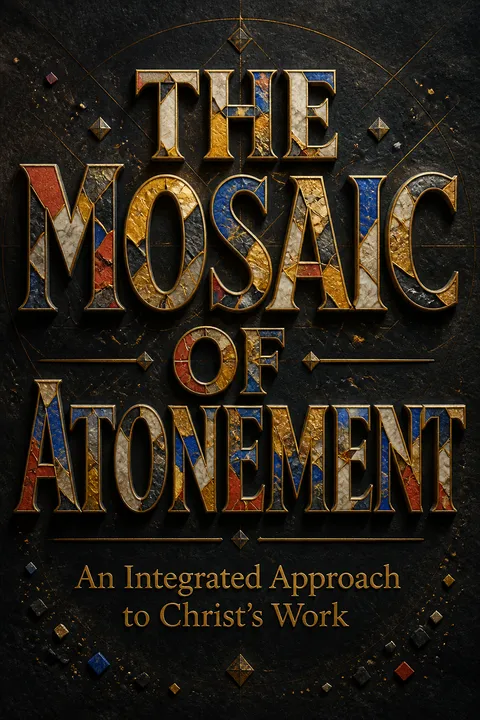
The aim is worship. McNall uses a mosaic rather than a puzzle as his guiding image. A mosaic preserves the distinct pieces while joining them into a larger picture. The cross is not a riddle humans can solve completely, and these four models do not exhaust its meaning. Their integration is meant to make the whole work more visible, not to claim a final, complete theory.
The strength of this approach is that it treats theological models as partial explanations with different jobs, much as a complex event can require legal, psychological, and political accounts at once. Integration can correct the blind spots created when one perspective dominates. It also has a demanding test: the pieces must genuinely explain one another, not merely sit beside one another. A mosaic metaphor invites that test, but does not itself prove the fit. Its value lies in directing attention toward the relationships among the claims.
Let Christ's representative humanity explain how one life can save many
A new head for humanity. Recapitulation means that Christ takes up and faithfully relives the human story, reversing Adam's failure. The early Christian theologian Irenaeus argued that humanity was made in the image of the incarnate Son. Christ is therefore not merely Adam's descendant; he is the archetype of human life and the rightful representative of the human family. As the New Adam, and as the one who also relives Israel's story, he acts on behalf of others.
Representation is relational. This account resists the idea that people are entirely separate individuals with no share in one another's lives. Paul can speak of people dying with Christ because they are bound to him. McNall treats that connection as the groundwork for Christ's ability to bear judgment, defeat evil, and offer a pattern for renewed human life.
The argument's distinctive move is to make Christ's identity, not an abstract permission to substitute one person for another, the basis of representation. Social and political life already depends on forms of shared identity: a leader can act for a community, and a family's history shapes its members. Those analogies make representation intelligible, though they cannot establish the book's stronger claim that humanity is united to Christ at a deep level. That claim depends on its biblical and theological premises, rather than on a general theory of collective identity.
Take science seriously without making Adam either literalist dogma or disposable myth
Keep the historical question open. Genetic research described in the book challenges the idea that humanity descended from one isolated ancestral couple, pointing instead to a larger ancestral population. McNall rejects both reflexively dismissing this evidence and treating science as the only authority on theological meaning. He argues that some historical human beginning of sin remains important to the Christian account of evil, while a young earth or Adam as the sole biological ancestor is not required.
Representative headship is one proposal. Adam could be a real person, or a representative pair, chosen from a wider population for a distinctive relationship with God and a moral vocation. This would preserve a historical fall without requiring monogenesis. McNall presents it as a possible way to read Scripture alongside science, not as a settled scientific finding or a proven reconstruction of human origins.
This is a useful distinction between a theological claim and a scientific model: the importance assigned to a historical fall does not automatically settle how human ancestry unfolded. The proposal also avoids treating a representative as necessarily a biological parent, a familiar distinction in political and social thought. Its limit is equally important. A theological need for historical referentiality cannot establish which population model is correct, and the proposed account of Adam remains speculative. Intellectual honesty means keeping both the theological stakes and the evidential uncertainty visible.
Hold substitution and union together when explaining Christ's judgment-bearing death
Two claims, not one. Penal substitution says Christ undergoes the penalty for human sin in others' place and instead of them. Incorporation says that people are somehow bound up with Christ, so what happens to him can also be said to happen to them. McNall argues that both are needed. Christ alone experiences the crucifixion and acts to save; yet he is not an unrelated innocent stranger selected to suffer for unrelated offenders.
The Trinity and covenant matter. McNall frames the cross as God's action in Christ, not a Father turning against an unwilling Son. The judgment targets sin, borne by the willing Son within the triune work of salvation. Covenant provides the setting: God binds himself to a people and takes responsibility for the consequences of their unfaithfulness. This account aims to answer the fairness objection without reducing the cross to a simple courtroom transaction.
The distinction between shared identity and distinct experience is doing real conceptual work here. It explains how a community can be implicated in a representative act without claiming that every member underwent the same physical event. It also blocks the familiar caricature of a hostile Father and passive Son. Still, incorporation does not make every justice concern disappear. Readers who do not accept the underlying claim of union with Christ may find the moral problem relocated rather than solved. The account is strongest when presented as a coherent Christian explanation, not a universally binding theory of punishment.
Keep penal substitution in the tradition, but never mistake it for the whole
Older than the Reformation. McNall surveys early Christian writers to challenge the claim that penal substitution appeared only in modern Protestant theology. Eusebius describes Christ taking a penalty owed by humanity; Athanasius links Christ's death to the law's judgment; Augustine says Christ bears punishment to cancel human guilt. The evidence is not uniform: Justin Martyr does not clearly teach the model, and Irenaeus often emphasizes representation and participation more than explicit substitution.
A presence is not a priority. McNall identifies three basic elements in what he calls mere penal substitution: Christ acts in others' place, bears a penalty for sin, and does so under divine sanction. He argues that Scripture also brings these themes together, especially in Isaiah's suffering servant and Paul's accounts of condemnation, sacrifice, and forgiveness. Historical and biblical presence supports a place for the model, not its supremacy over every other account.
This historical method is more careful than a simple search for allies: it distinguishes explicit claims from adjacent sacrificial or representative language. That distinction matters because a doctrine's history is rarely a clean line from one settled formulation to another. The survey also shows why historical precedent cannot settle the theological debate by itself. Early writers used different vocabularies and emphasized different mechanisms. Their testimony supports a broad family resemblance, while leaving room to dispute whether later labels accurately describe each individual source.
Explain Christ's victory through the cross, not merely beside it
The charge is disarmed. Christus Victor names Christ's triumph over sin, death, Satan, and the powers of evil. McNall argues that victory becomes more than a declaration of the outcome when it is connected to Christ's judgment-bearing death. In Colossians, the cross cancels the record of debt and disarms hostile powers. In Hebrews, Jesus shares human mortality and, through death, breaks death's hold. Revelation likewise pictures the Lamb's blood as central to the defeat of the Accuser.
A strange victory. The crucifixion looks like public defeat, yet the book reads it as the means of triumph. McNall also allows a qualified role for satanic self-deception: evil powers, blind to sacrificial love and driven by violence, help bring about the event that defeats them. God need not deceive; the powers' own aggression becomes part of their undoing.
Linking legal accusation to political and spiritual domination gives the victory model explanatory depth. It suggests that injustice is not only force imposed from outside; it can also draw authority from real wrongdoing and the stories used to justify control. The account's combination of courtroom and battlefield imagery is therefore more than decorative. Its main uncertainty is how literally to understand Satan and the powers. McNall offers a position between treating them as mere symbols and picturing them as ordinary individuals, but that middle ground remains theologically contested.
Expect Christ's victory to be real, unfinished, and embodied by a changed people
Already, but not complete. The resurrection and ascension establish Christ's victory, but evil and death remain visible. McNall calls this a staged triumph: the victory is real now, yet its final completion belongs to the future. The book of Ephesians presents believers as sharing in Christ's heavenly life while still facing struggle on earth. This makes both triumphalism and despair inadequate descriptions of Christian life.
The community participates. Romans pictures God crushing Satan under the feet of believers. For McNall, this does not mean people complete Christ's atoning work by their own power. It means that Spirit-enabled transformation, including love, holiness, and reconciliation across divisions, is one way the victory becomes visible. The church is not simply a crowd told that evil has lost; it is meant to become a changed community that resists evil's patterns.
The already and not yet pattern helps explain why religious hope need not depend on pretending present suffering is minor. It also gives ethical content to victory: a community's treatment of outsiders and vulnerable people can either make reconciliation credible or contradict it. The caution is that claims to represent divine triumph can become a cover for institutional power. McNall's emphasis on Christ's humiliating, self-giving path offers a restraint: participation should look like service and repair, not conquest over human opponents.
Let the cross expose scapegoating while drawing people toward costly love
Love beckons; truth restrains. McNall reconsiders Peter Abelard, often reduced to the view that Jesus saves only by setting a moral example. Abelard also wrote about Christ bearing human punishment. His account of love's influence adds that the cross awakens grateful love and a changed desire to obey. René Girard contributes a different emphasis: people imitate one another's desires, rivalry escalates, and communities can restore a false peace by blaming and expelling a scapegoat. The cross exposes that violence rather than endorsing it.
Useful, not exhaustive. McNall accepts Girard's account of rivalry and scapegoating as illuminating, but rejects it as a complete explanation of sin or salvation. People need more than an unveiling of their violence. The moral influence model therefore has both a positive pull toward love and a refusal of destructive habits, grounded in Christ's prior work rather than human self-rescue.
Girard's account connects individual desire with group behavior: a rival can make an otherwise unimportant object seem urgent, and a shared target can temporarily unify a divided group. That is a powerful lens for reading social blame and moral panics. Yet exposing a mechanism does not automatically end it; people can recognize harmful patterns and still benefit from them. Pairing critique with an account of grace and transformed desire addresses that gap. The pairing also prevents moral imitation from becoming a demand that victims passively accept abuse.
Treat the Spirit as the source of transformation, freedom, and redeemed difference
Transformation is not self-improvement alone. Drawing on Sarah Coakley and other theologians, McNall presents the Holy Spirit as awakening and purifying desire. The Spirit turns people toward Christ and neighbor, while also restraining desires that fuel violence, exploitation, or idolatry. This gives moral influence its power: change is enabled by God, not achieved by human effort alone.
Grace makes participation possible. The Spirit enables the church to embody reconciliation without making its members either self-sufficient or puppets. McNall prefers speaking of the Spirit's prior work rather than treating grace as a substance added to the soul. The Spirit also preserves particularity: a unified community need not become culturally or personally uniform. Distinct gifts and identities can contribute to shared service without erasing difference.
This account connects spiritual formation with social life. Desire is not merely private; it shapes what people imitate, what they tolerate, and whom they exclude. A Spirit-centered picture therefore gives transformation both an inward and a communal dimension. The unresolved tension between divine initiative and human freedom is handled with humility rather than a tidy formula. The emphasis on redeemed difference is also a meaningful safeguard against confusing unity with sameness, although any community must still ask whose differences it actually welcomes.
Analysis
McNall's central achievement is not simply defending several atonement models; it is assigning them distinct explanatory roles and showing why each needs the others. Recapitulation makes representation intelligible, penal substitution explains how sin's judgment is addressed, Christus Victor names the defeat of the powers, and moral influence describes transformed participation in that victory. This is an ordered account, but McNall resists turning order into a hierarchy. That distinction is persuasive: explanatory dependence does not automatically imply that one model is more important than the rest. The integration nevertheless rests on a substantial theological commitment. Christ is not merely appointed to represent humanity; humanity is understood as deeply connected to him as its archetype. This is what lets McNall answer the objection that punishment cannot justly pass from guilty people to an unrelated innocent person. For readers who do not share that account of humanity's union with Christ, the solution will not compel, even if it clarifies the internal logic of the Christian claim.
The book is also strongest when it treats historical and contemporary disputes with discrimination. It refuses both the claim that penal substitution is a recent invention and the equally reductive claim that every early reference to sacrifice means penal substitution. Its treatment of Adam similarly separates theological stakes from a single literalist account of ancestry, while acknowledging that the representative-head proposal remains uncertain.
The final turn toward practice is essential. Atonement is not reduced to ethical improvement, but neither is salvation detached from what communities become. The Spirit's work connects forgiveness and victory to restraint of violence, care across social divisions, and patient moral change. The synthesis offers a rich Christian interpretation, not a neutral proof that all readers must accept. Its most enduring contribution is methodological: preserve distinct images, ask what each explains, and judge any account by whether it can hold justice, mercy, human transformation, and God's victory together without making one cancel the others.
Review Summary
Glossary
Recapitulation
Christ relives humanity's storyA model of atonement in which Christ takes up and faithfully relives the human story, reversing Adam's failure. In McNall's Irenaean account, Christ is both humanity's archetype and representative head. His human life, obedience, death, and resurrection therefore have significance for the people connected to him.
Penal substitution
Christ bears sin's penaltyA model in which Christ, without having sinned, undergoes the penalty for human sin on behalf of others. McNall describes its basic elements as substitution, a penalty for sin, and divine sanction. He argues that this account must be framed within the Trinity and covenant, rather than as a hostile Father abusing an unwilling Son.
Christus Victor
Christ defeats evil's powersA pattern of atonement that emphasizes Christ's triumph over sin, death, Satan, and hostile powers. McNall treats victory as more than a result announced after the cross: Christ's death, resurrection, and ascension are the means of victory. The triumph has begun, though its complete realization remains future.
Vicarious judgment
Judgment borne representativelyMcNall's term for Christ bearing judgment on behalf of humanity while also being understood as genuinely connected to those he represents. It joins the claim that Christ suffers in others' stead with the claim that people are bound up with him. The term helps distinguish this account from the transfer of punishment between unrelated individuals.
Mimetic desire
Desire learned by imitationRené Girard's term for the human tendency to learn what to want by observing what others want. When people desire the same scarce object or status, imitation can become rivalry and conflict. Girard argues that groups may redirect that conflict toward a scapegoat, while the cross exposes the innocence of the victim and the violence of the group.
Defensive hierarchy
One model dominates the restMcNall's label for reducing atonement to a single preferred model and treating other biblical images as secondary or dependent. He argues that Scripture gives no clear warrant for making one model the master explanation. His alternative is to relate the models without assuming that their different roles establish a ranking of importance.
Disconnected plurality
Models remain unrelatedMcNall's label for affirming many atonement images while leaving them unconnected, as if each were useful in a separate situation but none helped explain the others. He regards this as an improvement over reducing the cross to one theory, but insufficient because it does not account for how the biblical themes interlock.
Staged triumph
Victory begins before completionMcNall's description of Christ's victory as both present and unfinished. The cross, resurrection, and ascension establish a real triumph over evil, yet suffering and death persist. The church participates in the unfolding victory through Spirit-enabled life, while the final defeat of evil and renewal of creation remain future.
Download PDF
Download EPUB
.epub digital book format is ideal for reading ebooks on phones, tablets, and e-readers.








