Key Takeaways
1. Embrace Foolishness: Challenge Conventional Wisdom & Manage Your Own Money
The wise may be instructed by a fool . . . You know how by the advice and counsel and prediction of fools, many kings, princes, states, and commonwealths have been preserved, several battles gained, and divers doubts of a most perplexed intricacy resolved.
Challenge the "Wise." The Motley Fool's philosophy, inspired by Shakespeare's jesters, champions the individual investor against the "Wall Street Wise" – brokers, money managers, and financial planners who often prioritize their own fees over client returns. For decades, these professionals have cultivated an image of "Wisdom," yet clear evidence shows that individual investors, armed with information and cheaper market access, can consistently beat the market. The core idea is that conventional wisdom often leads to mediocrity, and true insight comes from questioning the status quo.
Self-management is key. The Motley Fool believes you are the individual most personally invested in your financial success, and therefore, best suited to make your own money decisions. Many financial professionals argue you can't do it alone, but the Fool's track record proves otherwise. This means taking responsibility, doing your own research, and avoiding common pitfalls like buying stocks on vague recommendations or chasing "can't miss opportunities" peddled by others.
Resist base instincts. Foolishness attacks conventional wisdom by providing contrary truths that enable us to resist our own base instincts of fear and greed. These emotions often lead investors to make detrimental decisions, such as taking stupid gambles in pursuit of quick wealth or shying away from necessary risk in pursuit of illusory safety. True wisdom in investing lies in self-discipline and temperament, like patience and diligence, rather than blindly following market sentiment.
2. Stocks are the Truest Path to Lasting Wealth, Outperforming Other Assets
In pretty much any comparison between stocks and other asset classes, stocks win.
Historical outperformance. Investing in individual equities remains the most reliable path to lasting wealth. Historically, stocks have decisively outpaced bonds, cash, and gold over the long term. A Credit Suisse study tracking twenty-eight markets found stocks outperformed bonds, which outperformed cash, in twenty-seven of them by a wide margin. This consistent outperformance makes stocks the most profitable investment vehicle over decades and even centuries.
Long-term certainty. While daily stock market movements are essentially a coin flip (52% positive returns), longer holding periods dramatically increase the probability of positive returns.
- 88% of ten-year holding periods were positive.
- 100% of twenty-year and thirty-year holding periods made money.
This long-term perspective transforms the seemingly risky stock market into a near-certain path to wealth, provided investors have the proper timeline and temperament.
Avoid "Safety" traps. The pursuit of "Security" by avoiding stocks is a significant obstacle to long-term financial health. While Treasury bills are considered the safest investment, a dollar invested in T-bills in 1926 grew to $21 by 2014, whereas the same dollar in large company stocks grew to $5,317. The least-mentioned, biggest risk of all is not taking enough risk, as low risk inevitably leads to low returns, eroding wealth over time due to inflation.
3. Avoid Most Actively Managed Mutual Funds; Index Funds are a Better Default
Between 82 percent and 88 percent of all domestic stock mutual funds have underperformed the market’s average return over the decade ending in 2014.
Underperformance is rampant. The vast majority of actively managed mutual funds consistently fail to beat market averages. This damning statistic, often exacerbated by "survivorship bias" (funds that folded are excluded), reveals that most paid professionals cannot even match dumb luck. This underperformance is primarily due to high fees, frenetic trading, and a short-term focus, which erode investor returns through advisory fees, brokerage commissions, and capital gains taxes.
Fees matter most. Fund expenses are the single most critical factor in mutual fund performance. Legendary Vanguard founder Jack Bogle's "Cost Matters Hypothesis" states that the mathematical expectation of a speculator is a loss equal to transaction costs. Studies consistently show that funds with lower expense ratios outperform their more expensive counterparts across all asset classes and time periods.
- Average index equity fund expense ratio: 0.11%
- Average actively managed fund expense ratio: ~1%
- "Load" fees (sales charges) can range from 3.25% to 5.75% of initial investment.
Index funds: The average is excellent. Passively managed index funds and Exchange-Traded Funds (ETFs) simply replicate a market benchmark (like the S&P 500) by buying all its constituent stocks. They offer market-average growth year after year, demand virtually no research, and have significantly lower fees than active funds. If you can't beat the market, joining it through a low-cost index fund is a highly effective strategy, outperforming most active funds and providing instant diversification.
4. The Market is Beatable for Patient, Business-Focused Individual Investors
The stock market is messy and emotional and remains always a little bit wrong in its present estimation, in a charming and sometimes surprising way.
Efficient Markets Theory is flawed. While the Efficient Markets Theory (EMT) suggests stock prices always reflect fair value and future movements are unpredictable, the market is not a controlled laboratory. It's driven by diverse attitudes, time horizons, valuation models, and human emotions, creating inefficiencies. This "messiness" allows diligent individual investors to find underpriced opportunities that the collective, often shortsighted, market misses.
Small investors have an edge. Individual investors possess distinct advantages over large institutional funds:
- Agility: Institutions managing billions struggle to invest meaningfully in small-cap companies without driving up prices. Individual investors can get in early.
- Focus: Institutions often diversify into too many holdings, diluting the impact of winners and mirroring market performance. Individuals can concentrate on a few high-conviction ideas.
- Patience: Institutions face quarterly scrutiny, forcing short-term thinking. Individuals can hold for decades, riding out volatility.
This allows small investors to exploit niches of inefficient pricing and outperform.
Business-focused investing. Instead of relying on mechanical formulas or short-term price movements, successful investing involves adopting a "business owner" mentality. This means seeking out great growth-opportunity businesses, understanding their competitive advantages, market opportunities, and strength of leadership, and asking where the company, not the stock, will be in the next three to five years and beyond. This qualitative approach, combined with patience, is how individuals can consistently beat Wall Street.
5. Master Your Investing Mindset: You Are Your Own Worst Enemy
The investor’s chief problem—and even his worst enemy—is likely to be himself.
Behavioral biases derail success. Successful investing is less about what you know and more about how you act. Our innate behavioral biases cause most investors to buy high, sell low, and earn subpar returns. Awareness of these cognitive errors is the first step toward overcoming them.
Common detrimental biases:
- Loss Aversion: Hating losing money more than liking making it, leading to overreaction during market downturns.
- Illusions of Superiority: Overestimating one's own investing skills, often correlating with worse performance.
- Aversion to Changing Your Mind: Not wanting to admit original judgments were wrong, leading to the "sunk-costs fallacy."
- Anchoring Illusion: Fixating on past prices paid or arbitrary "fair" prices, missing future opportunities.
- Overestimating Self-Control: Believing one will be greedy when others are fearful, but becoming fearful oneself during crashes.
- Cognitive Dissonance: Justifying poor decisions to reduce mental discomfort (e.g., criticizing Wall Street while day trading).
- Normalcy Bias: Assuming something unprecedented won't happen because it hasn't before.
- Bandwagon Effect: Believing something is true because others do, fueling asset bubbles.
Patience and temperament are paramount. The world's best investors, like Warren Buffett, attribute their success not just to financial knowledge, but to their control over emotions, ability to think clearly under stress, and resistance to temptation. Recognizing that you are as biased as everyone else is an enormous step forward. The market rewards patience more than any other skill.
6. Tom's Everlasting Approach: Prioritize Culture, Strategy, Financials, Safety, then Valuation
An organization that has built, for example, a culture of proven innovation will continue to churn out positive results (and corresponding profits) long after it misses analysts’ expectations by $0.02 per share in the second quarter.
Long-term holding is paramount. Tom Gardner's "Everlasting Investing" framework prioritizes holding great businesses for decades, not just years. The worst thing an investor can do is lose their big winners by selling prematurely. While losses are capped at 100%, gains are unlimited, and missing out on "multibaggers" (stocks that increase many times over) is far more damaging than avoiding small losses.
The Five Tenets (in order of importance):
- Culture: The ecosystem of the organization – how it treats employees, customers, suppliers, and stakeholders. Look for founder-CEOs, high employee retention (Glassdoor.com ratings), and a clear, inspiring purpose (e.g., Facebook, Chipotle).
- Strategy: The company's plan for winning. Focus on pricing power (ability to raise prices sustainably, e.g., Starbucks, Amazon Prime), large and growing market opportunity, and strong customer loyalty (repeat purchases, recurring revenue).
- Financials: The underlying health of the business. Seek high, accelerating sales growth, high returns on invested capital (10%+ ROE), smart capital allocation (buybacks, acquisitions, debt management), and sustainable profit margins.
- Safety: Assessing potential risks. Consider leadership succession plans, threats of disruption (platform shifts), and the "law of large numbers" (companies becoming "too big to succeed"). Diversification among customers/suppliers is also key.
- Valuation: The market's current price tag. Focus on owner earnings (cash generated if the business didn't need to grow) and a 5-10 year outlook, aiming for at least a 15% annualized return. Look for negative market sentiment that creates buying opportunities (e.g., Facebook's IPO).
No hard-and-fast rules. While these tenets provide a robust framework, no single factor is an absolute necessity. The goal is to find a system that works for you, test it, adapt it, and most importantly, master your emotional temperament to stick with your winners through short-term noise.
7. David's Rule Breaker Approach: Seek Top Dogs Disrupting Emerging Industries
Every great business begins as a Rule Breaker.
Disrupting the status quo. David Gardner's "Rule Breaker Investing" focuses on identifying companies that actively break the "rules" of how business is done, solving old problems or inventing new possibilities. These are not hidden gems but often prominent innovators that shape industries, economies, and daily lives, making them outstanding long-term investments.
The 6 Signs of a Rule Breaker:
- Top Dog and First Mover: Dominant market share in an important, emerging industry (e.g., Baidu in China search, Salesforce.com in cloud services).
- Sustainable Advantage: Achieved through business momentum (Amazon), patent protection (biotech), visionary leadership (Jeff Bezos), or inept competitors (Blockbuster vs. Netflix).
- Strong Past Price Appreciation: Contrary to "buy low," Rule Breakers often have already done well, indicating market recognition of a winning company. A stock on the rise tends to remain on the rise.
- Good Management and Smart Backing: Visionary leaders (Steve Jobs, Mark Zuckerberg) with strong track records, often backed by successful venture capital firms. Good management trumps almost all other concerns.
- Strong Consumer Appeal: A powerful brand that represents a promise fulfilled daily, creating loyalty and habit (e.g., Starbucks). This often translates to pricing power and is hard for quantitative screens to capture.
- Grossly Overvalued by the Financial Media (The Wise): This is an iconoclastic indicator. When the media calls a Rule Breaker "overvalued" due to high P/E ratios, it often signals that other investors are sitting on the sidelines, creating future buying pressure as the company continues to perform.
Embrace the Hype Cycle. Rule Breaker investors understand Gartner's Hype Cycle, owning great innovators from the "Technology Trigger" phase, through the "Peak of Inflated Expectations" and "Trough of Disillusionment," into the "Slope of Enlightenment" and "Plateau of Productivity." The goal is to identify, buy, and hold through these phases, not to time them.
8. Dig into the Digits: Understand Key Financial Metrics for Growth Companies
If you don’t study any companies, you have the same success buying stocks as you do in a poker game if you bet without looking at your cards.
Financials confirm qualitative insights. While qualitative factors like culture and strategy are paramount, understanding a company's financial statements provides crucial confirmation or red flags. The "Foolish Eight" metrics offer a framework for evaluating small-cap growth companies, which often present the best opportunities for outsized gains.
Key "Foolish Eight" metrics for small-cap growth:
- Sales: $500 Million or Less: Focus on smaller companies with greater potential to double or triple in size.
- Average Daily Dollar Volume: $1 Million to $25 Million: Ensures liquidity while remaining "undiscovered" by large institutions.
- Minimum Share Price of $7: Avoids unstable, illiquid, or "sketchy" penny stocks.
- Net Profit Margin: At Least 7%: Indicates a company is soundly beating competition or has little competition.
- Earnings and Sales Growth: 25% or Greater: Demonstrates significant, dynamic growth.
- Insider Holdings: 10% or More: Aligns management's interests with shareholders'.
- Cash Flow from Operations: A Positive Number: Shows the company generates cash from its core business, rather than consuming it.
- Relative Strength—Strong Price Appreciation: Winning businesses with winning stocks tend to keep winning.
Beyond the basics: P/E and PEG ratios. The Price-to-Earnings (P/E) ratio (stock price / earnings per share) is the market's price tag. The Price-to-Earnings-to-Growth (PEG) ratio (P/E / growth rate) provides context, suggesting full valuation at a PEG of 1. However, these are shortcuts; the market often has good reasons for its valuations, and a high PEG can indicate strong market faith in future growth.
9. Consider Advanced Tools Like Shorting and Options, But Use Them Wisely
Options can make money when a stock goes nowhere, or when it falls, or, yes, as it rises.
Margin: A double-edged sword. Margin accounts allow borrowing money from a brokerage to invest more than you have, magnifying both gains and losses. While it offers leverage, it comes with interest payments and the dreaded "margin call," where falling collateral forces you to add funds or have your securities sold. Use margin with extreme caution, if at all, and never more than 20% of your portfolio's value.
Shorting stocks: Profiting from decline. Short selling involves borrowing shares, selling them, and then buying them back later to return to the lender. You profit if the stock price falls. While it goes against the market's long-term upward trend and carries "unlimited upside risk" (theoretically), it can be lucrative for individual stocks deemed overvalued or as a portfolio hedge.
- Shorting criteria: High debt-to-cash ratio with low cash flow, "closed" situations (limited growth potential), and low short interest (to avoid short squeezes).
- Pitfalls: Shares may be unavailable, "uptick" rule restrictions, forced buy-backs, no interest on short-sale cash, and paying dividends on shorted stock.
Options: Versatile tools for leverage and income. Options give the right (but not obligation) to buy (call) or sell (put) a stock at a set price by a certain date. They offer tremendous leverage (each contract controls 100 shares) and can be used for:
- Selling Puts for Income: You get paid a premium to obligate yourself to buy a stock at a lower strike price if it falls. You either get income or buy the stock cheaper.
- Buying Calls for Upside Leverage: You risk less capital for exposure to 100 shares, with magnified gains if the stock rises significantly.
- Buying Puts for Downside Protection: You pay a premium for the right to sell a stock at a set price, protecting against declines or profiting from a fall.
Options complement a long-term stock portfolio, offering ways to profit in various market conditions, but require careful understanding and risk management.
10. Patience and Compounding are Your Most Powerful Allies
By letting others build up your savings, you’ll have more time to devote to the nonfinancial things that matter to you.
The magic of compounding. The true power of investing lies in compounded growth, where your earnings generate further earnings. While initial annual dollar profits on a small investment may seem uninspiring, they accelerate dramatically over time. A $10,000 investment growing at 8% after-tax annually will yield significantly more dollar profit in its tenth year than its first, even without additional contributions. This "snowball effect" is the engine of generational wealth.
Time builds wealth. Investing is a marathon, not a sprint. The most attractive aspect of a long-term approach is that it eliminates day-to-day risk and worry. By intelligently investing in stocks (whether through index funds or carefully selected companies), you allow the efforts of countless businesses and individuals to build your wealth, freeing up your time and energy for life's non-financial pursuits.
Be aggressive, but disciplined. While patience is key, investors should also be aggressive in seeking out market-beating returns once they've mastered the fundamentals. Aiming for 15% annualized growth, for example, can transform a $25,000 nest egg with $2,500 annual savings into $1 million in just twenty-three years. This requires discipline, a willingness to learn, and the temperament to stick with your strategy through market volatility.
Continuous learning and adaptation. The investment world is constantly changing, but the core principles of Foolish investing remain: manage your own money, understand the businesses you own, track your performance, and be prepared for market fluctuations. Start cautiously, perhaps with index funds or blue chips, and then explore growth stocks and advanced strategies as your confidence and knowledge grow. The goal is financial freedom and the opportunity it creates.
Last updated:
Review Summary
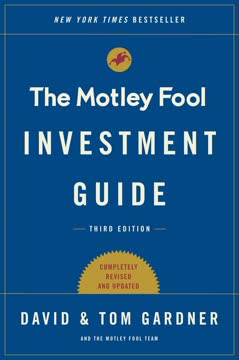
The Motley Fool Investment Guide receives mostly positive reviews, with readers praising its clear explanations of investment principles and strategies for beginners and experienced investors alike. Many appreciate the authors' emphasis on long-term investing, index funds, and self-directed portfolio management. The book's conversational style and humor are enjoyed by some but considered unprofessional by others. Critics note that parts of the book feel like marketing for Motley Fool services, and some find the advice on beating the market contradictory to earlier recommendations.
Similar Books