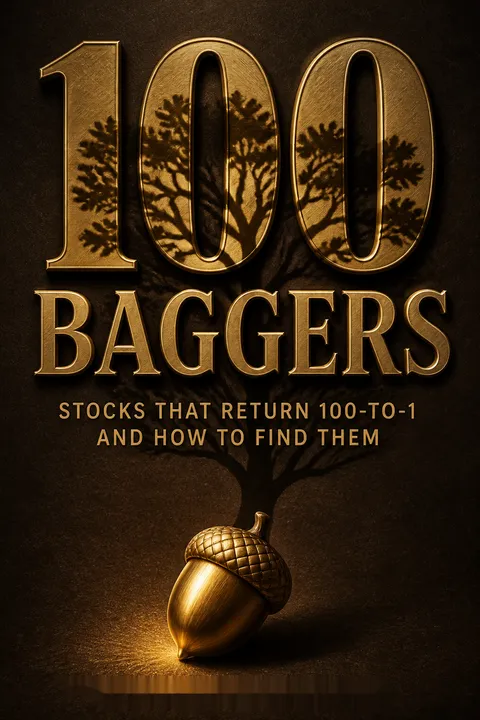


Key Takeaways
Measure success in decades: a 100-bagger needs patient compounding
A hundredfold takes time. A 100-bagger is a stock whose value grows to 100 times its starting level. In a study of 365 such stocks from 1962 to 2014, the typical journey took about 26 years. The arithmetic is sobering: a return of 20% a year takes 25 years to multiply money by 100; at 14%, it takes 35 years. The book's central point is not that every investor can reliably find one, but that aiming for exceptional compounders changes what deserves attention.
The last stretch matters. With steady 20% annual growth, a stock sold after 20 years has returned about 40-fold, while five more years more than double that result. The potential prize depends not just on selection, but on staying invested.
What's striking is how a spectacular outcome can come from an unremarkable process repeated for a long time. Compounding is nonlinear, so the years near the end contribute disproportionately to the final result. But a list of past 100-baggers cannot reveal how likely any candidate was to succeed at the outset. The study deliberately examines winners, not the full population of failures. Its strongest use is therefore as a map of possible routes, not a probability table promising that a particular stock will make the journey.
Use a coffee-can portfolio to stop good stocks from leaving early
Make selling harder. The coffee-can portfolio is a group of carefully selected stocks set aside for a long period, traditionally ten years, with little trading. Robert Kirby developed the idea after finding that a client's late husband had quietly bought his recommendations but ignored his sell advice. Most positions stayed small, but one, in Haloid, which became Xerox, grew to about $800,000.
Restraint can compound. Thomas Phelps showed how Pfizer investors who held from 1942 to 1972 made 141 times their money, despite stretches when the stock lagged. The approach is not a license to forget deteriorating businesses. It is a way to stop daily price changes and the appetite for fresh excitement from dictating premature sales.
The portfolio is useful partly because it changes the decision environment. Behavioral finance documents a tendency to sell winners too quickly and cling to losers, often because realizing a gain feels rewarding while admitting a loss feels painful. A precommitted holding period can reduce those impulses. Still, ten years without review would be reckless if a business loses its competitive position or its finances break. The sensible distinction is between checking whether the investment case remains intact and checking the ticker for reasons to act.
Favor businesses that can reinvest profits at high returns
Follow the reinvestment. Return on equity, or ROE, measures profit relative to shareholders' equity. Home Capital Group reported annual ROEs mostly above 20% from 1998 through 2012, reaching above 30% in some years. Over roughly 16 years, its stock became a 49-bagger excluding dividends. The example points to more than a high current return: the company must have opportunities to put retained profits back to work at similarly attractive rates.
Compounding needs fuel. Investor Chuck Akre identifies reinvestment as the crucial ingredient in an outstanding business. If a company earns 20% on its capital and can keep reinvesting at that rate, the capital base expands rapidly. Dividends can be valuable, but money paid out is no longer available for the business to compound internally.
This is a capital-allocation problem as much as a growth story. A company can report impressive returns and still disappoint if it has nowhere productive to deploy its cash. Conversely, a strong reinvestment opportunity can make retained earnings more valuable than an immediate payout. The qualification is important: high ROE alone can be inflated by debt, a shrinking equity base, or accounting choices. The meaningful question is whether the business can expand without weakening its economics, not whether a single ratio looks attractive.
Put capital behind owner-operators who share your economic fate
Align incentives with ownership. An owner-operator is a leader who holds a meaningful stake in the business, so personal wealth rises or falls with the value of the shares. The book points to founders and controlling investors such as Sam Walton, Steve Jobs, and Warren Buffett as examples of leaders who helped build exceptional companies.
Watch how they allocate. William Thorndike's study, The Outsiders, profiles CEOs who treated capital allocation as a central job. Henry Singleton's Teledyne, for example, repurchased about 90% of its shares over time. A dollar invested under Singleton grew to roughly $180. The broader lesson is to examine whether leaders reinvest, acquire, repay debt, distribute cash, or buy back stock with discipline, rather than judging them by sales growth alone.
Ownership can reduce the agency problem, the gap between what benefits managers and what benefits shareholders. It can also encourage long-term choices that look poor in a quarterly report but strengthen the business. Yet insider ownership is not a guarantee of good judgment: control can entrench a leader, limit outside scrutiny, or enable related-party decisions. A useful test is not merely how much management owns, but whether its decisions create value per share and whether minority shareholders can understand and assess those decisions.
Pair business growth with a price that leaves room to win
Two forces can multiply returns. The book calls earnings growth and valuation expansion the twin engines of a 100-bagger. MTY Food Group illustrates the combination. From 2003 to 2013, earnings per share rose about 12-fold, while the market's valuation rose from roughly 3.5 times earnings to about 26 times. Together, the business's growth and the higher multiple helped turn the stock into a 100-bagger over about ten years.
Price still matters. Paying too much at the start leaves less room for a higher valuation and makes the result depend almost entirely on extraordinary growth. A high price-to-earnings ratio is not automatically disqualifying, but it must be supported by durable growth and strong economics. The book's examples argue for reasonable expectations, not bargain hunting at any cost.
The return comes from both the business and the price other investors are willing to pay for it. That distinction helps explain why a good company can be a poor investment when expectations are already extreme. Multiple expansion is especially fragile: it can reverse even while earnings rise. For this reason, business growth is the sturdier engine, while valuation change is a possible bonus. Investors should also inspect cash generation and capital needs, since reported earnings can overstate the economic progress available to shareholders.
Look for durable barriers, then verify them in the margins
A moat protects returns. An economic moat is a lasting advantage that makes it difficult for competitors to take a company's customers or profits. Possible sources include a trusted brand, high switching costs, network effects, low costs, or a dominant position in a niche. Gillette showed how patents and technical know-how could help defend a market: its earlier patent work on stainless steel blades allowed it to collect royalties when competitor Wilkinson Sword sold its own version.
Check the economics. The book highlights gross profit margins as one clue that a business may have pricing power or a valuable position. But a moat is not permanent, and an attractive product alone does not prove one exists. Competitors can imitate, customer habits can shift, and a once-dominant company can lose relevance.
The moat idea connects competitive strategy to the persistence of returns. A company that can keep rivals from eroding its economics has more chance to reinvest at attractive rates. Gross margins can help reveal that advantage, but they are evidence, not proof: product mix, accounting, and industry structure also affect them. Strong analysis therefore asks both how value is created for customers and what prevents competitors from copying it. A moat should be a causal explanation for durable profits, not a reassuring label applied after success.
Let buybacks accelerate value only when management buys cheaply
Shrink the share count wisely. A stock buyback occurs when a company repurchases its own shares. If the business has surplus cash and the shares trade below intrinsic value, each remaining share represents a larger claim on future earnings and assets. AutoNation illustrates the effect: over the period discussed, it retired about 65% of its shares, while the stock rose about 520%.
The price is decisive. A repurchase is not automatically shareholder-friendly. Buying overpriced shares wastes capital, and stock-based compensation can offset the reduction in shares. Warren Buffett's standard, as summarized in the book, is that a company should have funds beyond business needs and repurchase only when shares are conservatively judged to be worth more than their market price.
Buybacks are a form of capital allocation, not a virtue in themselves. Their per-share arithmetic can be powerful, especially when a stable business generates cash but has fewer high-return growth opportunities. The risk is that executives may repurchase shares to support short-term earnings-per-share targets or to offset dilution, without increasing underlying value. The relevant comparison is between the return from buying the company's own discounted shares and the expected return from investing that money elsewhere.
Concentrate conviction, but never pretend stock-market odds are known
Make strong ideas count. The Kelly criterion is a method for estimating how much of a bankroll to risk when the bettor has an advantage and can estimate the odds. The book uses it to explain why some successful investors put large portions of their portfolios into a few favored positions instead of owning a sprawling collection of tiny bets. A half-Kelly approach reduces the suggested position size to make the ride less volatile.
Stocks resist precise odds. Unlike a well-defined wager, an investment's future probability and payoff are uncertain. A company's market, management, or competitive position can change. Concentration may magnify gains when judgment is right, but also magnifies the cost of error. The concept is a prompt to make position size reflect conviction and uncertainty, not an instruction to copy another investor's holdings.
Concentration is most defensible when paired with unusually strong knowledge and a durable margin of safety. Portfolio theory makes the trade-off clear: fewer holdings increase exposure to company-specific surprises, while broad diversification limits the damage from any one failure. Kelly's mathematics assumes probabilities and payoffs can be estimated; in public equities, those inputs are guesses. Fractional sizing acknowledges that model error is real. The practical lesson is disciplined selectivity, not maximal betting.
Keep debt low enough to survive a brutal market without selling
Avoid forced decisions. During the Great Depression, investor Benjamin Graham entered 1930 with substantial leverage. His account fell 50% that year, while the Dow Jones Industrial Average declined 29%. Graham later reduced debt and described the episode as a costly lesson. Borrowing can magnify returns in good markets, but it can also force a sale precisely when prices are depressed.
Cash preserves options. The book recounts investor Floyd Odlum using cash to buy deeply undervalued securities after the 1929 crash. A reserve is not a prediction that disaster is imminent. It gives an investor room to meet obligations and consider opportunities without relying on lenders or selling sound holdings under pressure.
This is the survival condition beneath long-term investing. A company may recover from a market collapse, but a leveraged investor can be wiped out before that recovery arrives. Liquidity therefore has option value: it buys time and preserves the ability to choose. Still, holding excessive cash carries its own opportunity cost, especially over long periods. The right reserve depends on obligations, risk tolerance, and access to capital. The essential point is to avoid a structure that turns a temporary decline into a permanent loss.
Ignore forecasts and track the business's earning power instead
Study the company, not the noise. The book argues that economic and market forecasts are unreliable guides to individual investments. John Maynard Keynes learned this through experience: after the 1929 crash, he shifted away from trying to time broad market cycles and toward selecting securities he believed were cheap relative to their long-term value. From 1927 to 1946, the Cambridge fund he managed earned about 12% annually, while the UK market fell about 15% over the period.
Follow the underlying capacity. Quarterly earnings and share prices can swing without destroying a business's long-term ability to earn. Investors should learn what drives sales, margins, customer demand, and reinvestment, then ask whether those drivers have changed. That is more useful than reacting to every headline or forecast.
Forecasting offers the comfort of a story about what comes next, but broad predictions rarely identify which businesses can adapt and prosper. Keynes's experience reinforces the value of moving from macro speculation toward company-level judgment. That does not mean ignoring interest rates, regulation, or economic shocks, all of which can matter. It means treating them as risks to assess rather than as precise timing signals. The most useful filter is whether new information changes the business's capacity to earn, not whether it moves the stock today.
Analysis
The book's most durable contribution is a shift in the unit of attention. Instead of asking whether a stock will rise next quarter, it asks whether a business can reinvest capital at high returns for long enough to make today's price look small in retrospect. This links corporate finance, competitive strategy, and investor psychology: business economics create the possible compounding, while patience allows the investor to capture it.
The historical examples make that logic memorable, but the evidence has a clear boundary. The study selects firms that succeeded, so it cannot establish how often a promising-looking company becomes a 100-bagger, or how many similar candidates fail. Its patterns are useful diagnostic questions, not a reliable screening formula. A high ROE, insider ownership, or rising gross margin may accompany success without guaranteeing it. Those measures need causal explanations and comparisons with the company's risks and alternatives.
The hardest tension is between patience and adaptation. A long holding period avoids emotional trading and taxes, but a business can lose its advantage, overpay for acquisitions, or face technological change. The sensible form of buy-and-hold is therefore not inactivity. It is infrequent, thesis-driven review: monitor the economics, management's capital choices, and the balance sheet, while resisting price changes that do not alter those fundamentals.
The portfolio implications are equally important. Exceptional outcomes often depend on a small number of winners, yet no investor can know in advance which candidate will become one. Concentration can amplify insight, but it also amplifies analytical error. Position sizing, liquidity, and avoidance of ruin are not side issues; they determine whether an investor remains present long enough for compounding to matter. The book is strongest as a discipline for searching and holding, and weakest if interpreted as evidence that past winners make future winners predictable.
Review Summary
100 Baggers receives mostly positive reviews for its insights on identifying high-growth stocks. Readers appreciate its focus on long-term investing, owner-operated businesses, and the power of compounding. The book is praised for its real-world examples and practical advice. Some criticize it for relying on hindsight and lacking a systematic approach. Overall, it's considered a valuable read for investors seeking to understand the characteristics of stocks with potential for extraordinary returns, though it emphasizes patience and careful analysis rather than quick profits.
People Also Read









Glossary
100-bagger
Hundredfold stock returnA stock that increases to 100 times its starting value, turning each invested dollar into one hundred dollars before relevant taxes and costs. In the book's historical study, returns include reinvested dividends and the companies meet a minimum size threshold. Such gains usually require sustained business growth and a long holding period.
Coffee-can portfolio
Long-term, low-trading portfolioA portfolio of selected investments that is deliberately left alone for an extended period, traditionally ten years. The method is meant to reduce trading costs, taxes, and emotionally driven decisions. Its purpose is not to ignore business deterioration, but to prevent investors from selling sound holdings merely because prices fluctuate or another stock looks more exciting.
Twin engines
Earnings and valuation growthThe book's label for the two forces that can combine to produce extraordinary stock returns: growth in a company's earnings and an increase in the valuation investors assign to those earnings. Either can contribute to appreciation, but relying on both creates more powerful results. Valuation expansion is not assured and can reverse, so it should not substitute for business growth.
Return on equity
Profit relative to equityA financial measure comparing a company's profit with the shareholders' equity used to generate it. The book treats sustained, high return on equity as a clue that a business may compound capital effectively. The measure alone can mislead if debt, accounting choices, or a reduced equity base inflate it, so it needs context.
Owner-operator
Leader with meaningful ownershipA business leader who owns a significant share of the company being managed. The term emphasizes that the leader's personal financial outcome is connected to shareholder value. Such alignment can support long-term thinking and disciplined capital allocation, but ownership alone does not ensure sound decisions, fair treatment of minority holders, or a durable business.
Economic moat
Durable competitive advantageA business characteristic that helps protect profits from competitors. Sources can include trusted brands, customer switching costs, network effects, low costs, patents, or dominance in a niche. A moat can help a company sustain attractive returns and reinvest them over time. It is not necessarily permanent, and an appealing product by itself does not prove a moat exists.
Kelly criterion
Advantage-based bet sizingA mathematical method for estimating what fraction of a bankroll to wager when the bettor has an advantage and can estimate the odds. The book connects it to investment position sizing and the idea of committing more to stronger opportunities. Since stock-market probabilities and payoffs are uncertain, the method is better treated as a conceptual guide than a precise formula.
SQGLP
Five 100-bagger characteristicsAn acronym used in a study of Indian 100-baggers to summarize five desired features: small size, high quality of business and management, strong earnings growth, longevity in quality and growth, and a favorable purchase price. The framework organizes recurring characteristics of large winners, but it does not demonstrate that any company possessing them will deliver a hundredfold return.
The Outsiders
Unconventional capital allocatorsThe book's name for CEOs profiled by William Thorndike who created exceptional shareholder returns through disciplined capital allocation. Their choices included reinvesting in operations, making acquisitions, using debt selectively, and repurchasing shares. They emphasized value per share and cash flow over corporate size or headline growth, adapting their choices to the circumstances of each business.
Earnings power
Underlying profit capacityA company's durable ability to produce profits, distinguished from temporary movements in reported earnings. The concept asks whether the business's competitive position, customer demand, and economics support future results, rather than treating a single quarter or year as definitive. It helps investors separate short-lived earnings fluctuations from changes that weaken or strengthen the long-term investment case.
FAQ
What's "100 Baggers: Stocks That Return 100-To-1 and How to Find Them" about?
- Focus on 100-baggers: The book explores stocks that return $100 for every $1 invested, turning a $10,000 investment into $1,000,000.
- Investment strategies: It provides insights into identifying and investing in these high-return stocks.
- Historical analysis: The author, Christopher W. Mayer, updates a study originally conducted by Thomas Phelps, analyzing stocks from 1962 to 2014.
- Practical advice: The book offers practical techniques and anecdotes to help investors find and hold onto potential 100-baggers.
Why should I read "100 Baggers: Stocks That Return 100-To-1 and How to Find Them"?
- Unique investment perspective: It offers a unique approach to investing by focusing on long-term, high-return stocks.
- Actionable insights: The book provides actionable insights and strategies that can be applied by everyday investors.
- Historical success stories: It includes real-life success stories and case studies of companies that became 100-baggers.
- Inspiration and motivation: The book aims to change the way you think about investing, energizing and exciting you about what's possible.
What are the key takeaways of "100 Baggers: Stocks That Return 100-To-1 and How to Find Them"?
- Long-term holding: The importance of holding onto stocks for the long term to achieve significant returns.
- Growth and reinvestment: Focus on companies with high returns on capital and the ability to reinvest profits effectively.
- Owner-operators: Invest in companies led by owner-operators who have significant skin in the game.
- Economic moats: Look for companies with durable competitive advantages that protect their high returns.
What are the best quotes from "100 Baggers: Stocks That Return 100-To-1 and How to Find Them" and what do they mean?
- "Buy right and hold on": This emphasizes the importance of selecting the right stocks and holding them for the long term to achieve substantial returns.
- "A lot of shavings don’t make a good workman": This suggests that frequent trading and activity do not necessarily lead to better investment results.
- "Every human problem is an investment opportunity if you can anticipate the solution": This highlights the potential for finding investment opportunities by identifying solutions to common problems.
- "The greatest fortunes come from gritting your teeth and holding on": This underscores the value of patience and perseverance in investing.
How does Christopher W. Mayer suggest finding 100-baggers?
- Focus on growth: Look for companies with significant growth potential in sales and earnings.
- High return on capital: Identify businesses that can reinvest profits at high rates of return.
- Owner-operator advantage: Prefer companies with leaders who have substantial ownership stakes.
- Economic moats: Seek businesses with durable competitive advantages that protect their market position.
What is the "Coffee-Can Portfolio" strategy mentioned in the book?
- Long-term holding: The strategy involves buying stocks and holding them for at least 10 years without selling.
- Simplicity and discipline: It emphasizes simplicity and discipline by preventing frequent trading and emotional decision-making.
- Focus on quality: Only include stocks in the portfolio that you believe are good long-term bets.
- Historical success: The strategy is inspired by a story of an investor who achieved significant returns by holding onto stocks for the long term.
What role do owner-operators play in achieving 100-bagger returns?
- Alignment of interests: Owner-operators have significant personal stakes in the company, aligning their interests with shareholders.
- Long-term focus: They often focus on long-term value creation rather than short-term performance metrics.
- Better decision-making: Owner-operators tend to make better capital allocation decisions, leading to higher returns.
- Proven track record: Many successful 100-baggers have been led by owner-operators with a history of creating value.
How important is a company's economic moat in becoming a 100-bagger?
- Sustained high returns: A strong moat allows a company to sustain high returns on capital over time.
- Competitive advantage: It protects the company from competitors, ensuring continued profitability.
- Long-term growth: Companies with moats can reinvest profits effectively, driving long-term growth.
- Investor confidence: A durable moat provides investors with confidence in the company's future prospects.
What is the significance of stock buybacks in accelerating returns?
- Shareholder value: Buybacks reduce the number of shares outstanding, increasing the value of remaining shares.
- Earnings concentration: They concentrate future earnings and dividends among fewer shares, boosting per-share metrics.
- Market signal: Buybacks can signal management's confidence in the company's undervaluation.
- Historical success: Many 100-baggers have effectively used buybacks to enhance shareholder returns.
How does the book address the impact of market downturns on finding 100-baggers?
- Opportunities in downturns: Market downturns can create opportunities to buy high-potential stocks at lower prices.
- Focus on fundamentals: Emphasizes the importance of focusing on a company's fundamentals rather than market conditions.
- Historical resilience: Highlights examples of companies that thrived despite economic challenges.
- Long-term perspective: Encourages maintaining a long-term perspective and not being swayed by short-term market fluctuations.
What is the role of luck in achieving 100-bagger returns?
- Unpredictable factors: Acknowledges that luck plays a role in the success of some 100-baggers due to unforeseen events.
- Preparedness: Emphasizes the importance of being prepared and positioned to take advantage of lucky breaks.
- Diversification: Suggests holding a portfolio of potential 100-baggers to increase the chances of success.
- Realistic expectations: Encourages investors to have realistic expectations and not rely solely on luck for success.
When should an investor consider selling a potential 100-bagger?
- Mistakes: Sell if you realize you've made a mistake in your investment thesis.
- Investment criteria: Consider selling if the stock no longer meets your investment criteria.
- Better opportunities: Be cautious about selling to switch into something better unless you're very sure.
- Non-investment reasons: Avoid selling for non-investment reasons, such as short-term price movements or market noise.
Download PDF
Download EPUB
.epub digital book format is ideal for reading ebooks on phones, tablets, and e-readers.








