

Key Takeaways
Treat every stock as a slice of a real operating business
A share means ownership. Buffett’s central habit is to look through the ticker symbol to the company: its products, customers, costs, managers, and cash generation. Buying a few shares should involve the same questions as buying the whole business. This perspective links his early education under Benjamin Graham, who taught him to seek bargains, with the influence of Philip Fisher and Charlie Munger, who pushed him toward durable, high-quality companies.
A textile mill became a platform. Buffett took control of Berkshire Hathaway in 1965, when its textile operations were struggling. Insurance and investments, not the mills, became the company’s engines. From 1965 to 2003, Berkshire’s per-share book value grew at an average annual rate of 22.2%, compared with 10.4% for the S&P 500 including dividends. Berkshire’s figures were after tax, while the index figures were before tax.
The ownership lens changes the question from “Will this price rise?” to “Would this business still make sense if the market closed?” That shift resembles the distinction between measuring a machine by its output and judging it by the price of its parts. It also discourages impulsive trading, since a temporary quote says little about whether customers still want the product. The approach is powerful, but it depends on access to intelligible business information. When accounting is opaque or the business changes rapidly, the owner’s perspective does not magically make the future knowable.
Stay within your competence, and let predictability narrow the field
Know what you can judge. Buffett’s “circle of competence” means the areas of business a person understands well enough to assess. Its size matters less than its boundaries. He avoided technology not because it was inherently worthless, but because he could not reliably estimate the economics of companies in that industry. By contrast, he could understand Coca-Cola’s business: make a concentrate, sell it to bottlers, and rely on a global distribution network to reach customers.
Familiarity is not enough. Buffett also looks for a consistent operating history and favorable long-term prospects. A company that has repeatedly produced similar results is easier to forecast than one depending on a dramatic turnaround or an untested business model. His test is not whether a company is exciting, but whether its future cash generation can be estimated with reasonable confidence.
This is a practical form of intellectual humility. In fields such as medicine and engineering, experts learn to distinguish problems they can solve from those requiring different tools or deeper knowledge. Investors benefit from the same discipline: refusing to act can be a sign of competence, not timidity. Still, familiarity can become a trap. A business that looks simple may be exposed to technological, regulatory, or consumer shifts that its historical record cannot capture. A useful boundary therefore needs periodic review, not permanent trust in yesterday’s understanding.
Pay attention to durable advantages, not just low prices
Look for a moat. Buffett favors businesses with an enduring advantage that protects them from competitors. He calls such a business a “franchise”: a provider of something customers want, with no close substitute and no regulation that removes its ability to earn attractive returns. A recognizable brand, customer loyalty, or hard-to-replicate distribution can help create that protection.
Quality can transform the bargain hunt. Coca-Cola’s worldwide brand and distribution helped it sell far more than a beverage concentrate. Gillette’s razor-blade dominance rested on product innovation and customer habit. Newspapers such as the Washington Post benefited from being a community’s main source of local advertising. Munger’s influence helped Buffett move beyond buying merely cheap companies toward paying a reasonable price for businesses with stronger economics.
The moat idea connects business strategy to the economics of switching costs and network effects: customers stay, or competitors struggle to reproduce the same value, so profits are less exposed to price wars. It also explains why a famous brand alone is insufficient. A brand must translate into repeat purchases, pricing power, or distribution leverage. The difficult judgment is durability. Advantages can erode through regulation, changing tastes, or a better substitute, so investors should ask what specifically protects the business and what could weaken that protection.
Choose managers who allocate capital rationally and report bad news
Management shapes value. Buffett studies whether leaders reinvest earnings, return excess cash, or buy other businesses. If retained profits cannot earn attractive returns inside the company, accumulating cash or pursuing acquisitions simply to keep growing can destroy value. He also looks for candid reporting, including clear explanations of mistakes rather than a glossy account of every result.
Beware the institutional imperative. This is the tendency of companies to imitate their peers and pursue familiar corporate habits even when those choices make little sense. The manufactured-home industry shows the danger: many firms chased sales through weak loans, then suffered when customers could not pay. Clayton Homes linked some sales compensation to loan performance, giving its staff a reason to care about credit quality. Buffett also objects to executive pay that rewards leaders regardless of results.
Capital allocation is a governance issue as much as a financial one. A company may produce excellent products yet squander its profits through overexpansion, acquisitions, or incentives that reward size over value. Candor matters because shareholders cannot evaluate a business if management hides the evidence. But annual reports and polished explanations are imperfect signals of integrity. A sensible investor compares stated plans with later actions, and treats unusually complicated disclosures or incentives as reasons to investigate rather than as proof of misconduct.
Measure the cash a business can deliver, not earnings headlines
Use owner earnings. Buffett’s term describes net income adjusted for noncash charges such as depreciation, then reduced by the capital spending and working capital needed to maintain the business. It aims to estimate the cash owners could ultimately receive without weakening the company. “Cash flow” that ignores necessary reinvestment can make a capital-hungry business look healthier than it is.
Test the quality of returns. Buffett emphasizes return on equity, preferably achieved without excessive borrowing, and pays attention to profit margins. He also asks whether each dollar of retained earnings has created at least a dollar of market value over time. Rising earnings per share alone prove little if the company has also expanded its capital base by the same amount or taken on more debt.
These measures focus attention on economic substance rather than accounting presentation. The distinction resembles the difference between a household’s income and its spendable surplus after rent, repairs, and debt payments. Yet owner earnings are estimates, not a directly observable fact. Maintenance spending is especially hard to separate from investment for growth, and management can influence both categories. The numbers are most useful when checked against several years of results, business conditions, and the company’s actual need to keep reinvesting.
Estimate future cash value, then demand a meaningful purchase discount
Work from future cash. Buffett uses the logic of discounted cash flow: estimate the money a business can generate for owners, then translate those future amounts into present value using a suitable discount rate. If the business is too unpredictable to estimate, he passes rather than pretending the calculation is precise.
Build in a margin of safety. This is the gap between estimated value and the price paid, protecting against errors in judgment or a decline in the business. In 1973, Buffett bought Washington Post shares for an average of about $22.75 each, when he believed the company’s intrinsic value was far higher. He also bought Wells Fargo when recession fears and real-estate worries had driven its shares down. In both cases, the investment case depended on business value, not recent price movement.
The method is appealing because it forces an investor to make assumptions explicit: how much cash, how soon, and with what uncertainty. Its weak point is that small changes in growth and discount-rate assumptions can produce very different valuations, especially far into the future. A margin of safety helps, but it cannot rescue a fundamentally wrong model. The strongest use of the calculation is therefore comparative and conservative: reject implausible assumptions, test more than one scenario, and avoid treating a single precise figure as truth.
Use insurance float as capital only when underwriting stays disciplined
Premiums create float. Insurers receive premiums before paying many claims. The money held in the meantime is called “float,” and it can be invested. If premiums exceed eventual claims and expenses, the insurer earns an underwriting profit and effectively holds capital at a negative cost. Berkshire used its insurance businesses to build a large investment base, while GEICO’s direct-sales model and careful customer selection helped distinguish it from competitors.
Cheap policies can poison the pool. Underpricing brings in cash at first but creates larger obligations later. General Re suffered from inadequate pricing and serious losses, including claims connected to the September 11 attacks. Buffett acknowledged that he had not understood the company’s problems when Berkshire bought it. He also sought value in bonds when they appeared more attractive than stocks, showing that the principles applied across securities, not only to shares.
Float is a distinctive advantage because it combines operating judgment with investing capacity. Its apparent abundance can also invite overconfidence: premiums are not free money, but liabilities whose timing and size are uncertain. Insurance therefore resembles a bank with a less predictable withdrawal schedule. The crucial discipline is matching price to risk and holding adequate reserves. Buffett’s account of General Re is a useful reminder that even a strong capital base and experienced leadership cannot substitute for detailed understanding of the underlying obligations.
Concentrate on a few strong ideas, then give them time
Focus investing means placing substantial investments in a small number of businesses with strong prospects and understandable economics, then holding them through ordinary market volatility. Buffett argues that excessive diversification can weaken research by spreading attention across companies an investor may not truly understand. He also favors low turnover, which reduces transaction costs and delays capital-gains taxes.
Conviction must be earned. When a scandal knocked American Express shares down sharply in 1963, Buffett invested about 40 percent of his partnership’s assets because he believed the underlying business remained sound. The shares later rose substantially. That episode illustrates the potential reward of a large, well-researched commitment, not a general instruction to bet heavily on any apparent bargain. A concentrated portfolio magnifies both good analysis and mistakes.
Concentration makes the investor’s knowledge count more, but it also makes the quality of that knowledge more consequential. Research on diversification and the book’s own examples point to a trade-off: fewer holdings may improve attention, while broad exposure can protect people who lack reliable skill or time. The right portfolio is partly a question of temperament and circumstances. A person who cannot tolerate losses or verify a company’s economics should not imitate Buffett’s concentration merely because his results make it look easy.
Treat market panic as a price signal, not an instruction
Mr. Market is an emotional partner. Graham’s parable imagines a business partner who offers a different price every day, sometimes buoyant and sometimes despondent. The quote is useful when it gives an investor a chance to buy or sell on favorable terms; it is not a reliable measure of the business’s worth. Buffett applies this logic by ignoring daily noise unless it creates an opportunity.
Emotion distorts timing. Fear can push a sound company below its value, while greed can drive a fashionable stock beyond it. The book also highlights overconfidence, overreaction to recent news, and reluctance to realize losses. Its practical lesson is to study the company first, then use other investors’ emotional swings without letting those swings dictate a decision.
The parable anticipates a central insight of behavioral finance: prices reflect not only information about companies, but also how people interpret and react to that information. This gives patient investors a potential advantage, though not a guarantee. Markets can remain pessimistic for years, and a falling price may reflect genuine deterioration rather than collective irrationality. The discipline is to separate new evidence about the business from a mere change in mood, while admitting that the boundary is often harder to see in real time.
Analysis
The book’s most important contribution is not a stock-picking formula but a way to organize uncertainty. It begins with a business, asks whether its economics and management can be understood, estimates the cash owners may receive, and compares that estimate with a market price. Each step limits a different kind of error: ignorance about the product, misplaced faith in management, misleading accounting, or emotional reaction to volatility. The method is compelling because its parts reinforce one another. Predictable businesses make valuation less speculative; a purchase discount absorbs some forecasting error; patient ownership allows business performance to matter more than short-term sentiment.
Its historical examples also reveal that Buffett’s method is not simply a fixed checklist. His thinking evolved from Graham’s emphasis on statistical bargains toward Fisher’s attention to business quality, with Munger pressing the case for paying a fair price for an exceptional company. That evolution matters: principles can endure while their application changes. A rigid imitation of Buffett’s past purchases would miss the role of judgment, learning, and scale.
The approach has real limits. Long-term predictability is easier to claim than to establish, and a moat can narrow as technology, regulation, or consumer behavior changes. Discounted cash-flow estimates are sensitive to assumptions that may be unknowable. Concentration magnifies the consequences of analytical mistakes, while corporate fraud can defeat even careful review. The book acknowledges some of these hazards, but its celebrated performance can make disciplined selection look more reproducible than it is.
The strongest practical reading is therefore not “copy Buffett,” but adopt his epistemic habits: define what is understood, distinguish operating evidence from market mood, examine capital allocation, and require a price that leaves room for being wrong. For investors without the time or ability to do that work, broad diversification remains a rational alternative. The framework is most valuable when treated as a demanding standard for decisions, not a promise of exceptional returns.
Review Summary
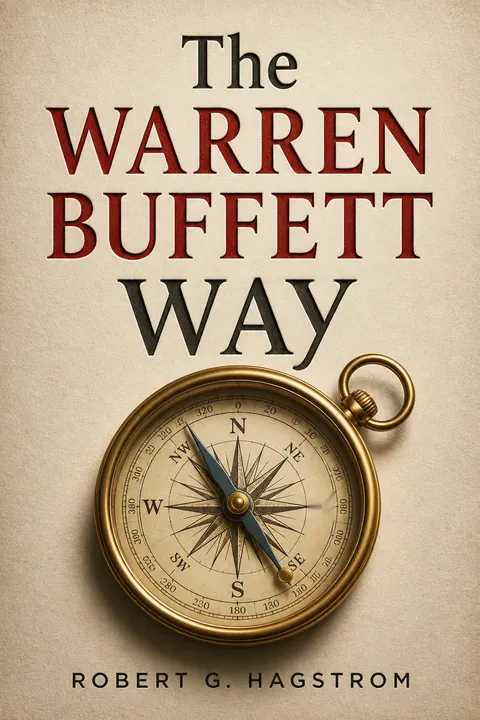
The Warren Buffett Way receives mostly positive reviews, praised for its insights into Buffett's investment philosophy and strategies. Readers appreciate the clear explanations of Buffett's principles, including focus on long-term value, understanding businesses, and staying within one's circle of competence. Some find it particularly useful for beginners, while others note its relevance for experienced investors. Critics mention the book's occasional superficiality and dry content. Overall, readers value the book for its educational content on Buffett's approach to investing and business analysis.
People Also Read






Glossary
Circle of Competence
Boundary of reliable understandingThe set of businesses, industries, and economic questions an investor understands well enough to evaluate. Buffett emphasizes that the boundary matters more than its size. Investors should avoid making confident forecasts outside it, while continuing to deepen their knowledge in areas they can assess.
Franchise
Durable competitive advantageIn Buffett’s specialized usage, a business with a product or service customers want, few close substitutes, and enough pricing power to earn attractive returns. A franchise is protected from competition by advantages such as a strong brand or distribution. The term distinguishes these businesses from commodity producers that mainly compete on price.
Owner Earnings
Cash available to ownersAn estimate of the cash a business could distribute to its owners while maintaining its competitive position and current operations. It starts with net income, adds noncash charges such as depreciation, and subtracts necessary capital expenditures and working-capital needs. The calculation is approximate because future investment requirements must be estimated.
Institutional Imperative
Companies imitate peersBuffett’s name for the tendency of organizations to preserve existing habits, spend available cash, follow the actions of competitors, and support leaders’ preferred projects. This imitation can produce irrational acquisitions, weak lending, and resistance to necessary change, even when individual employees are capable and well intentioned.
Margin of Safety
Discount protecting against errorThe difference between a security’s estimated intrinsic value and its purchase price. Buying well below estimated value provides a cushion if the analysis is imperfect or the business performs worse than expected. The concept does not eliminate risk, and its usefulness depends on a reasonable valuation and a sufficiently conservative price.
Focus Investing
Concentrated long-term portfolioA portfolio approach that commits significant capital to a limited number of businesses judged to have strong prospects and understandable economics. It favors careful research, long holding periods, and low turnover over broad, frequent trading. Because holdings are concentrated, this approach increases the effect of both sound analysis and error.
Float
Premiums held before claimsMoney an insurer receives in premiums before paying the claims and expenses associated with its policies. The insurer can invest these funds while holding them. Float is especially valuable when underwriting is profitable or inexpensive, but it is not risk-free capital because claims may be large, delayed, or difficult to predict.
Mr. Market
Emotional daily price offersBenjamin Graham’s allegorical business partner who offers to buy or sell an investor’s interest each day at a changing price. His mood swings between optimism and pessimism, so his quotes can diverge from business value. Investors may use favorable offers but should not treat his daily opinion as authoritative.
FAQ
What's The Warren Buffett Way about?
- Investment Strategies Explained: The book outlines Warren Buffett's investment strategies and philosophies, focusing on how he became one of the most successful investors in history.
- Business Fundamentals Focus: It emphasizes understanding the underlying business of any investment, rather than just trading stocks based on market trends.
- Historical Context: Provides a historical overview of Buffett's career, including key decisions and the evolution of his investment approach over decades.
Why should I read The Warren Buffett Way?
- Learn from a Master: Gain insights into the strategies of Warren Buffett, who has consistently outperformed the market.
- Timeless Principles: The investment principles are applicable regardless of market conditions, emphasizing rationality and discipline.
- Practical Guidance: Offers practical advice on evaluating businesses and making informed investment choices, valuable for both novice and experienced investors.
What are the key takeaways of The Warren Buffett Way?
- Understanding Value Investing: Emphasizes buying undervalued stocks with strong fundamentals, rooted in purchasing businesses at a discount to their intrinsic value.
- Circle of Competence: Advises investors to operate within their "circle of competence," investing in businesses they understand well to mitigate risks.
- Long-Term Focus: Advocates for a long-term investment strategy, encouraging holding onto quality businesses rather than chasing short-term gains.
What are the best quotes from The Warren Buffett Way and what do they mean?
- "Price is what you pay. Value is what you get.": Highlights the distinction between market price and intrinsic value, emphasizing understanding a business's true worth.
- "We simply attempt to be fearful when others are greedy and to be greedy only when others are fearful.": Reflects Buffett's contrarian strategy, suggesting looking for opportunities in times of market fear.
- "The most important thing to me is figuring out how big a moat there is around the business.": Refers to a company's competitive advantage, essential for long-term profitability.
What is Warren Buffett's investment philosophy in The Warren Buffett Way?
- Value Investing Approach: Focuses on identifying undervalued companies with strong fundamentals and consistent operating history.
- Management Quality: Places significant importance on the quality of management, seeking leaders who are rational and capable.
- Long-Term Perspective: Advocates for buying businesses to hold forever, emphasizing long-term value creation.
How does Warren Buffett evaluate a business before investing?
- Simple and Understandable: Prefers businesses that are easy to understand, allowing informed decision-making.
- Consistent Operating History: Looks for companies with a stable track record, indicating reliability and future performance.
- Favorable Long-Term Prospects: Assesses competitive advantages and market position for sustained profitability.
What are the management tenets that Warren Buffett values in The Warren Buffett Way?
- Rational Management: Values management teams that focus on increasing shareholder value through rational decisions.
- Candid Communication: Appreciates transparency with shareholders, discussing both successes and failures openly.
- Resistance to Institutional Imperative: Seeks managers who avoid imitating peers without critical evaluation.
How does The Warren Buffett Way define intrinsic value?
- Definition of Intrinsic Value: The true worth of a company based on fundamentals like cash flow and earnings potential.
- Calculating Intrinsic Value: Suggests using discounted cash flow analysis to estimate intrinsic value.
- Importance in Investing: Helps identify buying opportunities by comparing market price to intrinsic value.
What is the significance of the "circle of competence" in investing according to The Warren Buffett Way?
- Defined Knowledge Boundaries: Refers to areas where an investor has deep understanding, minimizing risks.
- Avoiding Mistakes: Sticking to known areas helps avoid costly mistakes from unfamiliar investments.
- Building Expertise: Encourages expanding the circle over time through knowledge and experience.
How does Warren Buffett view market fluctuations in The Warren Buffett Way?
- Exploiting Market Inefficiencies: Believes fluctuations create opportunities to buy undervalued stocks.
- Long-Term Focus Over Short-Term Noise: Advises focusing on long-term performance rather than short-term movements.
- Emotional Discipline: Stresses the importance of controlling emotions to make rational investment decisions.
What are the financial tenets that Warren Buffett considers in The Warren Buffett Way?
- Return on Equity: Looks for companies with high returns on equity, indicating efficient use of capital.
- Owner Earnings: Defines as cash available to shareholders, crucial for assessing financial health.
- Profit Margins: Evaluates how effectively a company converts sales into profits, indicating competitive advantage.
How can I apply the principles from The Warren Buffett Way to my own investing?
- Focus on Quality Businesses: Identify companies with strong fundamentals and competitive advantages.
- Conduct Thorough Research: Analyze financial statements and industry trends to understand business models.
- Be Patient and Disciplined: Adopt a long-term perspective, focusing on intrinsic value over market fluctuations.
About the Author
Other books by Robert G. Hagstrom
Download PDF
Download EPUB
.epub digital book format is ideal for reading ebooks on phones, tablets, and e-readers.








