

Key Takeaways
Follow the money into digital businesses, but demand durable economics.
Old rules missed new value. In 2014, Adam Seessel’s traditional value portfolio fell while the broader market rose. He owned companies such as Avon and Tribune Media because their shares looked cheap against assets or past earnings. But online competitors were eroding their businesses. Meanwhile, expensive-looking digital companies were gaining users, revenue, and influence. The choice, Seessel realized, was not simply between a tech bubble and sensible old-fashioned investing. It was whether established valuation habits had stopped recognizing where profits were moving.
Value investing keeps evolving. Ben Graham emphasized assets and liquidation value. Warren Buffett shifted attention toward profitable businesses with durable advantages. Seessel argues that the Digital Age demands another update: investors must understand software economics, intangible assets, and companies still investing to expand. The goal is not to buy technology indiscriminately, but to find lasting business strength where wealth is being created.
The strongest part of this argument is its insistence that investment traditions are tools, not sacred objects. A framework that once worked can become a liability when the economy changes. Yet identifying a powerful social trend is only the start: shareholders can still lose if they pay too much, misjudge competition, or mistake popularity for profit. The distinction between understanding digital adoption and forecasting a stock’s return is crucial. Seessel’s story is most useful as a lesson in intellectual flexibility, not as proof that technology shares must outperform.
Buy small shares of huge markets only when a durable edge protects growth.
Value 3.0 pairs growth with protection. Seessel’s framework looks for a company with a small share of a large, expanding market and an identifiable competitive advantage. A big market offers room to grow; the advantage gives the company a chance to keep earning as it grows. HEICO illustrates the combination. The Mendelson family built its aircraft-parts business by selling approved generic replacements at lower prices than original manufacturers. After years of proving safety, it had won the trust of airlines and regulators. Even after decades of growth, it held less than 5% of the estimated $50 billion aftermarket-spares market.
Check three dimensions. The BMP checklist organizes the decision around business quality, management quality, and price. Business quality receives the most weight, but price can veto a purchase. Seessel uses a target of at least a 5% earnings yield, equivalent to paying no more than twenty times the earnings measure he considers appropriate.
This framework usefully joins two questions often treated separately: can a company grow, and can it retain the gains from that growth? In economics, growth without barriers invites competitors to copy the opportunity and push returns down. HEICO’s record of safe delivery shows how trust can become a barrier in an industry where failure is costly. Still, a company’s stated market size is not necessarily a realistic opportunity, and a moat can weaken. Independent estimates and evidence of customer retention matter more than management’s optimistic market arithmetic.
A fast-growing product is not a moat; competitors can copy demand.
Growth alone is fragile. Vonage pioneered internet-based phone service, but rivals could imitate its technology and customers had little reason to prefer its brand. After going public at $17 per share, its stock lost more than 95% of its value before recovering only modestly. GoPro faced a similar problem: investors loved the action-camera idea, but competitors entered and GoPro lost most of its peak value. Both cases show why a growing market does not guarantee that one company will earn strong returns.
Look for defenses. Seessel describes several sources of competitive advantage: lower costs, brands, platforms that other businesses rely on, customer switching costs, early execution, and network effects. Network effects arise when a service becomes more useful as more people use it. Venmo and Airbnb illustrate the loop: more users attract more participants, making the service more valuable and drawing in still more users.
The distinction between a rising tide and a defensible business is central to sound competitive analysis. Strategy research often describes an advantage as a mechanism that preserves returns despite imitation, rather than merely a period of rapid sales. The book’s categories help readers ask what competitors would have to overcome. They should not, however, be treated as permanent labels. Brands can fade, users can migrate, and network effects can be countered by new standards or better products. The practical test is whether the company’s advantage remains visible in customer behavior and economics.
Judge managers by owner behavior and returns on capital, not charisma.
Stewardship shows up in choices. Seessel admires Tom Murphy, who ran Capital Cities with owner-like frugality. Murphy economized on executive comforts but spent heavily on newsrooms because strong local news attracted viewers and advertising. He also avoided issuing shares to fund acquisitions, which would dilute existing owners. At HEICO, the Mendelson family’s substantial share ownership aligned their financial interests with shareholders.
Know what creates value. Return on capital measures the profit produced relative to the resources invested to earn it. A manager who grows sales by pouring in ever more capital may destroy value despite impressive expansion. Seessel says executives should understand this measure, allocate money carefully, and treat shareholders as owners. His examples also warn against rewarding executives with excessive stock grants: those shares reduce existing owners’ proportionate stake.
The focus on capital allocation makes management evaluation more concrete than judging confidence, charm, or presentation skill. It also reflects a broader governance principle: incentives shape behavior, so ownership and dilution deserve close attention. Yet insider ownership is not a guarantee of good stewardship. Concentrated control can entrench poor decisions, and a frugal culture can underinvest in necessary change. Return on capital is most informative when interpreted alongside business durability and investment needs, rather than used as a single score that rewards harvesting a business at the expense of its future.
Replace reported P/E with cautious earnings power for reinvesting software firms.
Accounting can obscure investment. Under standard accounting rules, companies generally expense research, development, and marketing immediately, even when that spending is intended to build products and customers for years. A factory’s cost, by contrast, can be spread over its useful life. This can make a growing software company appear less profitable than a mature industrial business, even when its spending is productive.
Estimate the underlying capacity. Seessel calls a company’s potential profit generation in a more mature, lower-spending state its earnings power. Comparing Intuit with Campbell’s, he argues that Intuit’s investment in QuickBooks and marketing suppresses current earnings but supports future growth. His Amazon analysis projected revenue three years ahead and estimated profitability by business segment. That exercise turned an apparent multiple near ninety times reported earnings into roughly fifteen times estimated earnings power. The calculation depends on assumptions, not accounting certainty.
The key insight is that accounting measures are designed for consistency, not to capture every economic investment perfectly. Intangible assets, especially internally developed software and customer relationships, are difficult to represent on conventional statements. Adjusting for that gap can improve comparisons, but it also creates room for wishful thinking. Forecasting segment margins and deciding which costs are temporary investments require judgment. Earnings power is therefore best treated as a range of plausible outcomes, tested against conservative assumptions, rather than as a precise replacement for reported earnings.
Look for digital advantages even in paint, credit data, and discount stores.
Apply the same test beyond tech. Seessel highlights three kinds of resilient or improving businesses. Sherwin-Williams sells a product that cannot be delivered digitally and supports painters with a dense network of company-owned stores. Equifax sells credit information built from data that financial institutions provide and buy back in analyzed form; moving its systems to cloud computing could strengthen the business despite weighing on short-term profits. Dollar General serves communities where low prices and nearby stores matter, including places with few retail alternatives.
Ask what technology changes. A non-tech business may resist digital substitution, use technology to improve its service, or meet needs that online platforms do not serve well. These companies still need the same scrutiny as software firms: market opportunity, competitive advantage, capable management, and a price that leaves room for a reasonable return.
This broader application prevents the digital-economy thesis from becoming a simplistic instruction to buy software. Technology changes the competitive environment, but physical needs, logistics, trust, and local access remain important. Dollar General also shows that convenience is relative: a service that seems inferior to affluent online shoppers may be essential to customers facing distance, cost, or connectivity constraints. The caveat is that resilience is not the same as immunity. A tech-proof product can still face weak demand, rising costs, or poor management, so the investment case must rest on more than the absence of an obvious digital substitute.
Build conviction through research, then let time compound the business.
Investing is patient investigation. Seessel describes good investors as methodical researchers, not traders reacting to every market move. Start with companies encountered through work or daily life, then test those observations through filings, industry conversations, and further reading. He estimates that only about one in ten companies examined with demanding standards becomes a compelling candidate. Most should be rejected or watched until the facts or price change.
Match risk to temperament. Seessel’s friend Alex held Apple through several declines of roughly 30% and was rewarded over the long term. That example supports patience, but it does not mean every investor should concentrate their savings in a few stocks. Seessel advises readers to discover what level of concentration they can tolerate, keep other investments in an index fund or suitable fund, and add money regularly. A strategy is only useful if its owner can stick with it during a severe drop.
The process combines two advantages that are often underestimated: domain knowledge and freedom from short-term performance pressure. Familiarity can generate better questions, while patient ownership allows business results to matter more than daily sentiment. But conviction is not evidence by itself. A stock can fall because the original thesis is wrong, not merely because the market is moody. Regularly checking the facts, defining what would invalidate the thesis, and limiting exposure to what an investor can genuinely withstand make patience disciplined rather than stubborn.
Prefer wealth-producing companies over currencies, memes, and fashionable labels.
Separate an asset from a business. Seessel views Bitcoin as a potentially useful currency but not, by itself, a company that grows customers, revenues, or profits. He suggests looking instead at businesses that enable a crypto ecosystem, such as exchanges. He treats meme-stock surges similarly: coordinated buying drove GameStop and AMC sharply upward, but AMC’s declining attendance, heavy obligations, and high valuation did not support the excitement.
Test labels, too. Socially responsible and ESG funds may express legitimate values, but a label does not prove impact or attractive returns. The book cites concerns about higher fees, inconsistent definitions, and holdings that may conflict with investors’ expectations. Seessel’s proposed alternative is to evaluate companies directly and, if needed, add a personal ethical screen. His central distinction is between evidence-based ownership of a business and speculation on a price, story, or marketing category.
The book’s emphasis on cash-generating enterprises is a useful antidote to narratives that substitute social momentum for economic analysis. Yet financial value is not the only reason people hold currencies or choose screened funds. A person may rationally accept lower expected returns to express ethical priorities or hedge a particular risk. The sharper lesson is transparency: distinguish investment return, utility, and moral preference, then judge each on its own terms. Likewise, speculation can be knowingly limited, but it becomes dangerous when a lucky outcome is mistaken for a repeatable method.
Treat every moat as temporary, and monitor how technology changes the battlefield.
No advantage lasts forever. Seessel uses Sears as a warning: it once mastered mail-order retail and department stores, but failed to adapt to online commerce. Today’s leading platforms also face future competitors and changing habits. The book invokes the second half of the chessboard, a metaphor for compounding progress that begins slowly and then accelerates. As computing improves, new industries can emerge quickly and unsettle established leaders.
Watch change without panicking. Seessel argues that antitrust headlines may create buying opportunities because consumers rely heavily on major platforms and separated businesses could remain strong. But he does not claim that regulation or competitive threats are irrelevant. His investing principle is to favor companies that keep improving their products and disrupting themselves. A moat is valuable while it protects customer preference and returns, not simply because it once did.
This closing perspective makes the framework dynamic: competitive advantage is a condition to monitor, not a permanent corporate trait. The chessboard image captures how cumulative technological change can produce abrupt transitions, although computing progress does not make each predicted application or winner inevitable. Regulatory action can also reshape markets even when users value a service. The practical response is neither reflexive fear nor complacency: track product quality, customer behavior, competition, and policy. A company’s history can inform expectations, but its capacity to adapt is the more relevant evidence about its future.
Analysis
The book’s central move is to treat value investing as a method that must evolve with the economy. Graham’s asset-based analysis fit a world where corporate worth was visible in factories, inventory, and cash. Buffett’s attention to earnings, brands, and competitive advantages fit a more stable, consumer-centered era. Seessel’s proposed Value 3.0 framework extends that lineage toward software businesses with large growth opportunities, intangible assets, and substantial reinvestment. The narrative of his own shift, from cheap legacy stocks to digital platforms, gives the argument useful stakes: a low multiple can signal a shrinking future rather than a bargain.
The most valuable analytical contribution is the distinction between reported profit and a business’s possible earning capacity. Accounting rules can make long-lived investment in code, products, and customer acquisition look like current consumption. Segment analysis and comparisons with mature peers can help reveal that distortion. But the method is not mechanical. Amazon’s projected margins and Intuit’s adjusted earnings power rely on judgments about future scale, spending, and profitability. The same flexibility that corrects accounting blind spots can rationalize almost any expensive stock unless assumptions are tested against downside cases.
The book is persuasive about the importance of durable advantages and disciplined management, but its stock-picking confidence needs careful boundaries. Historical winners such as Apple and HEICO illustrate compounding vividly, while less successful companies receive less attention. A superior business can still be a poor investment at an excessive price, and diversification reduces the damage when a thesis fails. The author acknowledges temperament and index funds, though his preference for concentrated holdings may not suit most investors.
The enduring lesson is not that technology always wins, or that software metrics should replace conventional accounting. It is to connect business structure, management incentives, reinvestment, and price, then revise the analysis as evidence changes. The framework is strongest when treated as a disciplined inquiry rather than a formula promising market-beating results.
Review Summary
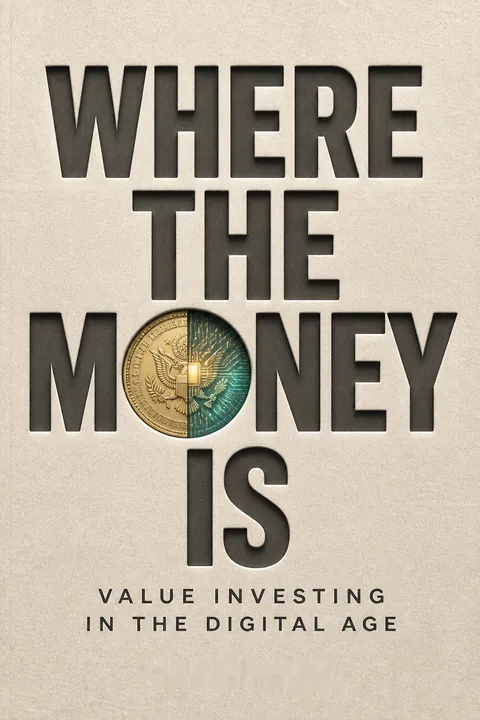
Where the Money Is presents a new framework for value investing in tech companies, dubbed "Value 3.0". Readers appreciate Seessel's insights on adapting traditional value investing principles to modern tech firms, particularly his analysis of GAAP accounting's limitations. Many found the book thought-provoking and practical, praising its clear explanations and real-world examples. Some critics felt the execution could be improved or disagreed with certain points. Overall, most reviewers recommend it as a valuable resource for investors seeking to understand and evaluate tech stocks from a value perspective.
People Also Read










Glossary
Value 1.0
Asset-based value investingThe first form of value investing described in the book, associated with Ben Graham. It evaluates a company mainly through its balance sheet, tangible assets, and potential liquidation value. Investors seek a price below a conservative estimate of what those assets could return after liabilities are paid. The method favors numerical discipline but can overlook businesses whose value comes from future earnings or intangible assets.
Value 2.0
Quality and competitive advantageThe approach associated with Warren Buffett’s move beyond Graham’s focus on liquidation value. It emphasizes a company’s ability to earn profits over time, especially when a durable competitive advantage protects those profits. Brands, low costs, and customer loyalty can support that advantage. Price still matters, but a strong business can justify paying more than traditional asset-based measures would allow.
Value 3.0
Growth, advantage, and disciplineSeessel’s proposed adaptation of value investing for the Digital Age. It seeks businesses with a small share of a large, growing market and a durable competitive advantage, evaluates whether management acts for owners and understands value creation, and tests whether the price is reasonable. It also adjusts for the way accounting can understate the profit potential of businesses investing heavily in future growth.
BMP checklist
Business, management, priceA three-part investment framework named for business quality, management quality, and price. The business questions examine market opportunity and competitive advantage. The management questions ask whether leaders act like owners and understand what drives value. Price is considered after the first two dimensions and can veto an otherwise attractive investment. Seessel uses an earnings yield of at least 5% as his general price hurdle.
earnings power
Underlying profit capacityAn estimate of a company’s potential ability to generate profits, distinct from reported earnings and from a precise forecast. The concept is especially relevant to growing digital businesses whose research, development, and marketing costs are expensed immediately, even when they may support future earnings. Analysts estimate earnings power by examining business segments, plausible margins, and growth while recognizing that the result depends on judgment.
moat
Protection from competitionA business feature that helps protect a company’s profits from competitors. Examples in the book include a low-cost position, a trusted brand, switching costs, platform control, and network effects. A moat is not simply rapid growth or popularity. It must help a company retain customers or earn attractive returns as rivals try to copy its products, lower prices, or enter its market.
network effects
More users increase usefulnessA competitive advantage that arises when a service becomes more valuable as additional people use it. More guests can attract more hosts to a rental platform, for example, and the larger selection can then attract more guests. This reinforcing cycle is also called a flywheel or virtuous circle. Network effects can support market dominance, though they do not guarantee that users will never switch.
fast-mover advantage
Early, urgent market entryAn edge gained by entering a market early or acting more quickly than rivals to establish a leading position. The book favors fast-mover over first-mover because a company need not literally invent a product to gain this advantage. Early entry alone does not preserve leadership; a company usually needs additional strengths, such as low costs, trusted products, or continuing innovation.
Mr. Market
The market’s shifting moodsBen Graham’s metaphor for the stock market as an emotional business partner who offers changing prices. At times, Mr. Market may be euphoric and offer an unjustifiably high price; at others, fearful and offer an unusually low one. Investors can treat those offers as opportunities rather than instructions, provided they judge the underlying business independently.
LTV/CAC
Customer value versus acquisition costA business measure comparing the lifetime value of a customer, or LTV, with the customer acquisition cost, or CAC. LTV estimates the revenue expected from a customer; CAC measures the spending required to win that customer. Digital companies use the ratio to evaluate marketing efficiency. The metric can reveal why customer acquisition spending may be an investment, although its usefulness depends on realistic retention and revenue estimates.
FAQ
What is "Where the Money Is: Value Investing in the Digital Age" by Adam Seessel about?
- Modern value investing focus: The book explores how value investing principles must evolve for the Digital Age, where technology companies dominate and traditional metrics often fail.
- Bridging old and new: Adam Seessel contrasts classic value investing (Graham, Buffett) with the challenges of evaluating digital businesses like Amazon and Alphabet.
- Introduction of Value 3.0: Seessel proposes a new framework—Value 3.0—that integrates business quality, management quality, and price, tailored for tech-driven markets.
- Practical tools and case studies: The book provides actionable checklists and real-world examples to help investors apply these updated principles.
Why should I read "Where the Money Is" by Adam Seessel?
- Adapting to the Digital Age: The book explains why traditional investing tools are often obsolete in today’s tech-driven economy and how to adapt.
- Learn a new framework: Seessel introduces Value 3.0, a disciplined approach for evaluating modern companies, especially those with intangible assets and rapid growth.
- Avoid common pitfalls: Readers learn to distinguish between true competitive advantage and mere growth, helping them avoid overpaying for trendy stocks.
- Real-world application: The book’s case studies and checklists make it practical for both novice and experienced investors.
What are the key takeaways from "Where the Money Is" by Adam Seessel?
- Value investing must evolve: Traditional metrics like P/E and price-to-book often misprice tech companies; investors need new tools.
- Focus on moats and management: Long-term success comes from identifying companies with durable competitive advantages and high-quality management.
- Price is still crucial: Even the best business can be a poor investment if bought at too high a price; adjusted earnings power is key for valuation.
- Compounding and patience: Holding superior businesses for the long term allows compounding to work, even through market volatility.
How does Adam Seessel define Value 1.0, Value 2.0, and Value 3.0 investing in "Where the Money Is"?
- Value 1.0 (Graham): Focused on buying stocks below liquidation value, emphasizing tangible assets and margin of safety.
- Value 2.0 (Buffett): Shifted to prioritizing business quality, durable moats, and management, using current earnings for valuation.
- Value 3.0 (Seessel): Adapts to the Digital Age by focusing on business and management quality, and using adjusted earnings power to value tech companies.
- Evolution of metrics: Each stage reflects changes in the economy, from asset-heavy to intangible, tech-driven businesses.
What is the BMP (Business, Management, Price) checklist in "Where the Money Is" and how does it work?
- Business quality: Assesses if the company has a durable competitive advantage and a small share of a large, growing market.
- Management quality: Evaluates whether executives act like owners, understand value drivers, and allocate capital wisely.
- Price as a veto: Ensures the stock is priced to yield at least a 5% earnings yield (20x multiple or cheaper), using adjusted earnings power.
- Systematic evaluation: The BMP checklist helps investors consistently identify superior companies in the digital economy.
How does Adam Seessel define and use "earnings power" for valuing tech companies in "Where the Money Is"?
- Adjusts for growth investments: Earnings power accounts for R&D and marketing expenses that GAAP accounting immediately expenses, which depresses reported profits.
- Projects future profitability: Seessel looks several years ahead, estimating what a company could earn once growth investments normalize.
- Segment analysis: He assigns realistic operating margins to different business segments, as with Amazon and Alphabet, to better estimate true earnings.
- Enables fair valuation: This approach allows apples-to-apples comparisons between tech and traditional companies.
Why do traditional valuation metrics fail for tech companies, according to Adam Seessel in "Where the Money Is"?
- Accounting distortions: GAAP accounting penalizes tech companies by expensing R&D and marketing immediately, making P/E ratios misleading.
- Heavy reinvestment: Tech firms prioritize growth, so reported earnings understate their true profitability and future potential.
- Asset-light models: Software and platform businesses have few physical assets, making price-to-book and similar metrics irrelevant.
- Need for adjustments: Seessel advocates for adjusting earnings to reflect economic reality, not just reported numbers.
What are the main types of competitive advantage ("moats") discussed in "Where the Money Is" by Adam Seessel?
- Low-cost producer: Companies that can deliver goods or services cheaper than competitors, crucial in commoditized industries.
- Brands: Strong customer loyalty and pricing power, though vulnerable to changing tastes and media shifts.
- Platforms and switching costs: Ecosystems that lock in customers, such as Apple’s iPhone or Microsoft Office.
- First-mover and network effects: Early or rapid market entry and products that become more valuable as more people use them, like Facebook or WhatsApp.
How does Adam Seessel suggest investors evaluate management quality in "Where the Money Is"?
- Owner-like mindset: Great managers prioritize long-term shareholder value and avoid self-enrichment.
- Understanding value drivers: Effective leaders focus on return on capital and smart capital allocation.
- Discipline and transparency: Data-driven decisions, wise investments, and clear communication are hallmarks of quality management.
- Aligned incentives: Modest compensation and significant ownership stakes indicate alignment with shareholders.
How does "Where the Money Is" by Adam Seessel explain the impact of GAAP accounting on tech company valuations?
- Industrial Age bias: GAAP favors asset-heavy companies by allowing depreciation, while tech firms must expense R&D and marketing immediately.
- Depressed reported profits: This accounting treatment makes tech companies look less profitable than they are in reality.
- Distorted valuation metrics: Investors relying on GAAP numbers may wrongly conclude that tech stocks are overvalued.
- Seessel’s solution: He recommends adjusting financials to better reflect the true economic value of tech investments.
What are some examples of companies analyzed using the BMP and earnings power concepts in "Where the Money Is"?
- Amazon: Seessel projects future revenues and assigns realistic margins, revealing Amazon’s true earnings power is much higher than reported.
- Alphabet: The analysis highlights Alphabet’s multiple platforms and network effects, adjusting margins to uncover undervaluation.
- Intuit: Seessel distinguishes between mature and high-growth segments, adjusting for growth rates and margins to make a confident investment.
- Case study approach: These examples show how to apply the BMP and earnings power frameworks to both tech and non-tech companies.
What advice does Adam Seessel offer for younger and older investors regarding technology and investing in "Where the Money Is"?
- For younger investors: Focus on mastering investment techniques and long-term discipline, not just technology trends or trading apps.
- For older investors: Embrace learning about tech companies and engage with younger generations to understand new industries.
- Intergenerational learning: Both age groups have knowledge gaps; bridging them is essential for success in the Digital Age.
- Continuous learning: Seessel encourages ongoing education, industry engagement, and expanding one’s circle of competence.
What are the best quotes from "Where the Money Is" by Adam Seessel and what do they mean?
- Ben Graham on adaptation: “As a newcomer… I could respond readily to the new forces…”—emphasizes the need for fresh perspectives in changing markets.
- Warren Buffett on moats: “The key to investing is… determining the competitive advantage… and the durability of that advantage.”—underscores the centrality of moats.
- Peter Lynch on common sense: “Use your own everyday experience and common sense…”—encourages leveraging personal knowledge and patience.
- Adam Seessel on pragmatism: “I recalibrated my instruments… I did it for the same reason Willie Sutton robbed banks: it’s where the money is.”—highlights the practical motivation for adapting investment strategies.
Download PDF
Download EPUB
.epub digital book format is ideal for reading ebooks on phones, tablets, and e-readers.








