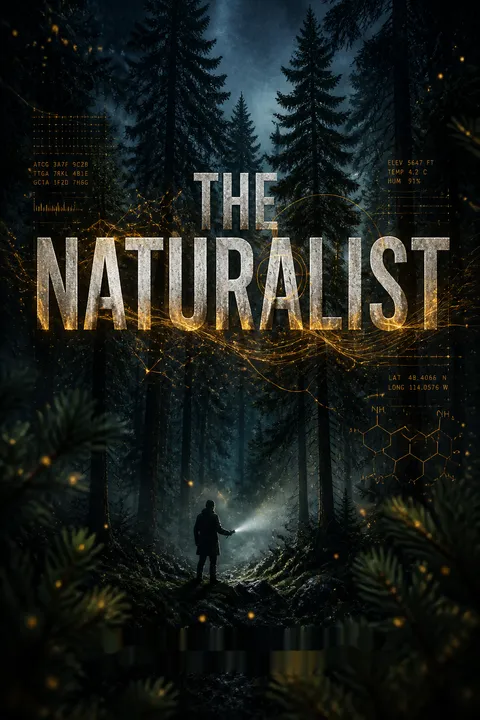


Plot Summary
The Forest Takes Shape
During a 1989 cross-country hike, college student Kelsie waits at a forest campsite while her boyfriend, Trevor, walks away to relieve himself. When he does not return, she follows his trail and finds one of his boots abandoned beneath a root. Back at the tent, she sees a dark shape appear between the trees and vanish when she looks again.
The woods seem to shift around her. Something launches from the shadows, pins Kelsie down, and slashes her with claws. As she lies bleeding, she cannot identify the creature or understand why it watches her instead of fleeing. Trevor remains missing, and the opening leaves the attack unexplained.
The book opens by making the forest an unreliable witness. Kelsie notices concrete signs, a missing boyfriend, a misplaced boot, a shape that disappears, but each clue resists ordinary explanation. Her fear is intensified by the absence of a clear motive: the attacker does not simply strike and retreat. This scene plants the novel's central problem of classification. When violence resembles animal behavior, people may accept a supernatural or natural explanation before asking whether a human has learned to exploit that uncertainty.
A Professor Becomes Suspect
Years later, biologist and computational researcher Theo Cray steps outside his Montana motel to fetch ice and finds an armed police operation aimed at a nearby room. Officers cuff him, search him, and take him in without explaining why. Detective Glenn tests Theo with photographs from several cases, watching how he reacts to injuries and how he sorts the images.
Theo groups pictures from Juniper Parsons's crime scene by subtle clues, including weeds and photographic distortions, before he recognizes a hand in one image. Juniper was once his student, though they had not spoken in years. Her death has made him a suspect, and his unusual detachment makes him look more incriminating than he understands.
Theo's first appearance establishes that his intelligence is both an investigative instrument and a social liability. He notices patterns before he identifies the person those patterns concern, a sequence that makes his reasoning look cold to people who expect emotion to appear first. Glenn's controlled interview exploits this gap without needing to bully him. The scene also establishes a conflict between evidence and legibility: Theo may be innocent, but he does not know how to perform innocence in a way the authorities recognize.
The Bear Is Hunted
Glenn explains that Juniper was mauled and dragged through the woods, and that physical evidence points to a grizzly. Theo learns she was researching isolated ecosystems, a subject connected to his own teaching, and remembers encouraging her to explore the natural world. He blames himself for failing to teach her how dangerous fieldwork could be.
When Fish and Wildlife trackers kill a large bear believed responsible, Theo goes to see it, but the dead animal inspires pity more readily than revenge. At the scene he receives a vial of Juniper's blood by mistake and keeps it. Later, he calls her mother, learns how much Juniper valued his teaching, and promises to investigate whether authorities killed the right bear.
Theo's grief arrives as a delayed cognitive process rather than a public display, which makes him judge himself against a social script he cannot easily follow. His guilt is concrete: he remembers teaching curiosity without giving equal weight to field safety. The dead bear complicates the desire for revenge, because Theo can see both Juniper's loss and the animal's accidental place in it. Taking the blood sample crosses a boundary, but it also gives Theo a task he can manage: turn mourning into a question that can be tested.
Two Bears, One Crime
With rapid DNA analysis arranged by philanthropist Julian Stein, Theo identifies hair from Juniper's wounds as belonging to Ripper, a grizzly recorded as dead the previous year. The bear killed by Fish and Wildlife is a different animal, Bart, whose DNA appears nowhere at Juniper's scene.
Theo takes this finding to Sheriff Tyson, Glenn, and bear researcher Dr. Kendall, arguing that someone planted old hair and made Bart look guilty. Kendall says Ripper's hair is likely contamination, and the officials treat the case as closed.
When Theo insists that Juniper was murdered, Tyson has him locked up, then orders him out of the county. Theo leaves furious, carrying an unsupported theory and the first clue that a human killer may be hiding behind nature.
The DNA contradiction is a genuine scientific anomaly, but Theo's leap from contamination to deliberate staging is not yet persuasive to anyone else. The authorities are not irrational to demand stronger proof; their failure is treating the most convenient explanation as sufficient. Theo's insistence also reflects his own vulnerability to a favored pattern. Yet the threat implicit in the data is real: if a killer can borrow an animal's signature, conventional investigation may close the case precisely when it should widen.
The Circuit of Missing Women
Alone in a motel, Theo maps Juniper's movements and uses MAAT, his adaptive pattern-finding program, to compare missing-person reports with population and highway data. The software traces a predator-like route through parts of Montana and Wyoming where people disappear more often than expected.
One point leads him to Hudson Creek and Chelsea Buchorn, a young woman whose friend reported her missing. Theo finds the town damaged by meth, weak policing, and quiet local corruption.
He tries to meet Amber Harrison, Chelsea's friend, but misunderstands her coded message and arrives at a setup involving her boyfriend and another man. They beat him and take his money. Theo is bruised, but the encounter also reveals how easily outsiders and vulnerable locals can be misread or exploited.
MAAT does not identify a person; it makes neglected absences visible as a spatial pattern. That distinction matters because the data are built from uneven attention. People with families, stable work, and social standing generate records, while those on society's edges can vanish without creating institutional urgency. Hudson Creek embodies the same failure at a local scale: its corruption is ordinary enough to be mistaken for background. Theo's beating is not a clue to the murder, but it teaches him that the town's vulnerabilities are active forces, not merely points on a map.
Amber Remembers the Shadow
Former educator Gus Wheeler explains Hudson Creek's history of vice, compromised officials, and young people abandoned to drugs. Theo returns to Amber, who finally describes the night Chelsea disappeared: while the two friends were walking in the woods, Amber saw a figure move like a man and then attack Chelsea. Devon, Amber's boyfriend, accompanies them when she takes Theo to the site.
Theo notices three kinds of plants growing together in a patch where the soil appears disturbed, an unusual mix that can follow digging. Devon fetches a shovel, and the first few scoops expose Chelsea's blue coat and a human arm. Theo covers the grave again to protect the remains and takes the coat to the police.
Amber's testimony gains force not because she suddenly becomes a flawless witness, but because Theo finally gives her time to describe what she saw without reducing her to her reputation. Her fear and guilt coexist with her memory of a figure that behaved unnaturally. Theo's botanical inference supplies a second, independent route to evidence, joining lived testimony to environmental traces. The discovery is both vindication and fresh injury: Amber is no longer dismissed as a liar, but the truth she has been trying to preserve is that her closest friend is dead.
A Body, Then a Beating
Hudson Creek police accept the coat and Theo's account, but later officials classify Chelsea's wounds as an animal attack, repeating the failure that buried Juniper's case. Theo sneaks into the medical examiner's van to collect samples before the body is moved, hoping to compare bacteria and other traces from the wounds.
Officer Gunther catches him and beats him severely. Theo wakes in hospital with his jaw wired and learns that Gunther has told colleagues he rescued him, rather than admitting to the assault.
Gunther later leaves Theo's samples with his belongings. The episode leaves Theo physically injured and still without official support, but his conversations with diner owner Jillian and Gus give him a local foothold and a reason to continue.
The institutions' mistake is not simply that they overlook evidence; they repeatedly translate disturbing evidence into familiar categories. A bear attack is an answer that ends work, while a human predator would require confronting years of missing people and local neglect. Theo's trespass is ethically compromised, but his urgency comes from recognizing that official handling may erase the very traces needed to challenge that conclusion. Gunther's violence makes the cost of pressing the case bodily immediate. Jillian and Gus offer a counterweight: care grounded in practical attention rather than credentials.
The Monster's Old Hunting Ground
After recovering, Theo returns to the field with better equipment and Gus's reluctant help. He finds Summer Osbourne, then locates several more women buried in isolated ground; their injuries and placement suggest that the killer has repeated his method for years.
Dr. Seaver, an anthropologist, shows Theo weapons designed to imitate claws, while an old account points him toward the Cougar Creek Monster, a 1983 encounter in which campers described a bipedal attacker. Elizabeth Collins, one of those campers, recalls it dragging her from a tent and clawing another student. With Jillian, Theo searches the ravine and finds metal scratches in a cave, then human ribs in a hot spring. The old legend now contains physical evidence.
This section turns folklore into a research question rather than accepting it as either truth or nonsense. The old campers' story matters because it records a behavioral precursor: an attacker experimenting with animal imitation before becoming harder to see. The hot spring adds evidence that does not fit the later burial pattern, suggesting the killer adapted his disposal methods. Theo's work is increasingly dangerous because his knowledge now reaches beyond isolated cases toward a history of violence. Jillian's presence also shifts the investigation from solitary observation toward shared risk.
Sarah's Scars Point Back
Dr. Mead notices that one older victim, Sarah Eaves, had healed claw-like wounds years before her death. Theo speaks with Sarah's son, who believes she would not have abandoned him voluntarily, then traces her youth to a foster home run by Jack and Julie Lane. Julie denies knowing how Sarah was injured and becomes alarmed when Theo shows her a clawed weapon.
A recording captures her calling someone after he leaves. Theo returns at night and discovers a hidden field of old cars, several matching vehicles owned by missing hikers from the 1980s. He reports the connection, but the woods catch fire and Julie is found dead. The evidence points toward a surviving foster child who has learned to erase witnesses and traces.
Sarah's scars make the past legible through the body, linking a vulnerable childhood to a later pattern of violence without yet explaining every step. Julie's evasions and the cars reveal that concealment has been built into the killer's history: victims are not merely attacked, but removed from ordinary systems of recognition. The fire and Julie's death escalate the investigation from retrospective research to immediate danger. Theo's habit of following clues alone has finally brought him close enough that the person he seeks can react to him.
The Confession That Isn't
Child welfare records identify the former foster child as Joshua Lee Clark, whose mother was murdered before he entered care. Before Theo can act on the name, Clark calls and orders him to destroy his notes, confess to Julie's murder and the other killings, then shoot himself. He threatens Jillian, Gus, Theo's family, and his students to make the demand credible.
Theo decides a direct appeal to police could expose them, so he steals the body of Christopher Dunleavy, a recently deceased man, and stages a shotgun suicide in his own clothes. He uploads a fabricated confession and watches the news report his death. Once presumed dead, Theo uses public records and MAAT to search for Clark without drawing him toward the people he loves.
Clark's threat weaponizes the very logic Theo trusts: he presents killing as a practical decision and makes Theo calculate which lives can be protected. The false confession is therefore not just a disguise, but an attempt to manipulate the same institutional appetite for a simple, satisfying explanation that has already hindered the investigation. Theo's choice to desecrate Dunleavy's body is morally costly and strategically desperate. His staged death also separates him from ordinary accountability, giving him room to investigate while making his own identity unstable.
The Tow Truck's Shadow
While presumed dead, Theo reviews the routes, missing cars, and places where stranded travelers would need help. He realizes Clark's access to victims may come from roadside recovery work: a tow operator can meet people when they are isolated, hear their stories, and remove their cars without attracting notice.
Theo rushes to Jillian's home, where police have already assembled, and names local tow operator Joe Vik as the likely threat. The officers know Vik as a respected businessman and hesitate to accept the accusation.
Before they can secure him, reports arrive that officers are down at Vik's home, along with his wife and stepdaughters. Vik escapes, and Theo warns that the assault is moving toward them. The group takes to the road, but Vik intercepts their convoy.
The solution is powerful because it makes predation look like service. A tow operator occupies a socially trusted role at the exact moment a traveler is least able to refuse assistance. Theo's deduction depends not on a secret lair or exotic weapon, but on noticing how an ordinary job connects isolated people, vehicles, and geography. The police struggle to accept the conclusion because Vik's civic reputation is evidence in their minds, even though it is precisely the sort of visibility that can conceal a person. The delay gives him time to strike.
A Predator Bleeds
Vik crashes the convoy, shoots at the trapped survivors, and wounds Detective Glenn, Theo, and a responding officer. When Vik drags Jillian away, Theo injects himself with stimulants and adrenaline from the ambulance supplies, forcing his injured body back into motion. He pursues Vik into the woods with one shotgun shell and improvised syringes.
The drugs do not make Theo a trained fighter; they buy him the seconds needed to distract Vik and drive a sedative into his neck. Vik overpowers him and leaves him bleeding, but Theo had also hidden blood bags beneath his clothes. As Vik falters, Jillian takes the shotgun and kills him. Medics carry Theo away, and his fading awareness folds Juniper's face into Jillian's.
The climax reverses Theo's customary role as observer, but it does not transform him into a competent action hero. He survives by improvising with the tools he understands, accepting that his body is expendable and that chemical intervention has a terrible cost. Vik's apparent invulnerability depends on controlling the pace and terror of each encounter; Theo disrupts that script long enough for Jillian to act. Her decisive shot completes a partnership rather than a rescue fantasy. The final merged image of Juniper and Jillian binds grief to renewed attachment, while leaving Theo's recovery unresolved.
Analysis
The novel turns ecological thinking into a method for reading crime. Theo's professional insight is that systems produce patterns: populations regulate themselves, species occupy niches, and movement leaves traces across space. His breakthrough comes when he recognizes that missing people can form a predator's route, but the analogy is not itself proof. The story repeatedly tests the difference between a useful model and an unquestioned explanation. Theo must revise his reasoning as new evidence arrives, from the bear DNA to Amber's testimony, disturbed soil, old car remains, and the hot-spring skeleton.
The central horror is not simply that a killer imitates an animal. It is that institutions and communities help the imitation work. Juniper's death is closed as a bear attack; Chelsea is dismissed as someone who left town; vulnerable women generate fewer urgent searches. Hudson Creek's corruption and poverty make disappearance easier to misread, but the novel also resists turning its residents into scenery. Amber, Devon, Gus, Jillian, and Sarah's son have their own loyalties, compromises, and forms of care. Their testimony and help supply knowledge that data alone cannot provide.
Theo's emotional development follows the same movement from abstraction toward relation. At first, he notices blood patterns and DNA before he can process whose blood it is. His guilt about Juniper is entangled with his failure to know her, while his later connection with Jillian makes the investigation harder to compartmentalize. Yet he never becomes a conventional detective or fighter. He acts through scientific improvisation, often recklessly, and survives only because other people contribute skills he lacks. The ending therefore does not endorse solitary genius. It shows that patterns can reveal where to look, but witnesses, allies, and moral responsibility determine what anyone does once they arrive.
Review Summary
The Naturalist received mixed reviews, with many praising its unique scientific approach to crime-solving and fast-paced plot. Readers enjoyed the protagonist, Theo Cray, for his intelligence and awkward charm. Some found the science fascinating, while others felt it was too technical. Critics pointed out plot holes and implausible scenarios, particularly in the finale. Despite these issues, many readers found the book entertaining and addictive, appreciating its blend of science and thriller elements. Overall, it was a polarizing read that left some eager for the sequel and others disappointed.
Characters
Theo Cray
The pattern-seeking biologistTheo is a computational biologist whose talent lies in connecting systems that other people treat as unrelated. He studies genetic data, ecosystems, and population behavior, then applies the same habits to crime. His emotional life is real but often arrives late and remains difficult for him to communicate, leaving him vulnerable to being misread as indifferent or evasive. He is also stubborn, distractible, and prone to treating people as data before recognizing their personal significance. His investigation forces him to move beyond intellectual certainty: he must learn to trust witnesses, accept help, and act in a world where a correct inference does not automatically protect anyone.
Jillian
The grounded former soldierJillian runs a diner in Hudson Creek and carries the practical composure of someone shaped by military service and personal loss. She meets Theo after his bruising encounter with Amber's circle and responds to him with a mix of blunt humor and compassion. Unlike Theo, Jillian reads social situations quickly and knows that danger is not an abstract possibility in the town where she lives. Her attraction to Theo does not make her a passive companion; she challenges his tendency to withdraw into analysis and chooses for herself how close to get to his investigation. She represents intimacy grounded in action, not the promise that affection can make risk disappear.
Juniper Parsons
The adventurous young scientistJuniper was Theo's former student, a zoology scholar whose interests led her toward field research and isolated ecosystems. She admired Theo's interdisciplinary approach and pursued scientific questions beyond the classroom, though he knew little about the work she later undertook. Through her mother and the fragments of her research, Theo gradually encounters a fuller person than the student he remembers: capable, curious, and more experienced outdoors than his first assumptions allowed. Juniper functions as both a personal connection and a challenge to Theo's self-image as a responsible teacher. Her story reminds him that intellectual encouragement has consequences when it sends students into the world.
Joe Vik
The familiar tow operatorJoe Vik is a large, quiet local businessman whose towing work and community presence make him familiar across the region. He sponsors local activities and appears rooted in ordinary civic life, the kind of person others feel they already understand because they see him often. That familiarity is part of what makes him difficult to assess from a distance. Theo's investigation raises questions about how trust, access, and routine can overlap in a small community. Joe is associated with the practical infrastructure of travel: the roadside, the stranded car, and the person who arrives when a stranger has few alternatives.
Detective Glenn
The patient interrogatorGlenn is a seasoned detective who uses calm conversation and careful observation rather than theatrical intimidation. He notices the gap between Theo's unusual intelligence and his limited ability to read people, and he tests that gap throughout their early encounters. Glenn's experience as a military spotter informs his patience and his attention to what others overlook. Though he can be manipulative and occasionally cruel in his probing, he is not simply an antagonist to Theo. He provides a grounded counterpoint to the professor's theories, representing practical knowledge acquired from years of dealing with real people.
Amber Harrison
The disbelieved witnessAmber is Chelsea's longtime friend, a young woman living amid addiction, precarious relationships, and the neglect of Hudson Creek. Her choices make her an unreliable witness in the eyes of the authorities, but they do not erase what she remembers. She carries guilt over running from the woods and anger at a town that dismissed her account. Her bluntness and defensive humor can conceal fear, while her willingness to return to the place where Chelsea vanished reveals the depth of their friendship. Amber is not a neat symbol of innocence or corruption; she is a person trying to remain heard in circumstances that teach others not to listen.
Gus Wheeler
The stubborn former educatorGus is a retired school principal who continues tutoring children after Hudson Creek's school closes. He sees the town's drug economy and civic corruption as the result of long neglect, not a sudden moral collapse. His concern for young people is practical and persistent, shaped by a teacher's refusal to abandon students once they become difficult. Gus befriends Theo and offers both local knowledge and training, while warning him that research cannot substitute for survival skills. His role is to make care tangible: he feeds, instructs, and challenges Theo rather than merely approving of his intentions.
Sheriff Tyson
The hard-edged sheriffTyson leads the county investigation with a forceful, unsentimental manner. She is focused on securing evidence and maintaining control, especially when Theo's claims threaten to send an already complicated case in a new direction. Her skepticism is shaped by law enforcement procedure and pressure to provide answers, but it can harden into premature certainty. Tyson represents the authority Theo must persuade, not merely defy. Her interactions with him expose how institutional confidence can protect a community while also closing it off from explanations that seem implausible.
Devon
Amber's volatile boyfriendDevon is Amber's boyfriend, a sharp-minded young man whose drug use and unstable surroundings obscure his interest in science. He initially participates in the violence against Theo, then accompanies Amber and Theo into the woods. His abrasive jokes and bravado mask insecurity, and his fascination with biology gives him unexpected common ground with Theo. Devon is shaped by a town that offers few futures and by relationships conducted through suspicion and provocation. He is neither merely comic relief nor a simple threat; his shifting cooperation shows how people can act badly while still caring about someone.
Julian Stein
The science philanthropistJulian is a wealthy technology entrepreneur and philanthropist who funds Theo's work and values the freedom scientific curiosity gives him. He can move resources quickly, including access to a rapid DNA laboratory, but his efficiency and privilege create a different distance from ordinary institutions. Julian recognizes that Theo needs a scientific problem to focus on, even when grief is the deeper issue. Their relationship is helpful rather than intimate: Julian supplies tools and pressure, while Theo supplies the questions. He embodies the way private wealth can accelerate research that public systems have not yet made available.
Dr. Mead
The blunt medical examinerDr. Mead is Montana's state medical examiner, an experienced scientist forced into a demanding public role after institutional disarray. She is impatient with imprecision and unapologetic about asking for the samples she needs. Her manner can be abrasive, but her expertise gives Theo an ally who examines bodies rather than settling for convenient labels. Mead's attention to an old set of scars opens a path into a history that routine case files had left unexplored. She combines professional rigor with a dark, practical humor suited to work where euphemism can obscure facts.
Chelsea Buchorn
The missing young womanChelsea grew up in Hudson Creek and shared a long friendship with Amber. The town remembers her through conflicting impressions: a troublesome girl, a loyal friend, and someone who may have left for a new life. Her online photographs capture a quiet attention to landscapes and animals, while Amber's memories reveal a childhood built on shared games and private names for the world around them. Chelsea's life is shaped by limited opportunity and the judgments of adults who assume they know what became of her. Her case exposes the danger of treating a person's disappearance as a choice simply because that explanation is convenient.
Summer Osbourne
A young missing travelerSummer is one of the young women whose disappearance draws Theo deeper into the pattern. Her family circumstances and age place her within the population that investigators can overlook when a person seems to have left voluntarily. Theo encounters her not through a personal relationship but through the data and geography surrounding her absence. Her presence broadens the case beyond Juniper and Chelsea, forcing Theo to understand that every statistical marker represents a life with family, habits, and plans.
Sarah Eaves
A troubled former foster childSarah spent part of her adolescence in foster care before leaving the system as a teenager. Later records reduce her to arrests, drug use, and a death ruled accidental, but her son remembers a devoted mother who made time for him while working. The contrast between those versions drives Theo to ask what her records omit. Sarah's old injuries link her childhood to a wider history of violence, while her story illustrates how a difficult life can make authorities less likely to investigate a suspicious ending.
Elizabeth Collins
The haunted former camperElizabeth was a teenager on the 1983 camping trip associated with the Cougar Creek Monster. Decades later, she has built a settled life but retains a clear memory of being pulled from her tent by a figure that moved like an animal. She initially dismisses the event as a hoax, partly because the story was distorted and ridiculed after it became public. Her testimony becomes useful when Theo approaches it as a witness account rather than a legend. Elizabeth shows how fear can persist even when a community finds it easier to laugh.
Julie Lane
The former foster motherJulie ran a foster home with her husband, Jack, caring for teenagers whom she describes as troubled but manageable. She presents herself as protective and strict, yet becomes guarded when Theo asks about Sarah Eaves and a set of old injuries. Her loyalty to the household's past complicates the account she gives outsiders. Julie's character occupies the uneasy space between caregiver and keeper of secrets, raising questions about what adults notice, what they excuse, and how a child can remain unseen inside a home meant to protect them.
Kelsie
The stranded camperKelsie is a college student who joins her boyfriend Trevor on a cross-country hiking trip despite her parents' disapproval. She is inexperienced outdoors and reluctant to admit when she is frightened. Her attempt to follow Trevor into the dark forest leaves her isolated at the campsite, where she encounters an attacker she cannot identify.
Trevor
Kelsie's absent boyfriendTrevor is Kelsie's journalism-major boyfriend, a lanky student with whom she shares music, games, and a desire for independence from their families. His temper and confidence in the outdoors make Kelsie hesitant to challenge him. During their hike, he walks away from camp and does not return.
Frank
The small-town ministerFrank is the Baptist minister in Hudson Creek, where he also tends the church grounds. He offers Theo tea and a limited account of Chelsea's reputation, reflecting the judgments and assumptions common in town. His own family life has been strained, giving his advice a complicated distance from the people he serves.
Dr. Seaver
The anthropologist of violenceDr. Seaver studies violence across cultures and historical periods. He shows Theo skulls bearing blunt-force trauma and weapons designed to imitate claws, helping him distinguish symbolic animal imagery from practical killing methods. His work gives Theo a historical frame for understanding how human violence borrows from the natural world.
Plot Devices
MAAT
Maps a predator's routeMAAT is Theo's adaptive pattern-recognition program, built to identify relationships among large and uneven data sets. Theo applies it to missing-person reports, population patterns, road networks, and geography. Its output does not name a culprit; it marks locations and routes where disappearances occur more often than expected. That result gives Theo a way to search beyond individual cases, but the program is only as reliable as the information and assumptions entered into it. It therefore acts as both investigative instrument and warning against confusing probability with proof.
Bear DNA
Breaks the false explanationHair recovered from Juniper's wounds carries genetic material that Theo compares against bear databases. The match points to Ripper, an animal believed to have died the previous year, while the bear killed by Fish and Wildlife is identified as Bart. The mismatch unsettles the official conclusion that Bart attacked Juniper. Later, physical evidence and further victims support Theo's suspicion that animal traces have been used to disguise human violence. Genetic analysis turns a seemingly closed wildlife case into the opening of a larger murder investigation.
Disturbed vegetation
Finds concealed gravesTheo uses his knowledge of plant competition to notice places where species that normally suppress one another grow together. Recently disturbed soil can reset the local conditions and allow several plants to take hold at once. In Chelsea's case, this odd mixture helps narrow a broad patch of woods to a likely burial site. Theo later learns to recognize similar ground patterns in other locations. The clue is not a magical sign that plants grow over corpses; it is an ecological consequence of digging that becomes useful when combined with a witness's directions and other evidence.
Animal imitation
Conceals human violenceThe killer's attacks imitate animal claws and appear in settings where a bear or large cat can plausibly be blamed. Animal hair, violent wounds, remote terrain, and bodies hidden or buried reinforce that interpretation. Earlier accounts of a bipedal creature and weapons designed to resemble claws suggest that the method developed over time. The disguise exploits both instinctive fear and institutional habit: witnesses doubt their own perceptions, while investigators can close a case by naming a familiar animal. It is a behavioral mask, not evidence of a supernatural creature.
The false confession
Buys Theo timeAfter the killer threatens people Theo cares about, Theo steals a recently deceased man's body, stages a shotgun suicide, and distributes a fabricated confession accepting responsibility for the murders. The plan is intended to convince the killer that Theo is dead and keep him from targeting his friends while Theo searches for him. It also exploits the authorities' appetite for a simple explanation. The deception is ethically serious, risks further harm to the dead man's family, and can only delay discovery. It gives Theo a short window, not a clean escape.
Download PDF
Download EPUB
.epub digital book format is ideal for reading ebooks on phones, tablets, and e-readers.








