

Key Takeaways
Stop turning self-improvement into proof that a better self exists
The target is an idea. The book argues that the self people try to improve is not a stable inner object, but a story assembled from thoughts, memories, emotions, and beliefs. The egoic mind is this stream of self-description mistaken for a solid identity. Improvement projects often reinforce it: the mind invents a gap between who someone is and who they should become, then promises to close that gap through more effort.
Notice, rather than fix. The author is not recommending that readers suppress thought or abandon practical change. He suggests noticing ambition, anxiety, and self-judgment as mental events, not final facts about a person. Meditation, yoga, or spiritual practice can become further self-improvement projects if their purpose is to produce a superior self. The proposed shift is modest: reduce the authority of the self-story, rather than pursue permanent bliss.
The useful distinction is between changing behavior and trying to perfect an imagined essence. Psychology can support real change without requiring a fixed, flawless self: a person can learn a skill, repair harm, or seek treatment while holding identity more lightly. This resembles cognitive defusion, a method in acceptance-based therapy that helps people notice thoughts without treating them as commands. The argument becomes less convincing if read as saying that no self exists at all. A changing narrative self is not the same thing as no embodied person, history, or responsibility.
Treat your explanations as interpretations, not reality itself
The mind fills gaps. The left-brain interpreter is the book's name for a process that creates explanations for events, often without access to all the evidence. In split-brain research, one patient saw a chicken-related image with one side of the brain and a snowy scene with the other. When asked why a hand had selected a shovel, the speaking side invented a plausible chicken-coop explanation, though it had not seen the snow scene.
Plausible is not proven. The book uses this research to suggest that everyday explanations also arrive with more confidence than their evidence warrants. A racing heart may be interpreted as fear, anger, or attraction depending on the situation. The exercise is to hear an inner judgment as a guess: a colleague's look may mean hostility, but the look itself does not establish that story.
This account captures a robust feature of human reasoning: explanations are often generated after a choice or reaction, then experienced as its cause. Predictive-processing theories likewise describe perception as an active interpretation constrained by incoming signals, rather than a passive recording. That makes the book's practice valuable in conflict, where a confident account can harden into accusation. Still, split-brain findings do not show that every explanation is invented or that reasoning is useless. The interpreter can be wrong, but it also helps people coordinate, learn, and correct their models when new evidence arrives.
When you fight a thought, you often give it more fuel
Resistance can amplify. The law of invincible opposition is the author's term for the tendency of effortful resistance to intensify the thought or feeling being resisted. Trying not to think of a number makes it salient; trying to force sleep can keep someone alert. The same pattern can appear in spiritual ambition: trying to eliminate the ego turns ego-elimination into another identity project.
Observe the loop. The book does not claim that every intention produces its opposite. Its practical point is narrower: efforts to escape an unwanted inner state can keep attention fixed on it. When anxiety appears, the instruction is not to order it away, but to notice the added thought that anxiety must stop. Victor Frankl's paradoxical intention, as described in the book, used this reversal by asking a sweating patient to try to sweat more, easing the pressure to prevent it.
Thought suppression research offers a close parallel: monitoring whether a forbidden thought has returned can keep that thought active. Acceptance-based therapies use a different response, allowing an unwanted feeling to be present while attention returns to chosen action. This does not mean acceptance always makes distress vanish, or that people should tolerate danger or injustice. The book's principle works best as a guide to inner struggle, not as a universal rule about behavior. Sometimes effort is necessary; the question is whether the effort addresses a real-world problem or merely argues with a feeling.
See the self as a pattern your mind keeps narrating
Patterns feel like objects. Apophenia is the experience of finding patterns in randomness. The book argues that the same pattern-making ability that detects danger and useful regularities can also construct a continuous self from changing memories, preferences, and roles. It links the emergence of self-description to early childhood, when children begin using language and concepts such as mine.
The shortcut has a purpose. The author draws on the evolutionary argument that false alarms can be safer than missed threats. A rustle might be wind, or it might be a predator; an ancestor who assumed danger could survive more often, even if that guess was frequently wrong. The mind's pattern-finding is therefore not a defect to erase. The invitation is to recognize that labels such as good, bad, and me are useful mental groupings, not necessarily boundaries built into reality.
The account connects selfhood to a well-supported cognitive fact: people build coherent narratives from incomplete, changing information. Narrative identity can help organize commitments and make experience intelligible, while also encouraging selective memory and overconfidence. The evolutionary example clarifies why the mind may prefer a meaningful story to uncertainty. But the book sometimes moves too quickly from categories being mentally constructed to categories having no reality. Money, borders, and social roles depend on shared human practices, yet their consequences are concrete. Seeing a category as constructed can loosen its grip without making its effects disappear.
Practice direct action before the mind labels the experience
Doing can precede naming. The book contrasts the what system, which identifies and labels objects, with the how system, which guides action in space. In an experiment described by the author, people judged one circle in an optical illusion to be larger than another, but their fingers opened to the correct size when they reached to grasp the circles. Their verbal judgment and skilled movement did not respond identically to the illusion.
Try the uncaptioned moment. The author connects this less verbal mode to activities such as archery, tai chi, rock climbing, and following the breath. A person can become absorbed in the action without repeatedly telling themselves what they are doing. Psychologist Mihaly Csikszentmihalyi's term flow describes this kind of deep involvement, where action feels continuous rather than monitored step by step.
The distinction is a vivid route into embodied cognition: skilled action depends on perception and movement working together, often faster than conscious commentary can describe. It also explains why reading instructions is not the same as acquiring a physical skill. The book's stronger suggestion, that this mode is more real or more conscious, is harder to establish. A lack of verbal report does not prove an experience is purer or closer to reality. Still, practical attention to movement can interrupt rumination and offer a useful alternative to endlessly analyzing what an experience means.
Return from imagined futures to what is happening now
The mind rehearses possibilities. The book describes the frontal lobe as a what-if system that plans, predicts, and imagines consequences. That capacity can protect people, but it can also turn a near miss into an extended mental film of injury, blame, and revenge. The author suggests asking what is wrong right now, rather than replaying the past or forecasting every possible outcome.
Memory is a reconstruction. Henry Molaison, known as H.M., could not form new lasting memories after brain surgery, revealing how much ordinary identity depends on memory. The book also gives a classroom test: after hearing a list of sleep-related words, many students confidently remember the word sleep even though it was absent. This illustrates how recall can add what seems likely. The author recommends treating recollections as accounts of what someone thinks happened, not perfect recordings.
The present-moment exercise can separate immediate facts from the predictions layered onto them. That distinction matters because planning is useful, while repetitive rehearsal can consume attention without improving a decision. Memory research also supports the broader caution: recollection is reconstructive, shaped by expectations and later information. But imperfect memory is not worthless, and present focus should not replace preparation, especially when a problem requires action. The strongest version of the advice is to distinguish what is happening, what is remembered, and what is feared, rather than dismissing the past or future altogether.
Notice complaints and drama without making them your identity
Opposition becomes a habit. The author treats complaining as the mind's routine attempt to declare that reality should be different. He asks readers to try an hour without voicing complaints, while emphasizing that the point is to notice the impulse, not forcibly silence it. Students who tried the exercise often discovered how automatic their fault-finding had become.
Stories recruit attention. In the Heider-Simmel demonstration, simple moving shapes are often perceived as characters chasing, bullying, or escaping one another. The author uses this to show how quickly people supply conflict and intention, even when the stimulus contains no human characters. Television dramas, workplace disputes, and private grievances can similarly pull attention into a familiar role: victim, villain, or hero. Watching the story form can make it less absorbing without requiring indifference to actual harm.
The section usefully distinguishes noticing a complaint from scolding oneself for complaining, which would simply add another layer of judgment. The shapes study is memorable because it makes narrative perception visible: viewers do not merely see motion, they infer motives. That same inference is essential to social understanding, so it cannot simply be switched off. Nor does every complaint signal needless drama; complaints can identify unfair conditions that need correction. The practical test is whether the complaint clarifies a solvable issue or keeps attention cycling around a story that no longer helps.
Recognize the old quest hidden inside every promise of more
The next prize moves away. The book links self-improvement to material desire: both can promise that a future acquisition will finally settle present unease. The author recalls collectors calling a prized watch their grail, echoing the quest story in which a troubled kingdom depends on finding a rare object. New houses, possessions, money, or status can fill the same role, yet satisfaction often fades and another goal appears.
Notice the plot. The author contrasts possessions that lose their novelty with relationships and experiences that can deepen over time. He does not argue that people should reject all goals or material goods. Instead, readers can ask whether a goal addresses a real need or is being asked to deliver lasting peace. Recognizing the recurring quest can make desire a useful signal, rather than a promise that the next achievement will complete the self.
The grail image neatly links consumer desire to narrative structure: a lack, a quest, and an imagined resolution. Research on adaptation to gains helps explain why new rewards often become ordinary, while relationships and meaningful activity can sustain satisfaction in different ways. The distinction should not be turned into a moral judgment against ambition or possessions. For people facing insecurity, more money or a safer home can genuinely improve life. The useful question is not whether wanting is wrong, but whether a finite purchase is being assigned the impossible job of ending all dissatisfaction.
Look for the space and context that make meaning possible
Meaning depends on relations. The fringe is William James's term for a vague feeling of knowing or connection that lacks a clear sensory object. The book illustrates it with a paragraph that seems disjointed until readers learn it describes flying a kite. The words were already present, but the context lets them cohere. In this account, understanding is not only identifying separate things; it also involves sensing how they relate.
The background matters. A figure stands out because of its background, just as a word depends on surrounding marks and empty space. The author invites readers to notice the space around objects and the context around thoughts, rather than focusing only on named things. This can make the mind quieter because space is harder to turn into a simple object or problem to solve. The exercise is experiential, not a claim that scientific explanations are useless.
The emphasis on context resonates with Gestalt psychology, where perception depends on organized relations between figure and background, not isolated inputs alone. It also points toward tacit knowledge: people can sense that something fits before they can explain why. That capacity matters in judgment, art, and social life. Yet the fringe is difficult to measure precisely, and a feeling of coherence can be mistaken for truth. Context can reveal meaning, but it can also make a false story feel convincing. The practice is strongest when it deepens attention without treating intuition as proof.
Explore self-other boundaries without treating speculation as proof
Identity is partly relational. The book asks readers to meet others before reducing them to labels such as status, appearance, or social role. Its Wal-Mart exercise is to observe people without immediately building a judgment about each one. The author frames this as recognizing a common awareness beneath different self-stories, rather than simply agreeing with every person's account of events.
Experience can shift. The book also discusses the rubber hand illusion: when a visible fake hand and a hidden real hand are stroked in synchrony, people can begin to feel that the fake hand belongs to them. The author takes such shifts as prompts to question whether awareness is confined to the familiar self-image. This is a philosophical invitation, not a settled neuroscientific conclusion. A flexible sense of body ownership challenges intuition, but does not by itself prove that consciousness exists beyond the brain.
The interpersonal exercise has ethical value when it interrupts snap judgments and makes room for curiosity. Research on perspective-taking suggests that imagining another person's viewpoint can reduce some forms of bias, although it does not automatically produce accuracy or fairness. The book's metaphysical reading of shared awareness is more speculative than its psychological insight. The rubber hand illusion demonstrates that bodily ownership can be manipulated by sensory cues; it does not establish consciousness outside the nervous system. Keeping that distinction intact allows the exercise to remain open-minded without confusing a striking experience with evidence for a cosmic theory.
Analysis
The book's strongest contribution is not its claim that the self is unreal, but its demonstration of how easily a person mistakes a mental account for the thing it describes. Split-brain interpretation, false recognition, optical illusions, and the moving-shapes demonstration all make a common point tangible: perception is active, selective, and often more confident than its evidence warrants. The repeated exercises turn this claim into a practice of noticing, rather than asking readers to accept a doctrine about consciousness.
Its practical advice converges with modern approaches such as cognitive defusion and mindfulness-based therapy. These methods do not require a person to eliminate thoughts. They change the relationship to thought, making room for emotion without obeying every interpretation. That is a more defensible and useful conclusion than the book's strongest formulation, that no self exists. Narrative identity is constructed, but people also have bodies, memories, relationships, and responsibilities. Constructed does not mean inconsequential.
The neuroscience is most persuasive when it describes specific effects, such as the brain's ability to rationalize actions or the flexibility of body ownership. It becomes less secure when lateralized brain functions are treated as a complete map of human consciousness, or when an illusion is offered as evidence that awareness extends beyond the brain. The book often signals that its exercises are pointers rather than proof, but readers should keep that distinction visible.
Its central paradox is also its best safeguard: trying to become free of the ego can become another ego project. This does not make every effort pointless. It suggests that self-improvement works better when aimed at concrete conduct, skill, or care, rather than a fantasy of final psychological completion. The book's most durable invitation is to see the mind's stories clearly, use them when useful, and stop mistaking their urgency for the whole of reality.
Review Summary
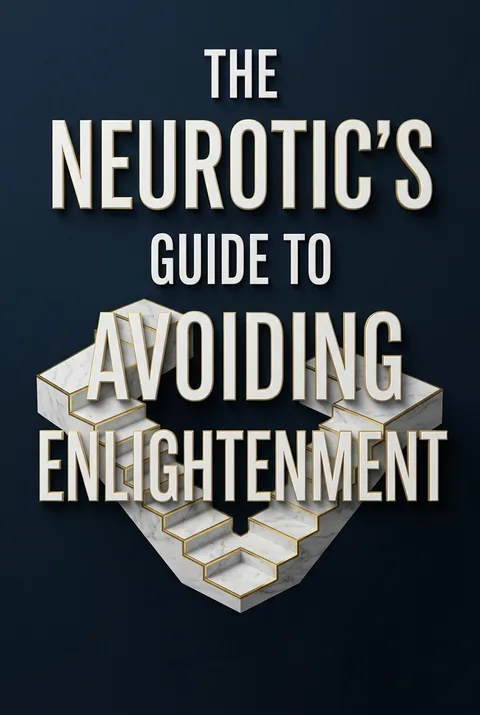
The Neurotic's Guide to Avoiding Enlightenment receives positive reviews for its thought-provoking exploration of neuroscience, Eastern philosophy, and self-improvement. Readers appreciate Niebauer's challenging ideas about the left brain's role in interpreting reality and the concept of no-self. While some find the writing style difficult, many praise the book's ability to stretch their thinking. Reviewers note its unique blend of scientific and spiritual perspectives, offering insights into mindfulness and acceptance. The book is seen as enlightening despite its intentionally paradoxical title.
Glossary
Left-brain interpreter
Story-making brain processThe author's term for the brain's tendency to explain events, connect details, and produce a coherent account of what is happening. Drawing on split-brain research, the book describes the interpreter as capable of generating plausible explanations even when it lacks key information. It is presented as a useful process that becomes misleading when its interpretations are mistaken for reality.
Law of invincible opposition
Resistance can intensify thoughtsThe author's name for the tendency of efforts to suppress or escape a thought or feeling to strengthen attention to it. Trying not to worry, for example, can keep worry active. The book applies the idea to self-improvement and spiritual striving, while noting that it is a pattern of inner experience rather than a literal rule that every action produces its opposite.
Apophenia
Patterns seen in randomnessA term used in the book for perceiving meaningful patterns in random or ambiguous information. The author connects this ability to the mind's broader pattern-making activity, including the construction of a consistent self-image. Apophenia can produce useful interpretations, but it can also lead people to see meaningful connections that the available evidence does not support.
What system
Labels and identifies objectsThe book's name for a brain system that identifies objects, faces, and categories. It helps a person recognize a friend despite changing visual input, but it can also impose a story or label on incomplete information. The author associates this system with interpretive consciousness and contrasts it with the action-oriented how system.
How system
Guides action in spaceThe book's name for a brain system involved in guiding action, such as reaching for an object or moving through space. In the author's account, it can support skilled behavior without requiring a verbal description of each step. The how system is linked to practices such as archery, tai chi, and absorbed activity, though the book's claim that it is a more direct form of consciousness is interpretive.
Fringe
Non-sensory feeling of knowingWilliam James's term, as presented in the book, for a vague sense of knowing or meaningful connection that lacks a clear sensory object. A tip-of-the-tongue feeling is one example. The author uses the fringe to describe how context and relationships can make separate details cohere, even when the connection itself is difficult to put into words.
Cartesian theater
Inner stage of experienceThe book's label for the familiar impression that sensory experiences and thoughts come together on an inner stage, viewed by a separate observer inside the head. The author uses the concept to question why consciousness seems confined to the skull. It is a philosophical metaphor, not a literal brain structure or a neuroscientifically established location.
Heider-Simmel Demonstration
Shapes provoke social storiesA short animation used in social psychology in which simple geometric shapes move around one another. Viewers commonly describe the shapes as pursuing, bullying, or escaping from each other, although the animation contains no human characters. The book uses the demonstration to show how readily observers infer motives and narratives from ambiguous movement.
Flow
Absorbed, unselfconscious activityPsychologist Mihaly Csikszentmihalyi's term for deep involvement in an activity, in which attention is absorbed by doing and self-monitoring recedes. The book connects flow to its distinction between labeling an action and carrying it out. Flow can occur in demanding activities that use a person's skills, and is not simply relaxation or inactivity.
About the Author
Download PDF
Download EPUB
.epub digital book format is ideal for reading ebooks on phones, tablets, and e-readers.








