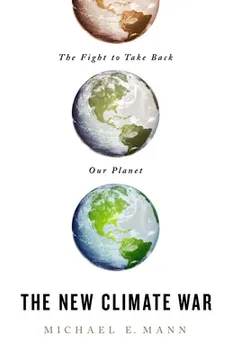


Key Takeaways
Treat climate obstruction as a changing campaign, not a settled science debate
The tactics evolved. Fossil fuel companies once challenged whether human activity was warming the planet. As visible impacts made outright denial harder to sustain, the emphasis shifted toward distraction, delay, and attacks on proposed solutions. Mann traces these tactics to earlier corporate campaigns: tobacco interests cast doubt on evidence of smoking’s harms, while industry groups attacked Rachel Carson after she warned about pesticides. Exxon’s own scientists had warned about the climate risks of fossil fuel use, and an internal 1982 projection closely anticipated later increases in carbon dioxide and temperature.
The messenger became a target. Climate researcher Ben Santer was accused of manipulating an international scientific report, and Mann’s temperature reconstruction, nicknamed the hockey stick, drew political attacks despite subsequent independent studies supporting its conclusion. Mann calls the targeting of individual researchers the “Serengeti Strategy ”: isolate a scientist to weaken trust in the broader evidence.
The history matters because misinformation is not simply a collection of mistaken claims. It can be an organized strategy that exploits the gap between a rapid accusation and a slower scientific correction. That makes transparency, independent replication, and clear explanations essential, not optional. The analogy to tobacco is useful, though it should not imply that every critic is paid or coordinated. Scientific skepticism remains valuable when it examines evidence in good faith. The practical test is whether a claim engages with the full body of evidence and accepts correction when its own predictions fail.
Ask who benefits when pollution becomes a story about personal guilt
Blame can be redirected. A deflection campaign shifts attention from corporate practices and public policy to individual behavior. Mann uses the famous “Crying Indian” anti-litter advertisement as an example. The ad stirred genuine environmental concern, but it was promoted by beverage companies facing pressure to support bottle-deposit laws. Its message focused on littering by individuals, not the companies producing disposable containers. The actor playing the Native American figure, Iron Eyes Cody, was not Native American.
The policy choice mattered. Bottle bills required deposits and returns, making beverage producers and retailers part of the solution. The ad instead made picking up litter feel like the main answer. Mann argues that the same framing appears in climate campaigns that foreground personal carbon footprints while leaving regulation, energy systems, and corporate responsibility in the background.
The ad’s effectiveness illustrates why a message can be emotionally sincere for audiences and politically convenient for its sponsors at the same time. Behavioral research also suggests that visible personal norms can help people coordinate, so individual action is not inherently a diversion. The key question is whether it opens a path toward institutional change or substitutes for it. A litter picker and a bottle-deposit law operate at different levels: one changes a single act, the other changes incentives across a market. Public communication is strongest when it makes both levels visible.
Pair personal climate choices with pressure for system-wide policy
Personal action has a place. Eating less meat, driving less, flying less, and choosing cleaner electricity can reduce an individual footprint and signal demand for alternatives. Mann’s objection is to treating these choices as a substitute for systemic change. Individual consumers cannot build public transit, modernize electricity grids, remove fossil fuel subsidies, or set enforceable limits on emissions.
Scale changes the result. The book points to research suggesting that emphasizing voluntary actions alone can weaken support for climate policy. It also uses the pandemic lockdowns as a caution: even a dramatic, temporary reduction in travel and consumption produced only a modest fall in global emissions. The durable solution requires public policy that changes the energy and transportation systems people depend on, alongside personal choices that support the transition.
This is a collective-action problem: the benefits of a stable climate are shared, while the costs of changing infrastructure and habits are unevenly distributed. Policy can coordinate those changes at a scale voluntary consumer decisions cannot reach. At the same time, everyday choices can shape norms, create political constituencies, and make alternatives more familiar. The useful distinction is not “personal or political,” but whether personal action is connected to broader leverage. Messaging that shames people for choices constrained by income, geography, or work risks alienating the very coalition needed for policy change.
Defend climate coalitions from wedges, purity tests, and manufactured online fights
Division is useful to opponents. A wedge strategy exploits existing disagreements to split a movement. Climate advocates can be pushed into fights over diet, flying, class, age, or which policy deserves priority, while the larger task of reducing emissions recedes. Mann describes bots and trolls amplifying inflammatory posts to make internal disputes appear more widespread and intense. He also warns that accusations of hypocrisy can redirect attention from a public figure’s policy goals to their private carbon footprint.
Scientists are targeted too. The Serengeti Strategy described earlier applies here: attacking a visible researcher can undermine trust in the wider community. Mann’s advice is to correct consequential falsehoods, avoid fruitless arguments with entrenched deniers, and not mistake an online pile-on for a representative public debate.
Online platforms reward material that provokes fast reactions, not careful distinctions. This creates a structural opening for manipulation even when no single actor controls the whole conversation. The response is partly technical, such as reporting automated accounts, and partly social: maintaining relationships across disagreements and refusing purity tests that turn policy coalitions into lifestyle tribunals. Still, disagreement is not always a wedge. Grassroots criticism can expose genuine inequities or gaps in policy. The useful question is whether a dispute clarifies choices and builds accountability, or consumes attention while leaving emissions untouched.
Keep carbon pricing available, and design it to protect low-income households
Prices can change incentives. A carbon tax charges for emissions, while cap and trade limits total pollution through permits that can be bought and sold. Mann points to the 1990 United States cap-and-trade program for sulfur pollution: emissions from coal-fired power plants fell 36 percent from 1990 to 2004 even as power output rose 25 percent. He argues that similar market tools can help make cleaner energy more competitive with fossil fuels.
Design determines fairness. Revenue from a carbon price can be returned to households, with larger benefits directed to those most affected by energy costs. The book notes that some carbon-pricing systems have reduced emissions, and that a price can complement regulations, clean-energy investment, and limits on new fossil fuel infrastructure. It is a tool, not a complete climate plan.
Pricing pollution is attractive because it uses a broad signal across millions of decisions, rather than requiring regulators to prescribe every technology choice. But its fairness depends on who pays, who receives the revenue, and whether alternatives are accessible. A household cannot respond to higher fuel costs by buying an electric car if it cannot afford one or lacks charging access. Pricing also needs strong monitoring and complementary standards, especially where consumers have few substitutes. The book’s strongest case is therefore not for a tax alone, but for treating pricing as one practical instrument within a broader public program.
Judge energy claims against the whole system, not a frightening snapshot
The playing field is tilted. Fossil fuels have benefited from direct support and from costs of pollution that are not fully reflected in market prices. Mann cites an International Monetary Fund estimate of about half a trillion dollars in explicit global subsidies, rising to roughly $5 trillion when health and environmental damages are included. Meanwhile, industry groups have campaigned against renewable-energy standards, solar incentives, and electric-vehicle support. Some efforts even restricted Tesla sales in certain states.
Clean energy has tradeoffs, not a veto. Wind farms can affect birds, and solar installations have land and manufacturing impacts. The book’s point is comparative: these harms should be weighed against the far larger impacts of fossil fuel extraction, pollution, and climate change. It cites research arguing that existing renewable technologies can meet a large share of energy demand when combined with electrification, storage, and grid improvements.
A full-system comparison guards against a familiar reasoning error: scrutinizing a new technology’s visible costs while treating the established technology’s costs as normal or invisible. Life-cycle analysis helps correct that bias by counting extraction, construction, operation, waste, and health impacts across options. Yet the comparison must remain specific. Local land use, mining practices, grid reliability, and wildlife protection deserve genuine assessment, not dismissal as industry talking points. The strongest case for renewables is not that they are impact-free, but that their impacts can be managed and are generally less damaging than continued reliance on fossil fuels.
Reject climate fixes that preserve fossil fuel dependence instead of cutting emissions
A bridge can become a destination. Natural gas emits less carbon dioxide than coal when burned, but methane can escape during drilling and transport. Since methane is a potent greenhouse gas, leakage can erode the climate advantage. Mann argues that calling gas a temporary “bridge fuel” can prolong investment in fossil infrastructure and crowd out cleaner alternatives.
Some fixes defer the hard choice. Carbon capture and storage remains costly, incomplete, and difficult to scale; using captured carbon to extract more oil can undercut its purpose. Large-scale solar-radiation geoengineering could alter rainfall patterns and damage the ozone layer, while leaving ocean acidification unresolved. Trees and soil can store carbon, but the book stresses that even optimistic estimates do not replace rapid emissions cuts. Adaptation and resilience matter, but they cannot substitute for mitigation.
The common thread is moral hazard: confidence in a future technical fix can make present pollution seem safer than it is. That does not mean every emerging technology should be rejected. Carbon removal may help address residual emissions, and adaptation is necessary for harms already underway. The distinction is between supplement and substitute. A credible portfolio measures each option against effectiveness, scale, risk, cost, and the possibility that it delays proven emissions reductions. Promises of a future rescue deserve especially close scrutiny when their main immediate benefit is permission to continue business as usual.
Describe climate danger accurately without telling people their effort is pointless
Risk grows with warming. Mann rejects the idea that there is a single cliff at 1.5°C or 2°C. The farther warming proceeds, the greater the danger, but each increment avoided still prevents additional harm. A finite carbon budget makes that principle concrete: cumulative emissions determine how much more warming the planet experiences.
Despair can disable. Doomism presents severe climate outcomes as inevitable, sometimes relying on unsupported claims of runaway warming or near-term social collapse. Mann argues that this can lead people to disengage, much as outright denial does. He contrasts it with communication that acknowledges the danger while preserving agency. In his account, worry and hope can motivate action more effectively than unbounded fear, especially when people can see a practical route to influence outcomes.
Accurate risk communication has to hold two truths at once: some harm is already occurring, and future harm remains sensitive to decisions made now. This resembles public-health communication, where warnings work best when they pair a credible threat with actions people can take. Fear is not always useless; it can prompt attention and collective response when efficacy is clear. But catastrophe language without probabilities, time frames, or agency can blur the difference between a worst case and a forecast. Precision is not reassurance. It is what makes urgency trustworthy.
Turn urgency into organized power through voting, education, and youth leadership
The closing plan is civic. Mann’s four-point battle plan is to reject defeatist doom, learn from young climate activists, educate people who are confused rather than fixed in denial, and pursue systemic policy change. Greta Thunberg’s school strike, followed by the global Fridays for Future movement, shows how a clear demand from young people can move climate into public debate. Mann argues that their moral claim to a livable future deserves adult support, not merely praise.
Participation has leverage. Readers can discuss climate risks, correct consequential misinformation, support organizations, contact representatives, and vote for leaders willing to enact climate policy. Individual habits still matter, but civic action can alter the rules and investments that shape millions of choices. The book ends with cautious optimism, not certainty: outcomes remain dependent on collective action.
This strategy connects communication to political power. Facts alone rarely change institutions; they need channels through which people can coordinate, set priorities, and impose consequences on decision-makers. Youth movements can supply moral clarity and urgency, while experienced organizations and voters can convert that attention into durable policy. The book’s appeal to voting is especially practical, though elections are only one point of leverage. Public procurement, workplace decisions, litigation, community planning, and financial choices can also shift incentives. Hope becomes more than mood when it is attached to organized, repeatable action.
Analysis
The book’s central contribution is its account of climate politics as a contest over attention and agency, not merely a dispute about atmospheric physics. Mann begins with a striking asymmetry: fossil fuel companies had internal scientific knowledge while public campaigns later cultivated doubt. He then tracks a shift from hard denial to softer obstruction, including personal-responsibility messaging, attacks on renewables, false solutions, and fatalism. That narrative makes the title’s “new war” legible as a change in tactics rather than an end to conflict.
Its most useful distinction is between actions at different scales. Individual behavior can build norms and reduce emissions, but only collective institutions can transform grids, transport, investment, and incentives. The book is strongest when it shows how a personal-action frame can become politically useful to industries whose emissions depend on system-wide arrangements. The Crying Indian story gives this argument a memorable historical anchor, while the sulfur pollution cap-and-trade example makes clear that policy can work across political boundaries.
The book also asks readers to resist two forms of distortion: denial that minimizes harm and doomism that treats harm as inevitable. That balance is intellectually important. Risk communication must preserve uncertainty without using it as an excuse for delay, and hope must be grounded in feasible levers rather than promises of effortless rescue.
A limitation is the book’s frequent use of war language and its sharp division between advocates and “inactivists.” This framing can clarify organized interests, but it can also encourage readers to infer centralized coordination where incentives, institutional habits, and partisan identity may explain some behavior. Policy disagreements among climate advocates are not all manufactured wedges, and market tools deserve scrutiny alongside regulation. The durable lesson is to evaluate claims by evidence, incentives, and outcomes, while building coalitions broad enough to make decarbonization politically possible.
Glossary
inactivists
actors promoting climate delayMann’s term for fossil fuel interests and their allies who work against meaningful climate action. The category includes outright deniers, but also people or organizations that downplay impacts, redirect blame, divide advocates, promote ineffective alternatives, or argue that action is futile. The term emphasizes the shared effect of these tactics: continued delay.
deflection campaign
shifting blame from systemsA communication strategy that redirects attention from corporate conduct, regulation, or market structures toward individual behavior. In the book’s examples, beverage companies promoted anti-littering messages while resisting bottle-deposit laws, and fossil fuel interests highlight personal carbon footprints. Personal actions may be worthwhile, but the deflection occurs when they are presented as a substitute for systemic change.
wedge strategy
exploiting internal disagreementsA tactic that uses existing disagreements within a group to weaken its ability to act collectively. In climate debates, it can turn real differences over lifestyle, identity, or policy into bitter disputes that displace shared goals. Mann argues that online amplification by trolls and bots can make these divisions more visible and intense, whether or not every disagreement is deliberately engineered.
Serengeti Strategy
isolating individual scientistsMann’s term for attempts to weaken public confidence in a scientific conclusion by targeting one researcher at a time. The attacks may question a scientist’s character, methods, or motives, and may spread faster than a careful response. The metaphor describes how isolating a visible researcher can make a broader scientific community appear vulnerable or untrustworthy.
seepage
contrarian framing entering mainstream discussionThe spread of misleading or industry-friendly frames into ordinary public discussion, including among people who do not intend to support fossil fuel interests. For example, media coverage can repeatedly emphasize individual lifestyle choices while giving less attention to policy and corporate responsibility. The frame becomes familiar through repetition, making it seem like neutral common sense.
doomism
claiming action is futileA form of climate messaging that portrays catastrophic outcomes as unavoidable and meaningful action as too late. Mann argues that this can discourage civic participation and mitigation, even when it comes from people who accept climate science. He distinguishes a sober account of serious risk from unsupported claims of imminent societal collapse or runaway warming.
carbon budget
remaining emissions allowanceThe finite amount of carbon dioxide humanity can emit while staying within a chosen warming limit. The concept links cumulative emissions to future warming: using more of the budget increases risk, while avoiding emissions reduces additional harm. It does not imply a precise cliff at a particular temperature, but offers a way to understand the consequences of continued emissions.
non-solution solution
a fix that delays real cutsMann’s label for proposals presented as climate solutions while leaving the main cause, fossil fuel dependence, substantially intact. Examples discussed include treating natural gas as a long-term bridge, relying on uncertain carbon capture to justify coal use, or emphasizing adaptation while ignoring emissions reduction. Some technologies may have limited roles, but they become non-solutions when they displace effective mitigation.
four point battle plan
four-part civic action planMann’s concluding framework for responding to climate obstruction: reject defeatist doom, learn from youth climate activists, educate people who are confused rather than entrenched, and seek systemic policy change. It combines communication and civic participation, directing readers away from fruitless arguments with committed deniers and toward people and institutions that can still be influenced.
cap and trade
tradable emissions limitA policy that sets a limit on total pollution and distributes or sells permits allowing emissions up to that limit. Companies can trade permits, creating an incentive to reduce pollution where it is least costly to do so. The book cites the United States sulfur-emissions program as evidence that this market-based approach can reduce pollution while economic output grows.
Download PDF
Download EPUB
.epub digital book format is ideal for reading ebooks on phones, tablets, and e-readers.








