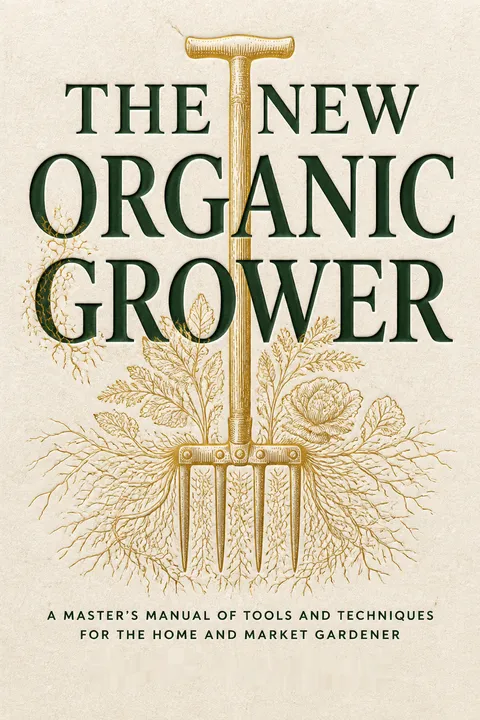


Key Takeaways
Coordinate soil, crops, water, tools, and labor as one living system
Think in relationships. Coleman’s central idea is biological agriculture: managing farming as a connected living system, not as a factory that assembles crops from purchased inputs. Soil organisms, minerals, water, sunlight, plants, and people all affect one another. Success comes from arranging their interactions so crops can grow well, rather than trying to control each factor in isolation.
Practice beats slogans. Coleman recalls a Kansas farmer managing about 700 acres without herbicides or pesticides and buying only small amounts of lime and phosphorus. Crop rotations, manure, cover crops, legumes, and mixed farming kept yields competitive with neighboring farms. The farmer relied on these methods because they worked, not because he followed a grand theory. Their added appeal was lower dependence on suppliers and fewer environmental harms.
What's powerful here is the shift from input lists to system design. A farm can be understood as a set of linked processes, where a change in soil cover may affect weeds, water, and future fertility at once. That view rewards attention to interactions that a narrow production metric can miss. It also demands humility: biological systems are harder to predict than assembly lines, so a method that succeeds on one farm cannot simply be copied everywhere without observation and adjustment.
Keep the farm small enough to manage, then compete on quality
Scale to attention. Coleman argues that a diversified vegetable farm of roughly one-half to five acres can suit a couple or small family. He estimates that one person can intensively manage about 2.5 acres, and that this area can supply a year’s vegetables for about 100 people. Appropriate equipment matters: his 1995 estimate put a basic tool package near $8,000, with optional additions bringing the total to about $15,000. He compared annual costs of roughly $2,000 per acre with potential revenue above $8,000 per acre. Those are historical estimates, not current budgets.
Make labor fit. Family labor is often the most dependable foundation. If hired help is needed, train workers carefully, pay fairly, and assign tasks that complement the grower’s strengths. Grow through better quality, variety, and service rather than automatically adding acreage.
The argument challenges the assumption that efficiency means expanding output per worker or per machine. In diversified growing, frequent observation and careful harvest can make small scale an advantage, not a defect. The economic figures make that case concrete, but they are tied to a particular era, region, crop mix, and market. They are best read as a model for calculating costs, not as a promise of income. The durable lesson is to match acreage, equipment, and labor to the level of care the business can sustain.
Choose a workable microclimate before paying to manufacture one
Read the land first. Coleman advises choosing a site for its soil depth, drainage, sun, wind exposure, water, access, and proximity to customers. Perfect soil is not essential: he turned a sandy, gravelly field with a pH of 4.3 into productive ground through years of manure, lime, minerals, green manures, and rotation. But some constraints, such as bedrock or a high water table, can be costly to change, so investigate them before buying.
Use free advantages. In the Northern Hemisphere, a south-facing slope warms earlier, while a hillside can let cold air drain away from crops. Windbreaks can shelter plants and reduce moisture loss, but badly placed trees may shade winter growing areas. Water deserves equal attention: Coleman suggests planning for as much as an inch of irrigation weekly when rain does not supply it.
This is a form of low-cost engineering: site choice and layout alter the conditions crops experience before any structure or machine is purchased. The idea applies especially well to farms, where small differences in slope, shade, and drainage can shape an entire season. The book’s broad advice still needs local verification, since the best exposure or drainage solution depends on latitude, climate, and crop. Its strongest practical instruction is to inspect what cannot easily be fixed before investing in what can.
Feed the soil's living processes instead of dosing each crop
Build capacity, not dependence. Coleman contrasts feeding plants directly with feeding the soil. In the first approach, soluble fertilizer supplies nutrients in readily available form, often crop by crop. In the second, organic matter and mineral materials support the biological and chemical processes that release nutrients through the soil. His early experience with free horse manure helped persuade him: vegetables on a rented New Hampshire plot performed exceptionally, without the purchased fertilizers he had expected to need.
Supply raw materials. Coleman emphasizes compost or manure, limestone to manage acidity, and finely ground mineral sources such as rock phosphate and greensand. He gives a target soil pH around 6.2 to 6.8 and recommends adjusting amendments based on soil tests and observation. Organic matter, he argues, improves structure, moisture retention, and soil life, while helping nutrients become available over time.
The useful distinction is between treating a crop’s immediate appetite and improving the soil’s ability to support many crops. That is a shift from short-term response to productive capacity. It also makes the farm less exposed to price and supply shocks. The recommendation should not be mistaken for a universal formula: amendment needs vary, and soil tests can disagree. Coleman himself urges interpretation rather than blind obedience to a single report. His broader point is strongest when treated as a direction of management, not a fixed recipe.
Rotate crops and keep soil covered to make fertility compound
Give each crop a place. Crop rotation means changing what grows in a plot over time, ideally avoiding repeated crops from the same plant family. Coleman presents it as a way to interrupt pest and disease buildup, vary nutrient demands, manage weeds, and improve soil structure. The sequence can also exploit relationships between crops: in his tested rotation, potatoes followed corn, while legumes preceded crops that benefited from their fertility.
Grow the next season. Green manures are crops grown for soil benefits rather than sale. Undersowing means planting one beneath a market crop after that crop is established. In Coleman’s cool climate, he often undersowed about four to five weeks after crop establishment, such as when corn reached 10 to 12 inches. In one rotation, plots were covered by a green manure for 26.5 of every 36 months. Grazing livestock on forage can add manure while producing saleable food.
Rotation and green manures function like preventive maintenance: they make future problems less likely while returning value that may be hard to measure in a single harvest. The approach is especially compelling because it joins pest management, soil protection, and fertility in the same practice. Yet an ideal sequence is local, not universal. Coleman offers patterns and a tested example, while also urging growers to adapt them. Records of crop performance and soil conditions help distinguish a useful rotation from a merely elaborate one.
Start crops in soil blocks to buy reliable harvest timing
Give seedlings a head start. A soil block is a compressed cube of potting mix that serves as both container and growing medium. Unlike a pot with hard walls, it lets roots grow to the block’s edge without circling around a container. The seedling can then establish quickly when planted in the field. Coleman favors blocks because they avoid plastic pots and make it easier to grow strong, uniform plants in a small, controlled space.
Use precision to save work. Transplants reduce gaps caused by poor field germination, can mature more predictably, and give crops a head start over weeds. A precision seeder and straight, evenly spaced rows make cultivation easier with a wheel hoe or small tractor. Coleman reserves direct seeding mainly for crops that are difficult or uneconomical to transplant, including carrots, parsnips, peas, and beans.
This is an example of matching technology to a biological bottleneck. The seedling stage is vulnerable and variable, so concentrating care in a greenhouse can make the later field operation more dependable. The method also reduces wasted ground and makes mechanical cultivation more precise. Its costs are real: blocks require a suitable mix, close attention to watering, and labor at transplant time. Whether that trade is worthwhile depends on crop, climate, and the value of a predictable harvest.
Cultivate weeds young, and treat pests as clues about plant stress
Prevent the weed problem. Coleman distinguishes cultivation from late weeding. Shallowly disturbing the soil when weeds are tiny takes less effort than removing established plants and helps prevent them from producing seed. Straight rows and sharp, light tools make it possible to work close to crops. His aim is not to eliminate every seed from the soil, but to stop the seed bank from growing through repeated reproduction.
Strengthen the crop. Coleman calls his pest-management outlook plant-positive: improve growing conditions rather than starting with the goal of killing insects. He argues that poor nutrition, compaction, moisture problems, or other stress can make plants more vulnerable. In a questionnaire to 50 organic growers, respondents estimated that healthy growing conditions helped them avoid, on average, 75 percent of the pest problems affecting chemical-farming neighbors. For remaining problems, he describes temporary tools such as row covers, water sprays, and insect removal.
The diagnostic idea is valuable because it asks what conditions are making a crop vulnerable, not only how to suppress a visible pest. That question can uncover problems with fertility, water, or timing that affect yield as well as pest damage. But pests are not always reliable indicators of a sick plant, and the growers’ 75 percent estimate is reported experience, not a controlled measurement. Plant health and direct protection need not be opposing strategies. The strongest reading combines root-cause improvement with practical safeguards when crops are at risk.
Extend harvest with movable protection, not year-round heat
Start with light protection. Coleman lays out a progression from favorable slopes and windbreaks to floating row covers, walk-in tunnels, and heated greenhouses. Low covers can warm soil, shelter plants from wind, reduce moisture loss, and block insects. They are most useful when their cost advances harvest enough to serve a real market, rather than simply covering every crop by default.
Let the structure move. A movable greenhouse can protect winter crops, then shift to another plot so the exposed soil can receive rain, sunlight, freezing temperatures, and green manures. Coleman’s winter system grows hardy crops such as mâche, spinach, carrots, and scallions; it extends the harvest season more than the growing season. In his Zone 5 home garden, a tunnel plus an inner cold frame raised the protected area’s effective hardiness by several zones, though winter crop choice and quality still depend on local conditions.
Season extension is framed as a design problem, not a contest to produce through every month at any cost. Mobile structures are especially interesting because they link climate control to crop rotation and soil recovery. The approach also makes energy use visible: a simple cover, an unheated tunnel, and a heated house are not interchangeable investments. Plastic durability and disposal remain part of the calculation, a concern Coleman raises himself. The right system balances added market time against labor, materials, energy, and soil effects.
Build markets around freshness, trust, and predictable customer relationships
Sell what small farms do best. Coleman argues that local growers can compete through freshness, flavor, variety, careful presentation, and a long season of availability. His Maine farm was six miles from a numbered highway, yet its reputation for quality brought more demand than it could meet. He cultivated customer loyalty with broad crop selection, attractive fields, friendly service, and a generous refund policy. Fast cooling after harvest also mattered: heat speeds produce deterioration, while cold storage and high humidity preserve quality.
Plan the relationship. Coleman describes a Food Guild, a subscription arrangement in which households sign up in advance for a farm’s produce. Customers can receive a broad supply of food, while the farm gains a clearer market and can spend less time selling each item. The arrangement can vary in delivery, customer participation, and service. His advice when demand exceeds supply is to consider higher prices before expanding and risking quality.
Marketing here is not a final step added after production. It shapes crop choice, harvest timing, and even how the farm is organized. Advance customer commitments can reduce uncertainty, while direct relationships make quality easier to communicate than an anonymous label can. The tradeoff is that a broad offering and personalized service can create substantial planning demands. A subscription model succeeds only when the farm’s promise matches its actual capacity, and when customers understand seasonal variation rather than expecting a supermarket’s uniform supply.
Record small field trials until your farm teaches its own rules
Make observation usable. Coleman learned from Scott and Helen Nearing to plan the year on paper, keep records, and notice small differences between crops and methods. A notebook tracking varieties, rotations, planting dates, and soil amendments turns scattered impressions into information that can guide the next season. He calls small, often low-cost improvements one percenters: incremental gains that can add up when many are applied together.
Learn before leaping. Coleman recommends working on farms before committing to farming, and asking whether the desire comes from a durable wish to grow food or a wish to escape a current life. He also warns against working seven days a week. Rest helps preserve judgment and makes it possible to plan better work rather than merely doing more of it.
The book treats practical knowledge as something generated through repeated cycles of action, observation, and adjustment. That is a form of disciplined learning, even when trials are informal. A record also protects against memory’s tendency to credit a favored variety or technique for a good season that may have had several causes. Small comparisons are not always controlled experiments, but they can still generate useful questions. The most transferable skill is not certainty; it is becoming better at noticing what the farm is telling its manager.
Analysis
The book’s most important achievement is to make small-scale farming legible as a designed system rather than a nostalgic retreat. Coleman links choices that are often treated separately: the shape of a field affects cultivation; cultivation affects weed pressure; crop succession affects fertility; fertility affects plant growth; and growing methods shape the kind of market a farm can serve. This interconnectedness is the book’s intellectual spine, and its practical emphasis on tools, schedules, and layout keeps the argument from becoming pure idealism.
Its strongest claims are operational. Crop rotation, early cultivation, seedling production, post-harvest cooling, and careful market planning are presented as learnable crafts, not mysterious gifts. The farm is also treated as an economic unit: labor, equipment, land, and customer demand must fit together. That combination makes the book useful to both commercial growers and serious gardeners.
The argument is less secure when it generalizes from experienced growers to broad claims about plant health, pest resistance, nutrition, or the superiority of particular fertility methods. Coleman acknowledges that evidence on food quality can be incomplete, yet at times speaks more confidently than that uncertainty warrants. His own insistence on testing and observation offers the best way to handle this tension: take the biological principles seriously, but verify their effects under local conditions.
The 1995 edition’s prices, suppliers, and production estimates are historical. Its more durable contribution is a method: begin with the land and the people available, reduce avoidable dependence, design for quality, observe carefully, and revise practices when results disagree with expectations. The result is not a universal recipe. It is a framework for building a farm that can learn.
Review Summary
The New Organic Grower receives mostly positive reviews, praised for its wealth of information on organic farming techniques. Readers appreciate Coleman's expertise, innovative ideas, and practical advice. Many find it useful for market gardeners and small-scale farmers, though some note it may be too advanced for beginners. The book covers topics like soil health, crop rotation, and pest management. While some criticize its age and specific focus, most readers consider it a valuable resource for those interested in organic agriculture.
People Also Read
Glossary
Biological agriculture
Farming through living processesColeman’s term for agriculture organized around soil life, crop diversity, organic matter, rotations, and other ecological processes. Rather than supplying each crop with purchased inputs, the grower supports the interactions that make soil fertility and plant growth function. The approach aims to reduce dependence on outside products while sustaining productive, high-quality crops.
Plant-positive
Strengthening plants against pestsA pest-management outlook that focuses first on creating conditions in which crops grow vigorously, rather than treating insects and disease as enemies to destroy. Coleman argues that stress can increase plant susceptibility, so fertility, water, drainage, spacing, and variety deserve attention. He does not deny that temporary physical or other controls may be needed.
Undersowing
Seeding a cover beneath cropsPlanting a green-manure crop among an established market crop so that the soil-improving plants are already growing when the sale crop is harvested. The cover can protect soil, suppress weeds, and contribute organic matter or nitrogen. Timing is critical: sow too early and it competes with the crop, too late and it may not establish.
Soil block
A self-contained seedling cubeA cube of moist potting mix pressed into shape by a blocker. It serves as both container and growing medium for a seedling, without a solid pot wall. Roots can grow to the edges instead of circling around a container, then spread into field soil after transplanting. Blocks can be made in several sizes for different crops and growing periods.
One percenters
Small cumulative farm improvementsColeman’s name for modest refinements in crop sequence, timing, soil care, or other management choices that may produce only a small benefit individually. Their value comes from combining many such adjustments over time. They are often inexpensive or free, but growers need to observe results because their effects may vary by soil, climate, and crop.
Feeding power
Roots' ability to access mineralsColeman’s term for a plant’s capacity to obtain nutrients from less-soluble mineral sources through its roots and associated soil processes. He argues that crops differ in this capacity, so strong-feeding plants can make minerals more available to later crops through their residues. The concept informs his suggestions about crop rotation and rock-powder amendments.
Mobile greenhouse
A greenhouse moved between plotsA greenhouse built to shift between prepared growing sites without being dismantled. Moving it allows protected crops to benefit from controlled conditions while the uncovered soil receives natural weather and can grow green manures or other crops. Coleman presents mobility as a way to combine season extension with crop rotation and soil renewal.
Food Guild
A farm subscription partnershipColeman’s name for a voluntary arrangement in which a farm supplies a committed group of households with produce and potentially other farm foods. Customers may sign up in advance and choose how much to participate in harvesting, delivery, or planning. The model gives growers a more predictable market and customers a direct relationship with their food source.
Predisposition Theory
Stress can precede plant diseaseA plant-pathology idea discussed by Coleman: unfavorable growing conditions can weaken or predispose a host plant, making it more vulnerable to disease organisms. The theory shifts attention from the pathogen alone to the interaction between organism and host environment. Coleman uses it to support improving crop conditions as part of pest and disease management.
FAQ
What is The New Organic Grower by Eliot Coleman about?
- Comprehensive organic manual: The book is a master’s guide to small-scale, biologically based organic vegetable production, covering everything from soil fertility to marketing.
- Focus on small farms: Coleman advocates for economically viable, low-input, high-efficiency farms, typically around five acres, that produce high-quality vegetables.
- Biological agriculture philosophy: The approach centers on working with natural systems—soil microorganisms, crop rotations, and green manures—to create sustainable, fertile soils and healthy crops without synthetic chemicals.
Why should I read The New Organic Grower by Eliot Coleman?
- Proven, practical expertise: Coleman shares over three decades of hands-on organic farming experience, offering tested methods rather than unproven theory.
- Holistic farming system: The book integrates production, soil management, pest control, and marketing, providing a complete system for successful organic growing.
- Empowerment for small farmers: It challenges the “bigger is better” mindset and provides a roadmap for profitable, manageable small-scale organic farming.
What are the key takeaways from The New Organic Grower by Eliot Coleman?
- Biological system management: Success in organic farming comes from managing living systems—soil, plants, and environment—rather than relying on purchased inputs.
- Soil health is central: Building and maintaining fertile soil through compost, green manures, and crop rotation is the foundation of the system.
- Plant-positive pest management: Healthy, unstressed plants naturally resist pests, reducing or eliminating the need for pesticides.
- Economic viability: Small-scale organic farms can be profitable with low capital investment and efficient, diversified production.
What are the best quotes from The New Organic Grower by Eliot Coleman and what do they mean?
- “Healthy plants are not bothered by pests.” This encapsulates Coleman’s plant-positive philosophy, emphasizing prevention through plant health rather than pest eradication.
- “The pest-free plant is not the normal plant with something added, but rather the normal plant with nothing taken away.” This highlights the idea that pest problems arise from deficiencies or stress, not from a lack of pesticides.
- “Good farming is a craft.” Coleman views farming as skilled, attentive work that requires observation, adaptation, and respect for natural systems.
What is Eliot Coleman's philosophy on small-scale organic farming and ideal farm size?
- Five-acre optimum: Coleman identifies five acres as the ideal size for a small family or couple, balancing diversity, quality, and labor intensity.
- Low capital, high return: Essential equipment and infrastructure can be acquired for $8,000–$15,000, with potential income per acre around $8,000.
- Focus on manageability: The scale is designed for hands-on management, high-quality production, and direct marketing, rather than mechanized, industrial farming.
How does The New Organic Grower by Eliot Coleman recommend building and maintaining soil fertility?
- Feed the soil, not the plant: Fertility is built through organic matter, compost, green manures, and biological processes rather than soluble fertilizers.
- Key amendments: Regular applications of compost or manure, rock phosphate, greensand, and limestone maintain nutrient balance and pH.
- On-farm nutrient cycling: The system reduces dependency on purchased inputs by recycling nutrients and supporting long-term soil health.
What is the role of crop rotation and green manures in Eliot Coleman's organic system?
- Pest and disease prevention: Rotating crops disrupts pest and disease cycles, improving soil structure and balancing nutrient use.
- Green manures as fertility builders: Leguminous green manures fix nitrogen, protect soil, suppress weeds, and add organic matter.
- Year-round soil cover: Combining crop rotation with undersown green manures keeps soil biologically active and reduces the need for external inputs.
How does Eliot Coleman define and use soil blocks for transplanting in The New Organic Grower?
- Soil blocks explained: Compressed cubes of potting mix serve as both container and growing medium, eliminating the need for plastic pots.
- Root health benefits: They prevent root circling and allow easy, minimally disruptive transplanting.
- Efficiency and sustainability: Soil blocks reduce costs, are environmentally friendly, and improve transplant quality and labor efficiency.
What are Eliot Coleman's recommended methods for weed management without chemicals?
- Prevention through early cultivation: Shallow, timely cultivation with hand tools prevents weeds from establishing.
- Efficient tools: Wheel hoes with oscillating blades and sharp, lightweight hand hoes minimize labor and crop damage.
- Long-term strategy: Consistent early control and use of green manures reduce the weed seed bank and suppress weeds over time.
How does The New Organic Grower by Eliot Coleman approach pest management and plant health?
- Plant-positive focus: The emphasis is on growing healthy, unstressed plants that naturally resist pests, rather than killing pests.
- Pests as indicators: Pest problems signal plant stress or imbalance; improving soil fertility and crop rotations addresses root causes.
- Minimal pesticide use: Coleman rejects both organic and chemical pesticides, arguing they disrupt natural balances and are unnecessary in well-managed systems.
What season extension and winter gardening techniques does Eliot Coleman describe in The New Organic Grower?
- Climate modification: Techniques include using south-facing slopes, windbreaks, and darkening soil to increase warmth.
- Protective structures: Plastic mulches, floating row covers, walk-in tunnels, and movable greenhouses extend the growing season.
- Four-season harvest: Combining passive protection layers and selecting hardy crops allows for fresh winter harvests without heating.
How does Eliot Coleman integrate livestock and poultry into his organic farming system in The New Organic Grower?
- Livestock for fertility: Horses and other livestock provide manure to improve soil fertility, requiring careful management.
- Poultry on pasture: Chickens and turkeys grazed on legume-grass sod contribute manure, reduce mowing, and produce eggs and meat.
- Movable housing: Lightweight, mobile coops protect poultry and facilitate daily movement to fresh pasture, integrating animals into crop rotations for mutual benefit.
Download PDF
Download EPUB
.epub digital book format is ideal for reading ebooks on phones, tablets, and e-readers.








