

Plot Summary
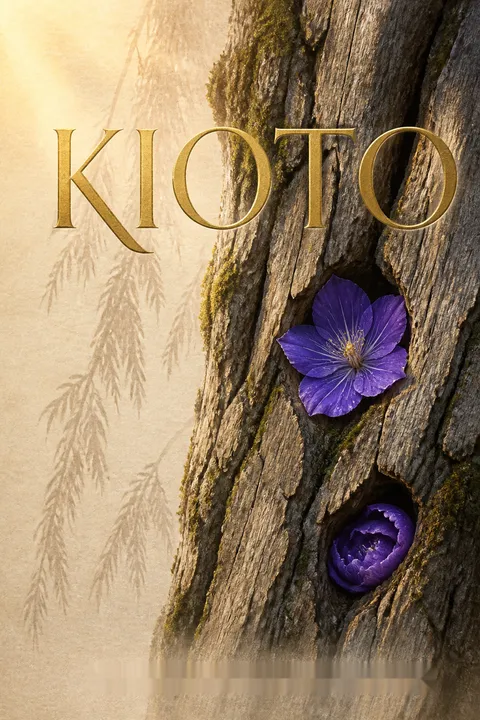
The Maple’s Quiet Violets
In the small garden behind her family’s Kyoto shop, Chieko watches violets bloom in hollows of an old maple and thinks about lives confined to unlikely places. She shares the garden with bell crickets she keeps in jars and a weathered stone lantern said to depict Christ. Then she goes to see the cherry blossoms with Shin’ichi, her gentle childhood friend.
At Kiyomizu Temple, looking out over the city at dusk, Chieko tells him she was left as a baby outside the shop’s lattice door. Her parents have offered her different versions of where she came from, but she has no wish to find her birth family. She obeys the parents who raised her, even when that means setting aside her own ambitions.
The garden gathers the novel’s private questions into physical objects: flowers rooted in a tree, insects enclosed in jars, and a religious figure worn nearly beyond recognition. Chieko’s confession to Shin’ichi is less a request for rescue than a test of whether he can hear her without turning her into a problem to solve. Her apparent obedience is not simple passivity. She has learned to keep desire quiet, and that self-restraint makes it difficult for others to recognize the loneliness beneath her composure.
The Lattice Door’s Secret
Chieko’s father, Takichiro, withdraws to a secluded temple, where he hopes to recover his failing confidence as a kimono designer. His business has become ordinary and precarious, while his artistic instincts still reach toward cloth patterns too unusual for the market.
At home, Chieko’s mother, Shige, urges her daughter not to feel trapped into inheriting the shop. Chieko presses her about the family’s old story, and Shige admits that she and Takichiro once took a baby they found beneath the Gion cherry blossoms.
The account is another attempt to soften what happened. The narrative makes clear that Chieko was actually abandoned at the shop entrance, where Takichiro found her. The Sadas registered and raised her as their daughter, while carrying the knowledge of her unknown origins.
The parents’ conflicting stories show how love can coexist with concealment. Takichiro and Shige did not merely provide Chieko with a home; they built a family identity around an origin they could neither explain nor repair. Their evasions protect her from one kind of pain while also limiting what she can know about herself. Takichiro’s retreat parallels this secrecy: both he and the family business are trying to preserve a form whose original confidence has weakened. The chapter makes inheritance emotional as well as material, passed down through silences, habits, and unfinished work.
The Obi in the Stream
In Saga, Takichiro draws a bold obi pattern after studying paintings by Paul Klee, hoping it will restore the originality he believes he has lost. He takes it to Sosuke, a Nishijin weaver, who assigns the work to his son Hideo. Hideo studies the design in silence, then tells Takichiro that its vividness feels discordant and troubled rather than harmonious.
Stung by the judgment, Takichiro crumples the drawing and throws it into a stream. The encounter exposes the different pressures on the two men: Takichiro fears his art has gone stale, while Hideo resents spending his days on routine work. Later, at the Botanical Garden, Hideo praises Chieko’s beauty, and Takichiro begins wondering whether the young weaver might suit his daughter.
The discarded design gives artistic judgment a personal cost. Hideo’s criticism wounds Takichiro because it touches the fear that his work has become either lifeless imitation or novelty without feeling. Yet Hideo’s response is not simply rejection: his close attention recognizes that the design demands more than routine craftsmanship. The garden encounter shifts that professional tension into family possibility. Takichiro begins to imagine marriage as a way to secure both Chieko’s future and his own artistic legacy, revealing how easily affection, economic anxiety, and the wish to preserve a craft can become entangled.
A Face in Kitayama
While visiting the Kitayama cedar village with Masako, Chieko sees a young worker whose face and bearing seem strikingly familiar. Masako insists on the resemblance, but Chieko brushes aside the possibility that it means anything.
The encounter nevertheless unsettles her, and later she wonders whether the girl might be the sister she never knew. Meanwhile, Hideo returns with an obi woven from the pattern Takichiro discarded. He had memorized the design and reconsidered it after meeting Chieko and hearing her speak about the workers’ fate.
Chieko admires the finished cloth, and Takichiro, seeing his daughter wear it, finds that Hideo has translated his drawing into something alive. The mountain girl remains unidentified, but the resemblance has entered Chieko’s thoughts.
Two forms of recognition arrive without explanation: Masako sees a likeness that Chieko refuses to pursue, while Hideo sees value in a design its creator has rejected. Both moments challenge the assumption that a thing’s meaning is fixed by its first appearance. Chieko’s refusal to investigate the girl protects the settled life she knows, but the image stays with her. Hideo’s woven obi offers a counterpoint: patient attention can make a discarded possibility tangible. The novel links seeing closely with responsibility, while allowing recognition to arrive before anyone is ready to act on it.
Sisters at Otabisho
During the Gion Festival, Chieko joins a worshipper’s repeated prayers at Otabisho and learns that the young woman is Naeko, a Kitayama worker who has spent years wondering what became of her twin sister. Naeko identifies Chieko as that sister. She explains that their mother is dead and that their father died after falling while cutting branches in the cedar trees.
Chieko is too shocked to share Naeko’s joy; the news makes her question the family she has always known. When Hideo approaches and mistakes Naeko for Chieko, Chieko hides in the crowd instead of correcting him. Shin’ichi later finds Chieko pale and unsteady and escorts her home. There, her mother notices her distress and prepares her bed beside her own.
The recognition is asymmetrical: Naeko arrives with a long-held hope, while Chieko must absorb a new family history in the middle of a crowded festival. Her withdrawal is not a rejection of Naeko so much as a limit on how quickly she can reorganize her sense of belonging. Hideo’s mistaken identification makes that tension visible before either sister can explain it. Meanwhile, Shige’s practical tenderness offers Chieko an immediate place to rest. The scene contrasts public ritual, where the sisters meet under the gaze of a deity and strangers, with the private care that steadies Chieko afterward.
Thunder over the Cedars
Chieko returns to Kitayama to see Naeko, and the sisters climb into the cedar grove where villagers cannot watch them. They speak about the cultivated trees, their parents, and the different lives each has led. A sudden storm traps them among the trunks. When Chieko fears the lightning, Naeko covers her with her own body and shields her until the thunder passes.
The closeness turns their resemblance into a lived bond rather than a visual coincidence. Chieko tells Naeko that Hideo intends to make her an obi, and asks her to accept it as a gift from her sister. Naeko resists, believing the promise belonged to Chieko. Back home, Chieko tells Shige that she has found her twin, and her mother welcomes the news without withdrawing her love.
The storm gives the sisters’ bond a bodily form: Naeko protects Chieko not by explaining their shared past, but by placing herself between her sister and danger. That care complicates the social distance Naeko feels between a city shop and a mountain workplace. The obi becomes an ethical test. For Chieko it can express kinship; for Naeko it risks making her feel like a substitute for someone else. Their disagreement shows that closeness cannot be bestowed by a gift alone. Chieko’s disclosure to Shige begins the harder work of fitting new knowledge into an existing family.
Chieko Opens the Ledger
As the Sada shop’s fortunes falter, Chieko stops treating its finances as her father’s private burden. Encouraged by Ryusuke, Shin’ichi’s forceful older brother, she asks the longtime clerk Uemura to show her the accounts and begins learning the business. She also selects a kimono from the shop for Naeko. Hideo completes an obi patterned with cedar trees and red pines, then carries it to the Kitayama village.
Naeko receives the kimono and obi and wears them when she meets Hideo at the Festival of Ages. For once, she watches the parade from a place of comfort rather than from her work among the trees. Chieko’s gifts let Naeko enter Kyoto’s public life on her own terms, though Naeko remains wary of being mistaken for her sister.
Chieko’s practical initiative marks a change in how she inhabits inheritance. Instead of merely wearing Takichiro’s designs or obeying the family’s expectations, she asks to understand the business that may determine its future. Her action is modest but consequential: she makes herself a participant in the shop’s survival. The clothes for Naeko serve a different purpose. They offer access to a world from which Naeko feels socially distant, yet the gift must not erase the labor and identity that are hers. Craft becomes a form of care only when it recognizes the recipient as distinct.
Two Brothers at Dinner
At the Festival of Ages, Shin’ichi and Ryusuke see Naeko in the kimono and obi and mistake her for Chieko. Chieko later explains to the brothers that the young woman is her twin.
Over dinner, Ryusuke says he wishes he had been the one to raise Chieko as a baby, a remark that makes his feelings harder to dismiss than Shin’ichi’s gentler affection. Ryusuke then helps Chieko confront the shop’s uncertain finances, while the Nishijin weavers’ trade association halts production to reduce a dangerous surplus of cloth.
Around them, Takichiro drifts into memories of Kyoto’s changing customs and seeks company in the old teahouses. The family’s questions about marriage and work remain unresolved, but Chieko is no longer keeping her new knowledge entirely to herself.
The mistaken identity at the festival turns the sisters’ resemblance into a social force: people respond to appearance before they know the person beneath it. Chieko’s disclosure to the brothers is a step away from carrying the revelation alone, though she remains cautious about what it will mean. Ryusuke’s declaration is emotionally forceful because it imagines care beginning at infancy, not merely courtship in the present. The surrounding economic strain broadens the stakes. Individual choices about marriage and work unfold inside a city where traditional trades are already adapting, contracting, or disappearing.
The Marriage She Fears
When Chieko visits Naeko in winter, Naeko reveals that Hideo has asked her to marry him. She cannot answer, because she suspects that he chose her partly as a stand-in for Chieko, whom he first mistook her for. Naeko also fears that marrying into Hideo’s weaving household would entangle her with Chieko’s family and invite gossip.
Chieko tells her that Takichiro and Shige know about her and would welcome her, but Naeko remains unable to trust that she would not become an obstacle. She describes the difference between a real woman and the idealized image a man might carry in his mind. Chieko asks her to come to the shop for a visit, hoping that time together might loosen Naeko’s fear.
Naeko’s hesitation is not a simple refusal of love. She is trying to protect her sister from a relationship she believes may be built on resemblance rather than recognition. Her language about an idealized image exposes a psychological danger in the twins’ likeness: Chieko can exist in another person’s imagination while Naeko is asked to live beside that image. Chieko’s reassurance is sincere, but it cannot settle the question for Naeko. The chapter treats marriage as a choice shaped by self-respect, class, and the fear of becoming useful to someone else only because one resembles another.
Powder Snow at Dawn
Before Chieko leaves to see Naeko, Takichiro tells her that the family would take the mountain girl in if she needed help. Later, Ryusuke’s father asks Takichiro to let his son work at the Sada shop and admits that Ryusuke hopes to marry Chieko.
That evening Naeko finally visits. Takichiro and Shige are startled by the sisters’ near-identical faces, but they welcome her. The twins prepare a room together and sleep side by side, sharing a closeness neither can make permanent.
At dawn Naeko leaves before the household wakes, carrying Chieko’s coat, umbrella, and clogs. She does not answer Hideo’s proposal, and Chieko cannot persuade her to stay. The sisters part with greater trust, but their different homes and uncertain futures remain intact.
The ending offers an encounter, not a solution. Naeko accepts the Sadas’ hospitality for one night, yet leaves before affection can be mistaken for a decision to abandon her own life. Takichiro’s welcome matters because it reverses the family’s earlier concealment with an explicit offer of care. Ryusuke’s father’s proposal places another possible future beside Naeko’s unresolved one, but Chieko is not reduced to a prize in either arrangement. The powder snow keeps the final image delicate and temporary: the sisters have crossed a threshold together, even though neither knows what lasting form their bond will take.
Analysis
The Old Capital makes inheritance a question of what can be passed on when its original form is weakening. Takichiro has inherited a textile business, a storehouse of historic fabrics, and an aesthetic vocabulary, yet he cannot simply reproduce the authority of earlier generations. His retreat and uncertain designs show tradition as labor rather than a stable possession. Hideo’s hand weaving offers one answer: continuity requires judgment and adaptation, not obedient copying. The same problem governs Chieko’s family history. Her parents’ love is genuine, but their evasions make belonging feel like something they must continually explain.
Chieko and Naeko bring this tension into sharp focus. Their resemblance suggests that identity might be shared, but their different upbringings have given them unequal access to work, security, and social ease. Naeko’s worry that Hideo loves an image of Chieko rather than the person before him is therefore more than romantic jealousy. It asks whether resemblance can make one person interchangeable with another. The sisters’ most convincing connection comes not from appearance but from action: Naeko shelters Chieko in the storm, and Chieko makes room for Naeko in her household without demanding that she stay.
Kyoto’s seasonal rituals give these intimate events a public frame. Festivals preserve old customs while shops, looms, and streets adjust to new pressures. The result is not a simple elegy for a lost past. The novel values tradition but refuses to pretend that preservation can stop change. Its people must decide what to keep through acts of care, creative work, and honest attention. The final overnight visit does not settle marriage, family, or business. It offers a smaller resolution: the sisters have met, recognized one another, and shared a home for a night, even if their lives remain distinct.
Review Summary
The Old Capital is a lyrical novel set in post-war Kyoto, exploring themes of tradition, modernity, and identity through the story of Chieko, an adopted daughter who discovers she has a twin sister. Readers praise Kawabata's exquisite prose, vivid descriptions of nature and festivals, and subtle exploration of human emotions. The novel is celebrated for its portrayal of Japanese culture and aesthetics, though some find the pacing slow. Many consider it a masterpiece that captures the essence of Kyoto and the changing face of Japan.
People Also Read






Characters
Chieko
The Dutiful ObserverChieko is a young woman raised in a Kyoto kimono wholesaler’s household, where family duty and aesthetic judgment shape her daily life. Quietly observant, she notices the overlooked details of gardens, fabrics, and people, but she is slower to name her own wants. Her obedience can look like contentment, yet her attention to others suggests a subtler form of agency: she studies what people need and often responds through concrete acts. She cares deeply for her parents and feels the pull of friendship and courtship without surrendering her own reserve. Kyoto’s seasons and traditions are not decoration to her; they are the language through which she makes sense of change.
Takichiro Sada
The Troubled DesignerTakichiro is Chieko’s father and the head of an old Kyoto textile business. He has an artist’s sensitivity but little taste for self-promotion, and he feels the distance between the distinctive designs he wants to make and the ordinary goods his shop must sell. His retreat into temples, historic cloth, and calligraphy reflects both creative hunger and a reluctance to face decline directly. He can be prickly with workers and business associates, yet his attention to fabrics and to Chieko reveals genuine tenderness. Takichiro’s understanding of fatherhood is entwined with responsibility: he wants to protect his daughter while fearing that the world changing around them will leave little room for his craft.
Naeko
The Kitayama CraftswomanNaeko works among the cedar groves of Kitayama, where physical labor has made her strong and self-reliant. She speaks plainly about work, nature, and the limits people impose on one another, yet beneath that directness lies a guarded need for connection. Naeko understands how class and circumstance shape what a person may accept, and she is reluctant to let kindness turn into dependence. Her bond with the world of the mountains is not picturesque; it is made of routine, effort, and practical knowledge. She approaches affection cautiously, valuing dignity as much as closeness and resisting any role that would make her feel secondary to someone else.
Shige Sada
The Quiet Household AnchorShige is Chieko’s mother and the steady keeper of the Sada household. She expresses care through food, clean rooms, and small acts of attention, while her calm manner can conceal intense feeling. Shige understands the pressures placed on her husband and daughter, but she does not always challenge them directly. Her silences are protective, sometimes at the cost of candor. She is deeply attached to Chieko and measures family life less by social form than by the daily work of staying close.
Hideo
The Exacting WeaverHideo is Sosuke’s eldest son and a highly skilled Nishijin obi weaver. His long hours at the loom have made him exacting and sometimes brusque, especially when he feels reduced to producing work without meaning. He judges fabric with a craftsman’s eye and takes responsibility for the quality of what he makes. Although he can speak harshly, his attention is capable of becoming generous and intimate. Hideo’s work is his strongest language: he remembers patterns, refines difficult designs, and invests personal feeling in the objects he weaves.
Ryusuke
The Forceful SuitorRyusuke is Shin’ichi’s older brother, a graduate student from a prosperous wholesale family. Direct and self-assured, he has a commanding manner that can make others feel scrutinized, but he is also willing to take practical responsibility. He recognizes the danger facing Chieko’s family business and encourages her to learn its accounts rather than remain sheltered from them. His interest in Chieko is more openly forceful than his brother’s, and he approaches affection as something that should be backed by action.
Shin’ichi
The Gentle Childhood FriendShin’ichi has known Chieko since childhood and carries an easy warmth that makes time with him feel familiar. He is less forceful than his older brother, tending instead to observe Chieko’s moods and offer companionship. His affection is real, but he does not always understand the sadness behind her self-control. The memory of his childhood role as a Gion Festival boy remains a tender link between them.
Masako
The Blunt CompanionMasako is Chieko’s friend, lively and outspoken where Chieko is reserved. She notices the resemblance between Chieko and a Kitayama worker before Chieko is willing to take it seriously. Her candor can be impulsive, but it helps bring an overlooked possibility into view.
Sosuke Otomo
The Nishijin MasterSosuke is Hideo’s father and a hand weaver whose modest household depends on the family’s skill. He respects Takichiro and remembers the help that allowed him to establish his trade. Sosuke sees the strain of changing markets but continues to value work made carefully by hand. His pride in Hideo is mixed with concern about his son’s difficult temperament.
Uemura
The Longstanding ClerkUemura has managed the Sada shop’s daily affairs for years and is accustomed to making decisions without Chieko’s involvement. Her questions about the accounts unsettle him, revealing how much practical knowledge has remained outside her reach. He represents the old arrangement in which family heirs are protected from the business they may someday inherit.
Plot Devices
The Maple Violets
A Pairing Across DistanceTwo small violets grow in separate hollows of the maple in the Sada garden. Chieko watches them each spring and wonders whether they can know one another despite their distance. The image quietly prepares the story’s concern with lives that resemble one another yet grow apart. As the novel proceeds, the flowers become a way to frame kinship, separation, and the hope of contact without turning those ideas into abstract commentary.
The Lattice Door
A Threshold of BelongingThe lattice entrance to the Sada shop is both a practical part of the old Kyoto house and a charged boundary between public business and private family life. It is tied to Chieko’s uncertain sense of origin and to the parents’ efforts to explain how she became their daughter. The door also anchors the household in a disappearing commercial world of traditional wholesalers, where an old sign and shopfront carry both beauty and economic vulnerability.
The Woven Obi
Craft Made Into CareThe obi carries artistic judgment across generations and relationships. Takichiro’s designs hold his struggle to remain an artist inside a declining family business, while Hideo’s weaving turns those designs into material work. Later, a cedar and pine pattern becomes a gift shaped by Chieko’s attention to another person’s life. The obi is therefore not merely clothing: it records who designed, who labored, who gave, and whether the recipient can accept the gesture without feeling reduced to a substitute.
Kyoto’s Festival Calendar
Time Made PublicThe novel moves through cherry blossoms, the Gion Festival, the Festival of Ages, and winter observances. These events give the story a seasonal structure while placing private choices amid civic ritual. Festivals repeatedly bring characters into accidental contact, but they also expose differences in class, work, and familiarity with the city. Their ceremonies preserve older forms even as Kyoto modernizes around them, allowing the plot’s personal transitions to unfold alongside a changing cultural landscape.
Download PDF
Download EPUB
.epub digital book format is ideal for reading ebooks on phones, tablets, and e-readers.








