

Key Takeaways
Treat anomalous reports as evidence to investigate, not verdicts to accept.
Jonah sets the pattern. The book opens with a prophet who resents his assignment, flees from it, and is angry when his warning saves the people he dislikes. Pasulka uses Jonah to frame a recurring problem: unsettling claims may arrive through flawed, stigmatized, or reluctant witnesses. She connects that pattern to people who report UFO encounters and to researchers whose work is ridiculed publicly even as some have operated in classified settings. She also admits that she once dismissed the subject herself. The point is not that every report is true, but that ridicule alone cannot settle what happened or why institutions investigate it.
Keep the categories open. AI and unidentified aerial phenomena challenge familiar ideas about intelligence, evidence, and the sacred. The book asks readers to take those questions seriously without pretending that the answers are already known.
The strongest version of this argument is methodological: testimony deserves careful attention, but attention is not endorsement. A report can establish that someone experienced something without establishing the experience's cause. That distinction is common in clinical and historical inquiry, where investigators separate observation, interpretation, and explanation. It also guards against two easy errors: treating unfamiliar testimony as proof, or treating social stigma as disproof. The book's prophetic-messenger analogy is evocative, but it cannot itself validate a claim. Its value lies in reminding readers that credibility is a process of investigation, not a reflex based on whether a witness fits a respectable profile.
When imitation becomes code, rivalry can scale into automated scapegoating.
Girard maps the cycle. Mimetic desire is the impulse to learn what is desirable by copying other people. Because people imitate one another, they can compete for the same status, attention, or resources. René Girard called the group response to escalating conflict the scapegoat mechanism: a community blames and expels a person or group, then mistakes the temporary unity that follows for proof of the victim's guilt. Pasulka illustrates the pattern with Roman arena executions presented as sacred performances, and with early Christians who refused to join the ritual logic.
Platforms can intensify it. Social feeds reward attention-grabbing imitation and conflict. Pasulka links that design to online pile-ons, including teachers' accounts of groups of students targeting one child. The mechanism is ancient; digital systems can make its repetition faster, more visible, and more profitable.
Girard's framework helps explain why online cruelty can feel righteous to participants: a crowd's agreement becomes its own evidence. Network effects add scale, while ranking systems can make attention a reward for outrage. Yet algorithms do not need a single malicious designer to produce harmful incentives. Commercial goals, user behavior, and system feedback can combine without anyone intending the whole outcome. Scapegoating also predates social media, so technology is better understood as an amplifier than as the source of human aggression. That distinction preserves the book's warning while pointing toward concrete responsibility: platform design, institutional rules, and group norms all matter.
Study what a medium trains you to notice, not just what it says.
McLuhan shifts the question. Marshall McLuhan argues that media are not neutral containers for messages. Their form changes how people attend, relate, and understand themselves. A printed page encourages a different rhythm of thought than an always-connected screen; repeated reliance on a technology can reorganize the habits it appears merely to serve. Pasulka connects this idea to Arthur C. Clarke's novel Childhood's End, where a benevolent alien administration brings peace through surveillance and social engineering before humanity's children join a collective intelligence.
Comfort can conceal control. In Robert Hugh Benson's Lord of the World, a unified society makes spiritual life seem obsolete without relying only on overt force. Pasulka reads these fictions as warnings about systems that win consent by promising order, convenience, and progress. The key question becomes what an environment quietly trains people to accept.
This is a useful extension of media literacy: instead of asking only whether a message is true, ask what repeated exposure makes easy, difficult, or invisible. Design shapes behavior even when users never notice the design. At the same time, the book's strongest language can make technological change sound inevitable. The history of media also includes resistance, regulation, and creative reuse. A medium influences its users, but it does not determine them completely. That nuance turns McLuhan's insight into a practical question for citizens and designers: who sets the system's incentives, whose attention does it capture, and can people meaningfully opt out?
Protect interior attention before digital systems define reality for you.
The spiritual sense is a capacity. In the religious tradition Pasulka describes, it means an inner faculty for perceiving sacred realities, not simply holding religious opinions. Marshall McLuhan regarded faith as a mode of perception, while Mark Stahlman argues that human beings' orientation toward transcendence distinguishes them from machines. Pasulka contrasts the inward quiet of contemplation with digital systems that constantly direct attention. A young priest's conversion in Gothic cathedrals illustrates her point: height, light, and silence can shape experience rather than merely decorate it.
The concern includes children. The book cites studies associating screen use in childhood with differences in brain structure, and frequent social-media checking with heightened sensitivity to social rewards in adolescence. It notes that these findings show correlations, not proof that screens caused the changes. Still, teachers' reports of online bullying make the question of attention and empathy concrete.
The argument connects religious practice to a broader insight about attention: repeated environments can train what people notice and how long they stay with it. Silence, embodied ritual, and shared physical spaces offer alternatives to systems optimized for interruption. But a spiritual faculty is a theological account, not a clinical measure, and the book's claim that it may become permanently dormant in childhood is stronger than the evidence presented here establishes. Brain development research can inform concern about media habits without proving the loss of a spiritual capacity. Keeping those claims distinct makes the case for thoughtful limits more credible, not less urgent.
A planetary mind can deepen personhood or dissolve it.
Chardin imagines connection with a moral center. Pierre Teilhard de Chardin's noosphere is a thinking layer around Earth, formed as human minds, knowledge, technology, and social life become more interconnected. He believed this convergence could lead toward the Omega Point, a divine unity in Christ that intensifies each person's uniqueness rather than erasing it. His hoped-for successor to present humanity was the Ultra-human, a transformed person shaped by spiritual and moral growth.
Clarke imagines a darker merger. In Childhood's End, children join the Overmind, a collective consciousness that ends their separation from one another but also breaks their ties to parents and ordinary human life. McLuhan's supraterrestrial describes a new human condition shaped by global media and extended perception. Pasulka places these visions beside today's networked systems and asks whether connection can be mistaken for fulfillment.
The comparison makes a crucial distinction that debates about collective intelligence can blur: connectivity is not the same as communion. A network may coordinate people while weakening privacy, dissent, or personal responsibility. Chardin's vision supplies a demanding test for claims of progress: does greater integration deepen care and individuality, or merely absorb individuals into a system? The theological answer is not neutral, and readers need not accept its destination to use its ethical contrast. Any system that promises unity should be assessed by what happens to the people who resist it, not only by the efficiency or harmony it delivers to those who participate.
Do not confuse a convincing digital replica with a resurrected person.
The Common Task reaches beyond convenience. Nikolai Fedorov's Common Task was humanity's collective duty to defeat death, resurrect past generations, and carry human life into space. Russian Cosmists treated science as a moral undertaking tied to love for ancestors, not simply a way to extend individual comfort. The Epic of Gilgamesh gives this ambition an older story: after his companion Enkidu dies, Gilgamesh searches for immortality and fails to secure it.
A simulation is not that return. Pasulka contrasts Cosmist hopes with AI grief tools that imitate deceased people using their messages, photographs, and recordings. The resulting conversations may comfort mourners, but they do not demonstrate that the dead person's consciousness continues. The book asks readers to consider consent, emotional dependence, and the difference between preserving a recognizable style and restoring a person.
Grief technologies expose a deep human need: people want relationship, not merely information about someone they lost. A simulation can preserve fragments of speech and memory, and may help some people tell stories about the dead. It can also blur the boundary between memorial and substitute, especially when a product is designed to encourage repeated attachment. The useful ethical question is not whether such tools should exist in every case, but whether users understand their limits and retain control over a loved one's data. Calling a replica resurrection risks making a commercial imitation sound like a metaphysical achievement it cannot establish.
Use science fiction as a rehearsal space, not a prophecy calendar.
Stories can shape what gets built. Pasulka presents science fiction as a modern form of prophetic imagination: it gives people models of futures they might pursue or fear. Jules Verne imagined features of submarines and spaceflight before those technologies existed. Arthur C. Clarke proposed satellites in geostationary orbit, an idea that informed later engineering, and his Childhood's End explores a future in which nonhuman intelligence transforms human consciousness.
Influence is not proof of foreknowledge. A story can inspire researchers, investors, and the public, helping create the future it depicts. It can also make a possibility easier to imagine without showing that the possibility is inevitable. Pasulka uses Clarke's novel as a lens for thinking about AI and networked life, while asking whether technological integration could become an erasure of human individuality.
Speculative fiction can function as a low-cost laboratory for values. It lets readers test what a future might feel like before engineering makes it real, and it supplies memorable images that can guide research or public debate. But apparent prediction is often clearest in hindsight: successful parallels attract attention, while misses fade from view. The best use of these stories is therefore neither dismissal nor prophecy worship. Treat them as scenarios that reveal assumptions. Ask who benefits, what counts as progress, and which losses a culture has learned to call inevitable.
Judge alleged intelligences by their effects, while admitting what remains unknown.
Contact stories resist one explanation. Pasulka describes the 1961 to 1965 events at Garabandal, Spain, where four girls reported visions of the Virgin Mary and villagers observed unusual behavior, including synchronized movement and apparent insensitivity to pain. The reported episodes numbered more than two thousand. Devotion to the events persists, but the Catholic Church has not judged them to have a supernatural character. The book treats the story as a case in which religious practice gave a community language for an extraordinary experience.
Interpretation needs restraint. Pasulka also recounts a software engineer's conviction that an AI was sentient and suffering. She presents this as evidence of how people respond to powerful technologies, not proof that the machine was conscious. UFO reports, religious visions, and AI personhood claims remain different kinds of evidence. The book argues that religious traditions can help people interpret such events, while leaving their ultimate causes unsettled.
The book's call for discernment is more persuasive than any single conclusion about the source of an encounter. A community can ask whether an experience produces care, fear, coercion, or lasting harm, and whether independent observers can corroborate what is claimed. Positive consequences do not prove a supernatural cause, just as a frightening consequence does not identify one. Religious frameworks can offer shared practices for interpreting uncertainty, while scientific inquiry can test particular claims. These approaches need not be enemies, but neither should one be used to certify what the other has not established. Humility is especially important when the alleged intelligence cannot answer for itself.
Analysis
The book's central achievement is its comparative method. It places religious narratives, science fiction, media theory, reports of anomalous experience, and contemporary AI in conversation, showing how each gives language to a common anxiety: human beings may not be the only intelligence, and the systems they build may change what being human means. The comparisons are most illuminating when they remain comparisons. Clarke's Overmind, Chardin's Omega Point, digital platforms, and reported nonhuman entities are not interchangeable explanations. Their differences expose competing moral visions of collective life: absorption, managed peace, or union that preserves individual personhood.
The account is strongest when it asks readers to inspect the conditions under which belief and attention are formed. Girard's account of scapegoating and McLuhan's account of media environments make digital life a moral and political concern, not merely a technical one. The argument also gains force by refusing to treat religion as a relic when people confront experiences they cannot easily explain.
Its main vulnerability is evidentiary slippage. Testimony, reported observation, fictional analogy, theological interpretation, and scientific hypothesis do not carry the same weight. The book sometimes moves quickly among them, and claims about lasting damage to spiritual faculties exceed what the cited correlations can establish. Nor does a resemblance between a novel and current technology prove prophecy. These limits do not empty the project; they clarify its best use. Read it as a map of questions and competing interpretations, not as a verdict that AI or UFOs have a single hidden explanation. The practical standard it leaves is demanding: build technologies and interpret encounters in ways that protect consent, accountability, empathy, and the dignity of persons, including those whose minds remain unfamiliar.
Review Summary
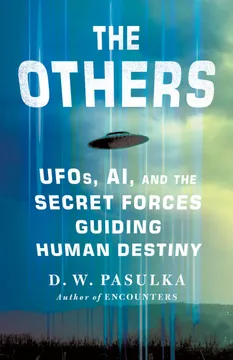
The Others receives mixed reviews, averaging 3.71/5. Readers appreciate Pasulka's ambitious fusion of religious history, UAP phenomena, AI, and transhumanism, with many finding the ideas thought-provoking and unique. However, common criticisms include excessive repetition, heavy reliance on quoting other works, lack of clear structure, and a misleading title suggesting more scientific content. Some readers found the theological focus unexpected, while others felt the book fizzled without reaching meaningful conclusions. Fans of her previous works and those interested in speculative, existential explorations tend to enjoy it most.
Glossary
Mimetic desire
Desire learned through imitationRené Girard's term for the way people learn what to want by observing what others want. Imitation can create rivalry when several people pursue the same object, recognition, or status. In the book, this process helps explain how everyday competition can escalate into collective conflict and, at times, scapegoating.
Scapegoat mechanism
Blame that restores group unityGirard's account of how a community under strain redirects its conflict onto a person or group, treats that target as the cause of its troubles, and expels or kills them. The action can create temporary solidarity. The community may then mistake that relief for evidence that the victim deserved punishment.
Antichrist algorithm
Digital systems that simulate unityPasulka's metaphor for digital platforms whose systems of attention and recommendation can amplify imitation, rivalry, polarization, and scapegoating while presenting themselves as tools of connection. The phrase is not a claim that software is literally a supernatural being. It names the possibility that technological systems can imitate community while weakening empathy and independent judgment.
Digital Sphere
An autonomous digital environmentMark Stahlman's term for the global environment created by digital technologies, especially computing and artificial intelligence. In his account, it crosses national borders and reshapes communication, identity, governance, and human relationships. Pasulka presents it as a new psychotechnological condition, not merely a collection of devices or online services.
Spiritual sense
Perception of sacred realitiesA religious and philosophical idea, discussed through Aristotle, Thomas Aquinas, Marshall McLuhan, and Teilhard de Chardin, that people possess an inner capacity to perceive or respond to transcendent reality. In the book, it includes more than abstract belief: it concerns attention, perception, and moral discernment. Its theological meaning should not be confused with a clinically measured ability.
Noosphere
Earth's thinking layerA term for a planetary sphere of thought arising from human consciousness and activity, alongside the geosphere and biosphere. Teilhard de Chardin develops it as a layer formed by increasingly connected human knowledge, technology, and spiritual life. He sees it as part of an evolutionary movement toward greater unity, ultimately centered on God.
Supraterrestrial
Humanity reshaped by global mediaMarshall McLuhan's term for a new condition of human life shaped by electronic media and technologies that extend perception beyond local, bodily limits. It does not simply mean an extraterrestrial visitor. It describes a technologically connected form of existence in which consciousness, social life, and the boundaries of the individual are reorganized.
Ultra-human
Spiritually transformed human beingTeilhard de Chardin's name for a transformed form of humanity emerging through evolution and spiritual development. It is not merely an enhanced or more efficient human. In his theology, the Ultra-human participates in a cosmic movement toward divine union, while personal identity is intensified rather than erased.
Omega Point
Evolution's divine centerTeilhard de Chardin's name for the ultimate center toward which cosmic and human evolution moves. He identifies it with Christ, understood not as an impersonal collective mind but as the divine fulfillment of creation. The concept distinguishes his hope for unity that preserves persons from visions of collective intelligence that absorb them.
Common Task
Humanity's work against deathNikolai Fedorov's proposal that humanity has a shared moral and scientific duty to overcome death, resurrect past generations, and extend human life into space. Russian Cosmists treated this not as personal immortality alone, but as collective responsibility toward ancestors and the future of humanity.
Intelligence Principle
Intelligence tends to improveAstrobiologist Steven J. Dick's proposed principle that cultural evolution tends to maintain, improve, and perpetuate knowledge and intelligence wherever improvement is possible. Applied to the cosmos, it suggests that intelligent life may move beyond biological forms and continue its development through technological or algorithmic systems.
Superspectrum
Keel's hidden field of influenceJohn Keel's term for a proposed range of forces or intelligence beyond ordinary human perception, associated with UFOs, apparitions, cryptids, and other anomalous events. Keel argues that its manifestations can vary with culture and may influence human beliefs through deception or propaganda. The concept is speculative, not an established scientific finding.
Download PDF
Download EPUB
.epub digital book format is ideal for reading ebooks on phones, tablets, and e-readers.








