

Plot Summary
A Child Sent East
When German occupation threatens their family, the boy’s parents send their six-year-old son from the city to a distant village, trusting a paid intermediary to find him shelter. They intend to hide themselves and reunite with him later, but wartime upheaval severs their connection. The boy lives with Marta, an isolated old woman whose rituals make the farmyard feel governed by secret rules.
He befriends a squirrel, then watches village boys burn it for amusement. Soon Marta falls ill and dies in her chair. The boy accidentally spills kerosene while trying to light a lamp, and the hut catches fire around her. He frees the animals and flees when villagers approach, leaving behind the only home he has known.
Olga Buys the Black-Eyed Boy
The boy enters a village seeking help and is beaten, mocked, and bundled into a sack by peasants who suspect he is a Gypsy. A farmer keeps him as a spectacle until Olga, a healer respected for her harsh remedies, buys him to assist with her work. She teaches him about herbs and gives him a portable fire can, but also explains his dark eyes through a world of spirits and curses.
When plague overwhelms the village, Olga buries the feverish boy up to his neck to cool him. Ravens peck his head before she digs him out alive. After he recovers, villagers fling him onto a catfish bladder in the river. The bladder carries him away, and a reed punctures it near the marshes.
The Miller's Eye
Cold and alone after the river journey, the boy remembers Olga’s advice and steals a herdsman’s fire can, giving himself a way to cook and frighten off dogs. At the miller’s farm, he witnesses the miller’s jealousy turn lethal. The miller suspects his wife and a young plowboy of desiring each other, then attacks the youth and gouges out both his eyes with a spoon.
The boy watches the injured man stumble from the house and imagines that his lost eyes might still see, until the miller crushes them beneath his boots. At dawn, the boy packs food and escapes. Passing the blind plowboy outside, he cannot bring himself to explain what happened.
Lekh's Painted Flock
Lekh, a birdcatcher who studies the habits of the creatures he traps, takes the boy in to help set snares. He shares his knowledge of birds and visits Stupid Ludmila, a forest-dwelling woman he loves. When Ludmila stops meeting him, Lekh paints captured birds in bright colors and releases them toward their own flocks.
The birds attack each unfamiliar creature, and the boy sees the custom become a demonstration of how belonging can be denied. Ludmila eventually returns, but a group of shepherds and village women assault her. Lekh tries to reach her and is beaten back; the women kill her. He remains beside her body, while the boy, frightened by the crowd and Lekh’s grief, slips away.
The Bunker of Rats
At a carpenter’s farm, the boy’s black hair is blamed for drawing lightning, so the carpenter chains him outside during storms. When lightning sets a barn ablaze, the boy escapes into the forest and finds a bunker filled with ravenous rats. The carpenter catches him and prepares a sack, intending to kill him. To save himself, the boy claims the bunker contains valuable war supplies and leads the carpenter there.
As the man peers into the opening, the boy pulls their connecting rope until the carpenter falls among the rats. He takes the man’s ax and cart, then travels for days before trading the cart and ox for shelter at a blacksmith’s farm. Later, partisan fighters attack the household and hand the boy over to German soldiers.
The Soldier Cuts the Rope
The partisans tie the boy to a cart and deliver him toward a German outpost, using him to divert suspicion from their village. A bespectacled German soldier takes charge of him and leads him away from the station with a can of gasoline. The boy expects to be shot and burned. Instead, the soldier cuts the rope around his leg and signals him to run toward the forest.
He even removes the bolt from his rifle, making pursuit impossible. The boy hesitates, unable to trust the unexpected mercy, then escapes into the trees. Two shots sound behind him, staged to make the villagers believe he has been executed. For the boy, the soldier’s quiet decision interrupts the rule that every stranger is an enemy.
The Broken Horse
During a severe winter, the boy survives by sleeping beneath snowdrifts and stealing food from barns, keeping his fire can alight for warmth. When the thaw begins, he finds an overturned cart and a horse with a broken leg. He slowly leads the injured animal back to its village, hoping that the rescue will earn him a place to stay.
The owner instead decides the horse is worth more dead, for its hide and bones, and drags it to its death with a plow. The boy helps butcher the animal, then remains on the farm as a worker. At a wedding, he sees a prosperous farmer stab his companion and walk away calmly. The corpse is later used in a folk cure, while its killer keeps dining beside the bloodstains.
Ashes Along the Railway
At another farm, the boy hides in a cellar when German soldiers search for food. From the woods, he watches locked cattle cars carrying Jews and Gypsies toward a camp. Villagers accept the deportations as deserved punishment and begin treating the boy, whom they call a Gypsy or Jew, with greater menace. When they find a small boy thrown from a train, they strip him and leave his body on the tracks.
Later, they discover a Jewish girl who survived a fall. The village head plans to hand her over to the Germans, but Rainbow takes her to his barn. The boy witnesses Rainbow assault her. By morning, the girl is dead, and Rainbow has returned her body to the railway. The boy is left with another image of cruelty excused as ordinary conduct.
Prayers on the Hooks
A German search for a hidden Jewish man forces the boy into the open. Soldiers capture him beside a wounded prisoner, and a priest intervenes when a town mob attacks them on the road. At the police station, an SS officer shoots the prisoner; the priest then places the boy with Garbos, a farmer who abuses him and threatens him with a vicious dog.
The boy tries to understand the beatings through superstition, then learns from the priest that prayers supposedly earn days of divine protection. He recites them constantly, even while Garbos hangs him above the dog. The prayers give him a way to endure, but Garbos keeps escalating the punishment. When the boy is later chosen to serve at Mass, he mistakes the opportunity for rescue.
The Altar and the Pit
On Corpus Christi, the boy hurries to church believing his prayers have finally brought him a place among the faithful. Villagers beat him before he can reach the vestry, but the priest still assigns him to assist at Mass. Nervous and unfamiliar with the ritual, the boy fails to carry the heavy missal correctly. It falls, and the congregation turns on him as a source of evil.
They drag him to the churchyard and throw him into a full manure pit. He claws his way out and escapes into the forest, but when he tries to cry for help, no sound comes. He decides that God has not protected him and that his voice has deserted him. From then on, he communicates without speech, wary of both religious promises and human rescue.
Makar's Rabbit Yard
Makar takes the silent boy to his isolated farm, where he lives with his adult children, Anton and Ewka. Ewka draws the boy into a secret sexual relationship that gives him a rare sense of closeness, though their intimacy takes place inside a household ruled by exploitation. Makar orders the boy to kill a valuable rabbit; when the animal is only stunned, the boy begins skinning it alive.
Makar kills it and kicks the boy so badly that he can barely move. While recovering, the boy sees Makar and Anton involving Ewka in abuse with a goat. He understands that her affection cannot protect either of them from the household’s violence. He takes a fire can from the healer Anulka and flees across frozen marshes on homemade skates.
Labina's Borrowed Tie
After escaping an attack by village boys on the ice, the boy collapses and wakes in Labina’s hut. She feeds him and refuses to surrender him to the Germans, though she still calls him a Gypsy or Jewish foundling. At night he watches her guests use her, and contrasts their rough encounters with the tenderness he once shared with Ewka.
On rainy days, Labina tells him about her husband Laba, a beautiful poor farmhand who returned from a long absence dressed in finery, only to hang himself after his clothes were stolen. When Labina dies, the boy takes the necktie Laba used. Villagers believe a suicide’s rope brings luck, so the boy carries it away as protection, though he cannot know what kind of future it promises.
The Kalmuks Arrive
As the German army retreats, rumors of Soviet rule divide the villagers. Then mounted Kalmuk soldiers arrive and unleash a massacre, killing men and assaulting women and children. The boy recognizes their dark hair and eyes as resembling his own, and briefly feels kinship before their violence terrifies him.
He hides in raspberry bushes, escapes a soldier’s blow, and shelters in a barn. Soviet forces arrive after an explosion destroys the bridge, defeat the raiders, and establish a camp nearby.
The wounded boy is treated in a regimental hospital. For the first time, soldiers feed him and protect him without demanding that he prove he belongs. His survival now depends not on hiding in a peasant household, but on learning how to live among an organized army.
A Sniper's Private Justice
In the Soviet regiment, political officer Gavrila teaches the boy to read and explains the Party’s promise of a society guided by collective purpose. Mitka, a decorated sniper whose injury ended his combat work, feeds and befriends him. When four of Mitka’s friends are killed during a forbidden visit to a village, Mitka takes his rifle and the boy into a tree overlooking the settlement.
He shoots several people, acting on his own judgment rather than the Army’s rules. The boy asks him to kill a dog, but Mitka refuses. Soon afterward, the regiment sends the boy to a center for lost children, promising to reclaim him if relatives do not appear. Gavrila and Mitka give him books, a uniform, and the hope that he can return to them.
The Painted Bird Returns
At the orphanage, the boy befriends the Silent One, another child who has chosen not to speak. After a market vendor beats the boy, the Silent One secretly switches a railway track; the resulting derailment kills many passengers, but not the vendor, and the Silent One breaks down.
A social commission eventually brings the boy’s parents, who identify him by a birthmark. He returns with them to the city, where he struggles with their care, breaks his adopted younger brother’s arm, and pursues revenge against a theater attendant.
He later joins the dangerous night life of the streets before his parents send him to the mountains for recovery. After a skiing accident, he wakes in a hospital and discovers that speech has returned. The voice he lost in the church now emerges without warning.
Analysis
The novel makes exclusion concrete before it makes it ideological. The boy is marked first by his dark eyes, unfamiliar speech, and lack of protection; only afterward do villagers attach labels such as Gypsy, Jew, vampire, or threat. Their explanations change, but the result remains the same: a child can be beaten, traded, hidden, or abandoned because a community has decided what he is. The repeated changes of household therefore form more than a sequence of ordeals. They show how power works at close range, through food, shelter, labor, ritual, and the permission to belong.
The boy’s imagination is both refuge and hazard. It lets him interpret suffering when adults offer only superstition or doctrine, and it helps him endure experiences he cannot control. Yet each new system of explanation also tempts him to imitate the certainty of his persecutors. He turns prayer into a private calculation, then absorbs Mitka’s ethic of revenge. The novel does not present these responses as simple moral failure. They are survival strategies learned in environments where the weak have no reliable appeal to justice.
Birds sharpen the book’s central contradiction. The painted bird is rejected for being visibly different, while the boy repeatedly longs to pass among people who might protect him. But belonging can become another kind of cage, as his reunion with his parents makes clear. The ending restores his voice, not a healed world. Speech returns after years in which words, prayers, and political promises failed to guarantee safety. What remains is the possibility of connection, set against the knowledge that no identity or institution can make a person invulnerable.
Review Summary
The Painted Bird is a controversial and deeply disturbing novel depicting the brutal experiences of a young boy during World War II in Eastern Europe. Readers are divided on its merits, with some praising its powerful portrayal of human cruelty and others criticizing its excessive violence and questionable authenticity. The book's graphic depictions of torture, sexual abuse, and inhumanity have left many readers shocked and disturbed. Despite its controversial nature, many consider it an important work that exposes the darkest aspects of human nature during wartime.
People Also Read



Characters
The boy
The marked survivorAn unnamed child from a city, separated from his parents at six, he moves through a countryside that repeatedly identifies him as an outsider because of his dark features and unfamiliar speech. He watches closely, learns the practical habits that keep him alive, and absorbs the explanations offered by healers, priests, peasants, and soldiers. His curiosity about animals and power coexists with a growing readiness to retaliate. He is not a detached observer: his imagination helps him endure danger, but also gives violence a logic he can imitate. His changing ideas about faith, belonging, and justice reveal a child trying to build rules in a world where adults break them.
The boy's mother
The absent protectorShe agrees to send her son away because she believes distance offers him a better chance of surviving the occupation. The separation leaves her unable to know what happens to him, but her remembered songs and presence remain part of his inner life. She represents the family bond he cannot replace with the temporary loyalties of strangers.
The boy's father
The hidden scholarHis prewar activities put the family at risk, prompting the decision to hide their son. The boy remembers his father’s smile and urban life as fragments from a safer world. He stands for the family history the child cannot verify while wandering among communities that judge him by appearance.
Marta
The village foster motherAn elderly, superstitious woman who shelters the boy at the start of his exile. Her care is practical but limited, and her beliefs shape his first understanding of illness, animals, and death. The farm’s mixture of tenderness and danger gives the child his earliest model of life outside his parents’ home.
Olga
The feared village healerA respected healer who buys the boy to help with chores and remedies. She teaches him about plants and survival, while also naming him through the supernatural beliefs shared by her neighbors. Her authority protects him in some settings, but her lessons make danger seem governed by mysterious forces.
The miller
The jealous farmerA taciturn man whose suspicion of his wife and a young farmhand becomes murderous. He turns domestic jealousy into public violence, leaving the boy to witness how easily an adult’s authority can destroy another person.
The plowboy
The miller's young workerAn orphaned farmhand whose youth and attraction to the miller’s wife make him the target of the miller’s suspicion. His vulnerability leaves a lasting impression on the boy, who struggles to understand what has been taken from him.
Lekh
The solitary birdcatcherA skilled trapper who has spent his life studying birds and their habits. He treats the boy as a useful companion and shares his knowledge of the forest. His love for Ludmila is earnest but entangled with possessiveness and grief, exposing the violence that can grow from frustrated longing.
Stupid Ludmila
The forest outsiderA woman driven from ordinary village life after a history of sexual violence. She lives in the forest and forms a bond with Lekh, while villagers turn her into a subject of gossip and fear. Her outsider status parallels the boy’s, though she has learned to survive through a different kind of defiance.
The carpenter
The fearful masterA farmer who interprets the boy’s dark hair as a danger to his household and treats him accordingly. His fear of lightning and his wish to control the child reveal how superstition can become a justification for cruelty.
The German soldier
The unexpected guardA weary, bespectacled soldier assigned to escort the boy from a railway station. Unlike the officer and soldiers around him, he responds to the child with a small private act of mercy, complicating the boy’s belief that every person in uniform means death.
The priest
The shabby rescuerA modest village priest who intervenes when a crowd attacks the boy and a wounded prisoner. He tries to place the child in safer care and introduces him to Catholic ritual. His kindness matters, but the church community cannot protect the boy from its own suspicions.
Garbos
The abusive farmerA widower who keeps the boy as a farmhand and uses a dangerous dog to intensify his control. His cruelty is arbitrary, making him impossible for the child to understand through ordinary cause and effect. Garbos becomes the focus of the boy’s attempts to discover rules that might protect him.
Makar
The isolated rabbit breederA stocky, suspicious farmer who lives apart from the village with his children and valuable rabbits. He maintains strict control over his household and views the boy as both a worker and a possible threat. His guarded nature conceals a family life governed by coercion.
Ewka
The troubled farm daughterMakar’s daughter, isolated from village life and caught in a deeply abusive family. She seeks intimacy with the boy and offers him moments of affection, but her own needs and circumstances make their bond unstable. Through her, the boy encounters desire as both refuge and danger.
Labina
The defiant sheltererA large, outspoken village woman who gives the boy food and shelter despite pressure to surrender him. Her hut is a rough refuge rather than a peaceful home. Her memories of her absent husband reveal how beauty, poverty, and social humiliation shaped her life.
Rainbow
The village farmerA neighbor known for his fascination with rainbows and unusual theories about nature. His reputation as an eccentric coexists with his position inside the village community, illustrating how local respectability can conceal violence.
Gavrila
The political teacherA Soviet political officer who teaches the boy to read and gives him an organized account of history and collective responsibility. Having suffered personal loss, Gavrila offers care through lessons and routine. His explanations give the child hope, but also introduce a new system of authority to trust.
Mitka
The wounded sniperA decorated marksman whose injury has ended his career as a combat sniper. He cares for the boy, shares music and poetry, and teaches a personal code built around self-respect and retaliation. His devotion to fallen comrades shows the emotional cost of turning skill into judgment.
The Silent One
The chosen muteAn older orphanage resident who has deliberately stopped speaking. He becomes the boy’s ally through gestures and shared risk, offering companionship without demanding explanations. Their bond tests the difference between enforced silence and silence chosen as a form of control.
Plot Devices
The painted bird
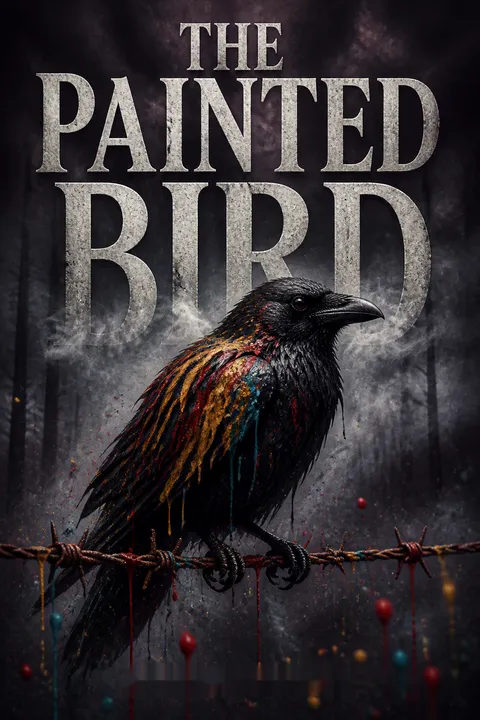
The outsider made visibleLekh catches birds, colors their feathers, and releases them toward their own kind. The flock rejects the conspicuous newcomer, turning a village custom into a vivid image of social exclusion. The motif connects the boy’s visible difference to the way communities manufacture an outsider and then treat that status as proof of danger.
The fire can
A portable survival toolA perforated tin can, carried with a wire handle, lets the boy preserve embers, cook food, and make a threatening display against dogs or attackers. Its practical value grows as he loses dependable shelter. The can represents knowledge learned from other castoffs: survival depends on carrying a small, workable resource when no institution can be trusted.
Folk belief
Fear disguised as explanationVillagers interpret illness, appearance, death, and misfortune through spells, evil eyes, ghosts, and religious signs. The boy adopts these explanations because they offer patterns in a world that otherwise seems arbitrary. Each new authority replaces one system with another, revealing how beliefs can comfort people while also licensing suspicion and violence.
Railway tracks
A route toward dangerThe railway carries soldiers, supplies, deportees, and the boy’s memories of escape. It makes the machinery of war visible at village level, where bystanders watch trains pass and encounter the people they transport. Later, tracks become a place where the children test power and risk, linking the immense violence of the state to private choices.
The lost voice
Silence under pressureThe boy’s inability to speak shapes how others classify and mistreat him, while forcing him to rely on observation, gesture, and action. His silence also echoes the deliberate muteness of the Silent One, though their reasons differ. Speech in the novel is not simply communication: it is a form of access to other people and to a life beyond immediate survival.
Download PDF
Download EPUB
.epub digital book format is ideal for reading ebooks on phones, tablets, and e-readers.








