

Key Takeaways
Make faith answerable to people your community would rather exclude
A church without borders. At eighteen, Dietrich Bonhoeffer entered St. Peter’s Basilica in Rome expecting to be repelled by its Catholic grandeur. Instead, he was moved by worshippers from different countries and backgrounds acting as one congregation. That encounter became the basis of his dissertation, Sanctorum Communio, which described the church as a living community reaching across national, ethnic, and class divisions, not simply a building or German institution.
Belief demands involvement. This vision made faith a public responsibility. A church, in his view, had to engage with ordinary people’s troubles, including those beyond its own membership. That principle eventually placed his Christian commitments in direct conflict with a government that defined belonging by ancestry.
What's compelling is that Bonhoeffer's universal church begins with a concrete experience of strangers sharing worship, not with an abstract slogan about tolerance. The idea also tests religious institutions: inclusion means little if it does not alter whom they defend when power draws boundaries. Yet universal language can conceal differences in history and need. The practical question is not only whether everyone belongs, but whether those facing the greatest danger receive protection and a voice. Bonhoeffer's conception becomes demanding precisely because it asks a community to act beyond its familiar circle.
Get close enough to suffering that it changes what you call real
Experience corrected theory. In Barcelona, Bonhoeffer went door to door to persuade families to send their children to Sunday school. The visits exposed him to poverty and to parents' sacrifices, while drawing him away from the academic life his family expected. In New York, African American pastor Frank Fisher brought him to Harlem's Abyssinian Baptist Church. Bonhoeffer found a powerful religious community there, then saw the humiliations of segregation during a trip south.
Witness changed his judgment. He also watched All Quiet on the Western Front, a film about a young soldier confronting the human cost of killing. These encounters helped shift him from treating faith and war as intellectual questions toward seeing them through the lives of people harmed by injustice and violence.
Bonhoeffer's education here is not simply exposure to unfamiliar customs. It is a change in the standpoint from which he evaluates claims about religion, race, and war. Proximity can reveal what polished abstractions leave out: who bears the costs, and whose experience is dismissed. Still, contact alone does not guarantee insight or solidarity. His response mattered because he listened, studied the conditions he witnessed, and carried those observations into his choices. The distinction is useful: empathy may begin with encounter, but it becomes ethically meaningful when it changes what a person is willing to support.
Confront discriminatory rules before obedience makes them feel normal
Discrimination became policy. In 1933, the Nazis began excluding people of Jewish ancestry from public employment through laws that expanded into education, medicine, law, and other professions. The Aryan Paragraph threatened Bonhoeffer's Jewish friend Franz Hildebrandt and many other clergy. Bonhoeffer urged church leaders to resist the rule, help people harmed by government policy, and challenge the machinery producing the harm. Many leaders rejected his position; the church accepted the policy and aligned itself with Hitler.
Legal does not mean just. The progression mattered. A boycott, dismissals, school restrictions, book burnings, and further exclusions made persecution increasingly ordinary. Bonhoeffer's protest came when the church still had choices, but he could not persuade it to use its influence. His early failure shows how quickly institutions can mistake compliance for moral neutrality.
The sequence in this account illustrates how discriminatory systems acquire legitimacy through routine administration. Each rule can be presented as limited or procedural, while the accumulated effect is to isolate a targeted population and make the next exclusion easier. Bonhoeffer's intervention insists that institutions must judge laws by their consequences, not merely their formal authority. There is a practical difficulty: people inside institutions may see only one measure at a time, while those targeted experience the pattern. Naming that pattern early is a form of resistance, though it may expose the speaker to retaliation.
When a church is captured, build a counter-community that acts
Organize beyond protest. Bonhoeffer helped form the Pastors' Emergency League, a network of clergy opposing the exclusion of pastors with Jewish ancestry. More than six thousand ministers signed its protest. The Nazis also tried to reshape Christianity into a national church loyal to Hitler, the Reichskirche. In response, dissenting Christians formed the Confessing Church, which rejected Nazi control of religious life.
Practice the values. Bonhoeffer and a small group of students established a clandestine seminary, where students studied, prayed, sang, and did manual work together. He believed discipleship required action, not simply inward belief, an idea he developed in The Cost of Discipleship. Yet the wider church would not adopt a forceful stand for Jews. The alternative community preserved a dissenting faith, but could not by itself stop persecution.
A counter-community can preserve moral language and train people to live by it when a dominant institution has been compromised. The seminary's daily practices matter: resistance is not only a declaration, but also the rehearsal of different loyalties and relationships. At the same time, internal integrity is not the same as public effectiveness. The Confessing Church's limits show that a principled enclave can remain too small, cautious, or inward-looking to protect people outside it. Any movement that resists capture must ask whether its structures connect conviction to practical help for those most exposed.
Treat resistance as coordinated work, not a lone heroic act
Different roles mattered. Bonhoeffer entered a resistance network led in part by his brother-in-law Hans von Dohnanyi, who gathered records of Nazi abuses. Dohnanyi, Bonhoeffer's brother Klaus, and other relatives and military figures worked toward removing Hitler and preparing a replacement government. Bonhoeffer's contacts with foreign church leaders made him useful as a courier and intermediary. His Abwehr position, arranged by Dohnanyi and Admiral Canaris, gave him a cover for travel and access to information.
Coordination carried risk. The conspirators needed military access, outside contacts, documentation, and people able to move between them. Bonhoeffer helped connect those parts, even while keeping his role from close friends. Several assassination attempts failed, including the July 1944 bombing that left Hitler alive. The network's purpose depended on many people acting together, not on one dramatic gesture.
This account makes resistance look less like a solitary act of bravery and more like a fragile system of complementary capabilities. A theologian's credibility, a lawyer's access to files, and a military officer's proximity to Hitler serve different functions. That division of labor helps explain why private conviction is rarely sufficient against organized power. It also creates vulnerabilities: secrecy can protect a network while isolating its members, and a failed link can endanger everyone. The story invites a practical question for any movement: which distinct skills, relationships, and safeguards turn shared opposition into coordinated action?
In a crisis, refusing to act can also make you responsible
No clean moral exit. Bonhoeffer had been a pacifist, and he continued to wrestle with the possibility that killing Hitler would violate his religious commitments. Dohnanyi asked whether treason could be justified; Bonhoeffer answered that the conspirators would remain answerable for their choices, even if they acted to prevent greater harm. He later supported the plot to assassinate Hitler, reasoning that a person who can intervene against an imminent attack cannot simply wait to help its victims afterward.
Responsibility is not certainty. Bonhoeffer did not present the conspiracy as morally spotless. He believed both action and inaction could involve guilt, and that judgment would not disappear just because the circumstances were extreme. His shift from pacifism to assassination is the book's hardest turn: faith did not spare him from choosing among terrible options.
The dilemma resembles the problem of moral residue: even a defensible decision can leave a person with responsibility for harm and no satisfying sense of innocence. That is more serious than the comforting claim that good intentions automatically justify action. Bonhoeffer's reasoning is strongest when treated as a demand for accountability, not as a general permission to break rules whenever danger is invoked. The facts of a crisis, the likelihood of preventing harm, and the risks to others all matter. His example does not settle the ethics of political violence; it makes evasion of the question harder.
Document atrocities and carry evidence beyond the regime's borders
Evidence made secrecy harder. In October 1941, as Jews were deported from Berlin and other German cities, Bonhoeffer gathered information about the roundups and sent a report through the resistance network. The book presents this report as likely the first account to alert the outside world to mass deportations. The Nazis used euphemisms and secrecy; records could make the scale and intent harder to deny.
Information needed helpers. Bonhoeffer and Dohnanyi also helped arrange forged documents and safe passage for fourteen Jews in Operation 7, moving the group to Switzerland. The effort succeeded, but its financial trail helped draw Gestapo attention to them. Bonhoeffer's reports and rescue work show two forms of response: preserving evidence for others to act on, and directly helping people escape when action was possible.
Documentation serves both memory and action. It can preserve details that a violent state would prefer to erase, and it can give distant observers a basis for understanding what is happening. But information is not self-executing. Bonhoeffer's efforts to alert foreign contacts met with reluctance, showing that evidence cannot substitute for political will, safe channels, or a willingness to accept costs. This distinction matters for contemporary whistleblowing too: exposure can change what is knowable, but institutions and publics still have to decide whether knowledge creates an obligation to respond.
Do not confuse safety with the place your duty requires
A safe escape felt wrong. In 1939, friends secured Bonhoeffer a place at Union Theological Seminary in New York to keep him from military service and danger. He soon felt he should not remain in the United States while his community faced the coming war. He returned to Germany on the last ship to cross the Atlantic before the war began, despite the protection and opportunity he had been offered.
Duty was personal, not universal. His return put him back among family, students, and fellow conspirators, where he could serve as a courier and help the resistance. The decision does not prove that everyone at risk should stay in a dangerous place. It shows how Bonhoeffer weighed his particular obligations and role against the safety available to him, rather than treating personal escape as automatically right or wrong.
The decision is often read as a simple contrast between courage and cowardice, but the story is more useful as a study in situated obligation. Bonhoeffer believed his presence had a purpose in Germany, and his return was a choice made within specific relationships and responsibilities. That does not make staying the correct answer for every person in danger. Leaving can preserve a life, protect dependents, or enable help from elsewhere. The harder question is what a person's safety makes possible, and what responsibilities remain when distance offers relief from witnessing a crisis.
Keep choosing whom to protect, even when escape could save you
Prison did not end his choices. Arrested in 1943 over the money transfers connected to Operation 7, Bonhoeffer was held for nearly two years. A guard arranged a possible escape, but Bonhoeffer decided against it, fearing that flight could worsen the danger facing his brother Klaus and brother-in-law Rüdiger Schleicher. He continued writing and ministering to fellow prisoners while the conspiracy around him was being uncovered.
The ending was brutal. Bonhoeffer was moved to Flossenbürg and executed on April 9, 1945, less than a month before Hitler died and weeks before Germany surrendered. His assassination plot had failed, and he never saw the war end. The account closes not with political victory, but with a record of decisions made in service of other people under pressure.
The final choice resists the easy image of a hero acting only for himself. Bonhoeffer's refusal to escape reflects concern for relatives who might bear the consequences, though it also shows how oppressive systems make private decisions dangerous to others. His death should not be treated as proof that sacrifice is always preferable to survival. Such a reading can romanticize loss and obscure the value of people who live to help. The more durable lesson is that courage is measured in part by attention to whom an action protects, and by honesty about its costs.
Analysis
Patricia McCormick structures this biography as a moral escalation. The opening image of a calm pastor preparing for a Gestapo search gives way to childhood grief, theological formation, encounters with poverty and racism, failed efforts to reform the German church, covert resistance, imprisonment, and execution. Each stage revises the reader's picture of Bonhoeffer. He is not introduced as a born conspirator: he begins as a privileged scholar and committed Christian whose beliefs become harder to separate from political choices.
The central tension is not simply whether Bonhoeffer was brave. It is how he could oppose violence, remain faithful to his church, and eventually support a plot to kill Hitler. The narrative takes that conflict seriously by showing his reluctance, his concern about guilt, and his awareness that inaction also has consequences. This prevents the assassination plot from becoming a clean moral victory. It remains a desperate choice with uncertain outcomes and grave costs.
The book also distinguishes individual conscience from collective capacity. Bonhoeffer speaks against discriminatory policy, helps organize dissenting clergy, reports deportations, aids escape, and joins a network involving family members, lawyers, intelligence officers, and military personnel. His work matters, but it cannot overcome a captured church, an effective dictatorship, or the reluctance of foreign governments to assist. His life therefore offers no formula in which courage guarantees success.
The account's middle-grade clarity gives complex events a strong narrative line, but that focus makes Bonhoeffer the central lens on a much larger history of persecution and resistance. The story is most useful when read not as a complete explanation of Nazi Germany, or as a demand that everyone make the same choices, but as a close examination of how convictions acquire consequences. It asks readers to notice when institutions normalize exclusion, to consider whose suffering is being ignored, and to distinguish moral certainty from the harder work of responsible action.
Review Summary
The Plot to Kill Hitler by Patricia McCormick is highly praised for its accessible and engaging portrayal of Dietrich Bonhoeffer's life and involvement in the resistance against Nazi Germany. Readers appreciate the book's concise yet informative approach, making it suitable for young adults and adults alike. Many reviewers found Bonhoeffer's story inspiring and thought-provoking, highlighting his moral courage and faith. The book is commended for its historical accuracy and ability to spark interest in further exploration of World War II history and Bonhoeffer's legacy.
People Also Read




Glossary
Sanctorum Communio
Bonhoeffer's church community theoryThe title of Bonhoeffer's dissertation, commonly rendered as Communion of Saints. It argues that the church is a living community that can cross national, ethnic, and class divisions, rather than merely a building or a formal institution. In the book, this idea helps explain why Bonhoeffer believed the church should respond to social suffering.
Pastors' Emergency League
Clergy network opposing Nazi interferenceA group organized by Bonhoeffer and other clergy to resist Nazi efforts to exclude pastors of Jewish descent and control the German church. More than six thousand ministers signed its protest. It provided an early structure for dissent, although it did not persuade the wider church to take effective action for Jews.
Confessing Church
Christian opposition to Nazi controlThe movement of German Christians who rejected the Nazis' attempt to subordinate the church to Hitler and Nazi racial policy. Bonhoeffer helped establish a seminary for its students. The movement maintained an alternative religious community, but its opposition to Nazi interference did not consistently become a broader defense of Jews.
Aryan Paragraph
Ancestry rule excluding Jewish GermansA Nazi policy first applied to public employment that barred people classified as non-Aryan, including people with Jewish parents or grandparents, from many professions and institutions. Its reach expanded into education, medicine, law, and other fields. The policy threatened Jewish clergy and became a test of whether the church would accept racial discrimination.
cheap grace
Belief without costly actionBonhoeffer's term for a version of Christian faith that seeks forgiveness or religious comfort without changing how a person acts. He contrasts it with discipleship that makes belief consequential in daily life. In the book, the idea explains why he thinks faith requires confronting injustice rather than remaining a private conviction.
Chronicle of Shame
Secret record of Nazi abusesHans von Dohnanyi's collection of documents, photographs, and witness accounts recording Nazi abuses of power. It included information about arrests, torture, theft, and the disappearance of targeted people. Dohnanyi gathered the material in secret so the resistance could preserve evidence and show what the regime was doing.
Operation 7
Secret escape plan for JewsThe resistance effort in which Bonhoeffer and Dohnanyi helped Jews leave Germany for Switzerland. The group used forged travel documents and arranged visas, sponsors, and funds. Although fourteen people reached safety, the financial arrangements attracted Gestapo scrutiny and contributed to the danger facing the conspirators.
Abwehr
German military intelligence agencyThe German intelligence organization where Dohnanyi worked under Admiral Wilhelm Canaris. Canaris allowed Dohnanyi to collect evidence of Nazi crimes and arrange for Bonhoeffer to serve as a counterintelligence officer. The position gave Bonhoeffer a plausible reason to travel, while concealing his work for the resistance.
Kreisau Circle
Group planning post-Nazi GermanyA resistance group of civilian and military figures, many from aristocratic backgrounds, who discussed a democratic German government after Hitler's fall. Its members were divided over assassinating Hitler, but the group helped connect civilian plans for a new government with officers capable of taking action against the regime.
FAQ
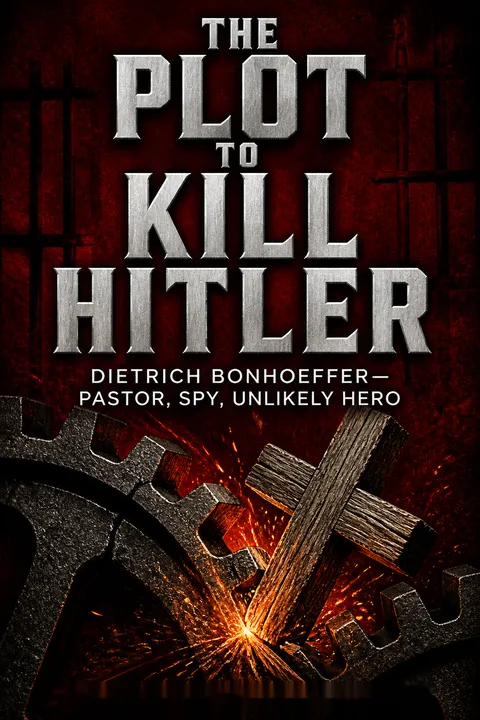
1. What is "The Plot to Kill Hitler: Dietrich Bonhoeffer—Pastor, Spy, Unlikely Hero" by Patricia McCormick about?
- Biography of Dietrich Bonhoeffer: The book is a biography of Dietrich Bonhoeffer, a German pastor, theologian, and member of the resistance against Adolf Hitler.
- Focus on Resistance: It details Bonhoeffer’s journey from a privileged childhood to his involvement in a plot to assassinate Hitler during World War II.
- Themes of Faith and Action: The narrative explores how Bonhoeffer’s Christian faith compelled him to take action against the Nazi regime, even at great personal risk.
- Historical Context: The book provides a vivid account of life in Nazi Germany, the rise of Hitler, and the moral dilemmas faced by those who opposed him.
2. Why should I read "The Plot to Kill Hitler" by Patricia McCormick?
- Inspiring True Story: The book tells the compelling and courageous story of a man who stood up to evil, making it both educational and inspiring.
- Accessible for Young Readers: Written in clear, engaging prose, it’s suitable for younger audiences and adults alike, making complex history understandable.
- Moral and Ethical Questions: It raises important questions about faith, conscience, and the responsibility to act against injustice.
- Relevance Today: The themes of resistance, civil courage, and standing up for what’s right remain relevant in contemporary discussions about justice and activism.
3. Who was Dietrich Bonhoeffer, and what made him an "unlikely hero" according to Patricia McCormick?
- German Pastor and Theologian: Bonhoeffer was a Lutheran pastor from an intellectual, non-religious family, known for his deep faith and scholarly work.
- Pacifist Turned Conspirator: Despite being a pacifist, he joined a conspiracy to assassinate Hitler, believing it was a moral imperative.
- Moral Conscience of the Resistance: He provided spiritual and ethical guidance to the conspirators, justifying their actions as necessary to stop evil.
- Personal Sacrifice: Bonhoeffer’s willingness to risk—and ultimately lose—his life for his beliefs made him an "unlikely hero" in the eyes of the author.
4. What are the key takeaways from "The Plot to Kill Hitler" by Patricia McCormick?
- Faith Requires Action: Bonhoeffer believed that true faith is not passive but demands action against injustice, even when it’s dangerous.
- Complexity of Moral Choices: The book illustrates the difficult ethical decisions faced by those resisting the Nazis, including the justification of violence for a greater good.
- Courage in the Face of Evil: Bonhoeffer’s story exemplifies civil courage—standing up for what is right, regardless of personal cost.
- Legacy of Resistance: His writings and actions have inspired later movements for justice, including the American civil rights movement.
5. How did Dietrich Bonhoeffer’s faith influence his actions against Hitler, as described in Patricia McCormick’s book?
- Faith as Motivation: Bonhoeffer’s Christian beliefs were the foundation for his opposition to Nazi ideology and anti-Semitism.
- Church as Moral Authority: He argued that the church must not only care for victims but also actively oppose evil, even if it means breaking the law.
- From Pacifism to Resistance: Initially a pacifist, Bonhoeffer’s faith led him to conclude that assassinating Hitler was a necessary act of Christian responsibility.
- Spiritual Support for Conspirators: He provided theological justification and spiritual comfort to those involved in the plot.
6. What was the "Aryan Paragraph," and why was it significant in "The Plot to Kill Hitler" by Patricia McCormick?
- Definition: The Aryan Paragraph was a Nazi law requiring all government employees, including pastors, to be of "pure Aryan" descent, effectively excluding Jews.
- Impact on the Church: It forced the church to choose between compliance with Nazi policies and upholding Christian values of equality and justice.
- Bonhoeffer’s Opposition: Bonhoeffer spoke out against the Aryan Paragraph, urging the church to resist and protect all victims, not just Christians.
- Turning Point: The church’s failure to oppose the law marked a critical moment in Bonhoeffer’s decision to resist more actively.
7. How did Dietrich Bonhoeffer become involved in the plot to assassinate Hitler, according to Patricia McCormick?
- Family Connections: Bonhoeffer’s brother-in-law, Hans von Dohnanyi, was a key member of the resistance and brought him into the conspiracy.
- Role as Courier and Spy: Bonhoeffer used his position in the Abwehr (German intelligence) as cover to travel, gather information, and communicate with the Allies.
- Moral Justification: He provided the conspirators with spiritual and ethical support, helping them reconcile their actions with their consciences.
- Active Participation: Bonhoeffer was involved in planning, intelligence gathering, and even helping Jews escape Germany (Operation 7).
8. What were the main challenges and dangers faced by Bonhoeffer and the resistance, as detailed in "The Plot to Kill Hitler"?
- Constant Surveillance: The Gestapo monitored their activities, tapped phones, and opened mail, making secrecy essential.
- Risk of Execution: Discovery meant certain death for Bonhoeffer and his fellow conspirators, as treason was punishable by execution.
- Isolation and Betrayal: The resistance operated in small, isolated cells, often without support from the broader church or public.
- Moral and Emotional Strain: The conspirators struggled with the ethical implications of their actions and the fear of endangering loved ones.
9. What is the significance of Bonhoeffer’s writings, such as "The Cost of Discipleship," in Patricia McCormick’s book?
- Call to Action: "The Cost of Discipleship" argues that faith must be lived out through costly, courageous action, not just belief.
- Critique of "Cheap Grace": Bonhoeffer warned against a passive, comfortable Christianity that avoids sacrifice or risk.
- Influence on Others: His writings inspired later movements for justice, including the civil rights movement and anti-apartheid activism.
- Legacy of Thought: Even after his death, Bonhoeffer’s theological and ethical ideas continue to challenge and inspire readers worldwide.
10. How does Patricia McCormick’s "The Plot to Kill Hitler" portray the role of the church in Nazi Germany?
- Complicity and Resistance: The book shows how much of the German church complied with Nazi policies, while a minority, including Bonhoeffer, resisted.
- Formation of the Confessing Church: Bonhoeffer helped found the Confessing Church, which opposed Nazi interference and the Aryan Paragraph.
- Moral Failure: The church’s failure to protect Jews and oppose Hitler is depicted as a profound moral failing.
- Bonhoeffer’s Vision: He believed the church should be a force for good, transcending national and ethnic boundaries.
11. What are some of the most powerful quotes from "The Plot to Kill Hitler" by Patricia McCormick, and what do they mean?
- "Silence in the face of evil is itself evil." – Bonhoeffer believed that not acting against injustice is itself a form of wrongdoing.
- "Not to speak is to speak. Not to act is to act." – This emphasizes the responsibility to take action, not just avoid wrongdoing.
- "Cheap grace is the deadly enemy of our Church." – From "The Cost of Discipleship," warning against faith without sacrifice.
- "He who passively accepts evil is as much involved in it as he who helps to perpetuate it." – Quoted from Martin Luther King, Jr., echoing Bonhoeffer’s philosophy.
12. How does "The Plot to Kill Hitler" by Patricia McCormick connect to modern issues of justice and activism?
- Universal Relevance: The book’s themes of standing up to injustice, even at personal risk, resonate with contemporary struggles for justice.
- Inspiration for Activists: Bonhoeffer’s life and writings have inspired civil rights leaders, anti-apartheid activists, and others fighting oppression.
- Moral Courage: The story encourages readers to consider their own responsibilities when confronted with wrongdoing or injustice.
- Legacy of Resistance: The book serves as a reminder that ordinary individuals can make extraordinary sacrifices for the greater good.


Download PDF
Download EPUB
.epub digital book format is ideal for reading ebooks on phones, tablets, and e-readers.








