Key Takeaways
1. Islam's Foundational Call to War: Muhammad's Life and the Qur'an
First basic fact: Muhammad ibn Abdallah ibn Abd al-Muttalib (570-632), the prophet of Islam, was a man of war.
Prophet as warrior. Muhammad's life, as documented in Islamic texts, was marked by warfare, leading raids, and ordering assassinations against his enemies. This established a precedent for his followers to fight for the new religion, with Allah commanding them to take up arms. His early struggles in Mecca, followed by his flight to Medina, transformed him from a preacher into a prophet-warrior.
Qur'anic exhortations. The Qur'an contains over a hundred verses that explicitly call believers to wage jihad against unbelievers, emphasizing battle and striking terror. These commands are not marginal but central to the text, directing Muslims to fight those who reject Islam, including Jews and Christians, until they submit or pay a special tax. The concept of "striving hard" (jahidi) is directly linked to battlefield engagement.
Victory and vengeance. Early Muslim victories, such as the Battle of Badr, reinforced the belief that Allah grants victory to the faithful, regardless of numerical odds. These battles also established principles like the appropriation of enemy possessions as booty and the justification of bloody vengeance against those who oppose Islam. The Prophet's actions and pronouncements during these conflicts laid the groundwork for the Islamic doctrine of jihad.
2. The Doctrine of Abrogation and Perpetual Jihad
In fact, most Muslim authorities agree that the ninth sura was the very last section of the Qur'an to be revealed.
Later verses supersede. Islamic theology employs the doctrine of abrogation (naskh), where later revelations from Allah can cancel or modify earlier ones. This is crucial because the Qur'an's more tolerant and peaceful verses generally date from Muhammad's earlier Meccan period, while the more violent and intolerant ones, particularly from the ninth sura (Al-Bara'ah), are from the later Medinan period.
The Verse of the Sword. Mainstream Islamic commentators, such as Ibn Kathir and Ibn Juzayy, assert that the "Verse of the Sword" (Qur'an 9:5) abrogates numerous earlier peaceful verses. This interpretation means that warfare against unbelievers, until they convert or pay the jizya, is the Qur'an's final and enduring command for the Muslim community.
Global imposition of Sharia. This theological framework leads to the understanding that the Islamic umma (community) must exist in a state of perpetual war with the non-Muslim world, interrupted only by temporary truces. Modern jihadist groups and theorists, like Sayyid Qutb and Sayyid Abul Ala Maududi, explicitly advocate for the forceful imposition of Islamic law (Sharia) globally, viewing it as Islam's primary duty to depose "Jahiliyya" (unbelieving society).
3. Systemic Intolerance: The Dhimma and Non-Muslim Subjugation
The subject peoples... must keep to the side the street; may not build higher than or as high as the Muslims' buildings, though if they acquire a tall house, it is not razed; are forbidden to openly display wine or pork ... recite the Torah or Evangel aloud, or make public display of their funerals or feast days; and are forbidden to build new churches.
Second-class status. Islamic law designates Jews, Christians, and other non-Muslims as "dhimmis," meaning "protected" yet "guilty" people. While allowed to practice their religions, they are subjected to a comprehensive system of humiliating regulations and taxes (jizya) designed to ensure their subdued, inferior status within Islamic societies. This system was first articulated by Caliph Umar ibn al-Khattab.
Historical realities. Historically, dhimmitude involved severe restrictions, including:
- Prohibitions on building new churches or restoring old ones.
- Mandatory hospitality for Muslims.
- Restrictions on dress, public displays of faith (crosses, bells), and speech.
- The jizya often collected through demeaning ceremonies, sometimes involving physical blows.
These conditions often led to mass conversions to Islam, as seen in North Africa and the Middle East, to escape the crushing burden and humiliation.
Modern advocacy. Despite claims that dhimmitude is a relic of the past, contemporary Muslim leaders, such as Sheikh Omar Bakri Muhammad and Sheikh Yussef Salameh, have called for its restoration. Elements of dhimmi laws, including unequal rights and restrictions on non-Muslims, persist in various forms across the Islamic world today, demonstrating that the concept of full equality for non-Muslims has not taken root.
4. Subjugation of Women in Islamic Law and Practice
Men have authority over women because God has made the one superior to the other.
Inferior status. The Qur'an and Hadith establish a clear hierarchy where women are considered inferior to men and are to be ruled by them. This foundational principle underpins numerous discriminatory practices, treating women as possessions rather than equals. The Qur'an likens women to a "tilth" for men to cultivate as they will, reinforcing their objectification.
Sanctioned abuses. Islamic texts explicitly sanction practices that oppress women:
- Wife-beating: The Qur'an (4:34) instructs husbands to admonish, banish, and "scourge" disobedient wives. Muhammad himself struck Aisha.
- Child marriage: The Qur'an (65:4) discusses divorce for women who "have not yet menstruated," implying child marriage. Muhammad married Aisha when she was six.
- Polygamy: Men are permitted up to four wives, plus slave girls (Qur'an 4:3).
- Unequal testimony: A woman's testimony is worth half that of a man (Qur'an 2:282), and four male witnesses are required for sexual offenses, making rape convictions nearly impossible and often leading to victims being charged with adultery.
Cultural impact. These religious tenets have profound cultural consequences, leading to widespread oppression in many Islamic societies. Examples include girls dying for violating dress codes, high rates of domestic violence, and restrictions on women's movement and education. The idea that Islam "honors" women is challenged by these pervasive legal and social realities.
5. Situational Morality: Deception, Theft, and Unequal Justice
"War is deceit."
Expediency over absolutes. Islam's overarching moral principle is often interpreted as "if it's good for Islam, it's right," leading to a flexible ethical code that differs significantly from universal moral values. Muhammad's declaration that "war is deceit" sanctions lying (taqiyya and kitman) when dealing with unbelievers, especially in times of conflict or self-preservation.
Sanctioned theft and unequal justice. The Qur'an and Hadith explicitly allow for the taking of "booty" from unbelievers in war, reinforcing the idea that their property is legitimate spoils. Furthermore, Islamic law applies a double standard to murder: while killing a Muslim is a grave sin, "no retaliation is permitted in the case of 'a Muslim killing a non-Muslim,'" with only a fine exacted, reflecting a lower valuation of non-Muslim life.
Absence of universal ethics. Unlike many other religious traditions that embrace principles like the Golden Rule, Islam, as interpreted by the author, makes such a sharp distinction between believers and unbelievers that it leaves little room for general beneficence. Unbelievers are to be questioned, resisted, and fought, not tolerated or loved, which fundamentally shapes interactions and legal outcomes.
6. The Myth of Islamic Scientific and Cultural Superiority
In fact, Islam was not the foundation of much significant cultural or scientific development at all.
Borrowed achievements. The much-celebrated "Golden Age" of Islamic culture and science was largely built upon, and often copied from, the achievements of pre-existing non-Muslim civilizations. Architectural designs for mosques were derived from Byzantine churches, and philosophical and scientific works were preserved and translated by Christian scholars, such as Huneyn ibn Ishaq, before being adopted by Muslims.
Hindrances to innovation. Core Islamic beliefs and legal interpretations actively hindered independent scientific and artistic development. Islamic law, for instance, explicitly forbids musical instruments and representational art, stifling creative expression. The absolute sovereignty of Allah, as interpreted by figures like al-Ghazali, precluded the concept of consistent natural laws, thereby undermining the very foundation of scientific inquiry.
Intellectual stagnation. After drawing upon and advancing the achievements of Byzantine and Persian civilizations, the Islamic world entered a period of intellectual stagnation. Philosophers like al-Ghazali condemned those who prioritized reason over revealed truth, leading to a decline in philosophical and scientific thought. This contrasts sharply with Europe, where a long-standing intellectual tradition, including the study of Arabic works, fueled continuous innovation.
7. Paradise as a Materialistic Reward for Jihad and Martyrdom
Allah hath purchased of the believers their persons and their goods; for theirs (in return) is the garden (of Paradise): they fight in His cause, and slay and are slain: a promise binding on Him in truth.
Sensual delights. Islamic Paradise, as described in the Qur'an and Hadith, is a place of lavish material and sensual gratification. It promises abundant gold, fine silks, fruits, and rivers of non-intoxicating wine. Crucially, it also promises "voluptuous women of equal age" (houris) who are eternally virgins, and "young male servants handsome as pearls," catering to physical appetites.
Motivation for martyrdom. This vivid, materialistic depiction of Paradise serves as a powerful motivator for jihad and martyrdom. Muhammad explicitly linked fighting in Allah's cause to guaranteed entry into Paradise, making it a "win-win" proposition: victory brings earthly spoils, while death in battle brings immediate, superior rewards in the afterlife. This promise directly fuels suicide bombings, as jihadists believe they are "slaying and being slain" for Allah.
Contemporary appeal. The allure of Islamic Paradise continues to motivate young men today, as evidenced by statements from would-be suicide bombers who explicitly cite the promise of virgins and other delights. Despite Qur'anic prohibitions against suicide, influential scholars like Sheikh Yusaf al-Qaradawi justify suicide bombings by reclassifying them as acts of martyrdom aimed at Allah's enemies, not self-destruction.
8. The Crusades: A Delayed Defense Against Centuries of Islamic Aggression
For your brethren who live in the east are in urgent need of your help, and you must hasten to give them the aid which has often been promised them.
Response to aggression. The Crusades were not an unprovoked attack by Europe but a delayed and defensive response to over 450 years of continuous Muslim aggression against Christian lands. Beginning with the conquest of Jerusalem in 638, Muslim forces systematically seized vast territories that were once predominantly Christian, including Syria, Egypt, North Africa, and parts of Europe like Spain and Sicily.
Escalating persecution. Christians in the Holy Land faced escalating persecution, including crucifixions, massacres, increased jizya taxes, bans on displaying crosses, and the destruction of churches, most notably the Church of the Holy Sepulcher in 1009. These acts of violence and subjugation created an urgent need for intervention, prompting the Byzantine Emperor Alexius I Comnenus to appeal to the West for aid.
Pope Urban II's call. Pope Urban II's call for the First Crusade in 1095 was explicitly framed as a defensive action to protect Eastern Christians and reclaim lost Christian lands from the Turks and Arabs. He emphasized the "imminent peril" threatening Christians and the need to "destroy that vile race from the lands of our friends," not as a call for unprovoked conquest or forced conversion, but as a liberation.
9. Crusader Realities vs. Politically Correct Myths
The Crusades came together as pilgrimages: Christians from Europe made their way to the Holy Land for religious purposes, with the intention to defend themselves if their way was blocked and they were attacked.
Not colonialism. The Crusades were not early manifestations of European colonialism. Crusaders, initially agreeing to return conquered lands to the Byzantine Empire, later established their own governments after feeling betrayed by Emperor Alexius. These states were not ruled from Western Europe, did not siphon wealth back to Europe, and saw many Crusaders settle and integrate, often forgetting their European origins.
Motives and atrocities. While individual Crusaders' motives varied and atrocities, such as the massacre in Jerusalem in 1099, occurred, these were not unique to Crusaders but typical of medieval warfare. The primary goals were religious pilgrimage, defense of Christians, and recapture of holy sites, not greedy gain or forced conversion. Crusaders often sold their property to finance their costly journeys, indicating sacrifice rather than profit.
Treatment of non-Christians. When Crusaders established kingdoms, they generally allowed Muslims and Jews to live in peace, practice their religions, and maintain their own tribunals, albeit with some restrictions and unfavorable taxation. The Spanish Muslim Ibn Jubayr even noted that Muslims sometimes preferred living under Crusader rule due to better order and equity compared to their own coreligionists, directly contradicting the narrative of Crusaders as uniquely barbaric.
Last updated:
Review Summary
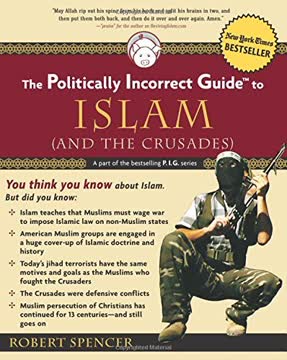
The Politically Incorrect Guide to Islam receives highly polarized reviews. Supporters praise Spencer's research, documentation of Quranic verses, and willingness to challenge political correctness about Islam's teachings on jihad and treatment of non-believers. They consider it essential reading for understanding Islamic doctrine and terrorism threats. Critics condemn it as biased, hateful propaganda that cherry-picks facts to portray Islam negatively while defending Christianity. They accuse Spencer of Islamophobia, stereotyping, and spreading intolerance. Some note his repetitive style and clear agenda, though opinions differ on whether this undermines his scholarship or represents necessary directness.
Similar Books