

Key Takeaways
Treat value judgments as claims about the world, not mood reports
The textbook’s trap. Lewis begins with a schoolbook’s claim that calling a waterfall sublime describes the speaker’s feelings, not the waterfall. He argues that this turns a judgment about what deserves admiration into a report about a private reaction. The distinction matters: people can reasonably disagree about whether something is beautiful or noble, but not about whether someone happens to feel a certain way.
Feelings can answer to reality. A fitting response, Lewis says, is not automatically correct just because it is sincere. A person may fail to feel the respect that a situation deserves, just as someone may fail to notice a color. Value judgments are therefore claims about what is worthy of a response, not merely records of what response occurred.
The distinction between having a reaction and judging it appropriate is crucial in moral and aesthetic life. Someone can feel fear without being in danger, or admiration for a cruel leader; sincerity alone cannot settle whether the response fits its object. Contemporary psychology likewise distinguishes emotion from the interpretation and evaluation surrounding it. Lewis’s argument does not, by itself, prove that values exist independently of human minds. It does show what is lost when every judgment is reduced to emotion: the possibility of criticizing our own responses as mistaken, shallow, or morally out of tune.
Educate feeling alongside reason, or principle loses its muscle
Reason needs a partner. Lewis calls the trained middle ground between intellect and appetite the chest. It consists of sentiments shaped by habit, such as courage, fairness, and reverence, that help a person act on what reason recognizes. Without this formation, knowing what is right may not be enough to do it. A card player who has learned that cheating is dishonorable may resist temptation more reliably than a clever ethicist who has never acquired that disposition.
Practice precedes insight. Drawing on Plato and Aristotle, Lewis argues that education should teach young people to admire and dislike the right things before they can fully explain why. This is not a replacement for thought. It is preparation for thought: reason can examine and refine sentiments, but it cannot reliably motivate action if every feeling has been dismissed as irrational.
Moral psychology supports the broad idea that judgment and motivation are intertwined. People often act through habits, social emotions, and practiced attention, not detached calculation alone. The chest metaphor makes a useful point: virtue is partly a cultivated capacity to care at the moment care is needed. Yet trained feeling is not automatically just. Communities can teach loyalty to a group alongside contempt for outsiders. Emotional education therefore needs reflective testing, and reason needs feelings that can be revised rather than simply obeyed.
Teach students to distinguish bad sentiment from humane feeling
Debunking is not discernment. Lewis criticizes a lesson that mocks a cruise advertisement for dressing up an ordinary holiday in romantic language about history and adventure. The advertisement is indeed manipulative. But, Lewis argues, simply exposing its exaggerations does not teach students why its writing fails or how genuine historical feeling differs from salesmanship. The same cynical technique could be used to mock serious writing about the past.
Mockery can impoverish. A student taught to distrust every emotional appeal may learn to feel clever rather than to judge well. Lewis makes a similar point about sentimental descriptions of horses: correcting the literal facts does not explain why imaginative affection for animals can be humane or artistically powerful. Education should help students tell shallow manipulation from worthy emotion, not train them to dismiss both.
This is a warning about a common failure of media literacy: spotting persuasion is easier than evaluating what is worth caring about. A student can learn that advertising uses emotion and conclude that emotion itself is suspect. The stronger lesson pairs skepticism with interpretation, asking what a work invites its audience to feel and whether that invitation is earned. Lewis’s examples are rooted in literary teaching, and his criticism does not offer a complete method for making these distinctions. Still, his standard is demanding in a productive way: critique should sharpen appreciation, not make indifference look like intelligence.
Facts and instincts cannot, by themselves, tell anyone what ought to be done
Description is not direction. Lewis argues that a factual statement, such as a sacrifice benefiting a community, cannot alone establish that anyone ought to make that sacrifice. The conclusion requires a value premise, such as the claim that the community should be protected. Evidence can show what an action will cause, but it cannot supply the purpose that makes the consequence worth pursuing.
Instinct cannot choose its own rank. Instincts conflict: self-preservation may oppose sacrifice, while care for present children may compete with concern for distant descendants. Calling one impulse more basic or more widespread does not prove that it deserves priority. Lewis’s point is not that facts and instincts are irrelevant. It is that turning either into an authority already assumes some standard for deciding which outcomes or impulses matter.
This is the classic is-ought problem: a description of what happens does not, without a normative premise, establish what should happen. The distinction remains useful in policy debates, where claims about efficiency or natural behavior can quietly smuggle in judgments about whose welfare counts. The argument is strongest against theories that pretend to derive all moral duties from facts alone. It is less conclusive against moral theories that openly defend their value premises or explain how obligations emerge from social cooperation. Lewis identifies a missing premise; he does not settle every account of where that premise comes from.
Rejecting shared moral rules leaves reformers borrowing the rules they reject
The Tao names a moral inheritance. Lewis uses the term Tao for a broad order of practical values, including duties of justice, honesty, mercy, care for family, and concern for other people. His appendix gathers examples from traditions including ancient Egyptian, Jewish, Greek, Chinese, Hindu, Roman, and Christian sources. He does not claim that a list of agreements proves the values true; he argues that moral innovators already rely on such principles when they praise progress, social welfare, or care for future generations.
Selective rejection has a cost. A reformer who dismisses inherited duties to parents but insists on duties to posterity needs a reason to retain one and discard the other. For Lewis, the new system has not escaped the old moral framework; it has selected fragments from it without explaining the selection.
The argument exposes a real danger in moral rhetoric: a movement may reject tradition in principle while quietly using inherited standards such as fairness, compassion, or human dignity to justify its goals. Lewis’s cross-cultural examples make the case for a shared moral vocabulary, though recurrence does not prove that every tradition agrees or that any particular rule is beyond criticism. The Tao works best here as a challenge to selective reasoning, not as a shortcut that ends debate. Its usefulness depends on distinguishing a common moral inheritance from a claim that all inherited practices deserve preservation.
Reform moral traditions from within their principles, not from nowhere
Change can be organic. Lewis compares moral development to changes in a language. A poet can reshape a language while working from its inherited resources; a planner who treats the language as disposable material is attempting a different kind of change. In the same way, moral traditions can be criticized and developed by drawing on their own principles, especially when one accepted duty conflicts with another.
Criticism still needs ground. Lewis does not say every inherited rule is flawless or that moral progress is impossible. He argues that a critic must bring some standard to the criticism. If every standard is dismissed as groundless, the critic also loses a basis for calling a practice unjust or a reform beneficial. A reformer can question a rule by showing how it contradicts a more fundamental value, rather than pretending to judge all values from nowhere.
Internal criticism explains how reform can be both radical and intelligible. A society may use its own commitments to expose a gap between its stated ideals and its practices. This approach is especially valuable where change must persuade people who share the tradition being challenged. Its limitation is that insiders can be excluded from defining the tradition, while those in power may label dissenters disloyal. A sound reform therefore needs both inherited principles and careful attention to whose experience has been ignored. Continuity can supply a language for change, but it should not become a veto on change.
Every new tool of control also gives some people power over others
Power is unevenly held. Lewis questions the claim that technologies such as aircraft, radio, or contraception simply increase humanity’s power over nature. Access depends on people and institutions that own, distribute, or regulate those tools. The same technologies can expose people to bombing or propaganda, or give one generation influence over whether and how future people are born.
Time belongs in the equation. If scientific planning can shape education, reproduction, or the traits of descendants, then the present acquires power over people who cannot consent. Even public control does not eliminate the problem: authority may shift to a government, a majority, or a small group of experts. The central question is not only what a technology can do, but who decides its use and who bears its consequences.
Lewis’s analysis anticipates a durable concern in political philosophy and technology ethics: capability is not the same as shared control. A technology can enlarge what a society can accomplish while concentrating decisions in the hands of owners, administrators, or states. His attention to future generations is particularly important because those affected cannot participate in present-day consent. The argument does not imply that every powerful technology is inherently oppressive. It does imply that assessments of progress should include distribution, accountability, and the ability of affected people to challenge decisions.
When experts manufacture values, their own choices lose any objective standard
The planners face a contradiction. Lewis imagines Conditioners, people with enough scientific and political power to shape the desires and moral judgments of everyone else. If they treat every value as a product of psychological processes, they cannot appeal to duty or goodness to decide which values they should create. Those standards, too, would be products they can manipulate.
Impulse becomes the fallback. The Conditioners may still act, but Lewis argues that without a valid standard they can only follow whichever desire happens to move them. Their decisions might be benevolent, but benevolence would have no special claim over selfishness or cruelty. The problem is not simply that powerful people might be wicked. It is that a theory that explains away all objective value cannot explain why its designers ought to use their power for anyone’s good.
This is a problem of legitimacy as much as personal morality. A planner who shapes other people’s preferences cannot justify the plan merely by saying that its subjects will learn to approve of it; that approval is part of what the planner manufactured. Contemporary debates about algorithmic decisions raise a related question: who chooses the goals a system optimizes, and under what authority? Lewis makes the danger vivid, though the conclusion depends on denying the planners any defensible moral commitments. In practice, public accountability and explicit ethical principles can constrain power even when societies disagree about ultimate foundations.
Treating humanity as programmable material turns mastery into abolition
Explanation can become reduction. Lewis distinguishes studying nature from treating it as nothing but material for manipulation. Scientific analysis often isolates measurable features, which can reveal useful truths, but those features are not the whole reality. A tree measured for timber, or a person reduced to a set of psychological responses, becomes easier to use and harder to encounter as a whole.
The controller is not outside nature. If people are shaped as raw material according to values chosen by planners, those planners still need motives of their own. Once objective standards are discarded, their impulses supply the only remaining direction. Lewis’s conclusion is that human control can end with people governed by the very appetites and forces they thought they had mastered. He is not rejecting science; he is warning against treating scientific control as a complete account of human flourishing.
The distinction between a model and the reality it models is central to responsible science. Quantification can isolate a feature for study without proving that other qualities are unreal or unimportant. The ethical danger appears when a useful abstraction becomes an exhaustive definition, especially when institutions then act on people according to that definition. Lewis’s warning is not a demonstration that scientific explanation inevitably dehumanizes. It is a practical test: does the method help people understand human life, or does it authorize decisions that treat them only as objects to be arranged?
Analysis
The book’s three-part argument moves from the classroom to moral philosophy, then to political power. Its opening target is not simply a bad English lesson. Lewis argues that teaching students to treat value language as disguised emotion trains them to distrust judgments before they can assess whether those judgments are sound. The image of the chest makes the educational consequence memorable: reasoning and appetite need a formed emotional character to connect them.
The philosophical core is a challenge to attempts to derive moral authority from facts, instincts, or social utility alone. Lewis insists that such accounts already depend on value premises. This remains a sharp diagnostic, especially when arguments about efficiency or biological necessity conceal judgments about what deserves priority. His appeal to the Tao, a shared inheritance of practical principles, offers a foundation for moral criticism, but it is not established merely by collecting cross-cultural similarities. Traditions disagree, and familiar moral rules can preserve unequal authority. Lewis’s own strongest point is narrower: critics must explain the standards they use, rather than claiming to have escaped all standards.
The final movement connects this problem to technological power. Scientific capacity is never simply humanity’s capacity; its benefits and risks are distributed through institutions, and its decisions can shape people who have no voice in them. Lewis’s imagined Conditioners expose the difficulty of designing values while rejecting any objective reason to prefer one design over another. The argument is not a prediction that every expert will become cruel. It is a warning that benevolent intentions alone cannot justify unaccountable control.
The book’s enduring value lies in joining epistemology, education, and governance. How people learn to feel shapes what they can recognize as worth protecting; what a society counts as real shapes what it permits itself to manipulate. Lewis sometimes treats a shared moral inheritance as more unified than historical experience warrants, but the central question survives that limitation: what human qualities disappear when explanation becomes permission to redesign?
Review Summary
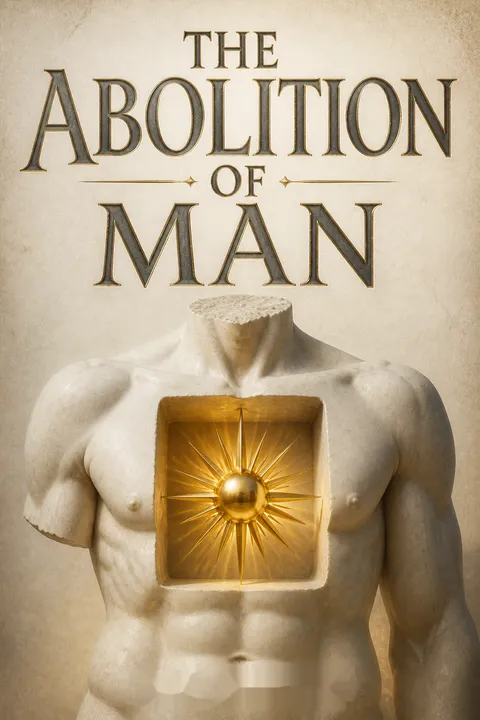
The Abolition of Man by C.S. Lewis examines moral relativism and objective values in education and society. Published in 1943, it critiques modern educational approaches that treat emotions as merely subjective. Lewis argues for the "Tao"—universal moral truths found across cultures—and warns against creating "men without chests" who lack moral character. The book explores how scientific rationalism, when taken to extremes, threatens human nature itself. Readers praise its prescience regarding contemporary issues, though many note its density requires multiple readings to fully grasp Lewis's philosophical arguments.
People Also Read



Glossary
the Tao
Shared order of valueLewis’s umbrella term for the objective moral order he finds expressed across varied religious and philosophical traditions. It includes practical principles such as justice, honesty, mercy, and duties toward other people. In his argument, the Tao is not simply one culture’s code or a set of preferences. It is the inherited framework that makes moral judgments and criticism intelligible.
Men without Chests
Reason without trained feelingLewis’s name for people educated to use intellect while their capacity for generous, disciplined sentiment has been weakened. The chest represents the emotional and moral habits that connect rational judgment to appetite and action. Without this middle element, a person may recognize a principle intellectually yet lack the trained courage, loyalty, or fairness needed to live by it.
Conditioners
Designers of human motivesLewis’s term for hypothetical planners who use powerful science, education, and political authority to shape the desires and moral judgments of future people. Because they reject objective value, they cannot appeal to a standard beyond their own preferences to justify which kind of humanity they produce. Their power is therefore both social and moral: they shape people while claiming authority to choose what people should become.
Practical Reason
Reason about what to doThe capacity to recognize basic principles of action, such as that justice should be respected or that human beings should not be treated merely as disposable means. Lewis distinguishes this from reasoning that draws conclusions about facts alone. Practical Reason supplies premises for action that cannot be derived solely from descriptions of what happens or what people happen to desire.
Magician’s bargain
Power purchased by reductionLewis’s analogy for gaining control over the world by treating things as material to analyze and manipulate, while surrendering part of their fuller significance. Applied to humanity, the bargain becomes dangerous: people who treat themselves as objects to be redesigned may lose the standards that would let them direct that power humanely. The apparent gain in control can leave them governed by unexamined impulses.
About the Author
Other books by C.S. Lewis









Download PDF
Download EPUB
.epub digital book format is ideal for reading ebooks on phones, tablets, and e-readers.








