

Key Takeaways
After Joy dies, grief reaches Lewis as fear, fog, and physical exhaustion
Grief arrives physically. In the opening pages, Lewis describes the death of his wife, Joy Davidman, through bodily sensations: a fluttering stomach, restlessness, repeated swallowing, and the sense that the world has gone muffled. He is not simply sad. He feels suspended and unable to take in ordinary conversation, while even small tasks seem pointless.
Daily life loses weight. Work can continue, but reading a letter, shaving, or making an effort feels needlessly difficult. He also discovers that grief can switch suddenly from numbness to painful memory. The book begins by treating bereavement not as an idea to explain but as an upheaval that affects attention, energy, and the body.
What's striking is how bodily this account is. Contemporary models of grief and stress likewise recognize that loss can disrupt sleep, concentration, appetite, and a sense of safety, not just produce sadness. That framing can help bereaved people interpret disorientation as part of an upheaval rather than a personal failure. Still, grief has no single bodily signature. Lewis's report is a precise account of one man's experience, not a checklist that every mourner must match.
Write grief down, but keep the person larger than your sorrow
A notebook creates distance. Lewis writes privately as a way to step outside the looping thoughts, though he doubts whether the exercise sometimes feeds them. He also catches himself turning Joy into an object for his own sorrow, a simplified figure whose purpose is to be mourned.
Her character resists that story. Remembering Joy's quick wit, sharp judgment, and capacity to challenge him restores her independence. She was not merely a source of comfort, and their marriage was not a sentimental picture. For Lewis, honest mourning must include the person who lived, not only the pain of the person left behind. His journal helps him notice when grief is making that distinction disappear.
Private writing can give distress a shape, making tangled reactions easier to examine. Research on expressive writing, however, finds varied results rather than a universal cure, and repeated writing can deepen rumination for some people. Lewis's own uncertainty is useful: the notebook is a tool, not a ritual that guarantees relief. Its strongest function here is ethical as well as emotional. It reminds the mourner that the loved one had a life and a temperament beyond the role they played in someone else's loss.
Accept that death ends shared life, even when love continues
Death changes the whole day. Lewis rejects the idea that a believer should treat death as insignificant. The familiar conversations, touch, routines, and mutual presence he shared with Joy are gone, and no reassurance about eternity simply restores them. Her absence is not confined to places they visited together; it alters ordinary life everywhere, including his experience of his own body.
Love cannot transfer pain. He can imagine Joy's fear and suffering, but he cannot literally undergo them with her. Marriage brings people close without erasing their separateness. This painful limit matters: love does not make either person invulnerable, and the survivor cannot undo death by imagining a reunion in earthly terms.
This insistence on irreversibility protects grief from being tidied into a lesson. In bereavement research, continuing bonds with the dead can matter deeply, but they do not erase the practical and sensory rupture of a shared life ending. Lewis holds both truths together: love remains meaningful, and the old relationship cannot simply resume unchanged. His account is particularly attentive to spousal loss, though its claim that no one can share another's pain applies more broadly. Closeness offers companionship, not access to another person's private experience.
Let grief test your faith without treating anguish as a verdict
Belief meets real stakes. Lewis discovers that confidence in an idea is different from depending on it when life is at risk. He compares faith to trusting a rope: its strength is not truly tested while it carries something light, but when someone must hang from it. Joy's death turns religious belief from an abstract position into a question with personal consequences.
Anger does not settle theology. Lewis fears not only losing belief in God but deciding that God is cruel. He considers fierce accusations, then recognizes that rage can produce arguments designed to strike back rather than describe what is true. His protest remains real, but he does not mistake its intensity for proof.
The passage offers a sharp distinction between professed belief and trust under pressure, a distinction also found in decision theory: commitments reveal their practical force when they carry a cost. Yet a crisis does not automatically expose the one true meaning of a belief. Shock, exhaustion, and attachment shape what seems plausible in the moment. Lewis's value lies in allowing the crisis to ask its hardest questions without declaring that either despair or renewed faith has won merely because it feels powerful.
Don't use afterlife certainty to deny death's irreversible cost
Comfort can become evasion. Lewis resists people who insist that Joy is certainly at peace or that death makes no difference. He does not claim that she is lost forever; he objects to confident descriptions of what no one can verify and to consolations that sidestep the earthly life that has ended.
Faith is not anesthesia. Religious belief may offer strength, but it cannot honestly promise that the marriage's daily life will be returned in familiar form. Lewis's questions about suffering and God's goodness remain exposed rather than neatly solved. That refusal makes room for grief and faith to occupy the same pages without pretending they are easily reconciled.
This is a strong challenge to forced positive reframing, the impulse to explain pain before acknowledging it. In religious and clinical settings alike, premature reassurance can make mourners feel that their grief is unwelcome or their questions disloyal. A more careful response recognizes the loss first and allows uncertainty to remain. The limit is that Lewis's argument is rooted in his Christian framework; people with different beliefs may find other forms of consolation. The broader point is not to ban comfort, but to avoid claiming knowledge that comfort alone cannot supply.
Measure healing by renewed life, not by constant sorrow
Grief keeps changing shape. Lewis first expects to map a stable condition, then realizes that bereavement behaves more like a journey through changing terrain. Familiar pain can return, but new reactions appear too. Revisiting places connected to Joy sometimes brings back memories of his earlier, unmarried life, and that old happiness feels alien rather than restorative.
Relief is not betrayal. On a lighter day, Lewis finds that he can remember Joy more vividly, not less. He also feels guilty when the sharpest pain eases, as though suffering were the evidence of love. He comes to distinguish preserving the relationship from preserving the agony. The bond can remain even as the mourner becomes able to live more fully.
Grief's uneven course fits contemporary models that describe people moving between attention to the loss and attention to ordinary demands. Such movement helps explain why a calmer day and a painful anniversary can both belong to the same bereavement. Lewis also identifies a moral trap: treating visible suffering as a measure of devotion. That pressure can burden mourners with guilt. His experience should not be turned into a schedule, though; the pace and pattern of adjustment vary, and renewed activity does not prove that grief is finished.
Love the actual person, not the memory you can control
Memory edits the beloved. Lewis fears that his image of Joy will gradually become his own construction. Recalling a man he had not seen for years, he finds that the living person immediately unsettles the picture he had carried. The same danger applies to remembering Joy: selective impressions can crowd out her surprises and contradictions.
Reality corrects its portraits. Lewis uses the term iconoclastic for the way real life breaks inadequate images. When Joy was alive, her opinions and actions repeatedly resisted his expectations; a memory cannot offer the same resistance. He extends the warning beyond bereavement: people who are still present can also be mistaken for the simplified versions held in someone else's mind.
Cognitive science describes memory as reconstructive: recollection is not a perfect recording but a process influenced by present concerns and later experience. Lewis turns that observation into a relationship ethic. The goal is not to distrust every memory, but to avoid mistaking an image for the whole person. This can also improve living relationships, where assumptions often replace curiosity. There is a practical limit: the dead cannot correct the record directly. That makes humility and openness to other people's memories especially valuable.
Keep loving the dead without making pain love's proof
The bond changes form. Lewis gradually sees bereavement not only as the end of married love but as another phase of it. That does not mean the marriage continues in its former everyday shape. It means he can remain faithful to Joy without insisting that grief stay at its most painful intensity.
Sorrow can obscure the beloved. In his worst moments, Lewis notices that his attention turns toward his own anguish and a simplified, pitiful version of Joy. When the pain eases, he sometimes encounters her memory with more of her wit and independence intact. He therefore wants to remember her with gladness when he can, rather than preserving misery as a tribute.
The idea of a continuing bond is prominent in modern grief scholarship: adaptation need not require severing an inner relationship with the deceased. Lewis adds an important distinction between maintaining love and maintaining acute distress. That distinction can relieve the fear that feeling better means caring less. His account is personal, not prescriptive; for some mourners, rituals or sustained mourning remain meaningful. The useful question is whether a practice honors the relationship or makes suffering itself the measure of loyalty.
Let praise widen love beyond possession, without pretending mystery is solved
Attention can turn outward. Near the end, Lewis notices that his journal has focused mainly on himself, then Joy, and only after that on God. He considers praise a way of attending to what he values with some joy, even when full closeness is impossible. Remembering Joy as both fierce and life-giving helps him see her as more than his loss.
Hope stays uncertain. Lewis records experiences that feel like a brief contact with Joy, but refuses to present them as evidence. He also admits that his ideas about God and reunion may be inadequate. The book closes not with a complete explanation of suffering or death, but with a modest change in how he can imagine what lies beyond his understanding.
Praise here functions as a discipline of attention: it turns the mind from possession and deprivation toward the distinct qualities of the person loved. That connects religious practice with gratitude research, which studies how deliberate attention can alter what people notice and value. But the distinction between a meaningful experience and evidence is essential. Lewis preserves the emotional significance of his impression without asking readers to accept it as proof of life after death. This combination of hope and epistemic restraint is more honest than certainty in either direction.
Analysis
A Grief Observed is less a theology of bereavement than a record of thought under emotional pressure. Its form matters: Lewis does not present a polished sequence of stages or a doctrine designed to settle the reader. The dated notebook entries show claims forming, collapsing, and being reconsidered. That makes the book unusually useful to readers who distrust tidy consolation, but it also means its insights emerge from one sharply particular experience: an intellectual Christian losing Joy Davidman after a marriage that was intense and comparatively brief.
The central tension is not simply faith versus doubt. It is the collision between abstract claims about divine goodness and the concrete fact of suffering. Lewis notices that ideas held at a distance can feel sturdy until they become personally consequential. His response is neither to declare anguish irrational nor to treat anguish as a final revelation. Emotion exposes hidden assumptions, but it can also distort judgment. That balance gives the book its intellectual honesty.
Its deepest account of love is similarly resistant to sentimentality. The mourner wants the beloved back, yet that desire can turn the beloved into a solution for the mourner's pain. Lewis's concern about memory therefore becomes a moral concern: the person loved must remain more than a usable image. This is a demanding idea, because the dead cannot challenge a survivor's recollections. It invites humility rather than a promise of perfect remembrance.
The book should not be mistaken for a universal map. Grief differs with the relationship, the circumstances of death, culture, and belief. Nor does Lewis resolve the problem of suffering. His lasting achievement is to show that unresolved questions can coexist with love, reflection, and tentative hope. The reader receives no shortcut around loss, but does receive permission to face it without falsifying either its cost or the limits of what can be known.
Review Summary
A Grief Observed is a deeply personal account of C.S. Lewis's struggle with grief after his wife's death. Readers find it raw, honest, and relatable, appreciating Lewis's vulnerability in questioning his faith and grappling with intense emotions. Many readers connect with the book during their own experiences of loss, finding comfort in Lewis's journey from anger and despair to a renewed, albeit changed, faith. While some criticize its heavy religious focus, most praise the book's profound insights into the universal human experience of grief.
People Also Read










Glossary
iconoclastic
Reality corrects mental imagesLewis uses this term for the way actual people and experiences break the simplified pictures made of them. A living person surprises, contradicts, and exceeds another person's mental image. For Lewis, memory can preserve links to someone who has died, but it cannot replace that person's independent reality.
Eternal Vet
God imagined as healerLewis uses this image for a God whose painful actions might be intended to heal, as a surgeon's operation can hurt while serving a restorative purpose. The image does not make suffering easy to accept. It sharpens the question of whether a good healer may permit pain that appears unbearable or unnecessary.
Cosmic Sadist
God imagined as cruelThis is Lewis's anguished possibility that the suffering people endure reflects a cruel, malicious power rather than a loving God. He tests the idea while grieving Joy, then questions whether it explains the world or merely gives anger a target. The term names a fear in his struggle, not his settled conclusion.
FAQ
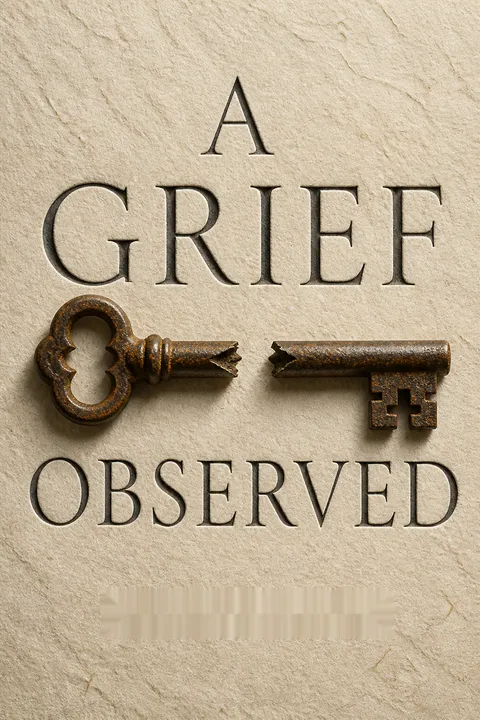
What's "A Grief Observed" about?
- Personal Reflection on Grief: "A Grief Observed" is a deeply personal account by C.S. Lewis, reflecting on his grief following the death of his wife, Joy Davidman. It explores the raw and tumultuous emotions he experiences.
- Exploration of Faith: The book delves into Lewis's struggle with his faith in God during his period of mourning, questioning the nature of God and the purpose of suffering.
- Universal Themes: While it is a personal narrative, the book touches on universal themes of love, loss, and the human condition, making it relatable to anyone who has experienced grief.
Why should I read "A Grief Observed"?
- Honest Exploration of Grief: The book offers an unflinching look at the grieving process, providing comfort and understanding to those who have experienced similar losses.
- Insight into C.S. Lewis's Mind: Readers gain a deeper understanding of Lewis's thoughts and beliefs, particularly his struggles with faith and doubt.
- Universal Relevance: The themes of love, loss, and faith are universal, making the book relevant to a wide audience beyond those familiar with Lewis's other works.
What are the key takeaways of "A Grief Observed"?
- Grief is Unique: Lewis emphasizes that each person's experience of grief is unique, though there are commonalities such as fear, forgetfulness, and the fear of losing memories.
- Faith and Doubt: The book highlights the coexistence of faith and doubt, showing how grief can challenge one's beliefs but also lead to deeper understanding.
- Love and Memory: Lewis discusses the importance of memory in keeping the essence of a loved one alive, while also acknowledging the limitations and distortions of memory.
How does C.S. Lewis describe his grief in "A Grief Observed"?
- Fear and Restlessness: Lewis compares his grief to fear, describing feelings of restlessness and a constant need to swallow.
- Emotional Paralysis: He talks about the emotional paralysis that grief brings, making even simple tasks feel overwhelming.
- Absence of God: Lewis describes feeling abandoned by God, likening it to a door slammed in his face during his time of need.
What role does faith play in "A Grief Observed"?
- Crisis of Faith: Lewis experiences a crisis of faith, questioning God's presence and goodness in the face of his wife's death.
- Search for Understanding: Despite his doubts, Lewis continues to search for understanding and meaning in his suffering.
- Reaffirmation of Belief: Over time, Lewis's faith is reaffirmed, though it is transformed by his experiences and reflections.
How does C.S. Lewis address the concept of memory in "A Grief Observed"?
- Fear of Forgetting: Lewis expresses a fear of losing the memory of his wife, worrying that his recollections will become distorted over time.
- Memory as a Comfort: Despite its limitations, memory serves as a comfort and a way to keep his wife's presence alive in his life.
- Dynamic Nature of Memory: Lewis acknowledges that memory is not static and can change, reflecting both the reality of his wife and his own perceptions.
What are the best quotes from "A Grief Observed" and what do they mean?
- "No one ever told me that grief felt so like fear." This quote captures the unexpected and overwhelming nature of grief, likening it to a pervasive sense of fear.
- "Her absence is like the sky, spread over everything." Lewis uses this metaphor to convey the all-encompassing nature of his wife's absence, affecting every aspect of his life.
- "Bereavement is not the truncation of married love but one of its regular phases." This quote suggests that grief is a natural part of love, a phase that must be lived through with fidelity to the relationship.
How does C.S. Lewis's writing style in "A Grief Observed" enhance the book's themes?
- Raw Honesty: Lewis's candid and unfiltered writing style allows readers to connect deeply with his emotional journey.
- Reflective Tone: The reflective nature of the writing invites readers to ponder their own experiences with grief and faith.
- Intellectual Depth: Lewis's intellectual approach provides a thoughtful exploration of complex themes, making the book both emotionally and intellectually engaging.
What is the significance of the foreword and introduction in "A Grief Observed"?
- Contextual Background: The foreword by Madeleine L’Engle and introduction by Douglas H. Gresham provide context for Lewis's writing, offering insights into his life and relationship with Joy Davidman.
- Personal Reflections: Both contributors share their personal reflections on grief, adding depth and perspective to Lewis's narrative.
- Framing the Narrative: The foreword and introduction help frame the narrative, preparing readers for the emotional and philosophical journey that follows.
How does "A Grief Observed" compare to C.S. Lewis's other works?
- Personal vs. Theoretical: Unlike his more theoretical works, "A Grief Observed" is deeply personal, offering a raw and intimate look at Lewis's own experiences.
- Exploration of Pain: While "The Problem of Pain" addresses suffering from a philosophical standpoint, "A Grief Observed" deals with it on a personal level, showing the emotional impact of loss.
- Complementary Perspectives: Together, these works provide complementary perspectives on suffering, faith, and the human condition.
What insights does "A Grief Observed" offer about love and loss?
- Interconnectedness of Love and Grief: Lewis illustrates how love and grief are interconnected, with the depth of one's love often mirroring the depth of one's grief.
- Enduring Love: Despite the pain of loss, Lewis's reflections affirm the enduring nature of love, which continues to shape his life even after his wife's death.
- Acceptance of Loss: The book encourages acceptance of loss as a natural part of life, while also acknowledging the ongoing process of grieving.
How does "A Grief Observed" address the concept of healing?
- Non-linear Process: Lewis portrays healing as a non-linear process, with moments of progress and regression, reflecting the complexity of grief.
- Role of Time: Time plays a crucial role in healing, allowing for reflection, acceptance, and eventual peace.
- Integration of Grief: Rather than seeking to "get over" grief, Lewis suggests integrating it into one's life, allowing it to coexist with love and memory.
About the Author
Other books by C.S. Lewis










Download PDF
Download EPUB
.epub digital book format is ideal for reading ebooks on phones, tablets, and e-readers.








